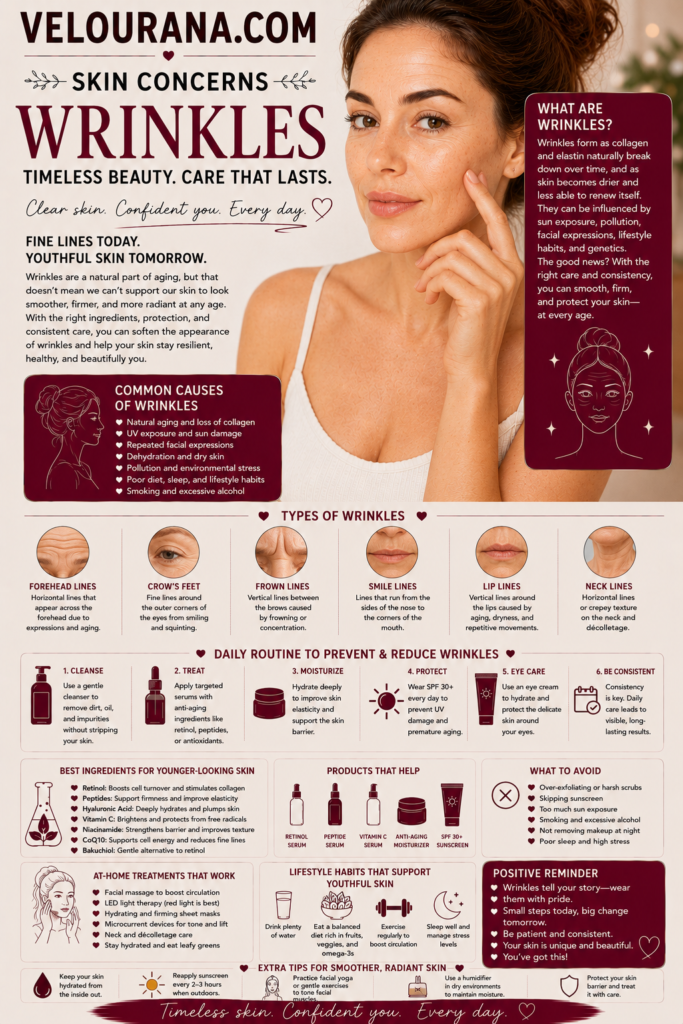
CATEGORY: Wrinkles
A wrinkle routine that works beautifully at thirty may feel surprisingly inadequate ten or twenty years later.
The reason is not that the products suddenly become ineffective. The skin itself changes. Oil production may decline. Water is lost more easily. Recovery from irritation can take longer. Collagen support gradually decreases. Elasticity changes. Hormonal shifts influence thickness, hydration and resilience. Sun exposure accumulated over decades begins expressing itself more clearly through pigmentation, roughness and fine wrinkling. Meanwhile, facial movement continues folding the same areas thousands of times every year.
The result is not simply "older skin."
It is skin with different requirements.
This is where many anti-aging routines go wrong. Instead of adapting to changing biology, they become progressively more aggressive. A person notices deeper lines and adds stronger acids. Dryness increases, so another active serum is added. Retinoid strength rises. Cleansing becomes more intensive. Eventually, the routine contains more treatment than support.
The skin responds by becoming irritated, tight and dehydrated.
Fine lines look worse.
The solution appears to be even stronger anti-aging care.
A more effective philosophy works in the opposite direction.
As the skin matures, the routine should become more deliberate. Active ingredients remain important, but barrier support becomes increasingly valuable. Sun protection becomes more consequential because previous damage cannot be erased but future damage can still be reduced. Hydration becomes a structural part of the routine rather than a cosmetic afterthought. Treatment is chosen according to the type of aging actually present rather than according to the number of candles on a birthday cake.
There is no single correct routine for every person over forty, fifty or sixty.
But there is a useful progression.
The objective gradually shifts from prevention alone toward preservation, correction and comfort—without turning the skin into a permanent experiment.
The Skin Does Not Age in Decades, but Decades Help Us Understand the Pattern
Age categories are useful only as broad guides.
There is no biological switch that activates at forty or fifty. Skin does not know when one decade ends and another begins. Two people of the same chronological age can have very different levels of dryness, sun damage, pigmentation, sensitivity and wrinkling.
Still, certain changes become increasingly common with time.
In the forties, early static wrinkles often become more noticeable. Lines that once existed only during facial movement may begin remaining visible at rest. Pigmentation from past ultraviolet exposure may become more obvious. Skin renewal can feel slower, and texture may become less uniformly smooth.
During the fifties, hormonal changes can make dryness and loss of firmness more prominent, particularly around and after menopause. Wrinkles may deepen more rapidly, not because the skin suddenly begins aging, but because multiple gradual processes converge.
Later decades bring further changes in thickness, elasticity, barrier function and underlying facial structure.
This means chronological age should guide attention, not dictate treatment.
The relevant question is always what the skin is doing now.
A forty-eight-year-old with sensitive, dry skin and mild wrinkling needs a different routine from a forty-eight-year-old with oily, sun-damaged skin and extensive pigmentation.
The calendar provides context.
The skin provides instructions.
In the Forties, Prevention Begins Turning Into Maintenance
Many people reach their forties with an anti-aging routine built around prevention.
Sunscreen.
Perhaps a retinol product.
An antioxidant serum.
A moisturizer used when the skin feels dry.
For some, this remains perfectly adequate.
But the forties often introduce a subtle shift.
The first noticeable change is frequently persistence.
Lines stay longer.
Dryness takes longer to recover.
Pigmentation becomes harder to ignore.
The complexion may not bounce back from late nights or environmental stress as quickly as it once did.
This is the period when maintenance becomes more important than occasional correction.
Consistency begins outperforming novelty.
Someone who uses sunscreen properly most days, moisturizes regularly and tolerates a well-selected retinoid may achieve more over ten years than someone constantly changing products in search of dramatic short-term effects.
This is because wrinkles develop slowly.
The routine must operate on the same timescale.
It is easy to underestimate the cumulative value of ordinary habits because they lack visual drama. Yet the daily prevention of additional ultraviolet damage is biologically meaningful precisely because it happens repeatedly.
The same applies to hydration.
Well-maintained skin generally looks smoother than skin allowed to become repeatedly dehydrated and inflamed.
A mature routine is therefore not defined by more products.
It is defined by fewer gaps.
The First Priority Is Protecting What Remains
Anti-aging culture tends to focus on what has already been lost.
Collagen has declined.
Elasticity has changed.
Wrinkles have appeared.
Firmness is reduced.
This framing encourages the search for replacement.
But protecting existing structure is just as important.
Ultraviolet exposure continues contributing to photoaging throughout life. Existing wrinkles do not make further damage irrelevant. A person with visible lines still has collagen, elastin, pigmentation systems and barrier function worth protecting.
This makes daily photoprotection central at every stage of wrinkle care.
The purpose is not merely to prevent sunburn.
It is to reduce cumulative ultraviolet exposure that contributes to structural deterioration, pigmentation irregularity and roughness.
This distinction matters because mature skin is often already carrying decades of environmental history.
Every additional year of unprotected exposure is added to what came before.
Sun protection does not reverse time.
It changes the direction of future accumulation.
That alone makes it one of the most rational anti-aging interventions available.
After 40, Hydration Becomes More Visually Important
One of the most underestimated changes in mature skin is the increasing influence of hydration on appearance.
Fine lines are accentuated when the outer skin is dry.
Texture becomes rougher.
Light reflects less evenly.
Foundation settles more obviously into creases.
The eye area can look suddenly more wrinkled.
When hydration improves, the same skin may appear noticeably smoother.
This happens because the outer layer becomes more flexible and slightly plumper, reducing the optical contrast of fine creases.
No collagen has been rebuilt overnight.
Yet the visual difference can be significant.
This is why moisturizer should stop being treated as the least sophisticated part of an anti-aging routine.
In mature skin, hydration is part of wrinkle management.
Ingredients that help attract water to the skin can improve surface hydration. Emollient components smooth the outer layers. More occlusive ingredients can help reduce water loss.
The ideal balance varies.
Someone with dry mature skin may enjoy a richer cream.
Someone who remains combination or oily may prefer a lighter formulation with strong humectant support.
The important factor is not richness itself.
It is whether the skin remains comfortable, flexible and consistently hydrated.
The Barrier Becomes Less Forgiving
Youthful skin can sometimes tolerate reckless routines surprisingly well.
Strong exfoliation.
Frequent retinoids.
Foaming cleansers.
Long hot showers.
Minimal moisturizer.
Eventually, the same habits may become much harder to tolerate.
Mature skin often recovers more slowly from barrier disruption.
This changes the economics of aggressive treatment.
The benefit of one active ingredient can be cancelled by the irritation created by several others.
Redness and peeling increase.
Dryness becomes persistent.
Fine lines become more visible.
The user feels older rather than younger.
The lesson is not that active ingredients should be abandoned.
It is that mature skin benefits from strategic spacing.
If a retinoid is already delivering meaningful treatment, another strong active may not need to be used on the same evening.
If exfoliation causes prolonged sensitivity, frequency is probably too high.
If cleansing leaves the face tight, the cleanser may be removing more than the skin comfortably tolerates.
A successful anti-aging routine should improve the appearance of the skin without requiring constant recovery from the routine itself.
Retinoids Become More Valuable—and Sometimes More Difficult
Retinoids remain among the most important topical ingredients for fine wrinkling and photodamage.
Their appeal often increases with age because the concerns they address become more visible.
Yet tolerance can become more complicated.
Dry mature skin may react strongly to a concentration that would have been manageable years earlier.
The correct response is not necessarily to abandon retinoids.
It may be to use them more intelligently.
Frequency can be reduced.
A lower-strength formulation can be chosen.
Moisturizer can be used strategically.
Other irritants can be minimized.
The objective is sustained use rather than maximum strength.
This point is particularly important because retinoids work through time.
A strong product used inconsistently because it causes repeated irritation may be less useful than a milder product used comfortably for years.
The mature-skin mindset should therefore move away from potency as a badge of seriousness.
Tolerance is not weakness.
Tolerance determines whether treatment can continue.
The Fifties Often Bring a Different Kind of Dryness
For many women, the menopausal transition changes skin noticeably.
Declining estrogen influences several features of the skin, including hydration, collagen and thickness.
The change can feel disproportionately rapid.
Someone may have used the same moisturizer for ten years and suddenly find it inadequate.
The skin begins feeling tight before lunchtime.
Fine lines become more visible.
Previously tolerated products sting.
The neck appears drier.
Makeup behaves differently.
This is not necessarily evidence that aging has accelerated beyond control.
The biological environment has changed.
Skin care should respond accordingly.
Richer moisturization may become useful.
Cleansing may need to become gentler.
Active ingredients may require more careful spacing.
The morning routine may need more hydration beneath sunscreen.
Nighttime care may benefit from ingredients designed to support barrier lipids and water retention.
The principle is adaptation.
Continuing to treat newly dry skin as though it were still naturally oily or resilient creates unnecessary discomfort.
Wrinkles After 50 Become More Structurally Diverse
Earlier in adulthood, many wrinkles are primarily fine lines and expression-related creases.
Later, the picture becomes more complex.
Collagen decline continues.
Elasticity changes.
Facial volume shifts.
Bone structure gradually remodels.
Fat compartments alter in position and size.
Ligament support changes.
Skin itself becomes thinner.
The resulting features may look like wrinkles but belong to several anatomical categories.
There are fine surface lines.
There are deeply etched expression creases.
There are folds created partly by changing volume.
There are shadows produced by altered contours.
There is laxity.
There is textural photodamage.
There may be all of these at once.
This is why a single anti-wrinkle cream becomes increasingly unrealistic as a complete solution.
The product may improve surface hydration.
It may support smoother texture.
It may improve fine lines.
But it cannot simultaneously reposition tissue, alter bone, stop muscular contraction and restore lost volume.
No topical cosmetic can.
Understanding that boundary allows skin care to be appreciated for what it genuinely does well.
The Eye Area Needs Less Aggression, Not More
The skin around the eyes often becomes one of the greatest sources of wrinkle concern.
Crow's-feet deepen.
Fine under-eye lines become more persistent.
Concealer creases.
The area may appear thinner.
Dark circles and volume changes can make the lines seem more pronounced.
The instinct is often to introduce a stronger eye treatment.
But the eye area is also particularly vulnerable to irritation.
A harsh active can make the skin dry and inflamed, exaggerating exactly the lines it was intended to improve.
This is why mature eye care should emphasize balance.
Hydration matters.
Sun protection matters.
Gentle treatment matters.
A carefully formulated retinoid may be appropriate for some people, but it should not produce chronic burning or scaling.
And not every perceived eye wrinkle is a surface issue.
Volume loss beneath the eye can create shadows.
Prominent tear troughs can make the area look older.
No moisturizer can replace that volume.
Again, anatomy determines what skin care can realistically accomplish.
Wrinkles Around the Mouth Require Different Expectations
The mouth changes dramatically with age because several structural influences converge there.
The skin moves constantly.
The lips themselves change in volume.
Support from surrounding tissues alters.
Fine vertical lines may develop.
Nasolabial folds deepen.
Marionette lines can become more noticeable.
The corners of the mouth may appear to turn downward.
Treating the entire region as one wrinkle problem oversimplifies the anatomy.
Surface lines can benefit from hydration and retinoid-based care where tolerated.
Sun protection reduces further photodamage.
But deeper folds are often heavily influenced by underlying structure.
This difference becomes especially obvious after fifty and sixty, when changes in volume and support become more visible.
A cream may improve the skin beautifully while leaving the fold essentially intact.
That is not poor performance.
It is the correct outcome for the anatomical level the product can reach.
The Neck Often Reveals the Weaknesses of a Facial Routine
The neck is frequently neglected until visible aging becomes difficult to ignore.
Horizontal creases deepen.
Texture becomes rougher.
Pigmentation may become uneven.
Skin can lose firmness.
The contrast between well-cared-for facial skin and an underprotected neck becomes increasingly obvious.
The solution is not necessarily a separate collection of expensive "neck products."
The more important change is conceptual.
The neck should be included in daily care from the beginning.
Moisturizer can extend downward.
Sun protection should extend downward.
Appropriate active ingredients can be introduced cautiously.
The neck may be less tolerant than the face, so irritation must be watched carefully.
This is particularly important with retinoids and exfoliating acids.
A facial product that produces no reaction on the cheeks can cause significant dryness on the neck.
Mature skin care benefits from treating different anatomical regions according to their tolerance rather than assuming the entire upper body behaves like the forehead.
Exfoliation Should Become More Selective
Exfoliation can make mature skin look brighter and smoother.
Dead surface cells can accumulate unevenly, and carefully used exfoliating ingredients can improve texture.
The difficulty lies in assuming that frequent exfoliation creates increasingly youthful skin.
There is a threshold beyond which exfoliation stops improving the surface and starts destabilizing it.
This threshold may become easier to cross as the skin matures.
Strong acids used several times a week may produce dryness.
Physical scrubs can create unnecessary friction.
Combining exfoliants with retinoids can become intolerable.
The result is redness, tightness and fine creasing.
At this stage, increasing exfoliation is the wrong response.
The goal should be enough renewal to improve texture without sacrificing barrier integrity.
More exfoliation is not always more sophisticated.
Sometimes maturity in skin care means recognizing when enough is enough.
Vitamin C Becomes Useful for More Than Wrinkles
Mature skin often presents several concerns simultaneously.
Wrinkles are visible, but so are uneven tone, dullness and sun-related pigmentation.
This is where antioxidant ingredients such as vitamin C can become useful within a broader routine.
Vitamin C is valued for antioxidant activity and its role in supporting more even-looking, brighter skin.
It is not a substitute for sunscreen.
It is not a filler.
It does not erase deep wrinkles.
Its value lies in supporting the overall appearance of aging skin.
This matters because perceived age is influenced by more than wrinkle depth.
Uneven pigmentation can make the complexion appear significantly older.
Improving luminosity and tone can therefore produce a noticeable rejuvenating effect even when expression lines remain.
A mature anti-aging routine often becomes more effective when it stops treating wrinkles as the only visible sign of age.
Pigmentation Can Age the Face as Much as Lines
Sun spots, uneven tone and patchy pigmentation can dramatically influence how old skin appears.
This is why someone with relatively few deep wrinkles may still feel that their complexion looks aged.
Photoaging affects more than collagen.
Pigment distribution changes too.
A good mature-skin strategy should therefore consider tone alongside texture.
Sun protection remains fundamental because pigmentation treatments struggle against continuing ultraviolet stimulation.
Retinoids, vitamin C and other appropriately selected ingredients can contribute to a more even appearance.
Professional treatments may also be considered when pigmentation is pronounced.
The broader lesson is that wrinkle reduction alone does not define successful anti-aging.
The face is perceived as a whole.
Firmness Changes Require a Different Vocabulary
Loss of firmness and wrinkles often occur together, but they are not the same thing.
Wrinkles are lines and creases.
Firmness refers more broadly to structural support, elasticity and how tightly the skin follows underlying contours.
A person may have relatively smooth skin but significant laxity.
Another may have deep expression lines but good overall firmness.
The distinction becomes increasingly relevant later in life.
Topical products can improve hydration and surface quality, creating a temporarily fuller appearance.
Certain ingredients may support collagen-related processes over time.
But dramatic lifting is difficult to achieve through cosmetics because laxity involves deeper architecture.
This is why claims that a cream can reproduce the effects of lifting procedures should be treated cautiously.
The surface can improve substantially without being physically repositioned.
Words matter because they shape expectations.
A Mature Routine Does Not Need Ten Serums
The beauty market tends to reward complexity.
Every concern receives a product.
Wrinkles need one serum.
Firmness another.
Pigmentation another.
Barrier support another.
The eyes receive a separate treatment.
The neck receives another.
Before long, the routine becomes a laboratory.
This is not necessarily more effective.
A well-designed mature routine can be relatively simple.
The skin needs cleansing appropriate to its condition.
It needs consistent photoprotection.
It needs sufficient hydration.
It may benefit from one or more carefully chosen active ingredients.
Additional products should solve specific problems.
The key is not the number of steps but whether each step has a purpose.
Complexity makes irritation harder to diagnose.
If six active serums are used simultaneously and the skin becomes inflamed, identifying the cause becomes difficult.
A simpler routine is easier to adjust and easier to maintain.
Long-term consistency usually matters more than cosmetic abundance.
Morning Care Should Prioritize Protection
Morning wrinkle care often becomes unnecessarily complicated.
The essential task of the morning routine is preparation for the environment.
Gentle cleansing may be appropriate depending on skin type and the products used overnight.
Hydration can restore comfort.
Antioxidant products may be added if desired and tolerated.
Sunscreen completes the protective strategy.
The exact sequence matters less than the function.
The skin is about to encounter ultraviolet radiation, temperature changes, pollution, wind, makeup and ordinary daily stress.
Morning care should help it meet that environment in a stable condition.
This is why aggressive exfoliation first thing in the morning often makes little sense for dry mature skin.
Protection should dominate the philosophy.
Evening Care Is Where Treatment Can Become More Focused
Nighttime routines provide an opportunity for more targeted treatment.
Sunscreen and makeup are removed.
The skin can be moisturized more generously.
Retinoids or other treatment ingredients can be used according to tolerance.
The absence of daytime exposure makes the evening a logical period for many active formulations.
Yet evening is also where routines become overloaded.
Several active ingredients are layered because there is time to use them.
This can be counterproductive.
A mature evening routine often works better when different treatments are distributed across the week rather than stacked into one session.
The objective is not to make every evening chemically impressive.
It is to keep the skin stable enough that treatment can continue for years.
Recovery Nights Are Not Wasted Nights
The concept of taking nights away from active treatment can feel counterintuitive.
If an ingredient works, why not use it constantly?
Because skin has limits.
A recovery evening focused primarily on cleansing and moisturization can help maintain tolerance.
This is particularly useful when retinoids or exfoliating acids are part of the routine.
The absence of an active ingredient does not mean nothing is happening.
Barrier repair is biological activity.
Water retention is biological activity.
Reduction of irritation allows the skin to function more normally.
For mature skin, recovery can be part of treatment rather than an interruption of it.
Seasonal Changes Matter More With Age
Skin rarely behaves identically throughout the year.
Winter can increase dryness.
Indoor heating reduces humidity.
Cold wind stresses the barrier.
Summer brings more ultraviolet exposure, heat and perspiration.
A mature routine should adapt.
The moisturizer that feels perfect in July may be inadequate in January.
A rich winter cream may feel excessive during humid summer conditions.
Retinoid frequency may need to change if the skin becomes irritated during colder weather.
The best routine is therefore not a fixed prescription.
It is a framework.
Products should change when the environment or skin changes.
Consistency should refer to the principles, not necessarily the exact bottles.
Makeup Becomes Part of Wrinkle Management
As wrinkles deepen, makeup technique influences how visible they appear.
Heavy foundation can collect in creases.
Excess powder can exaggerate dryness.
Thick concealer beneath the eyes can emphasize texture.
This does not mean mature skin should avoid makeup.
It means the approach may need to evolve.
Well-hydrated skin generally provides a better base.
Thin layers often perform better than heavy coverage.
Strategic application can create a fresher result than trying to conceal every line completely.
A wrinkle is three-dimensional.
No amount of pigment can make it physically flat.
Trying to fill it with makeup often highlights it.
Working with texture is usually more flattering than attempting to deny that texture exists.
Lifestyle Still Matters After Wrinkles Have Appeared
Once visible aging is established, it can be tempting to believe lifestyle changes no longer matter.
They do.
Smoking continues contributing to premature skin aging.
Ultraviolet exposure continues.
General nutrition continues supporting the body's health.
Adequate sleep continues influencing appearance.
None of these habits should be romanticized into wrinkle treatments.
A good night's sleep will not erase a static forehead line.
Drinking water will not refill lost facial volume.
Eating a particular fruit will not rebuild the dermal matrix overnight.
But the condition of the skin is influenced by the condition of the body.
Mature anti-aging care is strongest when topical products are placed within a broader health context rather than treated as isolated magic.
The Point at Which Skin Care Should Hand Over to Professional Treatment
Topical care has limits.
Recognizing them early can save enormous amounts of money.
If the primary concern is deeply etched dynamic wrinkling, topical cosmetics may soften the surrounding skin but not remove the muscular component.
If the concern is substantial volume loss, moisturization cannot replace three-dimensional tissue support.
If the issue is pronounced laxity, a cream cannot reproduce a surgical lift.
If extensive photodamage is present, professional resurfacing treatments may offer changes beyond what cosmetics can produce.
This is where dermatological or aesthetic consultation becomes useful.
Professional intervention is not mandatory.
Wrinkles do not require correction.
But if someone wants a substantial structural change, using the correct anatomical tool is more rational than purchasing increasingly expensive creams with unrealistic expectations.
Professional Procedures Should Still Be Chosen Conservatively
The existence of stronger treatments does not mean they should be approached casually.
Injectables, lasers, energy devices, peels and surgery carry different risks, costs, recovery periods and limitations.
The skill of the practitioner matters enormously.
So does individual anatomy.
A treatment appropriate for one face may be inappropriate for another.
Mature skin may also respond differently from younger skin depending on thickness, healing capacity and medical history.
The objective should not be to collect procedures.
It should be to identify whether a particular intervention addresses a particular concern.
The same disciplined thinking used in skin care should apply to professional treatment.
More is not automatically better.
Wrinkle Care in the Sixties and Beyond Should Prioritize Quality of Skin
Later in life, complete wrinkle elimination becomes an increasingly unrealistic goal.
But improving skin quality remains entirely meaningful.
Hydrated skin feels better.
A stable barrier reduces discomfort.
Protected skin accumulates less additional sun damage.
Improved tone can brighten the complexion.
Retinoids or other treatments may still improve texture when tolerated.
Medical skin checks remain important, particularly in extensively sun-exposed individuals.
The focus can shift from trying to appear a particular age toward maintaining the healthiest possible version of the skin that exists now.
This change in philosophy often produces better routines.
The skin is no longer forced into constant irritation in pursuit of an impossible surface.
It is supported.
And supported mature skin can look remarkably beautiful.
Texture Often Matters More Than One Deep Line
People tend to focus on their deepest wrinkle.
The line between the eyebrows.
The crease beside the mouth.
The fold under the eye.
But other people rarely examine faces in such isolated detail.
They perceive overall texture, tone, luminosity, expression and vitality.
Improving these broader characteristics can make the complexion look significantly fresher even when the deepest wrinkle remains unchanged.
This is why hydration, pigmentation management and barrier care deserve as much attention as wrinkle depth.
A luminous complexion with visible lines can look healthier and more attractive than irritated, overtreated skin with temporarily reduced texture.
Anti-aging should improve the whole face.
Not merely one millimeter of it.
The Routine Should Become Gentler as Expectations Become More Sophisticated
Early anti-aging often begins with fear.
A first wrinkle appears.
Treatment intensifies.
Years later, experience usually teaches a different lesson.
The strongest routine is not necessarily the most effective.
The most effective routine is the one that survives.
It survives seasonal changes.
It survives sensitive periods.
It survives busy weeks.
It survives travel.
It survives years.
This requires comfort.
A routine that demands perfect compliance with twelve products twice a day is fragile.
A routine built around a few reliable foundations is far more sustainable.
The sophistication of mature skin care lies in selecting what matters and ignoring what does not.
Progress Should Be Measured Over Months, Not Mornings
Wrinkle care is particularly vulnerable to daily over-analysis.
Someone begins a retinoid and examines the forehead every morning.
After one week, nothing has changed.
After two weeks, the skin is slightly dry.
The treatment is declared ineffective.
This timescale is unrealistic.
Meaningful structural changes occur gradually.
Photoprotection is preventive by nature, so its greatest benefit may be what does not happen years later.
Moisturizers produce rapid surface improvement but need continued use.
Retinoids require sustained use.
Pigmentation treatments require time.
Even professional procedures often involve gradual remodeling.
The mirror is therefore a poor daily measuring device.
Long-term photographs under consistent lighting can be more useful.
So can simply evaluating whether the skin feels healthier and looks more stable over several months.
Skin aging is slow.
Successful skin care should be judged slowly too.
Mature Skin Deserves Realistic Optimism
There are two unhelpful extremes in discussions of wrinkle care.
The first promises that aging can be reversed completely with the correct products.
The second argues that nothing matters because aging is inevitable.
Both are wrong.
Aging cannot be stopped.
But the condition in which skin ages can be influenced substantially.
Sun damage can be reduced.
Dryness can be treated.
Fine lines can be softened.
Texture can improve.
Pigmentation can become more even.
The barrier can remain comfortable.
Certain signs of photoaging can respond to evidence-based treatments.
Professional interventions can produce more substantial changes when desired.
This is realistic optimism.
It neither dismisses aging nor pretends to defeat it.
The Best Anti-Aging Routine Eventually Becomes a Skin-Preservation Routine
In youth, anti-aging can feel hypothetical.
Sunscreen is protecting against a future problem.
Retinoids may be used before significant wrinkling exists.
Moisturization is primarily about comfort.
Later, the purpose becomes more tangible.
The skin already carries visible history.
The goal is now to protect what remains, improve what can reasonably be improved and avoid creating additional damage through excessive treatment.
This is a more mature form of skin care in every sense.
Wrinkles no longer need to be interpreted as evidence of failure.
They become one feature within a much broader landscape.
Some lines can be improved.
Some can be softened.
Some can be treated professionally.
Some will remain.
What matters is that the skin surrounding them remains resilient, hydrated, protected and comfortable.
Aging Well Requires Changing the Definition of Success
At forty, success might mean delaying the appearance of fine lines.
At fifty, it may mean maintaining luminosity and reducing dryness while treating established photodamage.
At sixty, it may mean preserving barrier function, improving tone and deciding whether deeper wrinkles deserve professional intervention.
At seventy and beyond, success may simply mean skin that remains comfortable, protected and healthy while still looking vibrant.
These goals are not lesser versions of youth.
They are appropriate goals for different biological stages.
Skin care becomes more intelligent when success evolves with the skin.
The Wrinkles Change, and the Routine Should Change With Them
Aging skin does not ask for surrender.
It asks for adaptation.
The same principles remain important throughout adulthood: protect against ultraviolet radiation, support hydration, maintain the barrier, use evidence-supported treatments appropriately, avoid unnecessary irritation and recognize the limits of topical products.
What changes is the balance.
After forty, consistency becomes increasingly important.
After fifty, dryness and structural change may require greater support.
Later, skin quality often becomes a more meaningful target than complete wrinkle correction.
At every age, the routine should respond to the actual skin rather than to marketing categories.
There is no perfect anti-aging formula.
There is only a sequence of intelligent adjustments.
A richer moisturizer when dryness increases.
A gentler cleanser when the barrier becomes less tolerant.
A slower retinoid schedule when irritation appears.
More rigorous sun protection when accumulated photodamage becomes evident.
Professional evaluation when the concern has moved beyond what topical care can realistically address.
The mature face does not need to be treated as a problem that must be solved.
It needs to be understood.
That understanding changes wrinkle care from a permanent battle against age into something far more useful: long-term preservation of the skin's strength, comfort and appearance as its biology evolves.
Wrinkles will continue to develop.
Some will deepen.
Others will soften with better hydration and care.
New lines will appear alongside old ones.
This does not make anti-aging futile.
It simply means the purpose of good skin care was never to freeze the face at one moment in time.
Its purpose is to help the skin move through time in the best condition reasonably possible.
The End Velourana
 Discover More From Our Family of Websites
 ZodiacBearing (Astrology, Tarot, Numerology, Angel Numbers & Spiritual Guidance)
 Velourana (Beauty, Makeup, Hair Care, Skincare & Beauty Tips)
 HavenBearing (Home, Living, Organization, Décor & Everyday Inspiration)
 PawBearing (Pet Care, Dog Breeds, Animal Health, Training & Pet Products)
 PsyCatherine (Notes From the Journal of a Psychologist on Real Life)