
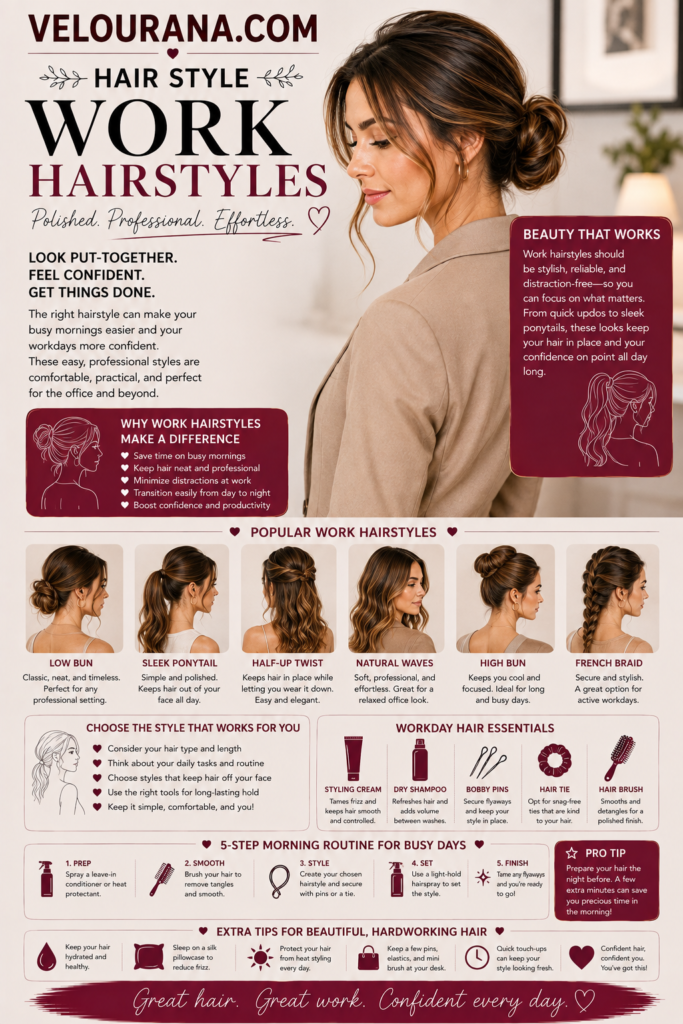
CATEGORY: Work Hairstyles
The relationship between hair and professional confidence is more complicated than the familiar instruction to look polished for work. Hair cannot make someone competent, intelligent or authoritative, and a hairstyle cannot compensate for the absence of those qualities. Yet personal presentation can influence how someone feels while moving through a professional environment, and hair occupies an unusually important position within that experience because it frames the face, changes the silhouette and remains visible throughout almost every interaction.
For many people, work hair is therefore not primarily about impressing other people. It is about reducing self-consciousness.
When hair feels right, it tends to disappear from attention. The person stops wondering whether it has moved, whether the front looks strange, whether the texture has changed or whether the hairstyle appears appropriate. Attention returns to the meeting, conversation, presentation or task at hand. The hairstyle has performed an important function precisely because it is no longer demanding thought.
When hair feels wrong, the opposite can happen. A style that feels unfamiliar may create unnecessary awareness. Hair repeatedly falling across the face becomes distracting. An uncomfortable fastening can remain present in consciousness for hours. A finish that depends on perfect smoothness can become a source of concern when weather or movement begins changing it.
This does not mean professional confidence should depend on appearance. It means that a practical, authentic grooming routine can remove one avoidable distraction from an already demanding day.
The most useful work hairstyle is consequently not the one that conforms most closely to an imagined corporate ideal. It is the one that allows the wearer to feel composed without becoming preoccupied with maintaining that composition.
The Professional Image Begins Before Anyone Else Sees It
The first person to experience a work hairstyle is the person wearing it.
That seems obvious, yet discussions of professional appearance frequently begin with how colleagues, employers or clients might perceive someone. The internal experience is treated as secondary, even though it influences posture, comfort and behavior long before another person forms an impression.
There is a meaningful difference between leaving home feeling assembled and leaving home already dissatisfied with the hair.
The difference may have little to do with objective perfection. A hairstyle can contain natural movement, irregular texture or a few flyaways and still feel completely right. Another can be technically immaculate but feel foreign to the person wearing it.
Familiarity matters.
People gradually develop an understanding of themselves through repeated visual patterns. Someone accustomed to volume around the face may feel strangely exposed when the hair is pulled severely backward. Someone who normally wears a short, precise shape may feel less composed when the hair becomes overly soft. A person who identifies strongly with natural curls may not experience a straightened finish as an improvement simply because it is smoother.
These responses are personal rather than universal.
They reveal why professional hairstyling becomes more convincing when it begins with the wearer's existing aesthetic identity.
Work may call for adaptation. A particular environment can influence the degree of formality or practicality required. But adaptation does not have to become disguise.
The strongest professional image often feels like a refined version of the person who already exists outside the workplace.
Authority Is Not a Hairstyle
Certain hairstyles have accumulated associations with authority.
Hair pulled away from the face can appear direct. Clean geometric cuts may communicate precision. Smooth surfaces are often described as polished. Restrained shapes have historically been associated with conservative professional environments.
These associations are culturally familiar, but they should not be mistaken for rules.
Authority does not reside in straight hair, a bun or a particular length.
A person with abundant natural curls can command a room without reducing their volume. Coily hair can create a powerful professional silhouette precisely because of its structure. Long hair can remain loose while the wearer communicates with complete confidence. A pixie can feel soft rather than severe and still belong comfortably in a senior professional setting.
The mistake occurs when visual shorthand becomes a judgment about competence.
Professional authority is built through expertise, communication, judgment and behavior. Hair participates in the visual presentation of that person but does not generate those qualities.
Understanding this can actually improve hairstyling decisions.
Instead of attempting to manufacture authority through a hairstyle that feels unnatural, the wearer can concentrate on creating a version of her own hair that feels deliberate and dependable.
This shifts the objective from looking like an abstract professional to feeling fully present as one.
The difference is significant.
One approach encourages imitation. The other encourages ownership.
Confidence Often Comes From Predictability
There is something reassuring about knowing how hair will behave.
A familiar work hairstyle removes uncertainty from the morning. The wearer knows how long it takes to create, how it responds to the commute, what happens after several hours and how much attention it will require during the day.
This predictability can be particularly valuable before important professional events.
On the morning of a presentation, interview or difficult meeting, experimenting with an unfamiliar hairstyle introduces another variable. Even if the result looks objectively attractive, the person may spend part of the day evaluating herself in it.
A reliable style does the opposite.
It creates visual familiarity at a moment when attention is needed elsewhere.
This does not mean important days require boring hair. A familiar style can be elevated without being fundamentally changed. Natural texture can receive more deliberate shaping. A usual blowout can become more polished. A regular part can be refined. The hairstyle can look especially considered while remaining recognizably connected to the wearer's normal appearance.
There is confidence in not needing to wonder what the hair is doing.
The style has already proved itself.
That knowledge can be more useful than novelty when professional attention matters most.
Looking Polished and Feeling Overstyled Are Not the Same Thing
Work hair occupies a delicate psychological territory because visible effort can be interpreted differently depending on the person and environment.
Some people enjoy highly polished styling and feel most themselves when every element of their appearance has been deliberately finished. Others become uncomfortable when work hair feels noticeably more constructed than their everyday appearance.
Neither preference is more professional.
The important question is whether the level of styling feels natural to the wearer.
Overstyling can create self-consciousness when someone feels as though the hairstyle is entering the room before she does. The hair becomes something to monitor rather than inhabit.
Understyling can create the opposite discomfort if the person feels unfinished.
The ideal point lies wherever grooming becomes supportive rather than distracting.
This is why professional polish cannot be measured by the amount of work invested. Twenty minutes of styling is not inherently more appropriate than five. A complex finish is not automatically more polished than beautifully maintained natural texture. A simple gathered shape can feel more intentional than an elaborate style if it suits the person and environment better.
Effort and effect are not the same thing.
The goal is not to make the labor visible.
It is to make the final appearance feel resolved.
The Face Changes When Hair Changes
Hair has a remarkable ability to alter how the face is visually framed without changing anything about the features themselves.
Volume near the temples changes the surrounding proportions. A center part creates symmetry. A side part shifts emphasis. Hair pulled backward exposes the entire face. A fringe changes the visible forehead. Curls create movement around the features. A short cut reveals more of the jaw and neck.
These changes can influence how someone feels during professional interaction.
A person who prefers some softness around the face may feel unusually exposed in a tightly pulled-back style. Someone who dislikes hair moving forward may feel more confident when the face is completely open. The correct choice is therefore deeply individual.
This becomes particularly relevant during presentations and conversations where facial expression carries much of the communication.
Hair that repeatedly falls into the eyes can interfere practically. A front section that needs constant adjustment creates visible movement unrelated to the conversation. Conversely, hair positioned comfortably allows facial expression to remain unobstructed without requiring the wearer to think about it.
The objective is not to expose as much of the face as possible.
It is to create a frame in which the wearer feels comfortable communicating.
That may involve loose hair.
It may involve complete openness.
It may involve asymmetry, curls, a fringe or a few carefully positioned sections.
Professional presence is strengthened when the hair supports expression rather than competing for attention.
Natural Texture and Professional Identity Should Not Be Opponents
The history of professional grooming standards has often placed unnecessary pressure on natural texture.
Smoothness was frequently treated as synonymous with neatness, while curls, coils and significant volume were expected to move toward a narrower aesthetic standard. The result was not merely a styling preference. It created an implication that some natural hair required greater transformation before entering professional spaces.
A modern approach to work hairstyles should reject that assumption.
Natural texture can be deliberate, sophisticated and entirely professional without being disguised.
The distinction between cared-for hair and altered hair is essential.
Curly hair can be shaped while retaining variation. Coily hair can create controlled or expansive silhouettes according to personal preference. Braids and twists can form part of a professional identity rather than being treated as exceptions to it.
This also changes the emotional relationship with getting ready for work.
When professional presentation requires someone to repeatedly move away from her natural appearance, grooming can become a form of daily negotiation. When natural characteristics are accepted as part of the professional image, styling becomes less about correction.
That does not eliminate choice.
Someone with curly hair may enjoy straightening it. Someone with coily hair may choose stretched styles. Professional freedom includes those decisions too.
The important point is that transformation should be a preference rather than a prerequisite for legitimacy.
Hair is most empowering when the wearer controls what happens to it.
An Important Meeting Should Not Require Becoming Someone Else
High-stakes professional moments often trigger a desire to increase every aspect of grooming.
The outfit becomes more formal. Makeup may become more deliberate. Hair receives additional attention. There is nothing inherently wrong with this. Ritual can help create a sense of readiness.
The problem begins when increased formality becomes unfamiliarity.
An important meeting is not necessarily the best time to discover how it feels to wear the hair in a completely different way.
If someone normally wears curls, suddenly straightening them because the meeting feels serious can create an unnecessary psychological shift. If the hair is normally loose, a severe updo may make the wearer feel physically and visually unfamiliar. If someone usually embraces volume, flattening the hair dramatically can alter the way she recognizes herself.
The professional situation already contains enough variables.
A more useful approach is often refinement.
The familiar hairstyle becomes its most intentional version.
The part is considered. The shape is balanced. The hair is comfortable. The finish receives attention. The style has enough stability to survive the meeting without becoming another concern.
This approach communicates something valuable internally: the person who handles ordinary work is also the person capable of handling important work.
She does not need a costume to become credible.
Hair Can Support Communication by Becoming Visually Quiet
Visually quiet hair does not necessarily mean small, straight or conservative hair.
It means hair that does not repeatedly interrupt the interaction.
A large natural silhouette can be visually quiet when its shape is stable and intentional. A sleek bob can be quiet because its lines remain clear. Long waves can be quiet when they sit comfortably away from the face.
The concept is about attention rather than volume.
During professional conversation, people naturally respond to facial expression, eye contact and speech. Hair becomes distracting primarily when it creates unexpected movement or requires repeated manipulation.
Touching the hair occasionally is entirely normal. Constantly correcting it can become distracting to the wearer first and potentially to others second.
This is why a hairstyle that feels secure can indirectly support communication.
The person is not thinking about the front section that keeps falling forward. She is not wondering whether the ponytail has loosened. She is not checking whether humidity has transformed the texture into something she was trying desperately to suppress.
Her attention remains where she wants it.
The hairstyle succeeds through absence of interference.
Professional Style Can Contain Creativity Without Becoming Performance
Many working environments now allow substantially greater personal expression than traditional corporate grooming standards once suggested.
This creates room for hair to become part of a recognizable professional identity.
Creativity can appear through shape, texture, cut, accessories or color. It does not require an elaborate hairstyle every morning.
A distinctive bob can become a signature. Natural curls can create a consistent visual presence. A carefully shaped short cut can communicate strong personal style. Braids can offer both practicality and aesthetic identity. Long hair can retain movement while remaining deliberate.
The strength of a signature is repetition with variation.
When someone consistently presents herself in a way that feels authentic, the appearance becomes familiar to colleagues and clients. It stops being interpreted as a styling event and simply becomes part of how that person looks.
This is particularly useful for people working in creative industries, but the principle extends beyond them.
Personal style does not cease to exist because the environment is professional.
The degree of expression may change according to context, but eliminating it completely can make professional presentation unnecessarily generic.
The most interesting work style often comes from understanding where individuality and environment comfortably overlap.
Hair Accessories Can Influence Professional Presence Through Restraint
Accessories create one of the easiest ways to alter work hair without reconstructing it.
Their professional effect depends less on whether they are permitted in some abstract sense and more on how they interact with the complete appearance.
A simple accessory can introduce structure to loose hair. A barrette can turn an ordinary half-up arrangement into something more deliberate. A headband can control the front while adding a recognizable visual line.
The accessory becomes less effective when it appears to solve a problem badly.
If it is constantly slipping, pressing or catching, it creates the same distraction as an uncomfortable hairstyle. If it overwhelms the hair or competes aggressively with jewelry and clothing, it may feel disconnected from the rest of the professional presentation.
The best work accessories tend to feel integrated.
They perform a function and contribute aesthetically at the same time.
This reflects the broader character of successful work styling: beauty and practicality are not separate objectives. The most satisfying decisions often accomplish both.
Age and Seniority Do Not Require Hair to Become Invisible
Professional women can encounter another restrictive assumption as careers progress: that authority and maturity should gradually reduce experimentation.
Hair is expected to become safer, shorter, quieter or more conservative as seniority increases.
There is no inherent reason for this.
A senior professional can wear long hair. She can wear curls, volume, a distinctive cut or a contemporary style. Maturity can refine personal taste without erasing it.
In fact, professional confidence may make personal styling easier over time because the wearer has accumulated greater knowledge of what genuinely suits her.
She understands which haircuts work with her texture. She knows how much maintenance she tolerates. She has experienced enough trends to distinguish novelty from something she actually enjoys.
This knowledge can produce stronger style, not less.
The relationship between hair and professional presence becomes less anxious because there is less need to imitate an external template.
Authority is already established elsewhere.
Hair can simply be good hair.
The Emotional Value of a Reliable Hairstyle Is Easy to Underestimate
Mornings contain enough decisions.
Clothing, schedules, messages, commuting, family responsibilities and unexpected problems can all arrive before the working day properly begins.
A reliable hair routine removes one source of uncertainty.
There is considerable value in knowing that the hair can be made presentable within a predictable amount of time. The routine becomes almost automatic. Products, tools and techniques are familiar. There is no daily search for inspiration and no repeated attempt to reinvent the professional image.
This does not mean the hairstyle becomes boring.
Reliability creates the foundation from which variation becomes easy.
A different part, altered texture or changed placement can create enough novelty without requiring a complete rethink.
The emotional benefit comes from control.
The wearer knows what to do when there are thirty minutes available and what to do when there are five.
She knows which version survives rain better.
She knows how the hair behaves on the second or third day.
She knows what to choose when an important meeting appears unexpectedly.
This knowledge turns hairstyling from a recurring problem into a familiar skill.
Confidence Grows When the Hairstyle Can Survive Imperfection
A fragile hairstyle creates fragile confidence.
If the wearer believes the appearance is successful only while every detail remains exactly as it began, ordinary changes can become disproportionately important.
A little humidity feels threatening.
A loosened wave feels like deterioration.
A flyaway becomes something to correct immediately.
A resilient hairstyle creates a different mindset.
The person knows that the overall appearance can absorb small changes.
The curls can become fuller.
The blowout can soften.
The ponytail can develop a little movement around the hairline.
The short cut can become slightly less precise.
The hairstyle remains itself.
This resilience is especially valuable at work because professional life is unpredictable. A day expected to last eight hours can become ten. A meeting can move outside. A commute can be delayed. The weather can change.
Hair that can tolerate reality removes the need to protect it from reality.
That freedom is part of what makes a hairstyle feel confident.
Professional Presence Comes From Coherence Rather Than Perfection
When someone appears professionally composed, the impression usually comes from the relationship between many elements rather than the perfection of any one of them.
Clothing fits the context.
Hair feels intentional.
Grooming appears considered.
Body language communicates attention.
Speech and behavior establish competence.
No single element carries the entire burden.
This perspective is useful because it places hair in its proper role.
Hair matters as part of presentation, but it does not need to become a performance of professionalism.
A natural curl pattern does not need to justify itself through extreme control. Long hair does not need to prove seriousness by being hidden. Short hair does not need to become severe. A ponytail does not need to imitate an evening updo.
The hairstyle needs only to belong coherently to the person, the environment and the day.
Once that standard replaces perfection, work hairstyling becomes considerably more flexible.
The Most Powerful Work Hairstyle Is the One You Stop Thinking About
There is a paradox at the center of professional hair.
A great deal of thought may go into finding the right haircut, understanding texture, developing a routine and deciding what degree of polish feels appropriate. Yet the ultimate success of all that thought is a hairstyle that requires very little thought while it is being worn.
The person leaves home and moves on.
She enters the meeting without checking the hair repeatedly.
She speaks without pushing it away from her face.
She works without becoming conscious of tension at the scalp.
She appears on camera without spending the conversation watching herself in the corner of the screen.
The hairstyle has become dependable.
This is where appearance and confidence meet in a healthy way. The hair has not created competence or authority. It has simply removed itself as a source of distraction, allowing those qualities to occupy the foreground.
That distinction matters.
Professional beauty should not suggest that women must perfect their appearance before they deserve confidence. It should offer practical ways of making presentation easier for people who choose to engage with it.
Hair can contribute to that ease when it reflects the wearer rather than an imposed template.
Natural texture can remain natural.
Volume can remain visible.
Long hair can remain long.
Short hair can remain expressive.
A familiar style can be refined rather than replaced.
The working environment may influence the final degree of formality, but it does not need to erase the individual inside it.
Over time, the best professional hairstyle often becomes less about styling and more about recognition.
The wearer recognizes herself in it.
She knows how it behaves.
She understands its limits.
She trusts it through an ordinary day and an important one.
That trust is far more valuable than achieving a theoretically perfect professional hairstyle that feels unfamiliar.
Because the purpose of work hair is ultimately not to convince the room that the hair is professional.
It is to allow the person wearing it to enter the room without needing to think about her hair at all.
The End
Velourana.
 Discover More From Our Family of Websites
 ZodiacBearing (Astrology, Tarot, Numerology, Angel Numbers & Spiritual Guidance)
 Velourana (Beauty, Makeup, Hair Care, Skincare & Beauty Tips)
 HavenBearing (Home, Living, Organization, Décor & Everyday Inspiration)
 PawBearing (Pet Care, Dog Breeds, Animal Health, Training & Pet Products)
 PsyCatherine (Notes From the Journal of a Psychologist on Real Life)

