
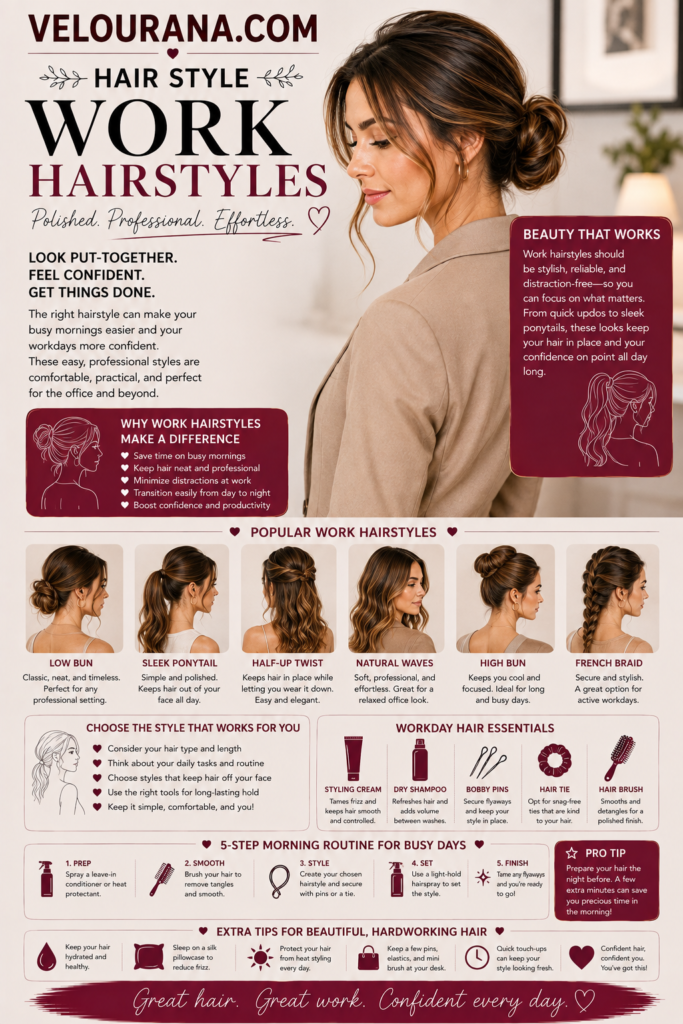
CATEGORY: Work Hairstyles
Work hairstyles occupy an unusual place in beauty culture. They are expected to look considered without looking theatrical, to survive a full day without demanding constant attention, and to sit comfortably somewhere between personal expression and the practical realities of a working environment. Yet the idea of what makes hair look “professional” has changed considerably. The rigid distinction between office hair and personal hair has weakened as workplaces themselves have become more varied, dress codes have relaxed, and individuality has become increasingly visible in professional life.
That change does not mean that work hairstyling has become irrelevant. It means that the question has become more interesting.
A useful work hairstyle is not simply a conservative hairstyle. Nor is it necessarily sleek, tied back, straight or understated. Curly hair does not need to be restrained to look professional, natural texture does not need to be transformed, and long hair does not automatically need to be gathered. What matters more is whether the hairstyle feels intentional, remains compatible with the demands of the day and allows the person wearing it to concentrate on work rather than on maintaining her hair.
This introduces a practical dimension that distinguishes work styling from many other beauty decisions. An evening hairstyle may only need to perform successfully for several hours. A work hairstyle may be expected to survive commuting, meetings, concentrated desk work, changes in temperature, telephone calls, video conferences, lunch, movement between locations and an unexpected extension of the working day. It needs to look convincing at nine in the morning without becoming irritating by three in the afternoon.
The strongest work hairstyles therefore begin with an understanding of real life. They acknowledge texture, density, length and personal style, but they also acknowledge time, comfort and the environment. The result is not a catalogue of supposedly appropriate hairstyles. It is a way of thinking about hair that makes professional grooming easier, more individual and far more sustainable.
Professional Hair Is Better Understood as Intentional Hair
For decades, professional appearance was often described through a narrow visual vocabulary. Hair was expected to be controlled, conservative and relatively inconspicuous. Smooth surfaces and restrained shapes became associated with seriousness, while more expressive textures or silhouettes were sometimes treated as unsuitable for formal working environments.
That understanding is increasingly difficult to defend.
A hairstyle does not become professional because every strand has been forced into the same direction. It becomes convincing when the complete appearance appears deliberate. A naturally curly silhouette can communicate exactly as much care as straight hair. Coily hair can be beautifully shaped without being compressed. A short textured cut can look exceptionally precise while retaining movement. Long hair can remain loose when its placement does not interfere with the work being performed.
Intentionality is visible in proportion and condition rather than conformity. The front of the hairstyle relates comfortably to the face. The overall shape makes sense. The hair does not appear to have been abandoned halfway through getting ready. At the same time, it does not need to announce the effort that produced it.
This distinction is important because professional styling works best when it feels integrated into the person rather than imposed upon her. Someone who normally wears natural curls may feel far more composed presenting those curls beautifully than repeatedly straightening them for work. Someone whose identity is strongly connected to a sharp bob does not become more professional by putting it into an unnecessary miniature ponytail. Someone with long straight hair may look completely appropriate wearing it loose if it remains comfortable and suited to her work.
Professionalism is conveyed through the whole person. Hair contributes to that impression, but it should not be required to erase individuality in order to do so.
The Working Day Changes What Good Hairstyling Means
The mirror at home is a poor simulation of an eight-hour working day.
A hairstyle can look excellent immediately after it is completed and still be badly designed for work. A tight fastening may begin to ache after several hours. A fringe may repeatedly fall into the eyes while reading. Long hair may become trapped between the back and an office chair. Loose front sections that looked attractive in the morning may become irritating during concentrated work. A heavy bun may make the wearer increasingly conscious of her scalp.
These are not minor inconveniences. They influence whether a hairstyle can realistically become part of a routine.
The best work styling tends to disappear from awareness after the person leaves the mirror. Hair remains visually present, of course, but it no longer requires supervision. There is no repeated checking, tightening, smoothing or rearranging. This freedom is one of the most valuable qualities a professional hairstyle can possess.
Comfort therefore deserves the same attention as appearance.
A secure hairstyle does not have to be aggressively tight. In fact, excessive tension is often counterproductive because it creates discomfort and encourages adjustment later. A gathered style can be stable while distributing its weight comfortably. Loose hair can remain practical when the front is positioned intelligently. Short hair can retain texture without repeatedly moving into the eyes.
The particular solution changes according to the person and the work being done. Someone spending most of the day at a desk has different practical requirements from someone moving continuously between locations. A person working with machinery, food, laboratory equipment or patients may face genuine safety or hygiene requirements that make hair restraint necessary. Someone working remotely may care more about how the upper silhouette appears on camera.
This is why work hairstyles are best considered in relation to the working day rather than according to a universal image of “office hair.”
The Morning Routine Is Part of the Hairstyle
A hairstyle that requires forty-five minutes every morning may be beautiful, but its sustainability depends on whether forty-five minutes genuinely exists.
Professional grooming becomes easier when the hairstyle respects the amount of time a person actually wants to devote to it. This is not an argument for abandoning styling. It is an argument for choosing where the effort produces the greatest return.
Much of the visual effect of work hair is concentrated around the face and upper silhouette. The direction of the front sections, the condition of the part, the balance of the crown and the way the hair sits around the jaw and shoulders can influence the complete appearance more strongly than meticulous manipulation of every section.
That understanding can make morning styling substantially more efficient.
Hair that was prepared well the previous evening may require only modest reshaping. Natural texture may need refreshing rather than complete reconstruction. A blowout can be preserved and redirected. A haircut with a strong inherent shape can reduce the amount of daily intervention required. Even the choice of where the hair is parted can transform the appearance without creating another lengthy process.
The most useful routine is repeatable. It should not depend on an unusually cooperative morning or perfect weather. If the hairstyle only succeeds under ideal conditions, it will eventually become frustrating.
There is also psychological value in consistency. A reliable grooming routine removes one decision from the beginning of the day. The person knows roughly how long the hair will take, how it will behave and what it will look like several hours later. That predictability can be more valuable for work than elaborate novelty.
Beauty routines become powerful when they support life rather than consuming disproportionate amounts of it.
Hair Texture Should Determine the Strategy, Not the Standard
One of the most persistent problems in discussions of professional hair is the assumption that all textures should move toward the same visual destination.
They should not.
Straight hair naturally creates clearer lines and smoother surfaces. Wavy hair contains movement that can give even a simple cut dimension. Curly hair develops volume and shape through its pattern. Coily hair can create highly defined silhouettes and extraordinary structural presence. These qualities are not obstacles to professional styling. They are the materials from which professional styling begins.
When natural texture is respected, the morning routine can also become more realistic.
Curly hair does not need every curl to be identical before it looks finished. The overall silhouette is often more important. A balanced crown, thoughtfully positioned front and healthy-looking pattern can create a polished appearance while preserving natural variation.
Coily hair similarly benefits from being considered in terms of architecture. Volume can sit higher, wider or more compactly depending on the desired shape. Twists, braids and gathered structures can be incorporated when they suit the wearer, but natural coils do not need to disappear before the hairstyle becomes appropriate for work.
Wavy hair can use its movement rather than repeatedly fighting it. A softer professional appearance may be more sustainable than trying to maintain an absolutely straight surface throughout a humid commute and long day.
Straight hair has its own considerations. Because its surface and perimeter are highly visible, small changes in direction can carry considerable weight. A clean part, deliberate ends and balanced volume may accomplish more than complicated styling.
The professional standard should therefore be coherence, not texture conversion.
When the natural characteristics of the hair become part of the design, the result usually feels more authentic and requires less unnecessary intervention.
A Good Haircut Does Much of the Professional Styling Before Morning Begins
Daily work hair is strongly influenced by decisions made weeks earlier in the salon.
A haircut with a clear shape can reduce the amount of effort required to make hair look intentional. Layers that respond naturally to the person's texture can create movement without extensive styling. A well-designed bob can retain its identity with relatively little morning manipulation. Long hair with thoughtfully positioned face-framing sections can sit attractively whether it is loose or gathered.
This relationship between haircut and routine is easy to underestimate.
When the underlying cut works against the natural behavior of the hair, daily styling becomes corrective. Sections must repeatedly be persuaded into positions they do not naturally occupy. Volume appears where it is unwanted and disappears where it is needed. The morning routine becomes an attempt to rebuild the shape that the haircut failed to provide.
A compatible cut reverses that relationship. Styling becomes refinement rather than reconstruction.
This matters particularly for work because repetition magnifies inconvenience. A complicated hairstyle created once for an event can be enjoyable. A complicated correction performed every weekday eventually becomes a burden.
The most successful professional haircut is therefore not simply the one that looks impressive immediately after an appointment. It is the one that continues to make sense after the wearer washes and styles it herself, sleeps on it, travels to work and lives in it.
A strong haircut gives work styling a foundation. Everything that happens in the morning becomes easier because the hair already knows roughly where it belongs.
Polish Does Not Require Perfect Stillness
Professional grooming is sometimes confused with immobility.
Hair is expected to remain exactly where it was placed, as though movement itself were evidence of disorder. Yet living hair moves. A bob shifts when the head turns. A ponytail responds to walking. Curls change position. Loose lengths move across the shoulders.
None of this prevents hair from looking polished.
In fact, a little movement often makes a hairstyle appear more natural and confident. The distinction lies between movement and distraction. Hair that moves attractively is different from hair that must constantly be pushed away from the face. A ponytail that swings naturally is different from one that loosens progressively throughout the day. Curls retaining their overall shape can change subtly without looking unfinished.
This more flexible understanding of polish is useful because it allows hairstyles to survive reality.
Humidity may soften a blowout. Crown volume may settle slightly. Natural curls may expand. A tucked section may become less precise. If the hairstyle depends on absolute stillness, these small changes can make it feel unsuccessful. If the design already allows natural movement, the same changes become part of the hairstyle's evolution.
Work hair should be stable in identity rather than frozen in detail.
The part remains deliberate. The silhouette remains balanced. The hair stays comfortable. The overall impression continues to look considered.
That is enough.
Meetings and Cameras Have Changed the Professional Frame
Modern professional life is increasingly viewed through a rectangle.
Video meetings have altered the way work hairstyles are perceived because the camera crops much of the body and concentrates attention on the head, shoulders and upper torso. Details that are subtle in person can become more prominent on screen, while other aspects of a hairstyle disappear entirely.
The front and upper silhouette consequently carry greater visual importance.
A hairstyle with all of its interest at the back may look very simple on camera. Hair that falls heavily forward can dominate a small video frame. Very flat roots may appear flatter under overhead lighting, while excessive height can be exaggerated by camera position.
This does not require creating a separate hairstyle for video calls. It simply adds another environment for the hairstyle to navigate.
Placement becomes useful. Hair can be arranged so that the face remains visible without feeling exposed. Natural texture can provide dimension around the upper silhouette. A side part can introduce asymmetry. Short hair can use crown shape to create presence. Gathered hair can make earrings, glasses or facial expression more noticeable.
Lighting also affects perception. Glossy straight hair may reflect light strongly, while curls and coils create changing highlights and shadows across the texture. Neither is preferable; they simply register differently on screen.
The goal remains the same as in person: the hairstyle should support communication rather than become something the wearer is continually monitoring in the small self-view window.
The Most Useful Work Hair Can Change Without Being Rebuilt
A working day does not always end when work ends.
There may be dinner, drinks, an event, travel or an appointment immediately afterward. A hairstyle that can shift character without requiring complete reconstruction becomes especially valuable on these days.
This versatility does not necessarily come from complicated styling. Often it comes from a strong, adaptable foundation.
Loose hair with controlled movement can become more dramatic simply by changing the part or increasing volume around the front. Hair that has been gathered through the day can be released when the texture left behind still looks intentional. A low, restrained shape can move higher or become softer. An accessory can change the mood without altering the entire structure.
The key is that the work version should not damage the evening possibilities.
An excessively tight fastening may leave uncomfortable tension and pronounced marks. A style saturated with heavy product may resist later movement. Hair that has been repeatedly manipulated throughout the day may be harder to transform quickly.
A flexible approach treats the working hairstyle as the first phase of the day rather than a structure that must be demolished before anything else can happen.
This is particularly relevant to modern schedules because professional and personal life often meet without a large preparation interval between them.
The most elegant transition may involve remarkably little. The work hairstyle already provided the polish. The evening adjustment merely changes its energy.
Personal Style Belongs in Professional Life
The idea that professional appearance should suppress personality has weakened for good reason.
Hair is one of the most visible aspects of personal presentation. It can communicate aesthetic preferences, cultural traditions, creativity and identity before a person says anything. Expecting everyone to converge on one narrow professional hairstyle would not only be unrealistic; it would make contemporary working life visually poorer.
The challenge is not eliminating personality. It is integrating it with context.
A creative workplace may allow considerably greater experimentation than a highly traditional environment. Client-facing roles may have particular expectations. Uniform requirements can influence practical choices. Certain workplaces impose genuine safety standards. None of this changes the broader principle that individuality and professionalism are capable of coexisting.
Someone who loves volume can retain volume.
Someone who prefers minimalist styling can make precision her signature.
Someone who wears braids can incorporate them into a polished professional appearance without treating them as a temporary departure from a supposedly neutral norm.
Someone with vivid personal style can decide how strongly she wants that style represented at work rather than assuming it must disappear entirely.
The most convincing professional image usually feels inhabited rather than performed.
When hair is radically disconnected from the way someone sees herself, that discomfort can be visible. When it feels authentic but considered, confidence tends to follow more naturally.
This is not an argument that appearance determines professional competence. It does not. It is simply an acknowledgment that when people choose to style themselves for work, the result can be both appropriate to the environment and genuinely their own.
Professional Hair Becomes Easier When Perfection Stops Being the Objective
A large amount of unnecessary effort in work grooming comes from trying to maintain a standard that real hair cannot sustain indefinitely.
Every flyaway does not need to disappear.
Every curl does not need identical definition.
Every wave does not need to retain its morning position.
Every short layer does not need to remain attached to the rest of the hairstyle.
Professional appearance is perceived as a whole.
When the shape is coherent, the hair appears cared for and the style suits the person, tiny irregularities rarely determine the impression. In many cases, those irregularities make the hair look more natural.
This is especially liberating for a hairstyle worn repeatedly.
A routine that requires perfection every morning is vulnerable to weather, sleep, time pressure and the unpredictable behavior of hair itself. A routine designed around a strong overall shape is much more resilient.
The difference can also reduce unnecessary manipulation.
Instead of repeatedly applying heat because one section does not behave identically to another, it may be possible to incorporate that variation into the style. Instead of rebuilding natural texture each morning, selected areas may simply need refreshing. Instead of tightening a gathered hairstyle whenever a little softness appears, the softer finish may still look entirely intentional.
Work hair benefits from standards that can survive ordinary life.
Polish should make the day easier, not create another source of anxiety.
Building a Work Hairstyle Around Real Life
The most sustainable approach to work hairstyling begins by observing what repeatedly happens during the day.
Perhaps the hair is always pushed behind the ears by lunchtime. That suggests the original front placement is not practical enough.
Perhaps a high ponytail consistently becomes uncomfortable after several hours. The problem may not be ponytails themselves but the height, tension or weight distribution.
Perhaps loose hair looks excellent in the morning but becomes irritating against the back of an office chair. A different placement or length strategy may solve the problem without abandoning loose styles completely.
Perhaps natural curls look their best on the second day rather than immediately after washing. The work routine can be built around that reality instead of treating it as an inconvenience.
Perhaps the hairstyle behaves perfectly in the office but struggles during the commute. Then the commute, rather than the workplace, is the environment the styling strategy needs to address.
These observations are more useful than copying a theoretically professional hairstyle from someone with different hair, a different schedule and a different working environment.
Personal routines become efficient when they are designed from evidence.
After several weeks, most people already know which parts of their hair create friction during the working day. The solution is to treat those patterns as information rather than repeatedly experiencing them as annoyances.
A work hairstyle should become progressively easier as the wearer learns what her hair actually needs.
The Modern Professional Hairstyle Is Ultimately About Freedom From Maintenance
The most valuable quality of a work hairstyle may be the one least visible in photographs: freedom.
The hair looks considered in the morning and then allows the day to happen.
It survives the commute without demanding reconstruction. It remains comfortable during concentration. It does not become an obstacle during meetings. It accommodates the natural behavior of the hair instead of requiring constant correction. It can soften slightly as the hours pass without losing its identity.
Achieving that does not require one particular hairstyle.
For one person, the answer may be loose natural texture shaped beautifully around the face. For another, it may be a precise short cut that requires little intervention. Long straight hair may work perfectly when its placement remains comfortable. A gathered style may be preferable for someone whose work involves constant movement. Braids, twists, curls, coils, waves and straight textures can all belong comfortably within modern professional presentation.
The common element is not appearance.
It is intention.
The hairstyle has been chosen in relation to the hair itself, the person wearing it and the day it needs to survive.
That perspective also changes the meaning of professional polish. Polish no longer requires disguising texture or eliminating individuality. It means understanding proportion, condition, placement and practicality well enough that the hairstyle feels complete.
The result should not look as though enormous effort was required every morning, even when considerable knowledge sits behind its simplicity.
A well-designed professional hairstyle is almost infrastructural. It supports the person without becoming the subject of the day.
That is why the most useful work hair often becomes a personal signature over time. The wearer discovers a shape, texture or routine that consistently works and begins refining it rather than replacing it. Small variations keep it interesting, but the foundation remains reliable.
There is confidence in that familiarity.
The person knows how the hair will behave. She knows how long it takes. She knows what happens when the weather changes. She knows whether it will remain comfortable through a long meeting and whether it can transition into the evening.
Professional style becomes less about complying with an abstract image and more about mastering one's own presentation.
That is a far more modern understanding of work hairstyles.
Hair can be expressive without becoming distracting. It can be polished without becoming rigid. It can retain natural texture without apology. It can move. It can soften. It can reflect personality.
Most importantly, it can allow the person wearing it to stop thinking about her hair and get on with everything else she came to work to do.
The End
Velourana.
 Discover More From Our Family of Websites
 ZodiacBearing (Astrology, Tarot, Numerology, Angel Numbers & Spiritual Guidance)
 Velourana (Beauty, Makeup, Hair Care, Skincare & Beauty Tips)
 HavenBearing (Home, Living, Organization, Décor & Everyday Inspiration)
 PawBearing (Pet Care, Dog Breeds, Animal Health, Training & Pet Products)
 PsyCatherine (Notes From the Journal of a Psychologist on Real Life)

