CATEGORY: Wrinkles
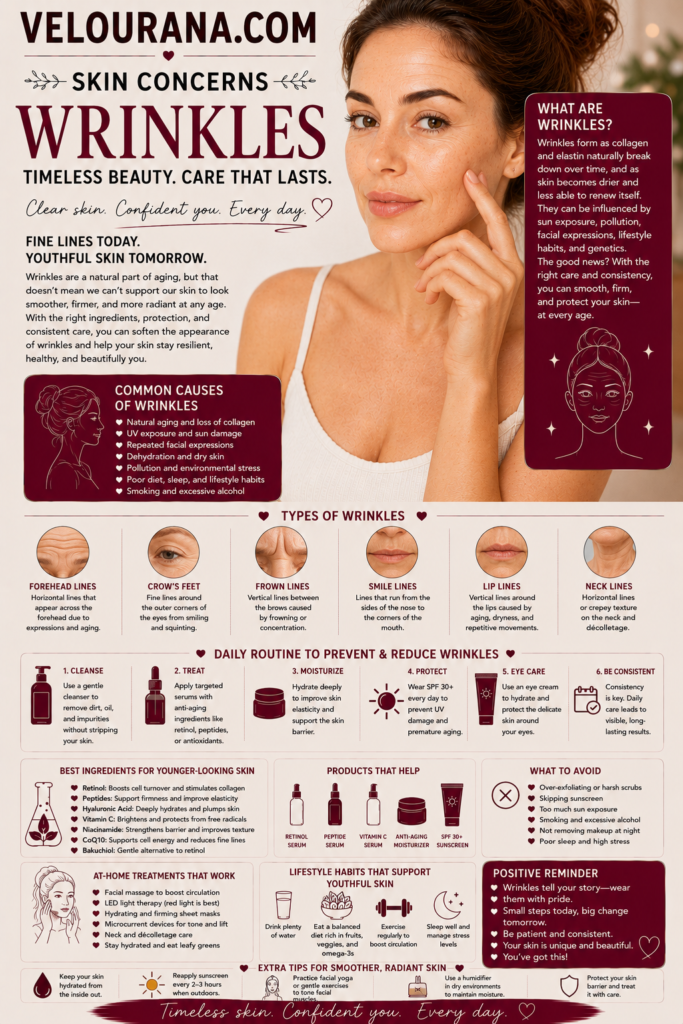
Wrinkles are often described as though they simply arrive with age: an inevitable collection of lines appearing one by one as the years pass. The biology is considerably more interesting. A wrinkle is not merely a mark on the surface of the skin. It is the visible expression of changes taking place across several layers at once—changes in collagen, elastin, hydration, facial movement, fat distribution, cellular renewal, and the accumulated effects of ultraviolet exposure and other environmental influences.
This is why two people of the same age can have dramatically different patterns of wrinkling, and why the same face can contain several entirely different kinds of lines. The delicate creases beneath the eyes do not necessarily develop for the same reasons as a deep line between the eyebrows. The folds around the mouth behave differently from the fine, almost papery texture that may appear across sun-exposed cheeks. Even within one small area, intrinsic aging, repeated expression, dryness, structural change, and photodamage can overlap.
Understanding those differences changes the way wrinkle care should be approached. The objective is not to search for a mythical cream capable of erasing every line. Skin care cannot reproduce the structural effects of a medical procedure, and reputable cosmetic care should never pretend otherwise. What a thoughtful routine can do is support hydration, protect collagen from avoidable damage, improve texture, encourage healthier-looking renewal, and reduce the visibility of some lines over time.
The most useful way to think about wrinkles, therefore, is not as isolated imperfections to be attacked, but as evidence of a changing skin architecture. Once that architecture is understood, wrinkle care becomes much more logical.
A Wrinkle Begins Beneath What We See
Young skin possesses a combination of qualities that allow its surface to remain relatively smooth. Its outer layers retain water efficiently. The dermis beneath provides a resilient supporting network, particularly through collagen and elastin. Facial tissues have volume, and the skin can repeatedly bend with movement and recover.
None of these characteristics remains completely static.
With age, skin tends to become thinner, drier and less elastic, while changes in collagen and deeper supporting tissues contribute to the formation of lines and folds. The process is influenced not only by chronological aging but also by genetics and environmental exposure.
Collagen is particularly important because it gives the dermis much of its tensile strength and structural support. Elastin contributes flexibility and recoil. These materials do not simply disappear at a particular birthday. Instead, their production, organization and quality change gradually. At the same time, the extracellular environment surrounding them changes as well.
The result is a surface that becomes less capable of returning perfectly to its previous position after it has been compressed, folded or stretched.
Imagine repeatedly folding two materials: one thick, hydrated and resilient, the other thinner and less elastic. The same mechanical movement produces very different consequences. Facial skin behaves in a comparable way. Expressions that once left virtually no trace can eventually begin leaving temporary lines, and temporary lines can gradually become visible even when the face is resting.
This helps explain why wrinkles should not be understood solely as surface damage. A cream can make the surface look smoother, particularly by improving hydration, but a deep wrinkle represents architecture that extends beyond the outermost layer.
The distinction matters because realistic expectations are one of the foundations of effective skin care.
Expression Lines and the Transition From Movement to Rest
The human face is constantly moving.
We smile, squint, laugh, concentrate, frown, speak, chew and raise our eyebrows. The skin follows the muscles beneath it, folding repeatedly along characteristic pathways. In younger skin, many of those folds disappear almost immediately when the expression stops. As elasticity and structural support change, some of them remain.
These are commonly described as dynamic and static wrinkles.
A dynamic line appears primarily during movement. Crow's-feet becoming visible during a broad smile are a familiar example. A static wrinkle remains at least partly visible while the face is relaxed. The two are not entirely separate categories; rather, they can represent stages along the same continuum.
Repeated facial expressions contribute to wrinkle formation because grooves develop beneath the surface where the skin repeatedly folds. As aging skin becomes less flexible, it becomes less capable of springing completely back into position.
This explains something that skin-care advertising occasionally obscures: not every wrinkle can be substantially altered by topical cosmetics.
A moisturizer can improve dehydration-related lines. A retinoid may gradually improve fine wrinkling and photodamaged texture. Sunscreen can reduce continuing ultraviolet injury. None of these stops the underlying facial muscle from contracting.
That does not make topical care pointless. It simply defines its territory.
Expression is also one reason wrinkles are profoundly individual. Two people with similar genetics and similar sun exposure can develop different patterns because their faces move differently. One person may naturally raise the eyebrows frequently and develop horizontal forehead lines. Another may contract the muscles between the brows more strongly. Someone who smiles extensively may develop pronounced lines around the eyes while retaining a relatively smooth forehead.
Wrinkles are therefore partly records of movement.
This is worth remembering in a beauty culture that sometimes presents every visible line as evidence that something has gone wrong. Some wrinkles are simply the structural consequences of having an expressive human face.
Sunlight Changes the Timeline
Chronological aging happens to everyone. Photoaging does not occur to the same degree in everyone.
That distinction is fundamental.
Ultraviolet radiation accelerates skin aging by damaging important components of the skin's supporting structure, including collagen and elastin. Areas receiving substantial cumulative sun exposure—particularly the face, neck, upper chest, forearms and hands—often show aging more visibly than areas that remain covered.
The effects extend beyond wrinkles. Long-term photodamage can contribute to uneven pigmentation, roughness, loss of elasticity and other visible changes. This is why skin that has experienced significant ultraviolet exposure can look different not merely because it contains more lines, but because its entire texture and tone have changed.
The contrast between intrinsic aging and photoaging also explains why sun protection occupies such an important position in evidence-based wrinkle care.
Sunscreen is sometimes treated as the unglamorous preliminary step before the supposedly exciting anti-aging ingredients begin. In reality, protecting skin against continuing ultraviolet damage may be one of the most consequential elements of the entire routine.
The American Academy of Dermatology recommends broad-spectrum SPF 30 or higher as part of efforts to reduce premature skin aging, while Mayo Clinic similarly emphasizes daily broad-spectrum SPF 30 or above and protective measures against ultraviolet exposure.
This does not mean that sunscreen freezes the skin in time. It cannot stop intrinsic aging, prevent every expression line, or restore structural changes that have already occurred.
Its importance lies elsewhere: it reduces an avoidable source of accelerated aging.
There is little logic in investing heavily in products intended to improve photodamaged skin while repeatedly exposing that skin to the environmental factor responsible for much of the damage.
For wrinkle care, prevention and treatment are not separate worlds. They operate simultaneously.
Why Dry Skin Can Suddenly Look Much More Wrinkled
There are mornings when someone appears to have aged overnight.
They have not.
Often, what has changed is hydration.
The outermost portion of the epidermis depends on an effective barrier and an appropriate balance of water and lipids. When that surface becomes dehydrated, its texture can become rougher and tiny creases become more obvious. Fine lines around the eyes are particularly capable of appearing dramatically different depending on hydration.
Moisturizers work largely by helping the skin retain water and supporting a smoother surface. Both the American Academy of Dermatology and Mayo Clinic note that moisturization can make some fine lines less visible, with Mayo Clinic describing the effect as temporary plumping of the skin.
The word temporary is important.
If a moisturizer makes a line less noticeable within minutes, it has not rebuilt the dermis in those minutes. It has altered the optical and physical characteristics of the surface. Hydrated skin reflects light differently, feels softer and can appear fuller.
This distinction is sometimes interpreted too negatively. Temporary improvement is still useful improvement.
We routinely use conditioner even though hair will need conditioning again. We apply lip balm despite knowing the lips will not remain moisturized forever. Maintaining skin hydration is similarly part of ongoing care rather than a permanent structural correction.
Ingredients such as glycerin and other humectants can help attract and retain water within the outer layers, while emollient and occlusive components can reduce roughness and water loss depending on the formulation.
The best moisturizer for wrinkle-prone skin is therefore not necessarily the richest or most expensive. It is one that maintains comfort and hydration without producing persistent irritation or congestion.
A sophisticated wrinkle routine often begins with something remarkably ordinary: keeping the skin barrier functioning well enough that the skin does not spend every day recovering from the routine itself.
Retinoids and the Difference Between Cosmetic Promise and Evidence
Few ingredient families have become as closely associated with aging skin as retinoids.
The terminology can initially be confusing. Retinoids are vitamin A derivatives encompassing several compounds. Retinol is a retinoid commonly used in over-the-counter cosmetic formulations, while prescription-strength options include compounds such as tretinoin.
Their reputation is not based solely on marketing.
Topical retinoids have substantial dermatological history, and long-term tretinoin use can improve aspects of photodamage including fine wrinkling. The American Academy of Dermatology notes that retinoids can increase surface-cell turnover and stimulate collagen while improving fine lines and skin tone.
But the existence of evidence does not mean that stronger is automatically better.
Retinoids can cause dryness, redness, burning, peeling and irritation, particularly when introduced too aggressively. The AAD recommends beginning cautiously, and irritation deserves particular attention because an inflamed skin barrier can undermine the very appearance someone is trying to improve.
This creates one of the recurring paradoxes of anti-aging care.
People who become anxious about wrinkles often want the fastest possible intervention. They may choose the highest concentration they can find, apply it too frequently, combine it immediately with exfoliating acids, and interpret stinging as proof that the routine is powerful.
The skin may respond with inflammation, dryness and exaggerated surface lines.
A slower routine can ultimately be more productive because consistency matters. A tolerable retinoid used appropriately over months is more meaningful than an aggressive routine abandoned after ten painful days.
Prescription retinoids require professional guidance, and retinoids should not be used during pregnancy.
The larger lesson extends beyond retinoids: wrinkle care is a long-term biological process, not a competition to create the strongest sensation on the skin.
Antioxidants, Vitamin C and the Supporting Cast
Retinoids receive enormous attention, but aging skin exists within an environment of oxidative stress, ultraviolet radiation and pollution. This has made antioxidants an important part of the broader conversation around skin aging.
Vitamin C is among the best-known examples.
Topically applied vitamin C is used in skin-care formulations partly for antioxidant support and may contribute to improvements in skin tone and other visible characteristics. Mayo Clinic includes vitamin C among ingredients that may improve the appearance of aging skin and notes its role in helping protect against damage associated with sun and pollution exposure.
The crucial word is support.
An antioxidant serum does not replace sunscreen.
This misconception is surprisingly persistent. Antioxidants and sunscreens can complement each other, but they perform different jobs. Sunscreen is designed to reduce the amount of damaging ultraviolet radiation reaching the skin. Antioxidants are used to help address oxidative processes associated with environmental exposure.
Similarly, vitamin C should not be expected to behave like a filler, a neuromodulator or a resurfacing procedure.
The same restraint should be applied to peptides, botanical extracts and the constantly expanding universe of anti-aging ingredients. Some formulations may provide meaningful cosmetic benefits. Others have considerably weaker evidence than their marketing suggests.
DermNet notes that many anti-aging formulations contain antioxidants, exfoliating ingredients, peptides and plant extracts, while emphasizing that the evidence supporting these ingredients is not equally strong and that topical retinoids stand apart in terms of established effectiveness.
This does not mean every ingredient without decades of clinical evidence is useless. Cosmetics can improve hydration, softness, luminosity and surface texture without qualifying as medical treatments.
It simply means that claims should remain proportional to evidence.
A serum can be excellent without being miraculous.
The Barrier Is Not an Obstacle to Anti-Aging—It Is Part of It
There is a strange tendency in aggressive skin care to treat the barrier as something standing between active ingredients and results.
It is the opposite.
The barrier is essential skin biology.
A compromised barrier can produce tightness, flaking, sensitivity, redness, burning and increased water loss. Under those conditions, fine surface lines often become more obvious rather than less.
This matters because many ingredients used in wrinkle-focused routines—retinoids and exfoliating acids among them—can become irritating when used excessively.
The solution is not necessarily to eliminate every active ingredient. It is to build a routine in which treatment intensity remains compatible with skin tolerance.
Gentle cleansing becomes relevant here. Cleansing should remove sunscreen, makeup, sebum and environmental debris without leaving the face feeling stripped. Hot water and unnecessarily harsh cleansing can make already dry mature skin less comfortable.
Moisturization then supports the water-holding capacity of the outer skin. DermNet specifically recommends regular moisturization for aging skin and notes that it improves water retention.
This creates a useful hierarchy.
A person does not need seven anti-aging serums simply because seven mechanisms sound more impressive than one. In fact, the AAD warns that using multiple anti-aging products over a short period can irritate the skin and recommends focusing on the principal concern rather than trying to treat everything simultaneously.
A carefully selected active ingredient inside a stable routine can be more sophisticated than an overflowing bathroom shelf.
The measure of a routine is not how many products it contains. It is whether the skin can live comfortably with it for long enough to benefit.
Why Wrinkles Around the Eyes Behave Differently
The eye area tends to reveal aging early because its skin is delicate and repeatedly folded by expression.
Every smile recruits the muscles surrounding the eyes. Squinting does the same. Meanwhile, the area may be exposed to ultraviolet radiation, makeup application and removal, rubbing, dryness and environmental stress.
The result can be a combination of dynamic crow's-feet, fine dehydration lines and eventually more persistent creasing.
This is precisely why treating every eye-area line as the same phenomenon leads to disappointment.
A hydrating eye cream may make tiny dehydration lines look considerably softer while doing relatively little to a deep expression line. A retinoid formulated appropriately for the area may gradually improve aspects of texture and fine wrinkling, but it will not eliminate the muscle movement producing crow's-feet.
The eye area also demonstrates why irritation is not synonymous with effectiveness.
Skin that is chronically dry and inflamed around the eyes can appear more lined. Someone may therefore escalate treatment because the lines look worse, causing additional irritation and creating a cycle in which increasingly aggressive wrinkle treatment produces increasingly wrinkled-looking skin.
Sometimes the correct intervention is not another active ingredient.
It is restraint.
The Mouth, Forehead and Neck Tell Different Stories
Wrinkles are geographically specific.
The forehead is heavily influenced by repeated muscle movement. Lines between the brows reflect another characteristic pattern of contraction. The mouth is constantly involved in speech, eating and expression. The neck moves, folds and receives substantial cumulative sun exposure while often receiving less skin care than the face.
Different regions therefore age differently.
Around the mouth, structural changes can combine with repetitive movement and changes in surrounding volume. On the forehead, dynamic lines can gradually become visible at rest. The neck can develop horizontal lines, textural changes and laxity that are not necessarily responsive to exactly the same strategies used for fine facial lines.
This regional variation becomes increasingly important when wrinkles become deeper.
At that point, skin care remains valuable for maintaining hydration, improving surface quality and limiting further photodamage, but the structural component may dominate what is visible.
No responsible topical product should promise the equivalent of a procedure capable of changing deeper tissue architecture.
Recognizing that boundary is not an admission that skin care has failed.
A healthy-looking, hydrated, even, comfortable complexion can still contain wrinkles.
In fact, one of the most productive changes in mature-skin care is moving away from the expectation that success means making the face appear completely unlined.
Lifestyle Leaves Its Signature on the Skin
Skin does not exist independently from the body or environment.
Smoking is one of the clearest examples. Tobacco exposure is associated with accelerated skin aging and wrinkling, and both Mayo Clinic and DermNet identify smoking as a contributor to premature aging.
Pollution can also contribute to extrinsic aging processes.
Nutrition is more complicated because skin-care culture has a habit of turning ordinary foods into supposed anti-aging medicines. No single fruit, tea or supplement should be expected to erase wrinkles. Nevertheless, overall nutrition matters to general health, and observational evidence has associated dietary patterns rich in foods such as vegetables, legumes and other nutrient-dense foods with healthier aging characteristics.
This should remain in perspective.
Eating well is not a substitute for sunscreen. Drinking additional water does not mechanically fill a deep forehead wrinkle. Collagen supplements should not be treated as magical rebuilding materials simply because collagen exists in skin.
The body is more complex than that.
Sleep, stress, smoking, nutrition, environmental exposure and general health can all influence how skin looks, but the relationship rarely reduces to one dramatic hack.
Wrinkle care becomes much easier when these exaggerated promises are removed.
When Skin Care Reaches Its Natural Limit
There is a point at which the conversation moves from cosmetic skin care into dermatology and aesthetic medicine.
Deep static wrinkles, substantial volume changes, pronounced photodamage and expression-related lines may respond more significantly to professional interventions than to topical cosmetics.
Available medical and procedural approaches include prescription treatments, resurfacing techniques, injectable neuromodulators, fillers and surgical procedures. The appropriate choice depends on the type of wrinkle, skin characteristics, medical history, expectations, potential adverse effects and willingness to accept recovery time.
These treatments do not all solve the same problem.
Neuromodulator injections, for example, reduce movement in selected muscles and are particularly suited to certain expression-related wrinkles. Fillers work differently, adding volume or structural support in appropriate areas. Resurfacing procedures target yet another aspect of aging skin.
This reinforces the central principle: wrinkles do not have one cause, so they cannot have one universal treatment.
A dermatologist can assess whether the dominant issue is movement, photodamage, volume change, laxity, surface texture or a combination. Professional assessment is especially useful when someone is considering procedures or prescription treatment, or when a skin change is unusual rather than simply a familiar line or crease.
Medical consultation also matters when sun-damaged skin develops persistent rough, scaly or changing areas. Significant ultraviolet damage is not solely cosmetic; it is associated with precancerous and cancerous skin changes as well.
Skin care should improve our relationship with the skin, not distract us from changes that deserve medical attention.
A More Intelligent Philosophy of Wrinkle Care
Once the biology is stripped of advertising language, an effective wrinkle strategy becomes surprisingly coherent.
Protect the skin from ultraviolet radiation.
Maintain hydration and barrier function.
Introduce evidence-supported active ingredients cautiously when appropriate.
Avoid creating chronic irritation in pursuit of faster results.
Give meaningful treatments enough time to work.
And understand the difference between something that improves the surface and something capable of altering deeper structure.
This approach is less dramatic than the endless cycle of miracle launches, but it is much more sustainable.
It also changes the way progress is judged.
Instead of examining the mirror each morning searching for the disappearance of a particular line, look at the skin as a whole. Is it more comfortable? Is persistent dryness improving? Does the surface appear smoother? Is tone becoming more even? Does the complexion recover more easily? Is the routine tolerable enough to continue for months rather than days?
These changes matter.
Over-the-counter wrinkle products generally produce modest improvements rather than results comparable with procedures, and visible changes can require weeks or months of consistent use.
That reality should not be disappointing. It should be liberating.
It means there is no need to chase every new ingredient or punish the skin into looking younger.
Wrinkles Are Part of Skin History, Not the End of Skin Beauty
A wrinkle is simultaneously biological and personal.
It may reflect sunlight accumulated over decades, the gradual reorganization of collagen, thousands of smiles, habitual concentration, genetics, environmental exposure and the ordinary passage of time. Some lines can be softened. Some can be prevented from deepening as quickly. Some can be treated substantially with professional procedures. Others will remain part of the face.
The goal of thoughtful skin care does not need to be the creation of an unnaturally motionless surface.
A mature complexion can have visible lines and still look exceptionally healthy. It can be luminous without being perfectly smooth. It can be soft, hydrated and even-toned while carrying expression lines around the eyes. Beauty and wrinkling are not mutually exclusive states.
The most valuable anti-wrinkle routine is therefore not necessarily the one containing the greatest number of products or the most aggressive ingredients.
It is the one that respects what skin is capable of changing.
Daily ultraviolet protection helps defend against avoidable photoaging. Consistent moisturization supports hydration and can soften the appearance of fine lines. Carefully selected retinoids can improve fine wrinkling and other signs of photodamage over time when they are appropriate and tolerated. Additional ingredients can support tone, texture and overall appearance. Professional treatments remain available when deeper structural changes require something beyond cosmetics.
Everything else begins with patience.
Skin aging is measured in years and decades. Meaningful care should be designed on a similar principle: not a frantic attempt to reverse time overnight, but a consistent effort to protect the skin that exists now and preserve its function, resilience and appearance for the years ahead.
Wrinkles may be among the most visible signs of aging, but they are only one feature of a much larger picture. When the skin is treated as living tissue rather than a collection of flaws, anti-aging care becomes more rational, more realistic and ultimately more useful.
The End Velourana
 Discover More From Our Family of Websites
 ZodiacBearing (Astrology, Tarot, Numerology, Angel Numbers & Spiritual Guidance)
 Velourana (Beauty, Makeup, Hair Care, Skincare & Beauty Tips)
 HavenBearing (Home, Living, Organization, Décor & Everyday Inspiration)
 PawBearing (Pet Care, Dog Breeds, Animal Health, Training & Pet Products)
 PsyCatherine (Notes From the Journal of a Psychologist on Real Life)