CATEGORY: Uneven Tone
When people think about visible skin aging, wrinkles usually receive most of the attention. They are easy to identify, easy to describe, and deeply embedded in the cultural language of getting older. Yet complexion research, cosmetic practice, and simple visual observation all point toward a broader truth: the impression of age is shaped not only by lines and folds, but also by how evenly light, pigment, redness, and texture are distributed across the face.
A person can have relatively few deep wrinkles and still appear noticeably older when the complexion becomes mottled, sun-damaged, inflamed, or dull. Another person may have visible expression lines yet retain a fresher appearance because the skin remains relatively clear and harmonious in tone. The difference is not mysterious. Human vision responds strongly to contrast. Areas of brown pigmentation beside lighter skin, redness beside neutral skin, or dull patches beside more reflective regions can fragment the complexion and make individual signs of aging appear more pronounced.
This is why uneven tone deserves to be understood as a central aging concern rather than a minor cosmetic detail.
The complexion acts almost like the background of a painting. Fine lines, pores, shadows, and contours are interpreted against it. When that background is relatively coherent, the face tends to read as calmer and more luminous. When it becomes increasingly irregular, every other feature seems to compete for attention.
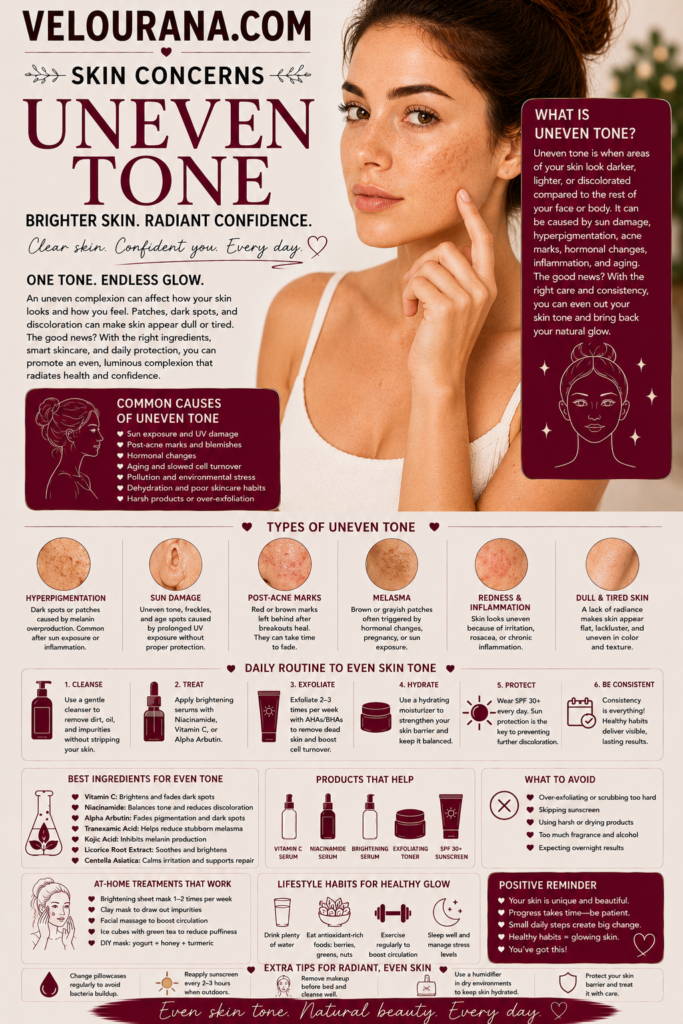
Age-related tone changes are rarely caused by one factor alone. Ultraviolet exposure, inflammation, slower recovery from blemishes, hormonal influences, vascular changes, dehydration, and altered skin texture can overlap. Pigment may accumulate in one area while another becomes red or dull. This makes uneven tone fundamentally different from a single dark spot.
The goal of skincare is therefore not to create perfectly monochromatic skin. It is to reduce unnecessary contrast and help the complexion regain visual continuity.
That distinction changes everything about how mature skin should be treated.
The Eye Reads Contrast Before It Reads Detail
Human vision is remarkably sensitive to differences.
The eye notices borders between dark and light, red and neutral, smooth and rough. This is useful in everyday life, but it also affects how the face is perceived.
A small amount of pigmentation may attract more attention than several fine lines because it creates a stronger local contrast. A red patch beside otherwise even skin can become the first thing someone sees. A rough, dry area can cast tiny shadows that exaggerate texture far beyond its actual depth.
This helps explain why complexion correction can sometimes create a surprisingly large visual improvement even when wrinkles remain unchanged.
The skin has not become younger in a literal biological sense.
The visual information has simply become more orderly.
This distinction matters because anti-aging skincare is often organized around individual structural concerns. One product targets fine lines. Another targets firmness. Another addresses pores. Pigmentation is treated as a separate category.
In reality, these concerns interact visually.
Smoother texture makes pigment appear less abrupt.
Better hydration makes the surface more reflective.
Reduced redness lowers color contrast.
Improved pigmentation allows the natural contours of the face to become more visually dominant than discoloration.
The complexion is not a collection of isolated problems.
It is a single visual field.
Photodamage Changes Color as Well as Structure
Sun exposure is often discussed in relation to wrinkles, collagen breakdown, and loss of elasticity.
Its influence on pigmentation can be just as important.
Repeated ultraviolet exposure stimulates pigment production and contributes to the development of localized discoloration such as solar lentigines. Over time, the distribution of color across exposed skin can become increasingly irregular.
This is one reason photoaged skin can look older even when its deepest wrinkles are not dramatic.
The face may contain areas of excess pigment, diffuse dullness, fine vascular changes, and textural roughness all at once.
These changes reinforce one another.
A sun spot looks darker against a lighter surrounding area.
Dryness makes the mark look more obvious because the surface reflects less light.
Fine lines create shadows near the same region.
Redness elsewhere adds another layer of contrast.
The cumulative effect is stronger than any single feature alone.
This is also why photoprotection is one of the most powerful long-term strategies for preserving even tone.
Sunscreen does not erase established pigmentation overnight, but it helps reduce repeated ultraviolet stimulation while protecting treatments that are trying to improve existing discoloration.
Without that protection, corrective skincare is operating on unstable ground.
Uneven Tone Can Develop Long Before It Becomes Obvious
Pigmentation does not necessarily become visible immediately after its cause.
This delayed relationship is important.
Years of intermittent sun exposure can accumulate gradually. Small episodes of inflammation can leave subtle changes. Hormonal influences may alter pigment behavior over time. The complexion can appear relatively uniform for years before the differences become obvious enough to attract attention.
Age makes this accumulated history more visible.
This is why a person may suddenly feel that their skin has changed dramatically even though the underlying process developed slowly.
The marks did not necessarily appear overnight.
The visual threshold was crossed.
Several subtle irregularities became strong enough collectively to change the overall impression of the complexion.
This also explains why prevention deserves more respect than it usually receives.
The best pigmentation treatment may be the damage that never becomes visible.
Daily sun protection, avoiding repeated irritation, controlling inflammatory skin conditions, and reducing unnecessary picking or scratching can alter the complexion's future long before the benefit becomes obvious.
Pigment and Redness Can Age the Face Together
Uneven tone is often interpreted as brown pigmentation, but redness can be equally influential.
Persistent redness around the cheeks, nose, chin, or forehead creates its own type of unevenness. In some skin tones, inflammation may appear bright red. In others, it may look purple, dusky, brownish, or deeper than the surrounding complexion.
This creates an important practical problem.
A person may use excellent pigment-focused products and still feel dissatisfied because half of the visual irregularity is vascular or inflammatory rather than melanin-based.
The skin may be clearer, but not calmer.
This is one reason professional evaluation can be useful when the pattern of uneven tone is difficult to understand.
Rosacea, dermatitis, acne, irritation, and other inflammatory conditions can all contribute to persistent color variation. Treating the inflammation may improve tone more effectively than adding another brightening serum.
For mature skin, this is particularly important because aggressive anti-aging routines can themselves produce chronic redness.
A retinoid, acid, exfoliating cleanser, and strong vitamin C product may all have legitimate roles individually. Used together without regard for tolerance, they can create enough irritation to make the complexion look older rather than younger.
The skin becomes redder, drier, rougher, and more reactive.
The routine may be technically sophisticated and visually unsuccessful.
Texture Alters the Way Tone Is Seen
Uneven tone is partly about pigment and partly about light.
A smooth surface reflects light in a relatively coherent way. A rough surface scatters it.
This means the exact same pigmentation can look different depending on skin texture.
Dryness, flaking, enlarged pores, fine lines, and roughness all interrupt reflection. Small shadows make neighboring color differences seem stronger. Makeup catches unevenly. Certain areas look dull while others appear brighter.
This is why hydration and barrier support can improve the appearance of tone even before pigmentation itself changes.
Moisturizer does not chemically remove a sun spot.
But by smoothing and hydrating the outer surface, it can reduce the optical contrast surrounding that spot.
This is one of the reasons complexion improvement often feels broader than the effect of any single active ingredient.
The skin begins to reflect light differently.
It appears clearer.
That clarity is a combination of biology and optics.
The Skin Barrier Determines Whether Treatment Looks Elegant or Aggressive
Barrier health becomes more important with age because mature skin may be less tolerant of repeated irritation.
This does not mean older skin cannot use active ingredients.
It means those ingredients need to be organized intelligently.
The barrier acts as a protective interface between the body and the environment. When compromised, water loss increases and irritants penetrate more easily. The skin may become tight, sensitive, red, rough, or flaky.
Every one of those changes can worsen perceived tone.
A damaged barrier also narrows the margin for corrective treatments.
Something that would normally be tolerated may suddenly sting. A mild acid becomes uncomfortable. Retinol produces more peeling. Sunscreen feels unpleasant, making consistent use less likely.
At that point, pigmentation treatment becomes harder because the foundation of the routine is unstable.
This is why barrier repair is not merely a side project.
It is part of tone correction.
A stable barrier allows the complexion to tolerate the treatments required to improve pigmentation over time.
Wrinkles Are Structural, but Tone Is Atmospheric
There is a useful distinction between structural aging and atmospheric aging.
Wrinkles and sagging are structural. They relate to changes in collagen, elastin, fat distribution, bone structure, muscle movement, and other deeper anatomical processes.
Tone is more atmospheric.
It determines the visual environment of the face.
A patchy, inflamed, dull complexion changes how every structural feature is perceived. Fine lines appear deeper because the surrounding skin has less luminosity. Shadows become stronger. The eye jumps between areas of contrast rather than taking in the face as a whole.
This explains why complexion treatments can have an unexpectedly refreshing effect.
They do not reconstruct facial anatomy.
They improve the visual context in which that anatomy is seen.
That makes tone correction one of the most efficient ways to improve the overall impression of mature skin.
Brightening Should Reduce Contrast, Not Erase Identity
The language of brightening can become uncomfortable when it is confused with lightening the person's natural complexion.
That is not the objective.
Healthy tone correction respects the individual's natural skin color.
The aim is to reduce abnormal or unwanted variation: dark marks left by inflammation, sun-induced pigmentation, patchy discoloration, or other uneven areas.
Freckles may remain.
Natural undertones remain.
The depth of the person's complexion remains.
The skin simply becomes less visually fragmented.
This distinction is especially important across diverse skin tones.
Pigmentary concerns do not imply that lighter skin is better skin.
Evenness refers to consistency within the person's own natural range.
Post-Inflammatory Pigmentation Can Make Aging Feel Faster
One frustrating change many people notice with age is that blemishes seem to leave more evidence behind.
The inflammatory lesion disappears, but the mark remains.
This creates a sense that the skin is accumulating history faster than it can erase it.
Post-inflammatory hyperpigmentation is one reason this happens.
Inflammation can stimulate pigment production, leaving a darker area after acne, eczema, injury, or irritation.
Repeated episodes create cumulative unevenness.
A few blemishes each year may not seem significant. But if each leaves a mark lasting several months, the complexion can gradually become more mottled.
The most effective strategy therefore includes preventing the inflammatory event when possible.
Treat acne.
Avoid picking.
Control eczema or dermatitis.
Reduce friction.
Stop using products that repeatedly provoke burning or redness.
Fading existing marks matters.
Stopping the production line matters more.
Stronger Treatment Is Not Always Faster Treatment
Pigmentation is particularly vulnerable to the belief that intensity equals speed.
People often assume that a stronger acid, higher retinol concentration, deeper peel, or more frequent exfoliation will produce faster results.
Sometimes increasing treatment strength does increase biological effect.
But only up to the point the skin can tolerate.
Beyond that point, inflammation becomes the limiting factor.
The skin barrier becomes compromised.
Redness increases.
Pigmentation-prone skin may produce additional discoloration.
Treatment has crossed from effective to counterproductive.
This makes mature pigmentation care a balancing exercise.
The objective is not maximal stimulation.
It is maximal sustainable progress.
Retinoids Improve More Than Lines
Retinoids are often associated with wrinkles, but their usefulness for mature skin extends into pigmentation and texture.
By influencing cellular turnover and other biological pathways, they can help improve aspects of photoaging, including certain pigment irregularities.
This makes them especially valuable when several aging concerns exist simultaneously.
A well-tolerated retinoid can contribute to smoother texture, improved fine lines, and a more even-looking complexion over time.
The key phrase is well tolerated.
A stronger formulation that creates constant peeling may look less elegant than a lower-strength product used consistently for a year.
Gradual introduction remains one of the most intelligent strategies.
The skin does not reward impatience.
Vitamin C Supports the Defensive Side of Tone Correction
Vitamin C fits naturally into a morning routine because it functions as an antioxidant and can support efforts to improve visible pigmentation.
Its role becomes more useful when considered alongside photoprotection.
Sunscreen reduces ultraviolet exposure.
Antioxidants support the skin against oxidative stress.
Moisturizer helps maintain barrier stability.
Together, these steps create a defensive environment.
This is important because tone correction should not be limited to attacking existing discoloration.
The complexion must also be protected from the processes that create more.
Azelaic Acid Is Useful When Inflammation and Pigment Overlap
Azelaic acid can be particularly relevant when uneven tone is connected to acne or inflammatory skin behavior.
This makes it useful for mature adults who still experience blemishes while also dealing with pigmentation.
The ingredient can support management of acne and certain forms of discoloration, allowing one treatment to address both the source of new marks and some of the marks themselves.
This is an elegant example of intelligent routine design.
Instead of stacking unrelated products, select ingredients that solve several relevant problems at once.
The fewer products required, the easier the routine is to tolerate and maintain.
Exfoliation Should Refine, Not Strip
Exfoliation can improve tone by helping remove dull surface cells and supporting more even texture.
But mature skin rarely benefits from constant resurfacing.
Alpha hydroxy acids may be useful when introduced thoughtfully.
The problem begins when exfoliation becomes habitual rather than strategic.
Daily exfoliating cleansers, acid toners, peel pads, weekly peels, and retinoids can quietly accumulate into a routine that never allows the barrier to recover.
The surface may initially look polished.
Weeks later, the complexion may be red, sensitive, shiny from dehydration, and increasingly uneven.
Refinement is the goal.
Not removal.
Makeup Often Demonstrates the Power of Tone Better Than Skincare Does
One of the easiest ways to appreciate how much uneven tone contributes to perceived age is through makeup.
A lightweight complexion product can sometimes produce a stronger visual transformation than expected.
Wrinkles remain.
Facial structure remains.
The person is not physically younger.
Yet the face looks fresher because redness and pigmentation have been reduced visually.
This demonstrates the importance of color continuity.
Makeup creates the effect instantly.
Skincare attempts to create a more durable version gradually.
The comparison also helps establish realistic expectations.
Skincare will rarely make natural skin look permanently airbrushed.
Nor should it.
The objective is to reduce enough irregularity that the bare complexion feels more balanced.
Professional Procedures Can Improve Tone, but Diagnosis Comes First
When pigmentation remains persistent despite good skincare, professional treatment may be appropriate.
Chemical peels, certain lasers, intense pulsed light, and other procedures can address specific pigmentary concerns depending on the diagnosis and skin type.
But professional treatment is not a universal shortcut.
Melasma can behave differently from solar lentigines.
Post-inflammatory pigmentation can respond differently from freckles.
Darker skin tones may carry greater risk of pigment changes after aggressive procedures.
The practitioner must understand not only the device or peel but the biology of the patient's skin.
Treatment selection should follow diagnosis.
Not trend.
The Best Sign of Progress May Be the Face Looking Calmer
Pigmentation changes slowly, which makes progress difficult to notice.
People often stare at one stubborn spot and conclude nothing is happening.
A broader view is more useful.
Does the complexion look calmer?
Are fewer new marks appearing?
Does redness settle more quickly?
Is the surface smoother?
Does makeup sit better?
Does the skin recover from blemishes with less residual discoloration?
Do photographs taken months apart show less contrast?
These changes may represent meaningful progress even before every individual mark has faded.
A More Youthful Complexion Is Often a More Coherent Complexion
There is no single feature that determines whether skin looks young or old.
Wrinkles matter.
Firmness matters.
Texture matters.
But tone quietly influences all of them.
When pigmentation, redness, dullness, dehydration, and roughness accumulate, the face becomes visually fragmented. The eye moves from one irregularity to another.
When the complexion becomes more even, the opposite happens.
Features reconnect.
Light moves more smoothly across the face.
Individual lines seem less dominant.
The skin looks calmer.
This is why uneven tone can sometimes affect perceived age more strongly than fine wrinkles.
The difference is not that pigmentation is more biologically serious.
It is that contrast has enormous visual power.
The most effective anti-aging approach therefore does not ask whether wrinkles or pigmentation matter more.
It recognizes that the complexion is an integrated system.
Protect it from unnecessary ultraviolet exposure.
Reduce inflammation.
Support the barrier.
Use corrective ingredients consistently.
Avoid chasing rapid results through irritation.
Seek professional assessment when pigmentation is unusual or persistent.
And measure success not by whether the skin becomes perfectly uniform, but by whether it becomes more coherent.
A mature face does not need to erase every line or mark to look vibrant.
Often, it simply needs the background to become quiet enough for the whole face to be seen again.
The End Velourana
 Discover More From Our Family of Websites
 ZodiacBearing (Astrology, Tarot, Numerology, Angel Numbers & Spiritual Guidance)
 Velourana (Beauty, Makeup, Hair Care, Skincare & Beauty Tips)
 HavenBearing (Home, Living, Organization, Décor & Everyday Inspiration)
 PawBearing (Pet Care, Dog Breeds, Animal Health, Training & Pet Products)
 PsyCatherine (Notes From the Journal of a Psychologist on Real Life)