
CATEGORY: Wrinkles
People often speak about wrinkles as though they follow a predictable timetable. Fine lines arrive in the thirties, deeper creases follow in the forties, and increasingly visible folds appear later. Real faces rarely obey such a neat sequence.
One person may reach middle age with relatively few visible lines but noticeable changes in firmness. Another may develop pronounced crow's-feet much earlier while retaining smooth skin elsewhere. Someone who has spent decades outdoors may show a dense network of fine wrinkles across the cheeks, while another person of the same age develops mainly expression lines across the forehead. Even identical chronological age does not produce identical skin.
The reason is that wrinkles are not controlled by a single clock.
They emerge from the interaction of inherited skin characteristics, cumulative ultraviolet exposure, facial movement, pigmentation, smoking, environmental conditions, hormonal changes, hydration, structural remodeling and the ordinary biological processes of aging. Each factor operates at a different intensity in every person. Over decades, those small differences accumulate.
This is why comparing wrinkles between individuals can be misleading.
Age alone cannot explain the pattern.
A seventy-year-old who has protected the skin consistently from ultraviolet radiation may have a different aging profile from someone younger who has experienced extensive sun exposure. A person with naturally dry skin may notice fine surface lines earlier than someone whose barrier retains moisture more effectively. Someone with a highly expressive face may develop strong movement-related creases regardless of excellent skin care.
Wrinkle formation is therefore better understood as a trajectory rather than a schedule.
Some influences are inherited. Some are environmental. Some can be modified. Others cannot. Most overlap.
Understanding that combination does more than explain why people age differently. It also helps identify which aspects of wrinkle care are worth focusing on and which promises should be treated with skepticism.
Chronological Age Is Only One Part of the Story
Chronological aging is unavoidable.
Cells change. Repair processes become less efficient. The dermis gradually changes in composition. Collagen production declines. Skin tends to become thinner and less resilient. Sebaceous activity may decrease, contributing to dryness. Deeper facial tissues also change with time.
These processes help explain why wrinkles become more common with age.
But chronological aging does not occur in isolation.
The skin someone has at sixty is not simply the skin they were biologically programmed to have at sixty. It is the result of sixty years of interaction between biology and environment.
That distinction is essential.
Imagine two houses built at the same time from similar materials. One stands in a protected location and receives regular maintenance. The other is exposed continuously to severe weather. Both have aged for the same number of years, but their surfaces, structures and repair needs can be dramatically different.
Skin behaves similarly.
The biological clock continues for everyone, but its visible expression is modified by everything that happens along the way.
This explains why age prediction from facial appearance is surprisingly unreliable. Some people look younger than their chronological age, others older, and much of that variation reflects the cumulative history of the skin rather than simply the date of birth.
A more intelligent wrinkle strategy therefore asks not only, "How old is the skin?"
It asks, "What has this skin experienced?"
Genetics Establish the Starting Architecture
Genetics influence many of the characteristics that determine how skin ages.
They affect skin thickness, pigmentation, oil production, facial structure, collagen characteristics, tendency toward dryness and numerous biological processes involved in repair and aging.
This does not mean there is a single "wrinkle gene."
Aging is far more complex.
Instead, inherited traits help establish the framework within which environmental influences operate.
Some people naturally have thicker dermal tissue. Others have finer skin in certain areas. Some retain oiliness into later adulthood, while others become dry relatively early. Facial anatomy also differs substantially, changing where folds develop and how strongly shadows emphasize them.
Bone structure matters.
So does the distribution of facial fat.
The shape of the orbit around the eyes influences how the eye area ages. Cheek projection influences the way tissues are supported. The relationship between the nose, lips, chin and jaw affects the folds that eventually become visible around the mouth and lower face.
Wrinkles therefore cannot be separated completely from facial anatomy.
Even before environmental exposure is considered, different faces begin with different mechanical environments.
This is one reason copying another person's skin-care routine does not guarantee the same result.
The biology beneath the products is not identical.
Pigmentation Changes the Way Sun Damage Develops
Natural skin pigmentation influences how ultraviolet radiation interacts with the skin.
Melanin provides some protection against ultraviolet damage, which can influence the timing and pattern of visible photoaging. More highly pigmented skin may, on average, develop certain forms of wrinkling later than lightly pigmented skin under comparable conditions.
But pigmentation is not sunscreen.
All skin tones can experience ultraviolet damage.
All skin tones can develop photoaging.
And all skin tones can develop skin cancer.
The visible signs may simply present differently.
In lighter skin, photodamage may become particularly obvious through fine wrinkling, redness, roughness and pigmentation changes. In deeper skin tones, uneven pigmentation may sometimes become a more prominent early sign than wrinkles.
This difference illustrates an important principle: aging skin should not be assessed using a single visual template.
The mechanisms are shared, but their outward expression can vary.
It also means that sun protection remains relevant regardless of complexion.
The purpose is not merely preventing a tan or sunburn.
It is reducing cumulative ultraviolet injury to the biological structures that influence long-term skin appearance and health.
Ultraviolet Exposure Can Rewrite the Aging Timeline
Among the environmental influences on wrinkle development, ultraviolet radiation is one of the most important.
Sun exposure affects the skin in ways that extend far beyond temporary redness or tanning.
Ultraviolet radiation contributes to oxidative stress and activates processes that can degrade structural components of the dermis. Over time, repeated exposure contributes to altered collagen organization, reduced elasticity, uneven pigmentation and rougher texture.
The cumulative nature of this damage is what makes it so significant.
A single afternoon outdoors may not visibly age the face.
Thousands of afternoons can.
Many people underestimate cumulative exposure because they associate sun damage only with vacations or intentional sunbathing. In reality, ordinary daily exposure matters too: walking to work, driving, sitting beside windows, eating outdoors, gardening, exercising, shopping or spending time on balconies.
The skin does not distinguish between glamorous Mediterranean holidays and ten-minute exposures repeated for twenty years.
Ultraviolet radiation is still ultraviolet radiation.
This is why daily protection has become such a central recommendation in modern dermatology.
The aim is not perfection. It is reduction of cumulative exposure.
Wide-brimmed hats, shade, protective clothing and broad-spectrum sunscreen all contribute.
The value of these measures is especially clear when considered over decades.
Wrinkle prevention is rarely about one dramatic action.
It is about the cumulative effect of thousands of ordinary choices.
Repeated Facial Movement Creates Personal Wrinkle Maps
Look at several people while they are speaking and their faces move differently.
Some raise their eyebrows constantly.
Some narrow the eyes while concentrating.
Some smile primarily through the mouth; others recruit the entire eye area.
Some furrow the brow deeply.
Some barely do so at all.
These patterns help determine where expression lines eventually become established.
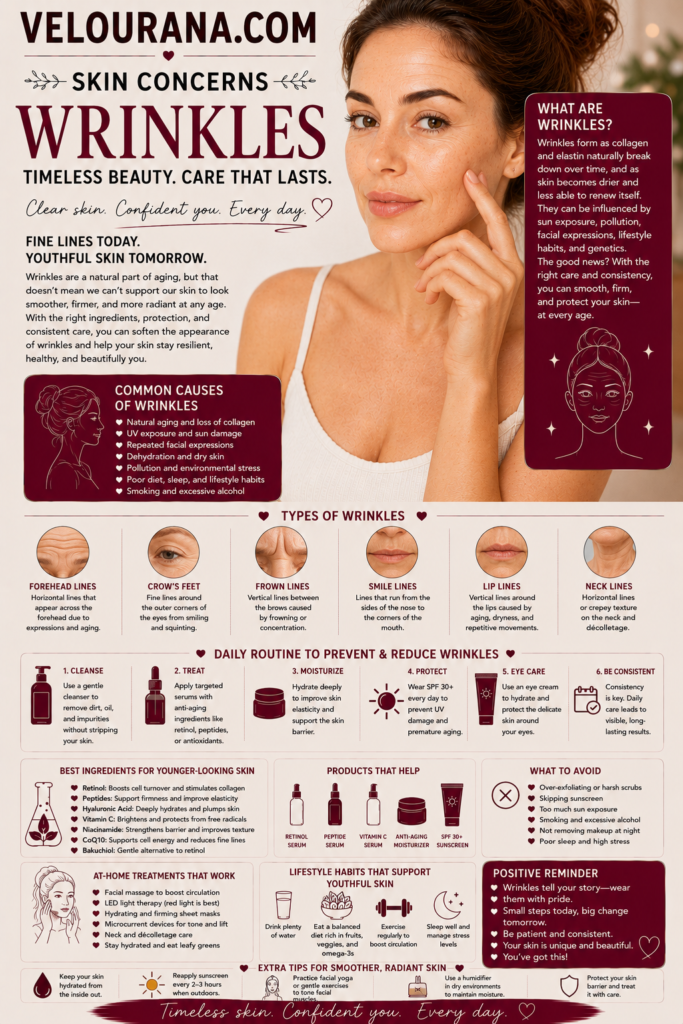
The forehead is particularly revealing. Repeated contraction of the muscles that elevate the eyebrows produces horizontal folding of the skin. Between the eyebrows, different muscles create vertical or diagonal creases. Around the eyes, smiling and squinting repeatedly compress the skin into crow's-feet.
During youth, these lines may disappear completely after the expression ends.
As tissue resilience changes, they recover less perfectly.
Eventually, some remain visible at rest.
This transition from dynamic to static wrinkling is not caused by facial movement alone. Movement interacts with the quality of the tissue being moved.
A young elastic surface can tolerate repeated folding differently from a thinner, photodamaged or structurally altered one.
This means facial expression does not need to be treated as an enemy.
Expressions are part of normal communication and personality.
Wrinkles are simply one consequence of using the face.
The goal of wrinkle care should not become the elimination of expression.
It should be an understanding of how movement contributes to the pattern.
Why Crow's-Feet Can Appear Early
Crow's-feet are among the first wrinkles many people notice.
The eye area is particularly vulnerable because several factors converge there.
The skin is delicate.
The muscles around the eyes are highly active.
Smiling creates repeated folding.
Squinting creates additional compression.
The area receives substantial sun exposure.
People frequently rub it, remove makeup from it and apply products close to it.
Hydration also influences how lined it appears.
This combination makes the outer eye area a natural location for early visible wrinkling.
Yet crow's-feet can vary dramatically between individuals.
Someone with a broad, frequent smile may develop them relatively early despite excellent sun protection. Another person may have minimal crow's-feet but strong forehead lines because their habitual expressions recruit different muscles.
This reinforces why wrinkles cannot be evaluated by age alone.
They are partly maps of movement.
Dryness Can Exaggerate the Appearance of Aging
Dryness does not create every wrinkle, but it can make many lines look considerably worse.
When the outer skin contains adequate water, it appears smoother and more flexible. When hydration decreases, microscopic surface irregularities become more visible.
Fine lines can suddenly appear deeper.
Texture can seem rough.
Makeup may settle more noticeably into creases.
This effect often becomes stronger with age because mature skin may produce less oil and retain water less efficiently.
Environmental conditions can intensify it.
Cold weather, indoor heating, air conditioning, low humidity, harsh cleansers and excessive exfoliation can all contribute to dryness.
This is one reason someone may believe that wrinkles have rapidly worsened over a few weeks when the underlying structural change has actually been gradual.
The immediate difference may be barrier condition.
Moisturizer can improve this appearance quickly because it changes the physical condition of the outer layer.
That effect should not be confused with permanent wrinkle removal.
But neither should it be dismissed.
Good hydration can make mature skin look substantially smoother and more comfortable.
Cosmetic improvement does not need to be permanent to be valuable.
Smoking Accelerates More Than Surface Aging
Smoking is strongly associated with premature skin aging.
The visible effects are produced through multiple mechanisms, including oxidative stress, vascular effects and influences on collagen-related processes.
Long-term smoking can contribute to increased wrinkling and a duller, less resilient appearance.
The association is important because smoking represents a modifiable influence rather than an unavoidable feature of aging.
It also demonstrates how skin reflects systemic exposure.
Skin is not isolated from the rest of the body.
Anything affecting circulation, oxidative stress, inflammatory pathways or tissue repair can potentially influence how skin behaves.
This is another reason anti-aging cannot be reduced entirely to topical products.
A highly sophisticated serum cannot fully compensate for environmental or lifestyle factors that continuously damage the tissue beneath it.
Pollution and the Modern Urban Skin Environment
Urban skin is exposed to a complicated environment.
Particulate matter, ozone and other pollutants can contribute to oxidative stress and inflammatory processes. Research into pollution and skin aging continues to expand, particularly regarding pigmentation, barrier disruption and signs of premature aging.
The exact contribution of pollution to individual wrinkle formation is difficult to isolate because people exposed to pollution are simultaneously influenced by sun exposure, lifestyle, genetics and many other variables.
Still, the broader principle is clear.
Skin aging occurs in an environment.
It is therefore sensible to support the barrier, cleanse appropriately and use sun protection rather than imagining that anti-aging begins and ends with one treatment serum.
This does not require aggressive cleansing.
In fact, repeatedly stripping the skin in an attempt to remove every trace of pollution can create another problem by damaging the barrier.
Effective cleansing should remove accumulated debris, makeup, sunscreen and excess oil while preserving comfort.
Mature skin rarely benefits from feeling squeaky clean.
Hormonal Change Alters the Skin's Structural Environment
Hormonal changes can significantly influence aging skin.
The menopausal transition is especially important because declining estrogen affects multiple aspects of skin biology, including collagen, hydration and thickness.
Many women notice that skin seems to change more rapidly during this period.
Dryness may increase.
Firmness may decline.
Lines that were previously subtle can become more obvious.
This is not simply imagination or a sudden failure of skin care.
The hormonal environment has changed.
The effects vary from person to person, but the transition helps explain why chronological aging is not always visually linear.
Someone may experience relatively gradual changes for years, followed by a period when aging appears to accelerate.
Understanding the biological context can prevent unnecessary panic and impulsive over-treatment.
It may also justify consultation with a dermatologist when skin changes become particularly troublesome or when professional treatment options are being considered.
Facial Volume Changes Can Make Wrinkles Look Deeper
The skin does not age independently of the structures beneath it.
With time, changes occur in fat distribution, bone and connective support.
These structural changes influence facial contours and can make certain folds appear deeper.
The nasolabial folds are a classic example.
They are often described simply as wrinkles running from the sides of the nose toward the corners of the mouth. In reality, their appearance is strongly influenced by deeper facial anatomy and tissue distribution.
Applying a topical cream to such a fold can improve surface hydration and texture.
It cannot reposition underlying volume.
This distinction becomes increasingly important as people age because not every "wrinkle" belongs primarily to the skin.
Some are shadows created by three-dimensional changes.
Some are folds.
Some are movement lines.
Some are textural creases.
The treatment appropriate to one may have little effect on another.
This is why the most useful question is not, "What is the best anti-wrinkle product?"
It is, "What kind of wrinkle am I looking at?"
Why Some People Develop More Forehead Lines
Forehead lines are among the most individually variable wrinkles.
Their depth depends partly on facial expression, partly on skin quality and partly on anatomy.
People who habitually raise the eyebrows produce frequent horizontal folding.
This movement may become particularly common when someone compensates for naturally heavy upper eyelids or simply uses the forehead strongly during communication.
Sun damage can make the skin less resilient.
Dryness can exaggerate the surface appearance.
Genetic characteristics influence thickness and elasticity.
Together, these factors determine how quickly the lines become permanent.
This explains why one person may develop deep forehead wrinkles while another person of the same age has almost none.
The difference is not necessarily because one person has "better skin."
Their mechanics may simply be different.
Sleep and the Question of Mechanical Creasing
The idea of sleep wrinkles receives substantial attention.
People often notice lines after waking, particularly where the face has been compressed against a pillow. Most temporary sleep creases disappear as the skin returns to its normal position.
Over long periods, repeated mechanical compression may contribute to certain wrinkle patterns, particularly as tissue resilience declines.
However, sleep position should not become a source of obsession.
Quality sleep is important for general health, and forcing an uncomfortable sleeping position solely to avoid hypothetical facial lines may create a poor trade-off.
Wrinkle prevention works best when priorities remain sensible.
Protecting against ultraviolet radiation has substantially more established importance than spending every night attempting to keep the face perfectly suspended away from a pillow.
Skin care benefits from proportion.
Why Aggressive Skin Care Can Make Wrinkles Look Worse
A common mistake in wrinkle care is assuming that visible aging requires maximum treatment intensity.
The logic seems reasonable.
If one exfoliation treatment improves texture, perhaps several will improve it faster.
If a retinoid is effective, perhaps the strongest concentration should be used immediately.
If tingling indicates activity, perhaps stronger burning indicates greater effectiveness.
Skin biology does not reward this approach.
Excessive exfoliation and aggressive active use can disrupt the barrier, causing redness, dryness, flaking and increased sensitivity.
All of these can make fine lines appear more obvious.
This creates an unfortunate cycle.
The user sees more wrinkles.
They apply more treatment.
The barrier becomes more compromised.
The skin appears even more lined.
The solution is not weakness.
It is precision.
Effective wrinkle care should challenge the skin enough to encourage beneficial changes without producing chronic inflammation.
A treatment that cannot be tolerated consistently is unlikely to deliver its theoretical benefits.
Retinoids Work Slowly Because Biology Works Slowly
Retinoids remain among the most important topical treatments for photoaged skin and fine wrinkling.
Their effects are meaningful precisely because they interact with biological processes rather than merely changing the surface temporarily.
But biology takes time.
Collagen remodeling is not an overnight event.
Changes in epidermal behavior require repeated treatment.
Skin must also adapt to the ingredient.
This is why judging a retinoid after ten days makes little sense.
Initial dryness may appear before improvement does.
Gradual introduction is often preferable, especially for sensitive or dry skin.
A lower-strength product used consistently can be more effective in practice than a stronger product that causes such severe irritation that it must be abandoned.
Wrinkle care frequently rewards patience more than intensity.
Sunscreen Is a Long-Term Structural Strategy
Sunscreen is sometimes treated as merely protective.
That description understates its strategic importance.
Preventing continuing ultraviolet damage protects the collagen, elastic tissue and pigmentation systems that anti-aging routines are attempting to preserve.
This makes sunscreen part of treatment logic, not simply prevention.
Suppose someone uses retinoids, antioxidants and expensive moisturizers but receives substantial unprotected ultraviolet exposure every day.
The routine is simultaneously attempting to improve damage and permitting one of its major causes to continue.
The contradiction is obvious.
Daily sun protection is therefore less glamorous than many anti-aging treatments but more foundational.
Broad-spectrum protection helps reduce exposure to both UVA and UVB radiation.
Application amount matters.
Reapplication matters during prolonged exposure.
Hats, shade and clothing matter too.
No sunscreen creates an invisible force field.
It is one element of a broader photoprotection strategy.
Antioxidants Belong in Context
Antioxidants are frequently marketed as environmental shields.
Ingredients such as vitamin C can contribute to antioxidant defense and may also support improvements in tone and signs of photodamage.
But antioxidants should remain in context.
They supplement sun protection rather than replace it.
They may support skin appearance but do not erase deep wrinkles.
Their usefulness also depends on formulation quality and stability.
Vitamin C, for example, is chemically challenging to formulate effectively because some forms are unstable.
A beautifully packaged serum containing an unstable formulation may sound impressive while delivering little meaningful activity.
This highlights a broader truth about anti-aging ingredients.
The ingredient name alone is not enough.
Concentration, formulation, packaging, pH, stability and tolerability all influence performance.
Skin care is chemistry applied to biology.
Marketing tends to discuss only the ingredient.
Peptides, Growth Factors and the Desire for the Next Breakthrough
The wrinkle market constantly searches for alternatives to retinoids.
Peptides, growth factors, plant extracts and newer biotechnology-derived ingredients are promoted with increasingly sophisticated language.
Some may be useful.
Some have promising evidence.
Others rely more heavily on theoretical mechanisms than robust clinical proof.
Consumers often assume that scientific terminology guarantees scientific effectiveness.
It does not.
A mechanism demonstrated in a laboratory does not automatically translate into visible improvement when the ingredient is placed inside a cosmetic formulation and applied to human skin.
That does not mean innovation should be dismissed.
It means evidence should be graded rather than treated as binary.
A useful anti-aging routine can include emerging ingredients without expecting them to perform miracles.
The strongest foundation still tends to be remarkably familiar: photoprotection, hydration, barrier support and well-established active treatment when appropriate.
Why Deep Wrinkles Need Different Expectations
As wrinkles deepen, the contribution of structural factors becomes greater.
A deeply etched forehead line may remain visible even when the skin is perfectly moisturized.
A pronounced fold around the mouth may be influenced by underlying tissue position.
Strong crow's-feet may be closely related to muscular activity.
Topical care can still improve the surrounding skin.
But expecting complete removal becomes increasingly unrealistic.
This is where professional aesthetic treatments enter the discussion.
Different interventions target different anatomical levels.
Neuromodulators reduce selected muscle activity.
Fillers influence volume and contour.
Resurfacing procedures target texture and aspects of photodamage.
Energy-based treatments attempt to stimulate remodeling at various depths.
Surgery addresses structural changes on an entirely different scale.
None is automatically necessary.
Wrinkles do not require treatment simply because they exist.
But if someone wants a degree of correction beyond what cosmetics can provide, recognizing the limits of topical products prevents years of expensive disappointment.
The Psychology of Comparing Skin
Social media has changed the way people inspect their faces.
High-resolution cameras, strong lighting, filters and digitally altered images create an unrealistic reference point for normal skin.
People compare their own moving, unfiltered faces to photographs that may have been softened, retouched or generated under ideal conditions.
Wrinkles then appear more abnormal than they actually are.
Even professional photography can hide substantial texture through lighting alone.
Soft frontal lighting minimizes shadows.
Side lighting emphasizes every line.
The same skin can appear years younger or older without changing biologically at all.
This matters because wrinkle anxiety often leads to excessive intervention.
A person becomes convinced that normal texture is severe aging and begins combining powerful treatments unnecessarily.
Healthy skin does not resemble a digitally blurred photograph.
It contains pores.
It contains lines.
It moves.
It reflects decades of expression.
A realistic reference point is one of the most valuable tools in anti-aging care.
The Difference Between Looking Younger and Having Healthier Skin
These goals overlap, but they are not identical.
Healthy skin has an intact barrier, appropriate hydration, good function and protection from unnecessary environmental damage.
Younger-looking skin is a visual category influenced by wrinkles, pigmentation, firmness, volume, texture and even facial anatomy.
A person can have healthy skin with deep wrinkles.
Another person can appear relatively wrinkle-free while having significant sun damage.
This distinction helps establish better priorities.
Reducing skin cancer risk through sun protection is medically meaningful.
Preventing chronic irritation is meaningful.
Maintaining barrier function is meaningful.
Improving dryness is meaningful.
Whether one forehead line completely disappears is a cosmetic preference.
There is nothing wrong with wanting cosmetic improvement.
The problem arises only when cosmetic perfection becomes confused with skin health.
A Better Way to Think About Prevention
Wrinkle prevention is often imagined as stopping wrinkles from appearing at all.
That is unrealistic.
Aging cannot be prevented.
Facial movement cannot and should not be eliminated completely.
Genetics cannot be rewritten through skin care.
The more realistic goal is reducing preventable acceleration.
That means limiting unnecessary ultraviolet exposure.
Avoiding smoking.
Maintaining the barrier.
Treating photodamage appropriately.
Using evidence-based ingredients without creating chronic inflammation.
Protecting exposed areas beyond the face.
And giving the routine enough time to work.
Prevention is therefore not an attempt to remain twenty forever.
It is an attempt to allow the skin to age without adding avoidable damage to the process.
Why Two People Following the Same Routine Can Still Age Differently
This is perhaps the most important lesson.
Skin care does not erase biological individuality.
Two people can use the same sunscreen, retinoid and moisturizer for twenty years and still develop different wrinkles.
Their genes differ.
Their facial expressions differ.
Their anatomy differs.
Their hormone histories differ.
Their cumulative exposures differ.
Their skin thickness differs.
Their response to treatment differs.
This should prevent unrealistic comparison.
A good routine is not proven by making someone look identical to another person.
It is successful when it supports that individual's skin as effectively as reasonably possible.
Wrinkles Should Be Managed by Cause, Not Fear
Wrinkles become much less mysterious when their major influences are separated.
Fine lines exaggerated by dryness call for barrier support and hydration.
Photoaging calls for sun protection and appropriate treatment.
Movement-related lines require realistic expectations about what topical products can accomplish.
Deep folds influenced by facial anatomy cannot be treated as simple surface problems.
Smoking and environmental exposure belong within the broader aging picture.
Genetics establishes characteristics that skin care cannot replace.
Hormonal change can accelerate visible changes even when routines remain consistent.
The most effective strategy is therefore not to attack every line with every ingredient.
It is to understand the dominant mechanism.
That approach is quieter than anti-aging advertising, but far more useful.
The Skin Ages Individually Because Lives Are Individual
Wrinkles are records of biology, but they are also records of experience.
They reveal sunlight.
They reveal movement.
They reveal the architecture inherited at birth.
They reveal changes in hydration, structure and support.
They sometimes reveal habits.
They always reveal time.
The fact that one person's wrinkles deepen faster than another's does not mean that one cared and the other did not.
Skin aging is too complex for that judgment.
What can be controlled should be approached intelligently.
Consistent sun protection can reduce avoidable photodamage. Moisturization can improve barrier function and soften dehydration-related lines. Retinoids and other evidence-based treatments can improve certain forms of fine wrinkling and photoaging over time. Avoiding smoking removes an important source of premature aging. Professional treatments can address deeper muscular, structural or textural concerns when someone wants results beyond the reach of cosmetics.
What cannot be controlled should be understood rather than feared.
Genetics will continue to influence skin thickness and structure.
Facial expressions will continue creating personal patterns.
Chronological aging will continue.
The objective is not to defeat those forces.
It is to separate unavoidable aging from preventable damage and to care for the skin accordingly.
That is why the best wrinkle routine is not necessarily the strongest or most elaborate one.
It is the routine designed around the biology of the individual wearing it.
Some wrinkles will soften.
Some will deepen more slowly.
Some will remain.
And over time, the most meaningful measure of good skin care may not be whether every line disappeared, but whether the skin remained protected, resilient, comfortable and cared for while those lines became part of its history.
The End Velourana
 Discover More From Our Family of Websites
 ZodiacBearing (Astrology, Tarot, Numerology, Angel Numbers & Spiritual Guidance)
 Velourana (Beauty, Makeup, Hair Care, Skincare & Beauty Tips)
 HavenBearing (Home, Living, Organization, Décor & Everyday Inspiration)
 PawBearing (Pet Care, Dog Breeds, Animal Health, Training & Pet Products)
 PsyCatherine (Notes From the Journal of a Psychologist on Real Life)

