
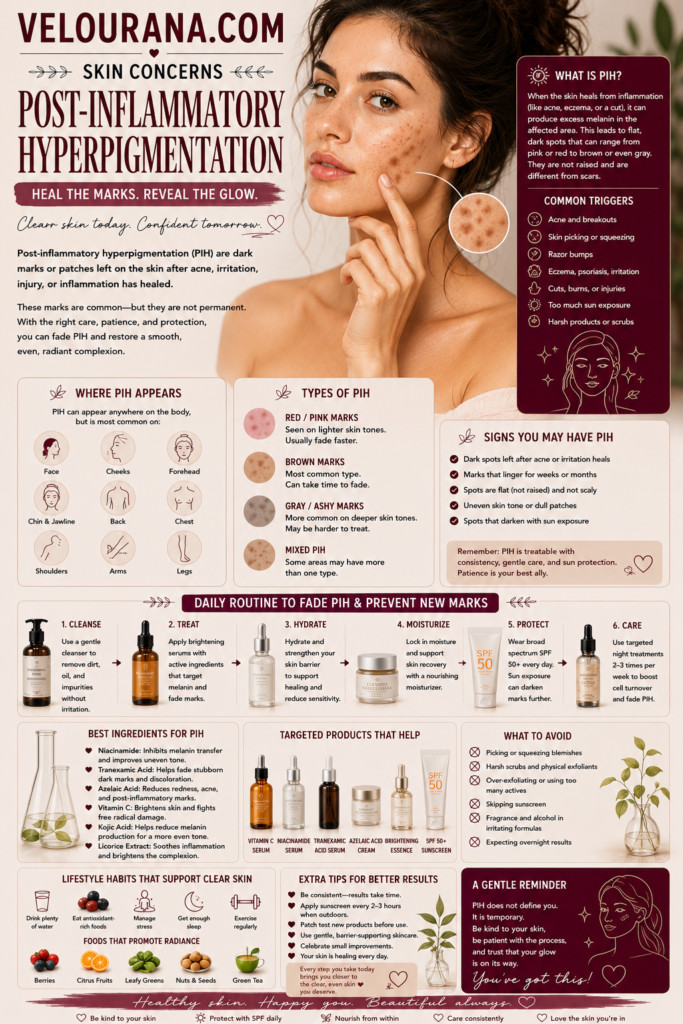
CATEGORY: Post-Inflammatory Hyperpigmentation
Two blemishes can heal on the same face, during the same month, under almost identical conditions, and leave behind marks that behave completely differently.
One may soften noticeably within a few weeks. The other may remain visible for months.
One may fade from deep brown to light tan relatively quickly. Another may seem almost unchanged despite consistent skincare.
One may disappear without ever attracting much attention. Another becomes the single mark a person notices every time they look in the mirror.
This uneven behaviour is one of the reasons post-inflammatory hyperpigmentation, or PIH, can feel unpredictable. It creates the impression that some marks are somehow “stronger” than others or that a product is selectively working in one area and failing in another.
But PIH is not a single uniform condition.
Every mark has a history.
Its persistence depends on how much inflammation occurred, how deep the pigment was deposited, how strongly the skin responded, whether the area continued to receive irritation, how much ultraviolet exposure it encountered, and whether new inflammation kept reinforcing the process.
This means fading time is not simply a property of the product being used.
It is the combined result of pigment depth, inflammatory intensity, skin tone, location, behaviour, environmental exposure and time.
Understanding this makes PIH easier to interpret.
Instead of assuming that a stubborn mark proves a routine is ineffective, it becomes possible to ask a more useful question:
What makes this particular mark different?
Not All Pigment Lives at the Same Depth
The single most important reason some marks fade faster than others is depth.
Post-inflammatory hyperpigmentation can involve pigment primarily within the epidermis, the outer layer of skin, or extend deeper into the dermis.
Superficial epidermal pigmentation often appears brown.
Deeper pigment can appear darker, greyer or blue-grey because of the way light interacts with pigment located below the surface.
This difference matters because epidermal cells are continuously renewing.
As keratinocytes move upward and eventually shed from the skin surface, pigment contained within them can gradually be carried away. Treatments that influence epidermal turnover or melanogenesis can support this process.
Deeper pigment is more complicated.
When inflammation disrupts the region between the epidermis and dermis, melanin can descend into the dermis and become taken up by macrophages. This pigment is no longer participating in ordinary surface turnover in the same way.
That is why some apparently small marks are unexpectedly persistent.
The visible size of the mark does not tell you how deeply the inflammatory event affected the skin.
A tiny but intensely inflamed lesion can leave deeper pigmentation than a larger but more superficial one.
This also explains why aggressively exfoliating a stubborn mark often accomplishes very little.
If the pigment is deeper, removing more surface cells cannot simply pull it out.
At that point, patience becomes not a cosmetic recommendation but a biological necessity.
The Severity of the Original Inflammation Matters
PIH is created by inflammation, so it follows that more intense inflammation can create a more significant pigmentary response.
A small superficial whitehead and a deep inflammatory nodule are not equivalent events.
The deeper lesion usually involves more swelling, more tissue disruption and a larger inflammatory response.
When that inflammation resolves, the pigmentary aftermath may therefore be more substantial.
This pattern is easy to recognise in acne-prone skin.
Small blemishes may leave faint traces or none at all.
Large cystic lesions can produce dark marks that seem dramatically disproportionate.
The same logic applies outside acne.
A mild insect bite that is left alone may heal with little discoloration.
The same bite scratched repeatedly over several days may become inflamed enough to leave a persistent mark.
A brief episode of irritation from a product may settle quickly.
A severe dermatitis reaction may produce pigmentation across a much larger area.
This is why preventing inflammation from escalating matters so much.
Once the pigment has formed, treatment can support fading.
But the best opportunity to influence the eventual intensity of the mark often exists earlier, while the inflammatory event is still active.
Repeated Trauma Can Make a Mark Deeper and Larger
A blemish has its own inflammatory biology.
Picking adds another layer.
When a lesion is squeezed repeatedly, pressure is applied not only to the follicle but also to surrounding tissue. The skin can become bruised, broken and more inflamed.
Fingernails may damage the surface.
Scabs form.
The same area is picked again.
The healing process is interrupted.
Each episode expands the inflammatory burden.
By the time the skin finally closes and settles, the resulting dark mark may be much larger than the original blemish.
This is why some pigmentation seems almost inexplicably stubborn.
The person remembers a small pimple but forgets three days of repeated manipulation.
The skin remembers the entire event.
The same principle applies to scratching, rubbing, peeling flakes, shaving over irritated areas and attempting aggressive extractions.
PIH is often not simply the aftermath of the original problem.
It is the aftermath of everything that happened to the area while the problem existed.
Skin Tone Influences How Strongly PIH Can Appear
Post-inflammatory hyperpigmentation can affect any skin tone.
But it is often more noticeable and persistent in more deeply pigmented skin.
The reason is not that darker skin heals poorly.
The difference lies in melanocyte activity and the amount and distribution of melanin.
When inflammation stimulates pigment production, skin with more active melanogenesis can produce a more obvious visible response.
This is one reason PIH can become a major cosmetic concern even when the underlying acne, eczema or irritation is relatively modest.
Someone may have only occasional breakouts yet accumulate dozens of dark marks.
Another person may experience similar inflammation with far less visible pigment afterward.
This individual variation can make product comparisons misleading.
A friend may report that a dark mark disappeared quickly with a particular serum.
Another person uses the same product and sees much slower change.
The difference may not be the product.
The skin's pigmentary response may simply be different.
Location Can Change the Timeline
Not every part of the body behaves the same way.
Facial PIH, body PIH and pigmentation in areas exposed to repeated friction can follow different timelines.
The face tends to receive more skincare attention and often has faster apparent turnover than certain body areas.
By contrast, marks on the legs, back, chest or areas exposed to repeated rubbing may persist longer.
Body pigmentation can also be continually reinforced by friction from clothing, shaving, sweating or scratching.
A mark on the shoulder beneath a bag strap may never receive a truly uninterrupted period of recovery.
A dark patch around the bikini line may be repeatedly exposed to shaving and ingrown hairs.
Marks on the legs may be reopened by scratching insect bites.
When location is ignored, people may assume that the product is failing.
In reality, the environment around the mark may be fundamentally different.
Sun Exposure Can Quietly Extend the Life of a Mark
A post-inflammatory mark may begin with acne, eczema or injury, but sunlight can influence what happens afterward.
Ultraviolet exposure stimulates melanogenesis.
This can deepen existing pigmentation or make fading more difficult.
The effect is particularly important when the mark is exposed repeatedly.
A person may be using a well-designed brightening routine at night while spending hours outdoors without consistent photoprotection during the day.
The routine is then working against an opposing signal.
This is why sunscreen becomes especially important once PIH has formed.
Photoprotection does not erase pigment overnight.
Its role is more subtle and more important.
It prevents an existing problem from receiving additional pigment stimulation.
In that sense, sunscreen protects the work being done by the rest of the routine.
Why Older Marks Can Behave Differently From Newer Ones
New PIH and old PIH do not always respond identically.
A newly formed mark may still be changing quickly.
Its colour may darken before stabilising.
Inflammation may not be completely resolved.
The area may remain slightly tender or reactive.
An older mark may represent pigment that has already settled into a more stable pattern.
This difference can influence both appearance and response.
People often become alarmed when a fresh mark appears extremely dark immediately after a blemish heals.
Sometimes that early intensity softens substantially over the following weeks without aggressive treatment.
By contrast, a mark that has remained unchanged for a year may require a more deliberate strategy or professional evaluation.
Time does not guarantee complete disappearance.
But the behaviour of a mark over time offers useful information.
Why Product Strength Is Not the Only Variable
When a mark fades slowly, the instinct is often to increase treatment intensity.
A higher acid percentage.
A stronger retinoid.
A second brightening serum.
A peel.
Another exfoliating step.
This assumes the limiting factor is insufficient product strength.
Sometimes it is not.
The mark may be deep.
The underlying inflammation may still be active.
The area may be receiving repeated ultraviolet exposure.
The skin may be irritated.
The product may be used inconsistently.
The diagnosis may even be wrong.
Increasing treatment strength cannot solve all of these problems.
In fact, stronger treatment may worsen some of them.
This is why PIH responds better to a complete strategy than to product escalation alone.
The Routine Can Be Working Even When One Mark Refuses to Move
One of the most frustrating experiences in pigmentation care is seeing most marks improve while one remains stubborn.
That one mark can distort the entire perception of progress.
The person begins judging the routine according to the slowest area rather than the overall pattern.
This is understandable.
The eye is naturally drawn to contrast.
A single dark mark on otherwise improving skin can become more noticeable precisely because everything around it is becoming clearer.
This is not treatment failure.
It may simply represent a deeper or more intensely inflamed lesion.
Progress should therefore be evaluated across the whole complexion.
Are fewer new marks appearing?
Are most old marks becoming lighter?
Has the overall tone become more even?
Is makeup covering more easily?
Has the contrast between marks and surrounding skin decreased?
One stubborn area should not automatically invalidate all other evidence.
Why Consistency Changes More Than People Realise
Pigmentation treatment often fails through inconsistency rather than ingredient choice.
A product is used for two weeks.
Then stopped because progress seems slow.
Another is introduced.
Then a third.
The skin becomes irritated.
Everything is discontinued.
After recovery, the cycle begins again.
This makes it almost impossible to determine what actually works.
PIH responds slowly.
That means treatment needs enough uninterrupted time to influence pigment production, epidermal turnover and inflammation.
Consistency also applies to sunscreen.
Using sunscreen only on bright summer days creates a very different environment from using it reliably.
The same is true of acne treatment.
If breakouts continue because treatment is irregular, new pigmentation continues to accumulate.
Fading cannot catch up when the source remains active.
The Importance of Stopping New Marks
Suppose someone has thirty visible areas of PIH.
They successfully fade three old marks this month.
But five new inflammatory blemishes each leave new pigmentation.
The complexion may look worse even though the treatment technically worked.
This arithmetic explains why preventing new marks is often more important than accelerating old ones.
Control acne.
Reduce scratching.
Avoid unnecessary extractions.
Manage dermatitis.
Improve shaving technique.
Reduce friction.
Avoid irritating products.
Protect against ultraviolet exposure.
Each prevented inflammatory event removes a potential future mark from the equation.
Over time, this allows fading to finally overtake accumulation.
Why Gentle Treatment Often Wins Over Aggressive Correction
There is a common assumption that stubborn pigmentation requires aggression.
But PIH is one of the conditions where aggression can easily become self-defeating.
Strong acids, frequent peels, abrasive scrubs and poorly tolerated retinoids can generate irritation.
Irritation creates inflammation.
Inflammation can create pigment.
This is particularly relevant in skin already prone to PIH.
The smarter approach is to maximise useful treatment while minimising unnecessary inflammation.
That may still include potent ingredients.
The difference is how they are used.
A retinoid introduced gradually can be powerful.
Azelaic acid can be useful.
Chemical exfoliation may contribute.
Professional procedures may have a place.
But intensity should be controlled.
The goal is not to prove that the skin can survive a strong routine.
The goal is to make the skin more even.
The Myth of the Overnight Brightening Product
PIH is ideal territory for unrealistic marketing.
A dark mark is easy to photograph.
Lighting can dramatically alter its appearance.
Makeup can mimic improvement.
Hydration can temporarily increase radiance.
This makes “instant transformation” claims especially persuasive.
But genuine pigment change is usually slower.
Established melanin does not simply dissolve after one application.
Products can influence melanogenesis and turnover.
They can support gradual fading.
They can improve the overall appearance of the skin.
But meaningful reduction in established PIH generally requires time.
This is particularly true for deeper pigmentation.
The more realistic the expectation, the less likely someone is to abandon a good routine prematurely.
When a Mark Is Actually Something Else
Not every mark left after acne is hyperpigmentation.
Some are post-inflammatory erythema.
These appear pink, red or purplish rather than brown and are driven more by vascular changes than excess melanin.
Some marks combine redness and pigmentation.
Others involve textural scarring.
Melasma can overlap with PIH.
Sun-induced pigmentation can coexist with acne marks.
This matters because different problems respond differently.
A product aimed at melanin may have limited impact on a primarily vascular red mark.
A pigment serum will not remodel an atrophic scar.
This is another reason stubborn marks deserve reassessment rather than automatic escalation.
Sometimes the treatment is not weak.
It is simply targeting the wrong process.
Why Professional Procedures Need Careful Selection
Chemical peels, lasers and other procedures can be useful for selected cases of persistent PIH.
But they are not automatically superior to topical treatment.
These procedures work by creating controlled biological effects.
If the response is excessive, inflammation increases.
And inflammation is the mechanism that created PIH in the first place.
This risk is particularly important in highly pigmented skin.
A practitioner experienced with the relevant skin type and condition can help determine whether a procedure is appropriate.
The strongest device is not necessarily the best option.
The best option is the one that creates improvement without triggering additional pigment.
What a Realistic Timeline Looks Like
There is no universal PIH timeline.
Some marks improve noticeably within weeks.
Many take months.
Deeper pigmentation may remain much longer.
This variability makes exact promises unreliable.
A better way to think about time is in phases.
First, the inflammatory trigger must settle.
Then new pigmentation must stop accumulating.
Then old pigmentation can gradually fade.
Some superficial marks soften relatively quickly.
Others require sustained treatment.
Deep pigment may persist despite excellent skincare.
This is why patience should not be confused with passivity.
The routine can be actively working while the visible change remains slow.
How to Measure Progress Without Becoming Obsessed
Daily mirror inspection is one of the worst tools for evaluating PIH.
The changes are too small.
Lighting varies.
Hydration changes.
Hormones influence skin appearance.
A mark can look darker in one room and lighter in another.
A more reliable approach is periodic comparison.
Photographs taken under similar lighting every few weeks can reveal gradual improvement.
The goal is not to create a forensic record of every pore.
It is to create enough distance to see direction.
Look for reduced contrast.
Look for softened edges.
Look for fewer new marks.
Look for a more even overall complexion.
These are meaningful signs even before complete disappearance.
The Most Important Question Is Not “How Fast?”
People understandably want to know when a mark will disappear.
But the more useful question is whether the conditions favour fading.
Is the inflammatory trigger controlled?
Is the skin barrier stable?
Is sunscreen being used consistently?
Is the treatment appropriate and tolerated?
Are new marks appearing less frequently?
Is there evidence that old marks are gradually becoming lighter?
If the answer to those questions is yes, the process is probably moving in the right direction.
The exact finish date may remain uncertain.
Skin does not operate according to a calendar.
But direction matters more than precision.
Some Marks Need More Patience, Not More Products
The modern skincare market encourages constant intervention.
There is always another serum.
Another peel.
Another treatment.
Another percentage.
Another procedure.
But PIH does not always require escalation.
Sometimes the skin is already receiving everything it needs.
The mark simply needs time.
This is particularly true when most areas are improving and only a few stubborn marks remain.
Changing the entire routine because of the slowest mark can destabilise progress everywhere else.
A better strategy may be to preserve what is working and allow the outlier more time.
This kind of restraint is difficult.
But it is often biologically sensible.
Why the Slowest Mark Can Teach the Most
A stubborn mark contains information.
It may reveal where inflammation was deepest.
It may reveal an area exposed to repeated friction.
It may reveal inconsistent sunscreen application.
It may reveal picking behaviour.
It may reveal a location where acne is still active.
It may reveal that the pigment is deeper.
Instead of seeing that mark only as failure, it can be used to refine the strategy.
That is the advantage of understanding PIH as a process rather than a cosmetic defect.
Every mark has a cause.
Every cause offers a clue.
Fading Is Not a Competition
Post-inflammatory hyperpigmentation does not disappear in the order it appeared.
The newest mark may fade before an older one.
A dark lesion may improve faster than a lighter one.
A tiny spot may persist longer than a larger patch.
This apparent randomness can be frustrating.
But once depth, inflammation, skin tone, location, ultraviolet exposure, irritation and time are considered, the pattern becomes more understandable.
The marks are not competing.
They are resolving according to different biological histories.
The Goal Is an Improving Pattern, Not Perfect Synchrony
An even complexion is not created because every mark disappears at exactly the same speed.
It emerges gradually.
New inflammatory events become less frequent.
New pigmentation becomes less common.
Some older marks soften.
Others take longer.
The contrast across the skin slowly decreases.
Eventually, the overall pattern changes.
That is the real measure of progress.
Not whether one stubborn mark is still visible.
Not whether a serum worked in seven days.
Not whether the skin looks perfect in one photograph.
The question is whether the complexion is accumulating less pigment than before and losing more pigment than it gains.
Once that balance shifts, improvement becomes possible.
The Skin Is Following Biology, Not a Deadline
PIH is frustrating because the cause often disappears before the consequence.
The pimple ends.
The rash settles.
The scratch heals.
The procedure is finished.
But the pigment remains.
That delay creates the illusion that something has gone wrong.
Often, nothing has.
The skin is simply moving through a slower phase of recovery.
Some marks are superficial.
Some are deep.
Some followed mild inflammation.
Others followed trauma.
Some are repeatedly stimulated by ultraviolet exposure or friction.
Some exist in skin that responds to inflammation with strong melanogenesis.
Each mark therefore carries a different timeline.
The most effective response is not to force all of them into the same schedule.
It is to reduce inflammation, protect the skin, use evidence-based treatment consistently, prevent new marks and allow biology enough time to complete what it started.
Some dark marks fade quickly.
Others take considerably longer.
The difference is not always under our control.
But the environment in which they fade can be.
And that is where good pigmentation care makes its greatest contribution.
The End Velourana.
 Discover More From Our Family of Websites
 ZodiacBearing (Astrology, Tarot, Numerology, Angel Numbers & Spiritual Guidance)
 Velourana (Beauty, Makeup, Hair Care, Skincare & Beauty Tips)
 HavenBearing (Home, Living, Organization, Décor & Everyday Inspiration)
 PawBearing (Pet Care, Dog Breeds, Animal Health, Training & Pet Products)
 PsyCatherine (Notes From the Journal of a Psychologist on Real Life)

