
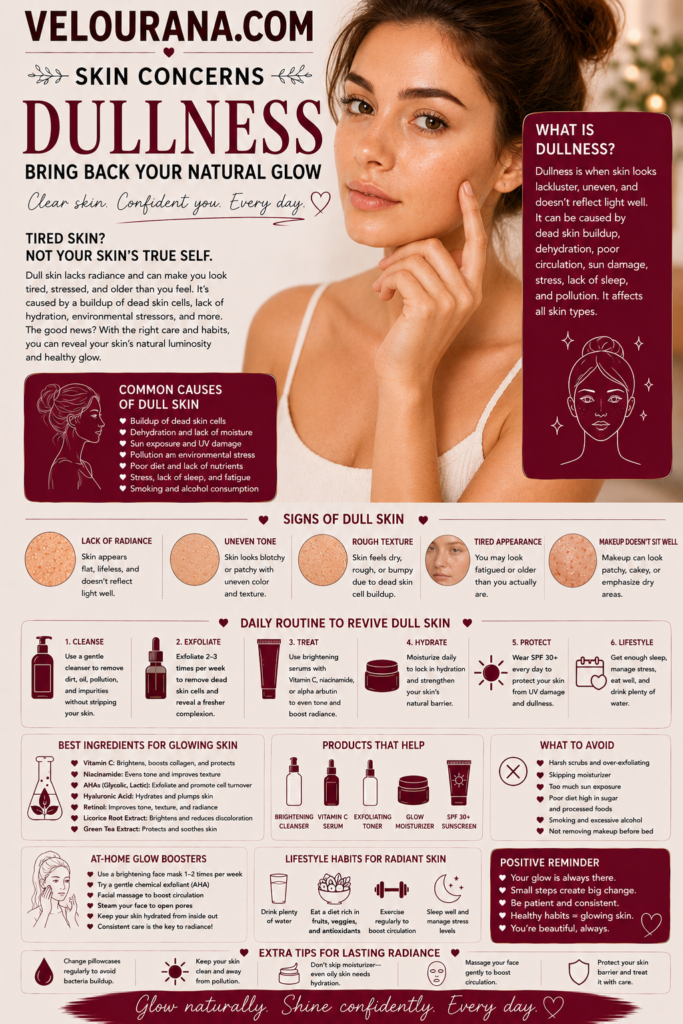
CATEGORY: Dullness
Some changes in ageing skin are easy to identify. A line deepens beside the mouth. A brown spot becomes more visible on the cheek. The jawline changes. The skin around the eyes becomes thinner. Dullness is more elusive because it rarely presents itself as one clearly defined alteration. Instead, the entire complexion seems to lose dimension.
The skin may look flatter.
Not literally flat in a structural sense, but visually less animated. Light does not seem to move across the face as smoothly. Certain areas appear dry while others remain shiny. Makeup loses freshness quickly. The complexion seems less transparent, less reflective and somehow heavier, even when there is no obvious skin disease.
This gradual flattening is one of the most interesting aspects of skin ageing because it reveals something important about radiance: glow is not produced by a single biological mechanism.
It is the visual result of several systems working together.
Surface smoothness determines how evenly light is reflected. Hydration changes the flexibility and optical behaviour of the outermost layers. Pigmentation influences visual uniformity. Sebum affects sheen. Fine lines and enlarged textural irregularities create micro-shadows. Deeper changes in facial structure alter the larger patterns of light and shade that shape the face.
When these variables change together, skin can appear dull even if each individual change is relatively small.
The conventional response is often to add a brightening product. Yet the most effective way to understand ageing dullness is to move in the opposite direction: instead of asking what ingredient creates glow, ask what physical and biological changes have interrupted it.
That question produces a more precise—and ultimately more useful—approach to mature skin.
Radiance Begins With Surface Geometry
Light interacts with skin before we consciously think about skincare.
When the surface is relatively smooth, light can be reflected in a more organised way. When it becomes irregular, rough or flaky, reflection becomes more scattered. This changes how luminous the complexion appears even if the underlying skin tone has not changed.
The principle is simple enough to observe elsewhere.
A polished stone and an unpolished stone can be exactly the same colour yet look dramatically different under the same light. The polished surface reflects light more evenly. The rough surface breaks it apart.
Skin is far more complex than stone, of course, but the optical principle helps explain why texture matters so much.
A mature complexion may develop microscopic roughness long before it feels noticeably coarse. Slower renewal, changes in hydration and cumulative environmental damage can alter the way surface cells are arranged. Fine lines add further irregularity. Areas around the nose, mouth and eyes may behave differently from the cheeks and forehead.
The result is not simply “rough skin.”
It is a surface that interacts with light less uniformly.
This is why a person may notice dullness most clearly under natural daylight. Soft artificial lighting can disguise subtle textural variation. Directional daylight reveals it.
The discovery often triggers an urge to exfoliate aggressively.
That reaction is understandable, but it can mistake optical roughness for a layer that simply needs to be removed.
Some irregularity may indeed respond to exfoliation. But some is related to dehydration. Some reflects deeper changes. Some comes from pigmentation. Some is simply normal mature texture.
Trying to erase all of it through repeated resurfacing can damage the very surface one is trying to improve.
The aim is not to make skin perfectly smooth.
It is to improve the conditions that allow its natural surface to behave more evenly.
Hydration Changes More Than Comfort
Hydration is sometimes treated as the least sophisticated part of anti-ageing skincare.
It lacks the drama of retinoids. It does not sound as technologically advanced as growth factors or peptides. It does not carry the instant transformative promise of exfoliating acids.
Yet hydration affects the appearance of dullness directly and immediately.
The outermost layer of skin contains cells surrounded by lipids that help regulate water loss. When water content falls, the surface becomes less flexible. Tiny lines may become more noticeable. Flaking can appear. Texture becomes easier to see. Makeup begins to catch around dry areas.
These changes alter reflected light.
This is why moisturiser can sometimes produce a visibly brighter complexion within minutes even though it has obviously not reversed years of photoaging.
The surface has simply become more hydrated and smoother.
This also explains why mature skin can look dramatically different at different times of the day.
A complexion may appear fresh immediately after moisturising, then become flatter by afternoon if water is gradually lost from the surface. Heated indoor environments, air conditioning, cold weather, low humidity and repeated cleansing can all influence this process.
Age adds another layer because the skin's natural lipid composition and ability to retain water change over time.
The common response is to search for a heavier cream.
Sometimes that works. Sometimes it does not.
A product can feel rich because it contains oils or occlusive ingredients, yet still fail to provide the balance of water-binding, softening and barrier-supporting components a particular complexion needs.
Texture alone does not determine moisturising effectiveness.
A light lotion can be beautifully formulated. A dense balm can be inadequate for someone who needs more humectant support. The correct product is the one that leaves the skin comfortable for a sustained period without creating congestion or irritation.
Mature radiance often begins with this surprisingly basic question:
Does the skin remain hydrated throughout the day?
Dryness and Dehydration Are Not the Same Thing
The distinction between dryness and dehydration becomes particularly useful with ageing skin.
Dry skin generally refers to insufficient oil or lipid content. Dehydrated skin refers to insufficient water.
A complexion can be both.
It can also be oily and dehydrated.
That combination is often confusing because visible shine is interpreted as proof that moisturiser is unnecessary. Yet sebum on the surface does not guarantee adequate water content within the outer epidermis.
This is especially relevant for people whose skin was oily when younger.
A long-established routine may continue to include foaming cleansers, alcohol-heavy toners and lightweight moisturisers long after the skin has become more vulnerable to water loss. The forehead may still produce oil, reinforcing the old identity of “oily skin,” while the cheeks become increasingly dehydrated.
The result can be a complexion that is simultaneously shiny and dull.
This sounds contradictory until one remembers that shine and radiance are different.
Shine comes largely from surface oil reflecting light.
Radiance depends on broader smoothness, hydration, evenness and texture.
An oily forehead can shine while the face as a whole still looks tired.
Recognising this prevents one of the most persistent mistakes in mature skincare: trying to eliminate every trace of oil from skin that already needs greater barrier support.
Sebum is not automatically the enemy.
Excessive oil may be inconvenient, but stripping the skin in response can worsen dehydration and textural irregularity. The more balanced goal is to control excess where necessary while maintaining the water and lipid environment required for a resilient surface.
The Barrier Determines Whether Brightening Efforts Succeed
The skin barrier is often discussed as though it were a separate skincare concern.
In reality, it influences almost everything.
A compromised barrier loses water more easily. Irritants penetrate more readily. The skin may sting, feel tight or become reactive. Surface texture becomes rougher. Redness may become more visible.
All of these changes can contribute to dullness.
This is why a sophisticated brightening routine built on a damaged barrier often performs badly.
Consider a common sequence.
Someone notices dullness and begins using an exfoliating toner every evening. The skin initially feels smoother. Encouraged, they add a retinol product. A vitamin C serum follows. Then comes a weekly peel.
Within several weeks the complexion is flaky around the mouth, tight after cleansing and mildly red. Makeup begins to settle strangely.
The person concludes that the skin needs more exfoliation because it looks rough.
In reality, the routine itself may now be creating part of the roughness.
The barrier rarely announces its condition dramatically. It often deteriorates gradually.
A little stinging becomes normal. Tightness is dismissed. Mild redness becomes accepted as evidence that active ingredients are working.
But radiance is difficult to achieve on an irritated surface.
Barrier support therefore belongs inside any serious discussion of dullness.
Gentle cleansing, adequate moisturising and restraint with active ingredients are not merely supportive measures taken between “real treatments.”
They are part of the treatment.
Why Over-Cleansing Can Make Mature Skin Look Grey and Flat
Cleansing is repeated so frequently that even small problems can become significant over time.
An overly aggressive cleanser may not create obvious irritation after one use. Used twice daily for months, however, it can continuously remove surface lipids and contribute to dehydration.
The visible result may not be redness.
It may simply be loss of softness and luminosity.
Some people associate effective cleansing with a tight sensation afterward. The face feels squeaky, almost polished. This can be psychologically satisfying because it creates a clear before-and-after experience.
Yet skin is not a kitchen surface.
Removing every trace of oil is not the objective.
A mature complexion often benefits from cleansing that removes sunscreen, makeup, excess sebum and environmental debris while preserving enough of the skin's natural lipid environment to avoid unnecessary stripping.
This may mean using a cream, milk, balm, oil or gentle low-foaming cleanser depending on the individual.
It may also mean cleansing once rather than twice in some circumstances.
Someone with very dry skin may find that a water rinse in the morning is sufficient while reserving cleanser for evening removal of sunscreen and makeup. Another person with oilier skin may prefer a gentle morning cleanse.
There is no universal ritual.
The important clue is what happens afterward.
If the face consistently feels tight within minutes of cleansing, the routine deserves reconsideration.
If moisturiser must immediately rescue the skin from discomfort every single time, cleansing may be creating a problem that the moisturiser is then asked to repair.
A well-designed routine avoids this unnecessary cycle.
Exfoliation Changes Texture, but Frequency Changes Everything
Appropriate exfoliation can be one of the most satisfying ways to address dullness.
Surface texture becomes smoother. Makeup applies more evenly. The complexion may appear brighter because light is reflected from a more uniform surface.
But exfoliation is one of those skincare practices in which more is not linearly better.
The skin does not reward enthusiasm indefinitely.
Chemical exfoliants work by loosening or altering the bonds between surface cells, depending on the ingredient and formulation. Alpha hydroxy acids such as glycolic and lactic acid are commonly used to improve superficial roughness. Other acids have different properties and may suit different skin types or concerns.
The important variable is not only concentration.
Frequency matters.
Contact time matters.
The rest of the routine matters.
Skin tolerance matters.
A person using a mild acid cleanser every morning, an exfoliating toner in the evening and a resurfacing mask twice weekly may be receiving far more total exfoliation than they realise.
Add a retinoid and the balance may shift further.
This cumulative exposure is often missed because products are marketed individually.
The skin experiences them collectively.
For ageing dullness, the most useful exfoliation is often the least dramatic amount that produces a meaningful improvement.
The surface should become smoother without entering a permanent state of recovery.
If peeling, burning or persistent redness appears, the treatment has moved beyond refinement and toward disruption.
This is particularly important because irritation itself scatters the visual qualities associated with radiance. An inflamed, flaky surface will not look luminous merely because newer cells have been exposed underneath.
Retinoids Work on a Different Timeline
Retinoids are frequently grouped together with exfoliants because both can cause visible peeling, but their role is broader.
Vitamin A derivatives influence cellular behaviour and are widely used to address photoaging, fine lines, uneven pigmentation and texture.
For a mature dull complexion, these effects can be valuable because several contributors to dullness often coexist.
The mistake is expecting immediate brightness.
Retinoid therapy is a long-term strategy.
The initial period may actually make the skin look less polished. Dryness and mild flaking can occur as the skin adapts. If the product is introduced too aggressively, irritation can become significant.
This creates a dangerous temptation.
Someone may believe the product is “bringing everything to the surface” and continue despite escalating discomfort.
But persistent irritation is not necessary for success.
A lower frequency, lower strength or more supportive moisturising strategy may produce better long-term adherence.
And adherence matters more than intensity.
A product used comfortably for a year has a far greater opportunity to influence the skin than one used aggressively for two weeks and then abandoned.
Mature skin especially benefits from this slower logic.
The goal is not maximum stimulation.
It is sustainable renewal.
Pigmentation Interrupts the Visual Continuity of the Face
Even perfectly smooth skin can appear dull if its colour is uneven.
This is where pigmentation becomes part of the luminosity conversation.
Over time, sun exposure can create solar lentigines, freckles and broader areas of uneven tone. Inflammation can leave post-inflammatory marks. Hormonal changes may influence melasma or other pigmentary patterns.
These variations break the visual continuity of the complexion.
Our eyes interpret even surfaces differently from mottled ones.
This does not mean healthy skin should be uniform like painted porcelain.
Natural pigmentation, freckles and variation are normal.
The relevant distinction is between natural variation and unwanted irregularity that has developed through damage or inflammation.
Addressing that irregularity can make the complexion appear clearer even without changing its overall colour.
This is why brightening should not be confused with lightening.
The aim is not to make darker skin lighter.
It is to reduce unevenness where desired and support the natural tone.
Ingredients such as vitamin C, niacinamide, retinoids and azelaic acid may be used in different contexts, while more significant pigmentation may warrant dermatological assessment.
But pigment treatments are fundamentally limited by one environmental reality.
If ultraviolet exposure continues stimulating pigmentation, correction becomes much more difficult.
Sunlight Can Quietly Undo the Entire Routine
Sun damage is cumulative.
This makes it unusually easy to underestimate.
A single ordinary day outdoors may not appear consequential. Yet the skin experiences ultraviolet exposure repeatedly across years and decades.
That accumulated exposure contributes to several visible features associated with ageing: uneven pigmentation, roughness, fine lines and changes in elasticity.
In other words, ultraviolet radiation does not create only one cosmetic problem.
It can alter several of the components that determine luminosity.
This is why sun protection belongs at the centre of any mature brightening routine.
A person can use sophisticated pigment serums, retinoids and exfoliating treatments, but if the skin continues receiving substantial unprotected UV exposure, the routine is working against an avoidable source of ongoing damage.
Daily broad-spectrum sunscreen therefore performs a dual role.
It reduces future photodamage and protects the improvements being pursued through treatment.
This is especially important when using certain active ingredients that increase the need for thoughtful sun protection.
The most effective routine is not simply corrective.
It is protective.
That may sound less glamorous because prevention rarely creates dramatic overnight photographs.
But ageing skincare is fundamentally a long game.
What does not happen matters.
Surface Oil Is Not the Same as Luminosity
One of the most common misunderstandings in beauty is the belief that radiance means shine.
It does not.
A complexion can be extremely oily and still look dull.
This often happens when the surface reflects light unevenly. Oil creates glossy highlights in certain areas, especially the forehead, nose and chin, while dehydration, roughness or pigmentation elsewhere prevents the face from looking consistently luminous.
The result can be both shiny and flat.
This distinction matters when choosing products.
Trying to eliminate all surface oil with mattifying cleansers and powders may reduce shine, but it does not necessarily improve radiance. In fact, excessive mattification can make mature texture more obvious.
Conversely, applying facial oil to dull skin can increase shine instantly without correcting the underlying issue.
Oils can be useful emollients, but they are not universal brighteners.
The visual goal is balance.
Some natural sheen helps the face look dimensional.
Too much can appear greasy.
Too little can make the skin look lifeless.
The ideal finish depends on preference, skin type and makeup style, but true luminosity usually sits somewhere between high-gloss shine and complete matte flatness.
Makeup Often Reveals Whether the Surface Is Healthy
Few things expose dehydration and texture as efficiently as foundation.
Bare skin can disguise small irregularities surprisingly well. Once pigment is spread across the surface, however, the product settles into every dry area, fine line and flake.
This is why mature skin may suddenly seem duller after makeup rather than brighter.
The problem may not be the foundation alone.
It may be the interaction between formula and surface condition.
A matte long-wear foundation that looked beautiful ten years earlier may now exaggerate dryness. Heavy powder can magnify texture. Thick layers of concealer around the eyes may create more shadow by collecting in lines.
The solution is not necessarily abandoning coverage.
It may be changing preparation, formula and application.
Hydrated skin generally creates a more forgiving canvas. Thin layers allow natural dimensionality to remain visible. Strategic concealer can reduce contrast without covering the entire face heavily. Powder can be limited to areas where it is genuinely needed.
This is particularly important because attempting to create radiance through highlighter alone can backfire.
Shimmer catches light wherever it is placed.
If the surface underneath is rough, the shimmer may emphasize that roughness.
Realistic mature makeup therefore works with texture rather than pretending texture does not exist.
The goal is not to create an artificial glass surface.
It is to restore dimension.
Facial Structure Also Changes the Way Light Falls
Not all dullness originates in the epidermis.
As the face ages, changes occur in fat distribution, bone structure, connective tissue and skin elasticity.
These deeper shifts alter the architecture of light and shadow across the face.
The cheeks may reflect less light because their contour has changed. The under-eye area may appear darker because hollows create shadow. Nasolabial folds can become more pronounced. The temples may appear less full.
These are not pigmentation problems.
They are structural.
This distinction is important because skincare cannot completely correct them.
A brightening serum cannot remove a shadow created by anatomical volume change.
A moisturiser cannot restore bone structure.
This is one of the places where unrealistic skincare marketing causes frustration. Consumers are encouraged to treat every visible sign of ageing as though it originated in the outer skin.
It does not.
Some concerns are epidermal.
Some are dermal.
Some are structural.
Knowing which category a concern belongs to prevents wasted effort.
For structural shadowing, makeup may provide immediate optical improvement. Professional aesthetic procedures may be considered by people who want a greater change, but they belong to a different decision entirely and require appropriate medical consultation.
Skincare still matters because improving the surface can make the entire face appear healthier.
But it should not be asked to perform jobs it cannot biologically perform.
The Neck and Chest Often Reveal Dullness Differently
The face receives most skincare attention, yet the neck and upper chest often show age-related dullness prominently.
These areas are frequently exposed to sunlight but historically receive less consistent sunscreen and moisturiser.
The skin may therefore develop uneven pigmentation, roughness and visible photodamage that contrasts with a more carefully treated face.
This difference becomes particularly noticeable when facial skincare improves.
The face becomes smoother and more even while the neck remains dry or mottled.
A coherent ageing skincare strategy therefore extends beyond the jawline where appropriate.
Gentle cleansing, moisturising and sun protection can be used on the neck and upper chest, while active ingredients may need to be introduced more cautiously because these areas can be more sensitive.
Aggressive treatments used comfortably on the face may irritate the neck.
This illustrates a broader rule:
The same person can have different levels of tolerance across different areas of skin.
Uniform routines are convenient, but skin is not uniform.
Climate Can Make Dullness Seem to Change Overnight
Skin does not exist in a stable environment.
Humidity, temperature, wind, heating and air conditioning can dramatically affect how the surface feels and looks.
A complexion that appears luminous in summer may become dull and papery during a dry winter.
A person travelling from a humid coastal climate to a cold dry city may notice changes within days.
This does not mean the skin has suddenly aged.
The environment has changed the balance of water at the surface.
Mature skin is often more vulnerable to these shifts because its baseline barrier function may already be less resilient than it once was.
Seasonal adjustment therefore makes sense.
A lightweight moisturiser may be sufficient during warm humid months and inadequate during winter. Cleansing frequency may need modification. Facial oils or more occlusive products may become useful temporarily.
The mistake is assuming one perfect routine should work unchanged all year.
Skin responds to context.
A mature routine should be stable in principle but flexible in execution.
Sleep Can Affect Appearance Without Being the Cause of Chronic Dullness
The relationship between sleep and appearance is real enough that almost everyone recognises it intuitively.
After a poor night, the eye area may look darker, the face puffier and the complexion less animated.
But chronic dullness should not automatically be blamed on sleep.
This matters because lifestyle explanations can become overly simplistic.
Someone with years of sun damage and dry mature skin may be told to drink water and sleep eight hours. These are healthy behaviours, but they do not directly reverse established pigmentation or texture changes.
Similarly, a person who sleeps well can still have dull skin.
Lifestyle affects the background.
It does not explain everything.
A more realistic approach separates temporary fatigue-related appearance from persistent skin changes.
If the complexion looks noticeably worse only after disrupted sleep, the answer may be simple recovery.
If it has gradually become rougher, drier and less even over several years, ageing and environmental exposure deserve more attention.
Nutrition Supports Skin, but There Is No Glow Food
The skincare world repeatedly turns foods into cosmetic promises.
Collagen drinks, antioxidant berries, green juices and vitamin-rich powders are marketed as though they can illuminate the complexion directly.
Nutrition certainly matters to health.
The skin depends on adequate protein, essential fatty acids, vitamins, minerals and energy just like every other tissue.
But there is no single food capable of switching radiance on.
A balanced diet supports normal physiology.
Deficiencies can affect skin.
Beyond that, dramatic cosmetic claims should be approached cautiously.
The same applies to water.
Adequate hydration is necessary for health, but drinking excessive quantities does not automatically flood the stratum corneum with moisture.
Topical hydration and barrier support remain important.
Internal hydration cannot replace moisturiser in someone with dry skin any more than moisturiser can correct systemic dehydration.
Different systems require different solutions.
Stress Often Changes Behaviour Before It Changes Skin
Stress is another factor frequently blamed for dullness.
Its effects can be both direct and indirect, but the behavioural pathway is often underestimated.
During stressful periods, routines become inconsistent.
People sleep less.
They may eat differently.
They may smoke more or drink more alcohol.
Skincare becomes hurried.
Sunscreen is skipped.
Makeup is left on overnight.
Picking and touching the face may increase.
These small behavioural changes accumulate.
The resulting complexion may appear duller not because stress has magically switched off skin radiance, but because stress has changed the conditions surrounding the skin.
This interpretation is more useful because it gives us something practical to address.
The goal is not to eliminate every stressful event from life.
It is to maintain a simple, resilient skincare baseline even when life becomes complicated.
A routine containing fifteen steps is unlikely to survive a difficult month.
A gentle cleanser, moisturiser and sunscreen usually can.
This is one reason simplicity is not a compromise.
It is a form of durability.
Professional Procedures Can Improve Texture, but They Are Not All the Same
When home skincare reaches its limits, professional treatment may offer additional options.
Chemical peels can address certain superficial concerns.
Laser and light-based procedures may target pigmentation, vascular changes or texture depending on the technology.
Resurfacing procedures can improve specific patterns of photodamage.
But the phrase “skin rejuvenation” is far too broad to guide treatment intelligently.
Different procedures work through different mechanisms.
Different skin tones carry different risks.
Different levels of downtime are involved.
A treatment appropriate for superficial pigmentation may do little for structural shadowing.
A procedure effective for texture may not be the best choice for redness.
Professional assessment matters precisely because dullness is not one diagnosis.
The more someone wants to move beyond general cosmetic improvement, the more specific the problem needs to become.
What exactly is creating the dull appearance?
Pigment?
Texture?
Dryness?
Redness?
Photodamage?
Volume loss?
Only then does it make sense to discuss treatment.
Sudden Dullness Deserves a Different Kind of Attention
Ageing-related dullness usually develops gradually.
A complexion that suddenly changes deserves a different response.
If the skin becomes unexpectedly pale, yellow, grey, extremely dry or otherwise visibly different—especially when accompanied by fatigue, weight change, illness or other systemic symptoms—the issue may extend beyond skincare.
Cosmetics should never be used to explain away unexplained physical changes.
Likewise, persistent scaling, bleeding lesions, rapidly changing pigmented spots or unusual areas of roughness should not automatically be treated with exfoliating acids.
Skincare has limits.
Knowing those limits is part of intelligent beauty care.
The face can occasionally provide clues about broader health, although appearance alone cannot diagnose disease.
When a change feels unusual or persistent, medical evaluation is more appropriate than experimenting indefinitely with products.
The Best Routine Is Usually More Boring Than the Marketing
A sophisticated routine for mature dullness does not need to feel sophisticated.
Its architecture is surprisingly simple.
Cleanse gently.
Maintain hydration.
Protect the skin from ultraviolet exposure.
Choose one or two evidence-based active ingredients according to the actual problem.
Allow time.
Adjust according to tolerance.
This does not produce a dramatic bathroom shelf.
It produces consistency.
A morning routine might involve gentle cleansing, an antioxidant treatment if desired, moisturiser and sunscreen.
An evening routine might include cleansing, a retinoid or other targeted active on appropriate nights, followed by moisturiser.
Exfoliation can be incorporated thoughtfully where needed rather than layered automatically.
Not every ingredient belongs in every routine.
The person with highly sensitive skin may benefit from less.
The person with significant pigmentation may need a different priority from the person whose main concern is dryness.
The person with extensive photodamage may eventually gain more from dermatological treatment than from buying another serum.
Personalisation begins with diagnosis, not product quantity.
Radiance Is Often the Result of Removing Problems Rather Than Adding Products
There is an interesting pattern in mature skincare.
People frequently experience their greatest improvement after they stop doing something.
They stop cleansing aggressively.
They stop using acids every night.
They stop trying a new product every week.
They stop powdering the entire face.
They stop skipping sunscreen.
They stop treating irritation as proof of effectiveness.
The complexion becomes calmer.
Hydration improves.
Texture softens.
Suddenly the skin looks brighter.
No miracle ingredient was added.
Interference was removed.
This may be the most overlooked principle in addressing dullness.
Skin often possesses much of the machinery required to look healthy. The routine's job is not to dominate that biology.
It is to support it.
Once unnecessary disruption is reduced, active ingredients can work within a more stable environment.
That is where improvement becomes sustainable.
Mature Skin Does Not Need the Glow of Youth to Have Its Own Luminosity
There is an uncomfortable assumption underneath much anti-ageing marketing: that the ideal mature complexion is one that looks as little like mature skin as possible.
This expectation distorts the conversation around dullness.
A fifty-year-old face will reflect light differently from a twenty-year-old face because its structure, texture and biology are different.
That is not failure.
The objective should not be to erase every line, every pore or every visible sign of time.
It should be to distinguish normal ageing from avoidable dullness.
Dryness can be improved.
Unnecessary irritation can be removed.
Uneven pigmentation can often be managed.
Roughness can be refined.
Photodamage can be reduced and prevented.
The barrier can be supported.
These changes can make mature skin look significantly more luminous without asking it to become young skin again.
That distinction creates healthier expectations and better routines.
The Return of Dimension
Dullness is often described as the absence of brightness.
A more accurate description may be the loss of dimension.
When mature skin becomes dry, rough and unevenly pigmented, the subtle contrasts that make a complexion look alive become flattened. Light no longer travels smoothly across the surface. Some areas appear excessively matte while others become shiny. Makeup exaggerates rather than softens these differences.
Restoring dimension requires more than adding glow on top.
It begins with surface quality.
Hydration improves flexibility and reflection.
Gentle exfoliation can refine irregular texture.
Retinoids may support longer-term renewal.
Targeted treatments can address unwanted pigmentation.
Sunscreen reduces the accumulation of additional ultraviolet damage.
A restrained routine preserves the barrier.
Makeup can then enhance rather than compensate for the skin.
None of these strategies transforms biology overnight.
That is precisely why they work best when approached without urgency.
Ageing dullness develops gradually.
Its improvement usually does too.
The mature complexion does not become radiant because it has been polished into submission.
It becomes radiant because the conditions responsible for dryness, roughness, unevenness and irritation have been progressively reduced.
And when those conditions improve, something subtle returns.
Not the exact shine of younger skin.
Something more appropriate.
Depth.
Soft reflection.
Variation without disorder.
Texture without harshness.
A complexion that catches light in a way that feels alive again.
The End Velourana.
 Discover More From Our Family of Websites
 ZodiacBearing (Astrology, Tarot, Numerology, Angel Numbers & Spiritual Guidance)
 Velourana (Beauty, Makeup, Hair Care, Skincare & Beauty Tips)
 HavenBearing (Home, Living, Organization, Décor & Everyday Inspiration)
 PawBearing (Pet Care, Dog Breeds, Animal Health, Training & Pet Products)
 PsyCatherine (Notes From the Journal of a Psychologist on Real Life)

