
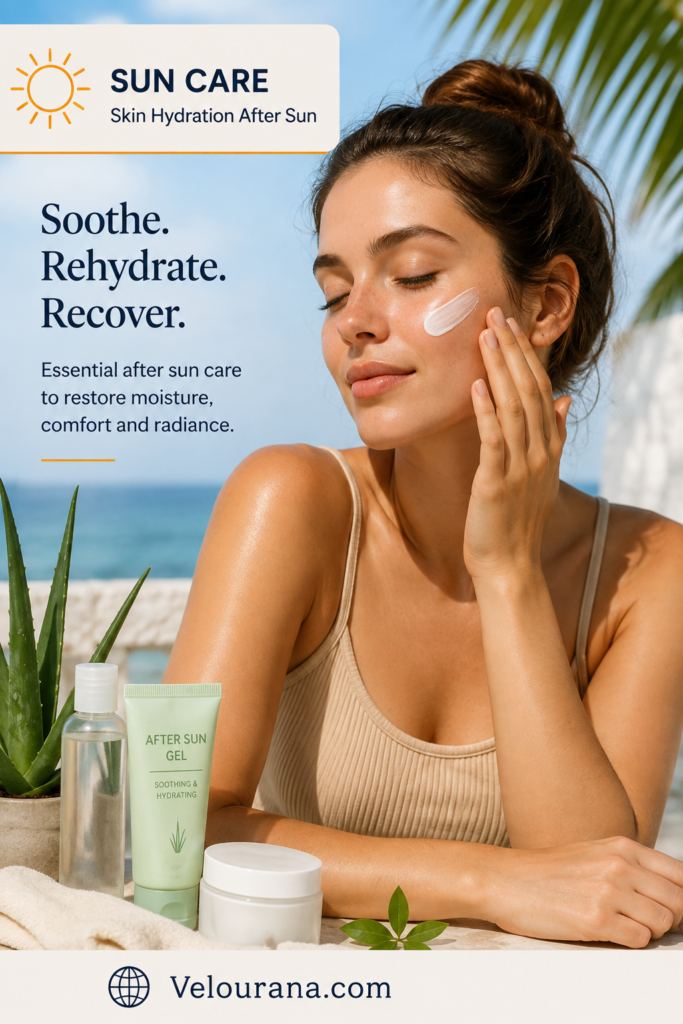
CATEGORY: Skin Hydration After Sun
Skin that feels tight after spending time outdoors is one of the most familiar summer skincare complaints. You may return from the beach, a swimming pool, a long walk, an outdoor lunch, or an afternoon in the garden and notice that your face suddenly feels less comfortable than it did earlier.
The sensation can be confusing.
The skin may look shiny from sunscreen and perspiration while simultaneously feeling tight around the cheeks, forehead, or eye area. After cleansing, the tightness may become even more noticeable.
This does not necessarily mean that your natural skin type has suddenly changed.
Heat, environmental exposure, swimming, wind, perspiration, cleansing, and changes in humidity can temporarily affect how hydrated the skin feels. Understanding these factors makes it easier to respond with a simple routine rather than immediately reaching for aggressive treatments or an excessive number of products.
The objective of after-sun hydration is straightforward: gently cleanse the skin, replenish moisture, provide appropriate moisturization, and allow it to become comfortable again.
Why Tightness Can Appear After a Summer Day
A single day outdoors can expose the skin to several different environments.
You may begin the morning in an air-conditioned room, walk outside into heat and humidity, spend several hours in sunlight and wind, swim in the sea, shower, return to air conditioning, and cleanse again before bed.
Every transition changes the environment around the skin.
Perspiration increases during heat.
Water evaporates.
Salt may remain on the skin after swimming.
Chlorinated water can leave the skin feeling different.
Wind increases the sensation of dryness.
Sunscreen and makeup require removal.
By evening, tightness can be the cumulative result of several ordinary summer experiences.
Sunlight Is Only Part of the Story
Because the sensation occurs after spending time outside, it is easy to attribute everything to sunlight.
Sun exposure certainly matters, and ultraviolet protection should remain central to any sun-care routine.
However, hydration is affected by more than UV exposure.
Someone sitting beneath an umbrella at a windy beach may still notice dry-feeling skin after repeated swimming.
Someone exercising outdoors may experience dehydration from heat, perspiration, and repeated washing.
Someone travelling may spend only limited time outside but experience dryness from hours of air conditioning.
After-sun skincare should therefore consider the entire day rather than sunlight alone.
Perspiration Does Not Mean the Skin Is Hydrated
Sweat makes the skin wet.
That does not mean the skin is adequately hydrated.
Perspiration is part of the body's temperature-regulation system. As it evaporates, it helps cool the body.
During hot weather, the face can therefore feel damp while the skin underneath begins to feel tight.
This explains why oily or perspiring skin may still benefit from a lightweight hydrating product.
Oiliness Can Exist Alongside Dehydration
Sebum and water are different.
A person with naturally oily skin may produce substantial surface oil while still experiencing temporary dehydration.
This can create the strange combination of shine and tightness.
Trying to remove every trace of oil through repeated aggressive cleansing may make the discomfort worse.
Instead, cleanse appropriately and choose hydration in a texture suitable for oily skin.
Wind Can Make a Major Difference
Wind is sometimes overlooked in summer skincare.
A warm, windy beach can feel more comfortable than still air because the breeze reduces the sensation of heat.
Yet that same airflow can increase evaporation from wet skin.
Repeated swimming followed by air drying can leave the face and body feeling increasingly tight.
After a windy day, hydration and moisturization may therefore be particularly welcome.
Salt Water Can Contribute to Tightness
Sea swimming is one of summer's pleasures, but salt residue can leave some people's skin feeling dry or tight.
Rinsing with fresh water after swimming can help remove the residue.
At the end of the day, take a gentle shower and cleanse the face appropriately.
Avoid trying to scrub salt away.
Water and gentle cleansing are usually enough.
Chlorinated Water Can Also Feel Drying
Pool water creates a different environment.
Some people notice that their skin feels dry after spending extended periods swimming.
Rinsing after leaving the pool can improve comfort.
Frequent swimmers may find that consistent moisturization after swimming works better than waiting until the skin becomes noticeably uncomfortable.
Air Conditioning Can Continue the Problem Indoors
The skin may initially feel relieved when you enter a cool building after being outside.
Several hours later, it may begin to feel tight again.
Strongly air-conditioned environments can be dry.
This creates an interesting summer contradiction.
The outside environment may be humid and hot while the indoor environment is cool and dry.
A good summer moisturizer should work comfortably across both conditions.
Cleansing Can Intensify Existing Tightness
Cleansing is necessary after sunscreen, makeup, perspiration, swimming, and environmental exposure.
The problem occurs when cleansing becomes too aggressive.
Very hot water, harsh cleansers, repeated washing, rough cloths, and vigorous rubbing can leave already uncomfortable skin feeling even tighter.
After-sun cleansing should therefore be effective but gentle.
Start by Cooling Down
Before beginning the skincare routine, move away from direct heat and sunlight.
Allow the body to cool naturally.
A comfortably cool or lukewarm shower can help.
There is no need for extremely cold water.
Cooling should feel pleasant rather than shocking.
Remove Sunscreen Properly
Sunscreen should be removed at the end of the day.
Water-resistant formulas may require more thorough cleansing.
If makeup is also present, a suitable first cleanser can help dissolve both makeup and sunscreen.
A gentle water-based cleanser can follow if necessary.
The exact method depends on the products being used.
Avoid Over-Cleansing
Once the skin is clean, stop cleansing.
A second or third wash simply because the face still feels oily may not be helpful.
Some sunscreen formulations leave a particular finish even after adequate cleansing, and skin itself naturally contains oils.
The objective is not to create a completely oil-free surface.
Water Temperature Matters
Very hot water may feel relaxing after a long day, but it can be uncomfortable for skin that already feels dry or tight.
Use comfortably cool or lukewarm water.
Extreme cold is also unnecessary.
Moderate temperatures are usually the easiest on stressed-feeling skin.
Pat Rather Than Rub
After cleansing, use a soft towel.
Pat the face gently.
Do the same with the body.
Rough towel drying adds friction at a moment when the skin may already feel sensitive.
Leave the Skin Slightly Damp
Hydrating products can be pleasant to apply while the skin remains slightly damp.
There is no need to wait until every trace of water has evaporated.
This creates a comfortable transition between cleansing and hydration.
Begin With a Lightweight Hydrating Product
A facial mist, hydrating toner, essence, or serum can provide the first layer.
Choose one.
There is rarely a need to use all four.
The objective is to provide water-rich hydration without immediately creating a heavy coating.
Glycerin Is a Reliable Hydrating Ingredient
Glycerin is found in countless skincare products because it works well as a humectant.
It can appear in inexpensive products and luxury formulations alike.
A glycerin-containing serum or gel can provide straightforward hydration after sun exposure.
The surrounding formulation determines how light or rich the final product feels.
Hyaluronic Acid Can Fit Easily Into Summer
Hyaluronic-acid serums are popular because many have lightweight, water-based textures.
They can be especially pleasant after cleansing.
Apply a modest amount.
If the skin is dry, follow with moisturizer rather than repeatedly applying additional serum.
Panthenol Can Be Useful in Simple Formulas
Panthenol frequently appears in hydrating gels and creams.
A lightweight formula containing panthenol can fit comfortably into an after-sun routine.
It may also be combined with glycerin, hyaluronic acid, or other hydrating ingredients.
One product containing several useful ingredients can keep the routine simple.
Aloe Vera Provides a Classic Summer Texture
Aloe gel is strongly associated with summer skincare.
Its high-water, lightweight texture naturally feels refreshing.
A slightly chilled aloe gel can feel particularly pleasant if the product's storage instructions permit refrigeration.
Remember to consider the entire ingredient list.
Not every aloe product has the same formulation.
A Facial Mist Provides Fast Refreshment
A mist is useful when the face still feels warm.
Fine droplets can create an immediate cooling sensation.
However, if the skin feels tight again once the water evaporates, the mist alone is not enough.
Follow with a serum or moisturizer.
Do Not Keep Spraying Instead of Moisturizing
Repeated misting can become tempting because the immediate sensation is pleasant.
If dryness keeps returning, address it with a more complete routine.
A mist provides refreshment.
A moisturizer provides longer-lasting support.
They serve different purposes.
Why Moisturizer Matters
Hydrating serums are useful, but they are not always sufficient on their own.
A moisturizer combines water with ingredients that help soften the skin and maintain comfort.
This becomes especially important when tightness repeatedly returns after applying a watery serum.
Gel Moisturizers for Oily Skin
Oily skin may prefer a water gel.
These formulas generally feel lighter than traditional creams.
They can provide enough moisturization without leaving a dense finish.
If the skin feels comfortable after the gel settles, there is no need to add another cream automatically.
Gel Creams for Combination Skin
Gel creams provide a useful middle ground.
They feel fresher than many traditional creams while offering more moisturization than extremely lightweight gels.
Combination skin can apply a thin layer across the face and use slightly more on dry areas.
Lotions for Normal to Dry Skin
A lightweight lotion can work particularly well in summer.
It provides more substance than a gel without necessarily feeling heavy.
This may be useful for people who spend substantial time in air conditioning.
Creams for Dry Skin
Dry skin may still need a traditional cream.
There is no rule saying summer skincare must consist entirely of gels.
The trick is to apply the cream after the skin has cooled and hydrated.
A smaller amount may be sufficient compared with winter.
Targeted Moisturization Can Prevent Heaviness
If only the cheeks feel tight, apply additional moisturizer there.
If the forehead feels comfortable, it does not need the same quantity.
Targeted application can make after-sun skincare more precise.
Ceramides Can Be Useful in Moisturizers
Ceramides appear in many barrier-supporting moisturizers.
They can be particularly useful when the skin feels dry after repeated swimming or cleansing.
Ceramide products are available in light lotions as well as rich creams.
Choose the texture rather than assuming the ingredient dictates heaviness.
Squalane Can Add Softness
Some moisturizers contain squalane as an emollient ingredient.
This can add softness without necessarily creating a heavy texture.
Dry skin may appreciate a gel cream or lotion containing a modest amount of emollient ingredients after the hydrating stage.
Hydrating Masks Can Be an Optional Extra
A hydrating mask can provide a pleasant evening ritual.
Sheet masks and gel masks are particularly refreshing during summer.
Use them according to their instructions.
A mask is optional.
It should not become necessary every time the skin feels slightly tight.
Refrigerated Masks Can Feel Especially Refreshing
If the product is suitable for refrigeration, a slightly chilled mask can enhance the cooling sensation.
There is no need to freeze it.
Gentle cooling provides plenty of refreshment.
Direct Ice Is Not Necessary
Applying ice directly to the face may sound like the fastest way to reduce warmth.
For ordinary after-sun skincare, it is unnecessarily extreme.
A cool damp cloth provides a gentler alternative.
A refrigerated gel can provide another.
The Eye Area May Show Dehydration First
Fine dehydration lines can become particularly visible around the eyes.
A lightweight hydrating eye gel or familiar moisturizer can help the area feel more comfortable.
Apply gently.
A cool compress can also provide refreshment.
Do Not Forget the Lips
Lips can feel dry after wind, swimming, sun exposure, and air conditioning.
Use a suitable lip balm.
During daytime outdoor exposure, a lip product with appropriate sun protection can also be considered.
The Neck Often Feels Tight Too
The neck is exposed to many of the same conditions as the face.
Cleanse it gently.
Apply moisturizer.
Include it in daytime sun protection.
The Chest Can Become Dehydrated
The upper chest is frequently exposed during summer.
A lightweight moisturizer or body lotion can provide comfort after showering.
Avoid applying only facial skincare while ignoring nearby exposed skin.
Shoulders May Need More Moisture
Shoulders can receive considerable exposure.
They may feel especially tight after swimming.
Apply a body gel, lotion, or moisturizer after showering.
Use gentle movements if the area feels sensitive.
Arms and Legs Need Consistent Hydration
The limbs can become dry after repeated swimming and showering.
Apply body lotion while the skin remains slightly damp.
This makes the product easier to spread and can improve the overall sensory experience.
Choose Body Texture According to Climate
Humid conditions often favor gel lotions.
Dry heat may require a richer lotion.
Strong air conditioning may make a cream more comfortable later in the evening.
There is no single perfect summer body texture.
Hydration After the Beach
A useful beach-day routine begins with fresh water.
Rinse away salt and sand.
Shower gently.
Remove facial sunscreen.
Apply a hydrating serum.
Follow with moisturizer.
Apply body lotion to exposed areas.
That is enough for most ordinary situations.
Hydration After the Pool
Rinse pool water.
Cleanse the face.
Apply serum or moisturizer.
Use body lotion.
Frequent swimmers should make this a regular habit rather than an emergency response to severe dryness.
Hydration After Outdoor Exercise
Allow the body to cool after exercise.
Shower.
Remove perspiration and sunscreen.
Apply lightweight hydration.
A gel moisturizer may feel particularly comfortable.
Hydration After a Windy Day
Wind can make the skin feel surprisingly dry.
After cleansing, use a hydrating serum followed by moisturizer.
Dry skin may need a richer final layer.
Hydration After a Day in Air Conditioning
Sometimes the tightness blamed on the sun actually becomes strongest several hours after coming indoors.
If this happens, evaluate the moisturizer.
A slightly richer lotion or cream may be useful.
Avoid Exfoliating Tight Skin Immediately
Tight skin can also look dull or textured.
This does not mean it requires immediate exfoliation.
Strong acids or scrubs can wait until the skin feels normal.
Hydration should come first.
Avoid Introducing Several New Actives
A skin-stressed evening is not the ideal moment to experiment with multiple unfamiliar products.
Keep the routine predictable.
Use products already known to be comfortable.
This makes it easier to identify what actually helps.
Avoid Heavy Fragrance if It Bothers Your Skin
Fragrance can make summer products enjoyable.
Coconut, cucumber, mint, citrus, and floral scents are common.
People who tolerate them may enjoy the experience.
Those who know fragrance causes discomfort should choose alternatives.
Menthol Is Not the Same as Hydration
Menthol can create an intense cooling sensation.
It does not necessarily provide moisture.
A product can feel extremely cold while doing little to address tightness.
Look at the complete formula rather than judging effectiveness by sensation.
Cooling and Hydration Are Different
Cooling makes the skin feel less warm.
Hydration addresses water content in the upper layers.
Moisturization helps maintain comfort and softness.
A good after-sun routine may combine all three, but they are not interchangeable.
Sunscreen Is a Different Function Again
Sun protection reduces ultraviolet exposure.
After-sun hydration does not.
This distinction is essential.
A cooling moisturizer may make the skin feel wonderful after an afternoon outdoors, but it cannot undo the exposure that occurred.
Prevention Remains the Foundation
Use appropriate broad-spectrum sunscreen.
Reapply according to the product instructions and circumstances.
Seek shade when practical.
Use suitable protective clothing, hats, and sunglasses.
After-sun skincare should support these habits rather than replace them.
Do Not Use Comfortable Skin as Permission for More Sun
Once a cooling gel has reduced tightness, the skin may feel completely normal.
That does not reset the day's ultraviolet exposure.
Feeling better is not evidence that additional exposure is harmless.
How Much Serum Should You Use?
Follow the product instructions.
More is not automatically better.
A large quantity of serum can leave the face sticky.
Start modestly.
Allow it to settle.
Add moisturizer if necessary.
How Much Moisturizer Should You Use?
Use enough to make the skin comfortable.
The correct amount varies with texture and skin type.
If a thick visible layer remains long after application, you may be using more than necessary.
Give Each Layer Time
There is no need to wait for an exact number of minutes between every product.
However, allowing a serum to settle briefly before moisturizer can make the routine feel more comfortable.
It also allows you to determine whether additional moisture is actually necessary.
A Minimal Routine for Tight Skin
A simple routine can consist of gentle cleansing, one hydrating serum, and one moisturizer.
This may be all the skin needs.
Body lotion can be added for exposed areas.
A More Luxurious Routine
If you enjoy a longer ritual, begin with a cool shower.
Cleanse gently.
Use a chilled facial mist.
Apply a hydrating mask according to its instructions.
Follow with a gel cream.
Apply body lotion.
Finish with lip balm.
The extra steps should add enjoyment rather than unnecessary complexity.
The Next Morning Provides Useful Information
Observe the skin after waking.
If it feels soft and comfortable, the previous routine probably provided enough hydration.
If tightness remains, consider a more moisturizing final product.
If the face feels excessively greasy, reduce the amount or richness.
Do Not Change Everything at Once
If the routine is not working, adjust one element.
Perhaps the cleanser is too aggressive.
Perhaps the serum is not enough.
Perhaps the moisturizer is too light.
Changing every product simultaneously makes it difficult to understand what improved or worsened the situation.
Summer Hydration Should Be Adaptable
Some days require almost no special after-sun care.
Others involve hours of swimming, wind, heat, and repeated sunscreen application.
The routine should change accordingly.
Skincare should respond to conditions rather than follow an inflexible script.
Tightness Without Visible Dryness Still Matters
The skin does not need to be visibly flaky before hydration becomes useful.
Comfort is a legitimate guide.
If the face consistently feels tight after outdoor exposure, adjust the routine.
Visible Flaking May Require Richer Moisturization
If dry areas begin to flake, a lightweight mist alone is unlikely to be enough.
Use a suitable moisturizer.
Persistent or severe skin problems should be evaluated appropriately rather than repeatedly treated with random cosmetic products.
When After-Sun Tightness Is More Than Ordinary Dryness
Cosmetic skincare is appropriate for ordinary mild dryness and dehydration.
Significant sunburn requires different consideration.
Severe pain, blistering, marked swelling, extensive burns, or other concerning symptoms may require medical attention.
Serious symptoms related to excessive heat also require appropriate care.
Do Not Try to Treat Serious Burns With Beauty Products
Aloe gel and moisturizer can provide cosmetic comfort in ordinary circumstances.
They are not substitutes for appropriate treatment of serious burns.
Knowing the limits of skincare is part of responsible sun care.
Hydration Is Maintenance, Not Damage Erasure
This is perhaps the most important way to understand after-sun skincare.
Hydration helps the skin feel comfortable.
It can improve the appearance of temporary dehydration.
It can soften rough-feeling areas.
It can make the evening after a hot day much more pleasant.
It does not erase ultraviolet exposure.
Build a Routine You Can Repeat
A routine only works if it is practical.
If every beach day requires twelve products and forty-five minutes of skincare, consistency becomes difficult.
A cleanser, hydrating serum, moisturizer, and body lotion provide a reliable foundation.
Keep One Cooling Product Ready
For additional comfort, keep one suitable product cool according to its storage instructions.
A facial mist or gel moisturizer is enough.
There is no need to refrigerate an entire skincare collection.
Let Texture Change With the Season
A winter cream can be replaced temporarily with a gel cream.
A heavy body butter can become a lotion.
A rich serum can become a water-based gel.
Seasonal changes do not mean abandoning good skincare principles.
They simply change how those principles are delivered.
The Best Response to Tight Skin Is Usually Gentle
When the skin feels tight after sun exposure, dramatic treatment is rarely the first requirement.
Move out of the heat.
Cleanse gently.
Add hydration.
Apply moisturizer.
Give the skin time.
Protect it again the following day.
This approach may appear simple, but simplicity is exactly what makes it useful.
After a demanding summer day, skin does not necessarily need more stimulation. It needs an environment and routine that allow it to feel comfortable again.
Hydration, appropriate moisturization, and sensible sun protection work together to provide that balance.
Treat tightness as a signal to reassess moisture rather than an invitation to scrub, over-cleanse, or overload the skin. Choose lightweight products when the weather demands them, richer textures when dryness requires them, and allow the condition of the skin to determine what comes next.
The End
Velourana.
 Discover More From Our Family of Websites
 ZodiacBearing (Astrology, Tarot, Numerology, Angel Numbers & Spiritual Guidance)
 Velourana (Beauty, Makeup, Hair Care, Skincare & Beauty Tips)
 HavenBearing (Home, Living, Organization, Décor & Everyday Inspiration)
 PawBearing (Pet Care, Dog Breeds, Animal Health, Training & Pet Products)
 PsyCatherine (Notes From the Journal of a Psychologist on Real Life)

