
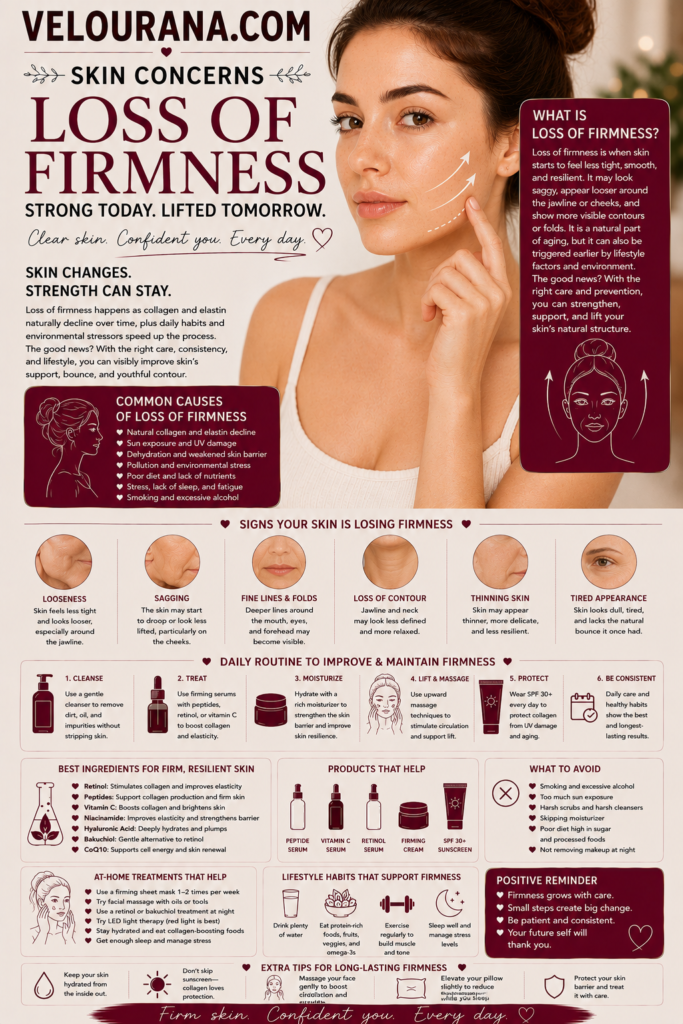
CATEGORY: Loss of Firmness
Loss of firmness is often described visually, but many people notice it first through touch.
The skin seems softer in a different way. It may move more easily over underlying tissues. After smiling, sleeping on one side or pressing the cheek, it can seem to take longer to return to its previous position. The face may look perfectly normal in one expression and suddenly less supported in another. What has changed is not necessarily the amount of skin. Often, it is the quality of the skin's recoil.
This is where elasticity becomes central.
Elasticity is one of the least understood aspects of skin aging because it is frequently confused with firmness, hydration and tightness. Yet each describes something different. Firmness relates to structural support. Hydration influences flexibility and surface plumpness. Tightness may simply be a sensation. Elasticity refers more specifically to the ability of tissue to deform and then return toward its original shape.
Youthful skin is not firm because it is rigid. It is firm because it combines strength with flexibility.
That distinction matters.
Skin that cannot move would be unhealthy. Every smile, blink and turn of the head requires deformation. The remarkable quality of younger skin is not that it resists movement, but that its structural networks manage movement efficiently.
As aging alters collagen, elastic fibres and the surrounding extracellular matrix, that efficiency changes. The skin can still move, but it may recover differently.
The gradual loss of this spring-like behaviour is one of the central experiences behind what people call loss of firmness.
Elasticity Depends on an Organized Network
Elastin is often discussed as though it were a single ingredient responsible for making skin stretchy.
The real structure is considerably more sophisticated.
Elastic fibres form a network throughout the dermis. These fibres include elastin along with associated microfibrillar components that contribute to their organization and function.
Together, they allow skin to stretch under mechanical force and then recoil when that force is removed.
The architecture matters as much as the material.
A pile of elastic protein would not automatically produce functional elasticity. The fibres need to be assembled correctly and integrated with the surrounding dermal matrix.
This is why topical products containing elastin should not be confused with rebuilding the skin's elastic system.
Applied proteins may contribute to the cosmetic properties of a moisturizer, particularly hydration or film formation, but they do not simply migrate into the dermis and reconstruct mature elastic fibres.
Functional elastic architecture is created biologically.
Much of it develops early in life and turns over extremely slowly.
That longevity is both useful and problematic.
It allows elastic fibres to function for decades, but it also means that damage can accumulate across decades.
Why Elastic Fibres Are Particularly Vulnerable to Time
The skin's elastic system has an unusual biological challenge.
Collagen is continually remodeled, although less efficiently with age. Mature elastic fibres, by contrast, are exceptionally long-lived.
This means the fibres responsible for recoil may remain exposed to mechanical stress, ultraviolet radiation and oxidative damage for very long periods.
The body does not simply replace the entire elastic network every few months.
As a result, the history of the skin becomes embedded within its structure.
Everyday movement is normal and expected. The face is designed to move. But environmental stress, particularly chronic ultraviolet exposure, can alter elastic fibre architecture over time.
This contributes to one of the paradoxes of photoaging.
Sun-damaged skin can accumulate abnormal elastin-related material, yet become less functionally elastic.
In other words, the presence of more elastin-related material does not necessarily mean better elasticity.
Quality, organization and location matter.
This is an important correction to the simplistic idea that aging skin merely "runs out of elastin."
The reality is more complex.
Some elastic structures deteriorate. Others become disorganized. Abnormal material can accumulate.
The result is not a neat numerical deficiency but a decline in the performance of an intricate network.
The Difference Between Stretch and Recoil
Skin must accommodate deformation constantly.
When we smile, the cheeks rise.
When we sleep on one side, the face is compressed.
When we turn the head, neck skin folds.
When we speak, muscles repeatedly move the tissues around the mouth and eyes.
Elastic tissue allows these movements without requiring the skin to remain permanently in each temporary position.
In younger skin, recoil is generally efficient.
With age, this ability can diminish.
That is why temporary creases can become more persistent.
A sleep line that disappeared quickly at twenty-five may remain visible much longer later in life.
An expression line around the eye may gradually become present even when the face is resting.
These changes are not caused by elasticity alone. Repetitive movement, collagen deterioration, epidermal changes and cumulative photodamage all contribute.
But declining recoil helps explain why repeated deformation leaves a more lasting visual trace.
Firmness is therefore not just about whether the skin appears taut when completely still.
It is about how the tissue behaves through movement.
Collagen and Elastin Work Together
The firmness-versus-elasticity distinction is useful, but the two systems should not be treated as separate machines.
Collagen and elastic fibres operate within the same extracellular environment.
Collagen provides tensile strength.
Elastic fibres provide resilience.
Imagine a structure that needs to resist excessive deformation but still bend under force.
Collagen helps prevent the tissue from stretching without limit. Elastic fibres help restore shape after stretching occurs.
When collagen becomes fragmented and the elastic network becomes damaged, both structural support and recoil deteriorate.
This explains why aging skin can simultaneously feel thinner, softer, less resistant and less springy.
The problem is not one missing component.
It is changing architecture.
The extracellular matrix also contains other molecules that contribute to hydration, organization and cell signalling.
Fibroblasts interact physically with this environment.
When the matrix deteriorates, the cells maintaining it are affected by that altered mechanical context.
Skin aging therefore becomes partly self-reinforcing.
The environment becomes less organized, and the cells responsible for maintenance operate within that deteriorated environment.
This is one reason structural aging is slow to reverse.
The system cannot simply be repaired by adding one fashionable ingredient at the surface.
Why Sun Exposure Changes Skin Mechanics
Ultraviolet exposure is one of the most important external influences on the mechanical aging of skin.
This is not limited to visible sunburn.
Repeated ultraviolet exposure triggers molecular changes that contribute to collagen degradation and abnormal remodeling of elastic tissue.
Over time, chronically exposed skin can develop the characteristic structural changes of photoaging.
These changes help explain why skin that receives substantial cumulative sun exposure often appears coarser, more wrinkled and less resilient than protected skin of the same chronological age.
Sunlight therefore changes not only pigmentation but mechanics.
This is why sunscreen deserves a place in any discussion about firmness.
A product marketed as "firming" may focus attention on stimulating collagen.
But preventing avoidable degradation of existing collagen and elastic fibres is equally important.
If the architecture continues to receive repeated ultraviolet injury, attempts to improve it are working against a persistent source of damage.
The more advanced the anti-aging routine, the more irrational it becomes to neglect basic photoprotection.
Protection is not separate from treatment.
It is part of the same strategy.
Dryness Can Make Elasticity Look Worse Than It Is
Not every sensation of reduced springiness reflects profound structural deterioration.
Dehydrated skin behaves differently from well-hydrated skin.
The stratum corneum requires an appropriate water content to remain flexible. When it becomes dry, the surface can feel rougher and less supple.
Fine lines become more visible.
The skin may appear less plump.
It can even feel tight, which is ironically sometimes misinterpreted as firmness.
When hydration is restored, these surface changes can improve quickly.
This does not mean that hydration rebuilds elastic fibres.
It means that surface flexibility contributes to the overall experience of skin quality.
The distinction is practical.
Someone with dry, irritated skin may believe they need stronger firming actives when the first priority should actually be barrier repair.
If the surface is uncomfortable and dehydrated, evaluating deeper firmness becomes more difficult because temporary dryness exaggerates texture and fine creasing.
A well-designed moisturizer can therefore improve the appearance of aging skin considerably even without altering deeper anatomy.
That is not a lesser achievement.
It is simply a different mechanism.
Why Tight Skin Is Not Necessarily Healthy Skin
The word "tight" has acquired positive associations in anti-aging marketing.
But skin can feel tight for bad reasons.
Over-cleansing can remove too much surface lipid and leave the face feeling stretched.
Harsh exfoliation can compromise the barrier.
Alcohol-heavy formulations can produce temporary astringency.
Clay masks may contract as they dry.
These experiences can create a sensation of tautness that people interpret as firming.
But a damaged barrier is not youthful architecture.
Healthy skin should feel comfortable.
Firmness should not require discomfort.
This distinction becomes particularly important for people escalating active ingredients in pursuit of tightening.
If the face feels extremely tight after washing, that is more likely to indicate excessive cleansing than successful anti-aging treatment.
If a serum burns and leaves the skin dry, the irritation should not be celebrated as proof of stimulation.
The most resilient skin is not necessarily the skin producing the strongest sensation.
Often, it is the skin functioning quietly.
What Facial Expressions Teach Us About Recoil
Dynamic movement reveals aspects of firmness that static photographs hide.
A face at rest may look smooth.
When the person smiles, fine creases form around the eyes.
When the smile stops, youthful skin tends to recover quickly.
With age, some of those lines remain visible.
This transition from dynamic to static lines reflects several processes.
Repeated muscular movement matters.
Collagen and elastic tissue change.
Photodamage accumulates.
The epidermis changes.
Subcutaneous support may also change.
No single factor explains every line.
But declining recoil is part of the picture.
This is why the movement of the face should not be treated as the enemy.
Expression is normal.
Trying to avoid smiling to prevent wrinkles would sacrifice ordinary human behaviour for an unrealistic cosmetic objective.
The meaningful intervention is not eliminating movement.
It is supporting the structures that accommodate movement as well as possible.
That again brings the discussion back to photoprotection, barrier care and appropriate long-term treatment rather than rigid behavioural avoidance.
Can Retinoids Improve Elasticity?
Retinoids are among the best-supported topical treatments for photoaged skin.
Their benefits extend beyond surface exfoliation.
They influence epidermal behaviour and dermal collagen-related processes, and long-term use can improve several visible characteristics of photoaging.
This can contribute indirectly to a firmer, more resilient appearance.
However, it is important not to oversimplify their relationship with elastin.
Retinoids do not function as an instant elastic-fibre replacement.
Their value lies within broader remodeling of aging skin.
That distinction protects expectations.
A person using retinol for several months may notice smoother texture and finer lines before perceiving any change in firmness.
Another may mainly notice improved pigmentation.
Responses vary.
The most reliable principle remains consistency.
Retinoids are not emergency lifting products.
They are long-term treatments whose usefulness emerges gradually.
Peptides and the Search for Better Elasticity
Peptides have become popular in products targeting both firmness and elasticity.
The concept is appealing.
Different peptides can act as signalling molecules, and certain peptide sequences have been studied for their potential influence on extracellular matrix processes.
The problem is that "peptides" describes a vast category.
One peptide is not automatically equivalent to another.
A clinically studied formula cannot be generalized to every serum containing a similarly named ingredient.
Concentration matters.
Stability matters.
Penetration matters.
The vehicle matters.
The final formulation matters.
This makes peptide products difficult for consumers to evaluate purely from ingredient lists.
A reasonable position is to regard peptides as potentially useful adjuncts rather than guaranteed replacements for established fundamentals.
If a well-formulated peptide serum is pleasant, compatible with the rest of the routine and affordable, it may be a worthwhile addition.
But it should not displace sunscreen or proven treatment simply because its marketing language sounds technologically advanced.
Firmness care benefits from hierarchy.
The strongest foundations should come first.
Why Mechanical Stretching Does Not Restore Elasticity
Another intuitive idea is that repeatedly stretching or massaging the face might train the skin to become more elastic.
This misunderstands the structure.
Elasticity is not strengthened like a skeletal muscle.
Pulling, stretching or aggressively manipulating the skin does not teach damaged elastic fibres to rebuild themselves.
Gentle massage can feel pleasant.
It may temporarily affect fluid distribution.
It may help someone enjoy their skincare routine.
But the act of mechanically pulling the skin upward does not permanently reconfigure the dermal elastic network.
In fact, repeated force should not be assumed to be beneficial merely because it is applied in an upward direction.
The face has no awareness of whether gravity is being symbolically opposed.
Mechanical manipulation should therefore remain gentle.
The goal is comfort, product application or temporary relaxation—not structural relocation.
Sleep Lines Reveal Mechanical History
Sleep creases provide an interesting example of the interaction between compression and aging.
When the face rests against a pillow, the skin can fold in directions that differ from expression lines.
In younger skin, these marks may disappear quickly after waking.
As structural resilience declines, they can remain longer.
This has led to claims that sleeping only on the back can prevent facial aging.
Reality is less absolute.
Sleep quality is important to health.
For many people, forcing an uncomfortable sleep position would be counterproductive.
Mechanical compression may contribute to certain lines, but it exists within a much larger system involving intrinsic aging, photodamage, facial anatomy and skin quality.
The sensible conclusion is not to become afraid of touching the pillow.
It is simply to recognize that aging skin takes longer to recover from deformation.
That observation tells us something about recoil.
It does not create a reason for obsessive sleep behaviour.
Hormonal Aging and Changes in Resilience
Skin mechanics can change noticeably during periods of hormonal transition.
For many women, menopause coincides with increasing dryness, reduced dermal thickness and changes in collagen.
This can make a previously stable routine feel insufficient.
Skin may appear less resilient.
Products may behave differently.
The neck and lower face can become areas of greater concern.
This does not mean menopause suddenly causes all facial aging.
It means hormonal changes interact with processes already underway.
The appropriate response is usually adaptation rather than panic.
A richer moisturizer may become helpful.
Retinoid frequency may need adjustment.
Sun protection remains essential.
Harsh exfoliation may become less tolerable.
If broader menopausal symptoms are present, those should be discussed medically rather than approached solely through cosmetic skincare.
The skin is part of the body.
Its changes cannot always be separated from systemic biology.
Why Elastin Supplements Are Not a Simple Solution
The popularity of collagen supplements has naturally produced interest in other structural proteins as well.
The underlying logic often follows a straightforward path: if the skin contains elastin, consuming something related to elastin should increase skin elasticity.
Biology is more complicated.
Proteins consumed orally are digested into peptides and amino acids rather than transported intact into the face.
The body then uses those components according to its broader metabolic priorities.
Research into oral supplements may identify possible effects from certain preparations, but the existence of a skin protein does not automatically prove that eating that protein will reconstruct the corresponding tissue.
This is the same reason eating collagen is not equivalent to inserting collagen fibres directly into the dermis.
Supplement claims should therefore be evaluated according to actual clinical evidence rather than intuitive nutritional logic.
A healthy diet provides important substrates for normal tissue function.
But no single food or supplement can be expected to recreate the elastic architecture of young skin.
Professional Treatments Can Target Remodeling More Intensely
Topical skincare works within limitations imposed by the skin barrier and by the depth at which products can act.
Professional procedures can sometimes create stronger remodeling responses because they deliberately interact with tissue more intensely.
Microneedling creates controlled micro-injury.
Certain lasers create thermal or ablative effects.
Radiofrequency and ultrasound technologies may deliver energy to specific depths.
These procedures are intended to trigger tissue responses that differ in magnitude and mechanism from ordinary cosmetic application.
They may therefore improve aspects of laxity or texture more substantially than topical care alone.
But stronger intervention also creates greater responsibility.
Results vary.
Device quality matters.
Operator skill matters.
Treatment depth matters.
Skin type matters.
Complications are possible.
A procedure should not be selected simply because an advertisement uses the word "tightening."
The first question should be which tissue needs treatment.
If the concern is primarily poor skin quality, one category of intervention may be appropriate.
If the problem is substantial volume loss or tissue descent, another may be required.
No technology is universally suited to every manifestation of loss of firmness.
Why Lower-Face Laxity Is Harder to Treat Topically
The lower face is where expectations often collide with anatomy.
A person may have excellent skincare habits and still develop a softer jawline.
This does not necessarily mean the skincare failed.
Lower-face aging involves more than dermal elasticity.
Fat compartments change.
Supportive structures change.
Bone remodels.
Skin quality changes.
Gravity continues acting across all these layers.
A topical product can influence the outer component of that system.
It cannot substantially rearrange the deeper components.
This is why some people see considerable improvement in texture from skincare while remaining disappointed by jowls.
They are evaluating two different problems with one standard.
The skin may genuinely have improved.
The anatomy has simply continued to age.
Recognizing that distinction is important because otherwise people can spend progressively larger amounts of money on products that cannot physically reach the source of their concern.
Measuring Elasticity at Home Is Difficult
Professional studies can use specialized instruments to assess biomechanical properties of the skin.
At home, assessment is far less precise.
Pinching the cheek and timing how quickly it returns is not a reliable diagnostic test for facial aging.
Hydration, location, pressure and technique all affect the result.
Likewise, comparing how the skin feels from one morning to another tells very little about long-term dermal remodeling.
A more useful approach is visual and practical.
Does the skin look healthier over several months?
Is texture smoother?
Are fine lines less prominent?
Does the face tolerate treatment well?
Has photoprotection become consistent?
These questions may not isolate elasticity scientifically, but they provide a better framework for evaluating whether the routine is beneficial.
Perfect measurement is not necessary for useful skincare.
But false precision should be avoided.
The Best Elasticity Strategy Is Mostly Preventive
Because mature elastic fibres are difficult to recreate, preservation becomes especially important.
This does not mean improvement is impossible.
It means prevention deserves greater respect.
Ultraviolet protection helps reduce one of the major avoidable sources of structural deterioration.
Avoiding smoking removes another known contributor to premature skin aging.
Maintaining barrier health reduces unnecessary inflammation and dehydration.
Using appropriate evidence-supported treatments can improve the condition of photoaged skin.
Taken together, these actions may not create the dramatic sensation of a tightening mask.
Their value accumulates instead.
The strategy is quiet.
It is repetitive.
It lacks the excitement of a sudden transformation.
But the biology of elastic tissue makes long-term preservation especially rational.
Elastic Skin Is Supple, Not Frozen
There is a broader beauty lesson hidden inside the science of elasticity.
Youthful skin is admired partly because it moves well.
It stretches.
It folds.
It responds to expression.
Then it recovers.
The objective of healthy firmness should therefore never be a face that appears immobile or rigid.
Elasticity is dynamic.
This is why the idea of "tightening everything" can become conceptually misleading.
The ideal is not maximum tension.
It is balanced mechanical behaviour.
Skin should possess enough structural strength to maintain its integrity and enough flexibility to accommodate life.
A smooth face without movement is not a biological definition of youth.
Resilient tissue is.
Reframing the Goal
When skin begins to lose its springiness, it is understandable to search for something capable of restoring the sensation immediately.
But the elastic network has been changing for years.
It carries the history of ultraviolet exposure, chronological aging, mechanical stress and biological change.
No single application can erase that history.
What can be done is more practical.
Protect the elastic architecture that remains.
Reduce avoidable photodamage.
Maintain hydration and barrier function so surface flexibility is not unnecessarily compromised.
Use well-supported treatments to improve broader signs of photoaging.
Treat claims about instant elastic reconstruction with skepticism.
Consider professional assessment when substantial laxity rather than skin quality has become the dominant concern.
Most importantly, judge the skin according to what healthy elasticity really means.
Firmness is not hardness.
Youthful skin does not resist every movement.
Its beauty lies partly in its ability to move and recover.
As that recovery becomes slower with age, the most intelligent skincare strategy is not to demand that the skin behave as though time has never passed.
It is to preserve as much resilience as biology realistically allows.
That goal is less dramatic than promising a permanent lift from a bottle.
But it respects what elastic skin actually is: not a static surface, but a living structure designed to bend, stretch and return through thousands of movements over an entire lifetime.
The End Velourana
 Discover More From Our Family of Websites
 ZodiacBearing (Astrology, Tarot, Numerology, Angel Numbers & Spiritual Guidance)
 Velourana (Beauty, Makeup, Hair Care, Skincare & Beauty Tips)
 HavenBearing (Home, Living, Organization, Décor & Everyday Inspiration)
 PawBearing (Pet Care, Dog Breeds, Animal Health, Training & Pet Products)
 PsyCatherine (Notes From the Journal of a Psychologist on Real Life)

