
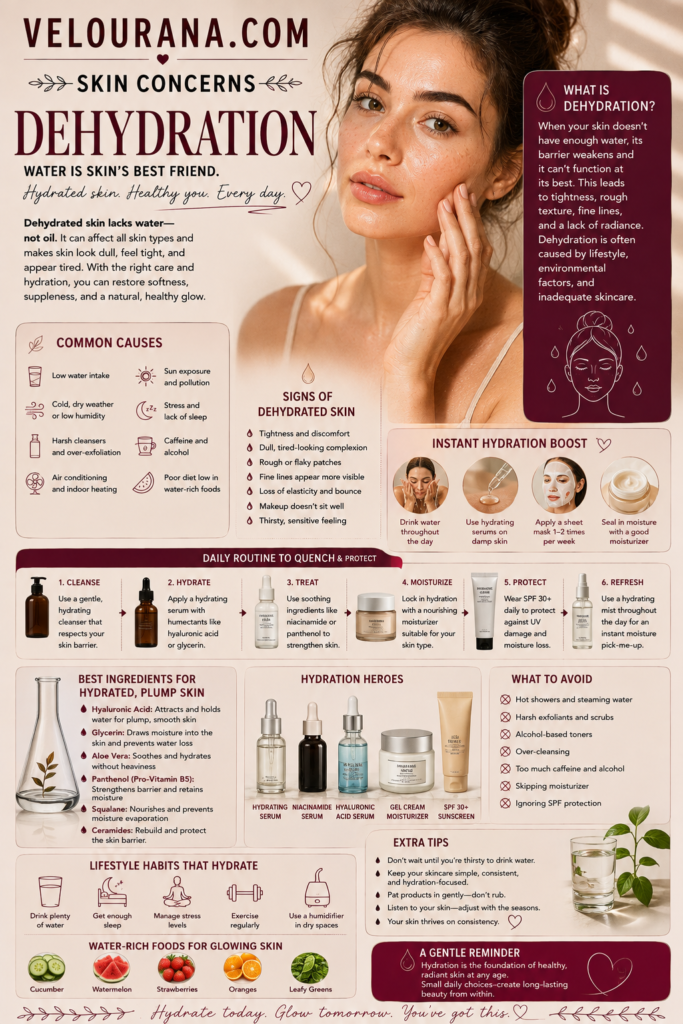
CATEGORY: Dehydration
Dehydrated skin rarely announces itself with a single obvious cause. More often, it develops gradually through a collection of ordinary habits that seem harmless in isolation. A cleanser that feels pleasantly thorough. A shower that is a little too hot. An exfoliating acid used one evening too many. Air conditioning running for hours. A lightweight moisturiser that once felt perfect but is no longer enough for the season. None of these choices necessarily creates a problem on its own. Together, however, they can shift the balance between the water the skin contains and the water it loses.
This is what makes dehydration so easy to misunderstand. People often search for one offending product, one missing ingredient or one dramatic explanation. In reality, the condition is frequently cumulative. The skin's outermost layers are continually interacting with climate, cleansing, friction, active ingredients, indoor environments and the products applied afterward. When enough of these influences encourage water loss or weaken the skin's ability to retain moisture, the complexion begins to feel different.
The signs can be subtle at first. Tightness appears after cleansing. Makeup seems less forgiving. Fine surface lines become more visible. The face looks dull even though it may still produce oil. Products that once felt comfortable begin to sting. Texture becomes rougher.
By the time dehydration is obvious, the routine may already have been working against the skin for weeks.
Understanding the condition therefore requires more than identifying "hydrating ingredients." It requires identifying the behaviours that repeatedly remove water, challenge the barrier or prevent the skin from recovering. Once these patterns are recognised, dehydration becomes less mysterious and often much easier to correct.
Water Loss Begins With the Barrier
The outermost layer of the skin, the stratum corneum, plays a central role in maintaining hydration. It is not a solid waterproof sheet, but it does help regulate how readily water leaves the body through the skin.
Water naturally moves toward the surface and evaporates. This process, known as transepidermal water loss, occurs continuously. Healthy skin does not eliminate water loss entirely; rather, it keeps the rate within a range that allows the surface to remain comfortable and functional.
Problems arise when the barrier becomes less efficient.
The stratum corneum contains flattened cells surrounded by organised lipids, including ceramides, cholesterol and fatty acids. Together, these components help maintain cohesion and reduce excessive permeability. When this structure is disrupted, water can escape more readily and external irritants can penetrate more easily.
This is why dehydration and barrier function are so closely connected.
A person can apply multiple hydrating products and still struggle if the underlying routine repeatedly compromises the outer layer. The skin may temporarily feel better after a serum or cream, only to return to tightness several hours later.
The practical lesson is simple: hydration is not only about adding water. It is also about protecting the system that helps retain it.
Many everyday habits interfere with that system without looking particularly dramatic.
Hot Water Feels Comforting but Can Be Surprisingly Drying
Hot water is one of the most common contributors to dryness and dehydration because it is so closely associated with comfort and cleanliness.
A long, steaming shower feels relaxing. Hot water seems to dissolve oil more effectively. During winter, the contrast between cold air and a hot shower can feel especially satisfying.
The skin, however, does not necessarily share that enthusiasm.
Prolonged exposure to very hot water can remove surface lipids and increase dryness. Dermatologists commonly recommend using warm rather than hot water, especially for people whose skin already feels dry, sensitive or easily irritated.
The effect can become particularly noticeable when hot water is combined with frequent washing.
Someone may take a long hot shower in the morning, wash their face again after exercise, and cleanse thoroughly before bed. The individual events seem routine. Collectively, they create repeated opportunities for the barrier to be stripped.
The face is especially vulnerable when harsh cleansing accompanies the heat.
Reducing water temperature does not mean washing in cold water or abandoning enjoyable showers. The goal is moderation. Warm water can cleanse effectively without the same degree of lipid removal associated with prolonged very hot exposure.
Shortening shower duration can help as well.
The important point is that hydration is influenced by things that happen before skincare products ever touch the face.
Overcleansing Can Turn Clean Skin Into Uncomfortable Skin
Cleansing is necessary, but the idea that skin should feel completely stripped after washing has created a persistent hydration problem.
A cleanser is meant to remove unwanted material: dirt, excess sebum, sunscreen, makeup, pollutants and residue. It does not need to remove every lipid from the surface.
When cleansing is too aggressive, the skin may feel extremely tight immediately afterward. Some people interpret that sensation as proof the cleanser is effective.
In reality, tightness is often a warning sign.
Strong surfactants, repeated cleansing and vigorous rubbing can all contribute to barrier disruption. The effect is more pronounced when the routine includes several cleansing steps even when they are not necessary.
Double cleansing, for example, can be useful for removing long-wearing makeup or resistant sunscreen. It is not automatically superior for every person on every occasion. Someone wearing little product may not need the same cleansing intensity as someone wearing a full face of makeup.
Morning cleansing is similarly individual.
Some people benefit from a gentle cleanse on waking. Others, particularly those prone to dehydration, may find that a lighter morning routine maintains comfort better.
The correct routine depends on what is on the skin, how oily the complexion is and how it responds afterward.
A useful rule is to judge cleansing by the hours that follow, not merely the first thirty seconds.
If the face feels comfortable, supple and clean, the cleanser is likely doing its job. If it feels tight, stings or requires an immediate rescue layer of heavy moisturiser, the routine may be unnecessarily aggressive.
Exfoliation Can Become a Hidden Source of Dehydration
Exfoliation occupies a complicated place in skincare because its benefits can be immediately visible.
Acids and exfoliating treatments can improve texture, address clogged pores and contribute to a smoother appearance. Because these results are rewarding, it is easy to assume that increasing frequency will produce even better results.
The skin does not always agree.
Chemical exfoliants such as alpha hydroxy acids and beta hydroxy acids alter the bonds between surface cells and encourage shedding. Used appropriately, they can be valuable. Used too frequently or combined carelessly with other actives, they can contribute to irritation and barrier disruption.
Dehydration can then appear in a misleading form.
The skin becomes rough and flaky. The person sees the roughness and assumes more exfoliation is needed. Another acid treatment is applied. The surface temporarily feels smoother, but the underlying dehydration worsens.
This creates a self-reinforcing loop.
The appearance of flakes does not always mean the skin needs to be exfoliated more. Sometimes it means the skin needs fewer interventions and more time to recover.
The distinction becomes easier to recognise when roughness is accompanied by tightness, stinging, unusual sensitivity or burning.
In those situations, reducing exfoliation can be more productive than increasing it.
Too Many Active Ingredients Can Overload the Routine
Modern skincare encourages targeted treatment.
Retinoids address visible ageing and acne. Vitamin C is used for antioxidant support and uneven tone. Niacinamide appears in countless formulations. Acids address texture and congestion. Benzoyl peroxide may be used for acne. Azelaic acid can support several concerns.
Each ingredient can make sense individually.
The problem emerges when they are all used together without considering the skin's tolerance.
The skin does not experience these ingredients as separate marketing categories. It experiences the total chemical and physical burden of the routine.
A person may use an exfoliating cleanser, vitamin C serum, acid toner, retinoid and acne treatment within the same week while also cleansing aggressively. None of these steps appears outrageous in isolation. Combined, they may become too much.
Dehydration often appears as one of the first signs.
The complexion starts feeling tight. Moisturiser stings. The skin becomes more reactive. Fine flakes develop around the nose and mouth. Makeup begins sitting unevenly.
Instead of adding another soothing serum, the more useful response can be simplification.
Reducing active frequency allows the barrier to recover and helps reveal which products are genuinely necessary.
A smaller routine can also improve diagnostic clarity. When ten products are used simultaneously, identifying the source of irritation becomes difficult. When the routine contains only a few essentials, cause and effect become easier to observe.
Air Conditioning and Heating Quietly Change the Skin's Environment
Indoor climate control is another common cause of dehydration because it affects the skin for many hours without being noticed.
Air conditioning removes moisture from indoor air. Heating can create similarly dry environments during winter.
The result is lower humidity.
When the surrounding air contains less moisture, water can evaporate from the skin more readily. This does not mean that air conditioning directly "sucks water" out of the skin in a dramatic sense, but prolonged exposure can contribute to dryness and discomfort.
Office workers are particularly familiar with this effect.
Someone may spend eight or ten hours in climate-controlled air, commute in another air-conditioned environment and then sleep in a heated or cooled room. Their skincare routine may remain unchanged while their surroundings continuously encourage water loss.
Seasonal changes amplify the problem.
A moisturiser that feels perfectly adequate during humid summer weather may provide insufficient support during cold winter months or extended indoor heating.
This is why seasonal skincare adjustments are often necessary.
Increasing moisturiser richness slightly, reducing aggressive cleansing and limiting unnecessary exfoliation may be enough to restore balance.
Hydration should respond to environment rather than remain rigid throughout the year.
Travel Can Dehydrate Skin Faster Than Expected
Travel combines several dehydration triggers at once.
Aircraft cabins have low humidity. Sleep is often disrupted. Cleansing routines become irregular. Climate changes can be abrupt. People may move from humid conditions to cold, dry air within hours.
The skin can react quickly.
After a long flight, the complexion may feel tight, dull and less smooth. Fine lines may appear more prominent. Makeup applied on arrival may cling awkwardly.
This does not mean a single flight has permanently damaged the skin.
It reflects temporary environmental stress.
A simple travel strategy is usually more effective than an elaborate one. Gentle cleansing, moisturiser and sunscreen provide a reliable baseline. Strong exfoliation or multiple unfamiliar products are better avoided when the skin is already adapting to a new environment.
Frequent facial misting can feel refreshing, but mist alone may not provide lasting hydration if the water evaporates rapidly afterward. Following a hydrating layer with an appropriate moisturiser offers a more complete approach.
The broader principle applies beyond travel.
Whenever the environment changes dramatically, the skincare routine may need to change with it.
Skipping Moisturiser Because Skin Is Oily
One of the most common dehydration mistakes is assuming oily skin does not need moisturiser.
The logic seems straightforward: if the skin already looks shiny, adding another layer feels unnecessary.
But oil and water are different components.
Sebum production does not guarantee adequate water retention. Oily skin can therefore be dehydrated.
When moisturiser is removed entirely from the routine, the skin may become increasingly tight despite remaining shiny.
This is particularly common among people treating acne.
They may use strong cleansers, exfoliating acids and drying spot treatments while avoiding moisturiser because they fear clogged pores.
The better approach is not to abandon moisturisation but to choose a texture that suits the skin.
Lightweight lotions and gel-creams can provide hydration without the heavy feel associated with traditional rich creams.
A good moisturiser does more than add oil.
It can include humectants that bind water, emollients that smooth the surface and ingredients that help reduce water loss.
For oily skin, the balance of these components can be adjusted through formulation.
The objective is comfort, not heaviness.
Using the Wrong Moisturiser for the Season
Even people who moisturise consistently can become dehydrated if the product no longer matches environmental conditions.
A gel moisturiser may work beautifully in warm, humid weather.
When winter arrives, the same product may no longer provide sufficient support.
The person continues applying it faithfully because it was previously successful, then becomes confused when tightness develops.
This illustrates an important principle: skincare products do not exist in isolation.
Their effectiveness depends partly on the surrounding environment.
During colder or drier periods, a slightly richer moisturiser may be appropriate. This could mean switching from a gel to a lotion, adding a cream at night or using a more occlusive product on specific areas.
The reverse can happen in summer.
A heavy winter cream may feel excessive when humidity rises.
Adapting texture seasonally is not inconsistency. It is responsive skincare.
Layering Without Sealing Can Leave Hydration Incomplete
Hydrating serums have become extremely popular.
Ingredients such as hyaluronic acid and glycerin can help attract and bind water in the outer skin. Toners, essences and serums built around these ingredients may create an immediate feeling of plumpness.
The problem arises when these layers are treated as substitutes for moisturiser.
A humectant-focused serum can help increase hydration, but it may not provide enough support to reduce water loss on its own.
Following with a moisturiser often creates a more complete system.
The moisturiser adds emollient and sometimes occlusive components that help smooth the surface and slow evaporation.
This is why someone can use multiple hydrating serums and still experience tightness.
The routine is filling the reservoir without adequately improving retention.
Applying Moisturiser Too Late
Timing also matters.
After washing, the skin contains surface water that begins evaporating almost immediately.
Applying moisturiser while the skin is still slightly damp can help retain some of that moisture.
Waiting until the face is completely dry is not necessarily disastrous, but it misses an easy opportunity.
This principle is particularly useful after showering.
Body moisturiser applied shortly after bathing can help reduce dryness far more effectively than waiting until much later.
The same concept applies to the face.
Hydration sometimes improves not because the product changed, but because application timing did.
Friction Can Contribute More Than People Realise
Physical friction is another overlooked contributor to barrier disruption.
Rubbing the face vigorously with a towel, using abrasive cleansing brushes, scrubbing with rough cloths or repeatedly wiping the skin can all create mechanical stress.
This is especially relevant when the skin is already dehydrated.
A soft patting motion is generally kinder than vigorous rubbing.
Exfoliating tools deserve particular caution.
A physical scrub combined with a chemical exfoliant may create more irritation than either method alone.
The desire for smooth skin often encourages excessive polishing.
But a rough surface caused by dehydration is not always improved by more friction.
Sometimes the skin needs protection rather than abrasion.
Face Masks Can Be More Drying Than They Appear
Clay masks are popular for oily and acne-prone skin because they absorb surface oil and create an immediately matte finish.
Used occasionally, they can feel satisfying.
Used frequently, they may contribute to dehydration, especially when combined with other oil-control products.
The problem is not that clay is inherently harmful.
It is the cumulative removal of surface lipids.
Someone using a strong cleanser, exfoliating acid and clay mask several times per week may unintentionally build a routine that continuously strips the complexion.
Hydrating sheet masks can create the opposite problem: they may provide temporary plumping but encourage the belief that one mask can compensate for an otherwise harsh routine.
Neither extreme addresses the underlying pattern.
Consistency matters more than occasional rescue treatments.
Alcohol-Based Products Are Not Automatically Bad, but Context Matters
Alcohol is often discussed in skincare as though every formulation containing it is automatically dehydrating.
The reality is more nuanced.
Different alcohols serve different functions. Fatty alcohols such as cetyl alcohol and stearyl alcohol are commonly used as emollients and texture-enhancing ingredients and are not equivalent to volatile alcohols such as ethanol.
Even volatile alcohols can have useful formulation roles.
The relevant question is whether the finished product suits the skin.
A highly alcohol-based toner used repeatedly on already irritated skin may increase dryness for some people. A well-formulated sunscreen containing alcohol may still be comfortable and effective.
Ingredient lists should therefore be interpreted in context rather than through fear.
Dehydration is rarely explained by one ingredient alone.
Sunscreen Neglect Can Undermine Skin Quality
Dehydration is often discussed separately from sun protection, but ultraviolet exposure influences overall skin health.
Chronic UV exposure contributes to structural changes associated with premature skin ageing, including changes in collagen and elasticity. While sunscreen does not directly function as a hydration treatment, protecting the skin from excessive UV exposure supports long-term barrier health.
Some people skip sunscreen because they dislike heavy or greasy formulations.
This is especially common among those with oily skin.
Modern sunscreens, however, exist in a wide range of textures.
Finding one that works cosmetically with the rest of the routine can make consistent use much easier.
Hydration and protection are complementary rather than competing goals.
Stressing the Skin With Constant Product Changes
Another subtle cause of dehydration is instability.
The skincare market moves quickly. New ingredients, launches and trends appear constantly.
Someone may change cleanser one week, introduce a new acid the next, switch moisturiser shortly afterward and add another serum before the skin has had time to respond.
When irritation develops, identifying the cause becomes almost impossible.
Skin benefits from consistency.
This does not mean routines should never evolve.
It means changes are easier to evaluate when introduced gradually.
A stable baseline of cleanser, moisturiser and sunscreen allows active products to be assessed more intelligently.
Without that baseline, the routine becomes a moving target.
Dehydration Is Often a Pattern, Not a Product Problem
The most important insight is that dehydration is frequently caused by a pattern rather than one mistake.
Hot water alone may not create a problem.
A strong cleanser alone may not create a problem.
An exfoliating acid alone may not create a problem.
Air conditioning alone may not create a problem.
But combine all four with insufficient moisturiser, and the skin may struggle.
This is why solving dehydration often requires looking at the entire routine.
Instead of asking, "Which product should I buy?" it can be more useful to ask, "What am I doing every day that encourages water loss?"
The answer may involve reducing something rather than adding something.
When Simplicity Becomes the Most Effective Strategy
When skin becomes noticeably dehydrated, simplification can provide clarity.
A basic routine built around gentle cleansing, moisturising and daytime sun protection gives the barrier an opportunity to stabilise.
Active treatments can be reintroduced gradually once comfort returns.
This is particularly useful when the complexion is stinging or reacting unpredictably.
Simplification should not be confused with neglect.
It is deliberate restraint.
The goal is to remove unnecessary variables so the skin can recover.
Once stability improves, additional products can be added based on genuine needs rather than impulse.
The Difference Between Immediate Relief and Lasting Improvement
Dehydrated skin can be temporarily soothed very quickly.
A mist feels refreshing.
A serum makes the skin appear plumper.
A rich mask softens the surface.
These effects are valuable, but they do not necessarily address the cause.
Lasting improvement requires changing the conditions that produced dehydration in the first place.
If hot showers, harsh cleansing and excessive exfoliation continue every day, no serum can permanently cancel their effects.
Hydration therefore has two dimensions.
The first is immediate: adding water-binding and softening ingredients.
The second is preventive: reducing unnecessary water loss and barrier disruption.
The second is often more important.
When Persistent Dryness Needs Professional Attention
Not every case of tight or flaky skin is simple dehydration.
Persistent itching, cracking, bleeding, rash, swelling or inflammation may indicate a dermatological condition.
Eczema, psoriasis, contact dermatitis and other conditions can mimic ordinary dryness.
If symptoms are severe or fail to improve despite sensible changes, professional evaluation is appropriate.
The skin can communicate discomfort in many ways.
Treating every signal with another cosmetic product is not always the best response.
The Most Hydrating Habit May Be Doing Less
Dehydration teaches an important lesson about skincare.
Improvement does not always come from adding more.
Sometimes the most effective change is cooler water.
Sometimes it is a gentler cleanser.
Sometimes it is reducing exfoliation.
Sometimes it is simply applying moisturiser consistently.
The skincare industry encourages constant intervention because intervention is visible.
Restraint is quieter.
But the skin does not need to be constantly corrected.
It needs an environment in which its barrier can function efficiently.
When everyday habits support that environment, hydration becomes much easier to maintain.
The complexion feels more comfortable. Texture becomes smoother. Fine lines appear less exaggerated. Makeup behaves more predictably. Sensitivity decreases.
These improvements do not require a miracle ingredient.
They require understanding how water is lost and stopping the routine from making that loss worse.
Hydrated skin is not created by one product.
It is maintained by a collection of small decisions made consistently.
And sometimes, the most powerful of those decisions is simply to interfere less.
The End Velourana
 Discover More From Our Family of Websites
 ZodiacBearing (Astrology, Tarot, Numerology, Angel Numbers & Spiritual Guidance)
 Velourana (Beauty, Makeup, Hair Care, Skincare & Beauty Tips)
 HavenBearing (Home, Living, Organization, Décor & Everyday Inspiration)
 PawBearing (Pet Care, Dog Breeds, Animal Health, Training & Pet Products)
 PsyCatherine (Notes From the Journal of a Psychologist on Real Life)

