
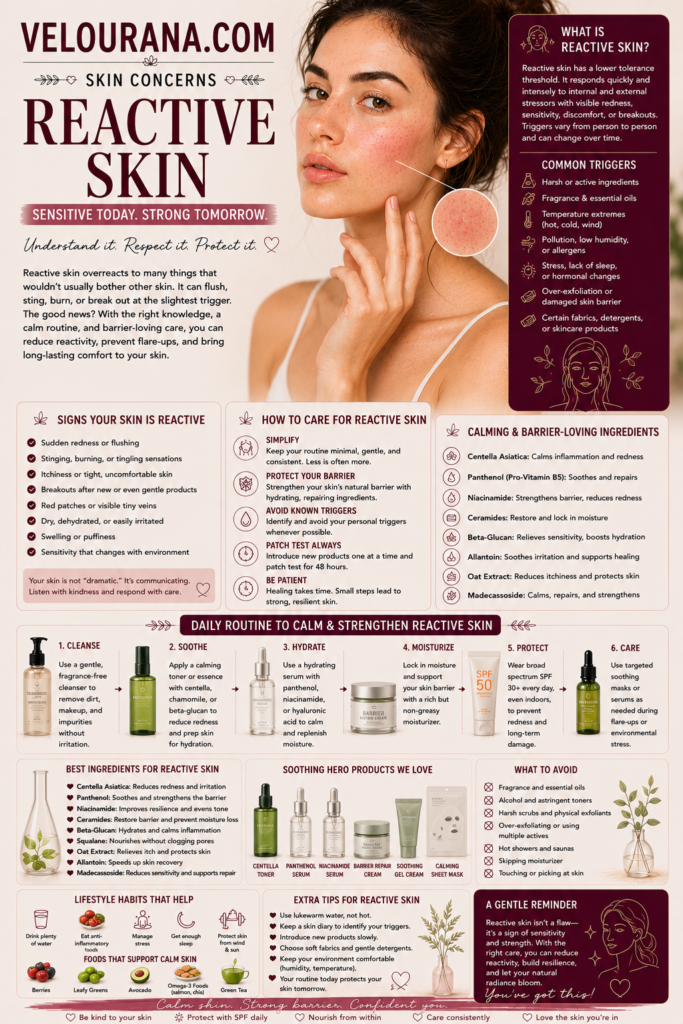
CATEGORY: Reactive Skin
One of the most unsettling things about reactive skin is not simply that it reacts. It is that the rules seem to change.
On Monday, a moisturizer feels perfectly comfortable. On Thursday, the same moisturizer produces a faint sting around the nose. A cleanser may work beautifully throughout summer and suddenly leave the face tight when autumn arrives. Makeup that normally disappears into the complexion can feel uncomfortable after a windy afternoon. Even water can occasionally seem irritating when the skin is already unsettled.
This inconsistency encourages a familiar conclusion: My skin hates everything.
Usually, that is not the most useful interpretation.
Reactive skin is better understood as skin with a variable tolerance threshold. What the complexion comfortably handles today depends partly on what has happened to it before the product ever touches the face. Weather, ultraviolet exposure, cleansing, friction, exfoliation, active ingredients, hydration, heat and the general condition of the skin barrier can all influence how the next exposure feels.
This means that a reaction is not always evidence that the final product applied was solely responsible. Sometimes it was simply the last contribution to a much larger accumulation of stress.
Understanding this changes the way reactive skin can be managed. Instead of endlessly classifying products as “good” or “bad,” skincare becomes an exercise in recognizing patterns, protecting tolerance and knowing when to simplify.
That is a far more realistic way to understand a complexion whose needs are not identical every day.
Skin Tolerance Is Not a Fixed Number
We often speak about skin type as though it were a permanent specification.
Dry. Oily. Combination. Sensitive.
These categories can be useful, but real skin is dynamic. Its condition changes in response to environment, behaviour, products and physiology. Even someone whose underlying skin type remains relatively stable can experience substantial differences in comfort from one period to another.
Reactive skin makes those fluctuations particularly noticeable.
Imagine skin tolerance as a moving ceiling rather than a fixed wall. Under comfortable conditions, the ceiling may be relatively high. The skin tolerates cleansing, sunscreen, makeup and a carefully chosen treatment without complaint.
Then circumstances change.
Cold weather arrives. Indoor heating dries the environment. The person exfoliates more frequently because the skin looks dull. A new cleanser is introduced. Makeup is removed more vigorously than usual.
None of these events necessarily creates dramatic irritation independently.
Together, however, they may lower tolerance.
Now the moisturizer that was previously uneventful produces stinging.
The instinctive response is often to blame the moisturizer because it was the product being applied when discomfort appeared. Yet chronology does not always establish cause. The moisturizer may merely have encountered skin that was already irritated.
This distinction is extremely important.
If every product that stings compromised skin is permanently classified as unsuitable, someone with reactive skin can eventually eliminate products that were never the fundamental problem.
The more informative question is whether the same product repeatedly causes the same response when the skin is otherwise stable.
Repetition reveals patterns.
One isolated episode provides much less certainty.
The Cumulative-Stress Effect
Reactive skin rarely experiences the day as a series of completely separate events.
Skin experiences accumulation.
Morning cleansing is followed by skincare. Skincare is followed by sunscreen. Sunscreen may be followed by makeup. Then comes sunlight, heat, cold, wind, sweat, pollution or air conditioning. At night, everything is removed, sometimes with two cleansing stages, before another collection of products is applied.
Each step may be reasonable.
The cumulative experience can still become excessive.
This is one reason why a routine composed entirely of individually respected products can nevertheless become irritating.
Suppose a person uses an exfoliating toner three evenings each week. They also use a retinoid on alternating evenings, a strong vitamin C formula in the morning and an acne treatment when blemishes appear. Every product has a legitimate purpose.
But the skin does not care that each product has excellent reviews.
It experiences the combined biological effect.
When several treatments influence exfoliation, cellular turnover or barrier function, the total routine may exceed what that individual complexion tolerates. The resulting redness can then be mistakenly interpreted as evidence that another product—the cleanser, moisturizer or sunscreen—is defective.
Reactive skin therefore benefits enormously from thinking in terms of total load.
This idea extends beyond active ingredients.
Mechanical friction contributes to the load.
Hot water contributes.
Dry weather contributes.
Sun exposure contributes.
Repeated cleansing contributes.
An irritating cosmetic contributes.
One isolated factor may be tolerable. Several occurring together may not be.
This explains why reducing a routine temporarily can be so informative. It removes some of the accumulated load and makes it easier to determine whether the skin becomes more comfortable.
When the Barrier Is Under Pressure
The skin barrier has become one of the most discussed concepts in contemporary skincare, sometimes to the point where every problem is casually described as “barrier damage.”
The reality deserves more precision.
The outermost layer of the epidermis, particularly the stratum corneum, plays a critical role in limiting water loss and protecting the body from the external environment. When this barrier is functioning poorly, the skin may become drier and more susceptible to irritation.
Sensitive skin research has identified barrier impairment as one factor that can contribute to heightened sensitivity, although it is not the only mechanism involved. Differences in sensory nerve responses and other biological processes also appear important.
For the person looking in the mirror, however, the practical consequences can be straightforward.
Skin that is under pressure may begin to feel tight after cleansing.
Products may sting.
Areas around the nose or mouth may become flaky.
The cheeks may become more easily flushed.
The complexion may feel simultaneously dry and uncomfortable even if it normally produces plenty of oil.
This is where another misconception becomes important: oily skin cannot have barrier problems.
It can.
Oil production and barrier condition are related to different aspects of skin physiology. A person can have a naturally oily complexion and still experience irritation, dehydration or sensitivity.
Responding by aggressively degreasing the face can make the situation worse.
When reactive skin feels uncomfortable, the objective should not automatically be to remove more oil, exfoliate more thoroughly or “deep clean” the complexion.
Sometimes the skin needs fewer interventions rather than stronger ones.
Weather Can Change the Meaning of a Routine
A skincare routine that works throughout the year is convenient.
For reactive skin, it may not always be realistic.
Winter presents one set of challenges. Cold outdoor air, wind and heated indoor environments can contribute to dryness and discomfort. Summer presents another combination: heat, perspiration, stronger ultraviolet exposure and potentially more frequent cleansing.
Transitions between environments can matter as well.
Someone walks through cold winter air and enters a strongly heated building. The face flushes.
Someone leaves an air-conditioned room and steps into intense summer heat. The skin suddenly feels warm.
Someone spends a windy afternoon outdoors and discovers that their evening skincare stings despite having caused no problems that morning.
The routine did not necessarily change.
The context did.
This is why reactive skin should be managed seasonally rather than ideologically.
A lightweight moisturizer that is ideal in humid weather may provide insufficient comfort during a dry winter. A rich cream that feels protective in January may become unpleasant in August.
Even cleansing needs can change. Someone wearing water-resistant sunscreen and makeup during summer may require more thorough evening cleansing than someone spending a quiet winter day indoors.
Good skincare adapts to circumstances.
It does not force the skin to obey a routine simply because that routine worked six months earlier.
The Difference Between a Trigger and the Final Straw
Identifying triggers is useful, but reactive skin creates an important investigative problem.
The product that immediately precedes discomfort is not necessarily the original trigger.
Consider an ordinary sequence.
On Sunday, the skin is exfoliated.
On Monday, a retinoid is applied.
On Tuesday morning, the weather is cold and windy.
On Tuesday evening, makeup is removed rather vigorously.
Then moisturizer is applied.
It burns.
Which event caused the burning?
It is tempting to answer: the moisturizer.
But the more accurate answer may be that the skin had accumulated several forms of stress and the moisturizer simply revealed how sensitized it had become.
This is the difference between a trigger and a final straw.
Sometimes they are the same thing. A genuinely irritating product can provoke discomfort directly.
Sometimes they are not.
This distinction prevents a particularly frustrating pattern in which someone repeatedly replaces gentle basic products while continuing the behaviours that are actually destabilizing the complexion.
They buy a new cleanser.
Then a new moisturizer.
Then a different sunscreen.
Then a calming serum.
Yet exfoliation continues at the same frequency, active ingredients remain heavily layered and cleansing remains aggressive.
Nothing improves because the investigation is focused on the wrong suspects.
When reactivity appears, it can therefore be useful to look backwards rather than only at the last application.
What happened during the previous twenty-four or forty-eight hours?
What changed?
Was anything used more frequently?
Was the weather unusual?
Was there prolonged sun exposure?
Was a new product introduced?
Was the skin already tight before the supposedly problematic product was applied?
Reactive skin often leaves clues before the dramatic moment.
Learning to notice those clues is one of the most valuable forms of skincare literacy.
Why More “Soothing” Products Are Not Always the Answer
The beauty industry has an enormous vocabulary for sensitive skin.
Calming. Comforting. Soothing. Barrier-supporting. Recovery. Rescue. Relief.
Some products carrying these descriptions can be excellent.
The problem begins when the label itself becomes evidence.
A product marketed as soothing is still a formulation containing multiple ingredients. Reactive skin responds to the formula, not the adjective printed on the packaging.
This matters because the instinctive response to irritation is often to purchase more products designed for irritation.
A calming toner is added.
Then a soothing serum.
Then a barrier essence.
Then a recovery cream.
The routine that originally contained four products now contains eight, all in the name of simplification.
Every additional formula introduces another variable.
For someone whose skin is already unstable, that can make troubleshooting considerably more difficult.
The better strategy is often to identify products that are already known to be well tolerated and use those as a temporary foundation.
This is where “boring” skincare becomes remarkably valuable.
A familiar cleanser that does not leave the skin tight.
A moisturizer that has repeatedly caused no difficulty.
A sunscreen that is comfortable enough to use consistently.
These products may not produce the excitement of a newly launched treatment, but reliability is an underrated skincare quality.
Reactive skin benefits from having a home base.
When something goes wrong, there should be a routine simple enough to return to.
The Problem with Chasing Immediate Results
Many modern skincare routines are designed around visible transformation.
Smoother texture. Faster fading of pigmentation. Fewer blemishes. Brighter skin. Reduced appearance of fine lines.
The desire for results is reasonable.
The difficulty is that faster treatment can also mean greater irritation potential, particularly when frequency and intensity are increased without allowing the skin to adapt.
Reactive skin is especially vulnerable to the belief that stronger must be better.
If exfoliating once weekly produces improvement, three times weekly must work faster.
If a low-strength treatment is tolerated, a higher concentration must produce superior results.
If one active ingredient is beneficial, combining several must accelerate progress.
Biology does not always reward that logic.
A treatment that produces theoretical benefits but repeatedly leaves the skin inflamed may be less useful in practice than a gentler strategy that can be maintained consistently.
This is particularly relevant because irritation itself can complicate cosmetic concerns. For some skin tones and individuals prone to post-inflammatory hyperpigmentation, repeated inflammation may contribute to unwanted discoloration after the irritation settles.
The most aggressive route toward brighter or clearer skin can therefore become self-defeating.
Reactive skin often rewards the slowest effective approach.
That does not mean abandoning meaningful treatments.
It means allowing tolerance to determine intensity rather than allowing impatience to determine it.
Why Friction Deserves More Attention
Ingredients receive enormous scrutiny.
Physical handling receives much less.
Yet reactive skin experiences both.
A perfectly gentle cleanser can become part of an irritating routine if it is massaged aggressively for several minutes. A soft towel can become abrasive when used to rub the face dry. Cotton pads repeatedly dragged across the skin can create mechanical stress. Facial brushes, cleansing devices and scrubs add another layer of friction.
Even makeup removal can become surprisingly aggressive when long-wearing products require repeated wiping.
This is why skincare technique deserves the same attention as skincare formulation.
Hands can usually accomplish cleansing without aggressive pressure.
Towels can absorb water without scrubbing.
Products can be spread rather than vigorously massaged.
The face does not need to feel polished after every cleanse.
For reactive skin, reducing unnecessary friction is particularly useful because it requires no additional product and no additional expense.
It is simply a change in behaviour.
This principle can extend beyond the bathroom.
Frequently touching the face, rubbing irritated areas, repeatedly checking rough patches with the fingertips or scratching itchy areas can prolong discomfort.
When skin feels unusual, people naturally pay more attention to it.
Unfortunately, that attention can become physical.
Sometimes one of the kindest things to do for reactive skin is to stop touching it.
Introducing New Products as Controlled Experiments
There is nothing inherently wrong with enjoying new skincare.
Reactive skin simply benefits from treating experimentation more carefully.
The worst possible testing environment is an entirely new routine.
If five products are introduced simultaneously and the face begins burning three days later, there is almost no useful information.
One product might be responsible.
Several might be interacting.
The reaction might reflect excessive cumulative activity rather than intolerance to any single formula.
Now imagine the opposite approach.
The existing routine is stable.
One new product is introduced.
Everything else remains unchanged.
The skin is observed.
If the product is tolerated, it can gradually become part of the routine before another variable is introduced.
This process is slower but enormously more informative.
Patch testing can add another layer of caution, particularly for someone with a history of reactions. It cannot perfectly predict how every formula will behave across the entire face, but it can sometimes reveal an obvious problem before widespread application.
Frequency also matters.
A product does not always need to begin with daily use simply because the instructions permit it. Depending on the ingredient and intended use, gradual introduction may make it easier to assess tolerance.
The purpose is not to make skincare unnecessarily complicated.
It is to make cause and effect easier to understand.
Reactive skin often becomes frustrating precisely because cause and effect have been obscured by too many simultaneous changes.
The Value of a Skin Diary
For persistent reactivity, memory is surprisingly unreliable.
People remember dramatic episodes.
They are less likely to remember the small circumstances surrounding them.
A simple skin diary can reveal patterns that intuition misses.
It does not need to become an elaborate scientific project. Recording the products used, unusual environmental exposure, new treatments and significant reactions may be enough.
After several weeks, associations can become visible.
Perhaps flushing repeatedly follows hot showers.
Perhaps stinging occurs mainly the morning after exfoliation.
Perhaps a moisturizer seems problematic only when used after another specific treatment.
Perhaps winter wind is a stronger trigger than any cosmetic.
Perhaps irritation repeatedly appears two days after introducing a particular product rather than immediately.
This information is much more useful than the vague impression that the skin is “always sensitive.”
A diary also reduces the temptation to rewrite history.
When a reaction occurs, people often become convinced that a product has always been problematic. Written observations may reveal that it was used comfortably for three months before another variable changed.
That does not prove the product is innocent.
But it improves the investigation.
Reactive skin becomes easier to manage when impressions are gradually replaced by patterns.
Knowing When Redness Needs More Than Skincare
Not every red or uncomfortable complexion should be managed exclusively through cosmetic experimentation.
Persistent or recurrent symptoms may indicate an underlying dermatological condition.
Rosacea can involve flushing, persistent redness, visible blood vessels, burning or stinging and acne-like bumps. Eczema can produce inflammation, dryness and itching. Contact dermatitis may develop after exposure to an irritant or allergen. Other conditions can also produce facial redness.
This is why duration and severity matter.
A brief episode after obvious over-exfoliation is different from redness that persists for months.
Mild temporary stinging is different from repeated swelling.
Occasional sensitivity is different from painful burning that interferes with normal skincare.
Eye symptoms accompanying facial redness deserve particular attention because ocular involvement can occur with rosacea and may require professional assessment.
Dermatologists can also investigate suspected allergic contact dermatitis through patch testing when appropriate.
The practical dividing line is simple: when the pattern is persistent, severe, unexplained, worsening or repeatedly returning despite sensible gentle care, diagnosis becomes more valuable than further cosmetic experimentation.
A skincare shelf cannot replace medical evaluation.
Creating More Good Skin Days
Reactive skin is often discussed almost entirely in terms of preventing bad days.
There is another way to frame the goal.
Create more good ones.
A good skin day does not necessarily mean flawless texture, invisible pores or perfect uniformity. It means the complexion feels comfortable enough that you are not constantly thinking about it.
Cleansing does not sting.
Moisturizer disappears without drama.
Sunscreen feels acceptable.
The face does not become increasingly tight throughout the afternoon.
There is no urgent need to inspect every patch of redness.
Those quiet days are valuable because they establish the skin's baseline.
Once you know what comfortable skin feels like, early signs of declining tolerance become easier to recognize.
Perhaps the first warning is tightness after washing.
Perhaps it is a faint sting around the nostrils.
Perhaps products begin feeling unusually warm during application.
These subtle changes can become signals to reduce optional treatments before the situation develops into obvious irritation.
Reactive skin management then becomes preventive rather than purely corrective.
Instead of waiting for a significant flare and then trying to rescue the complexion, you respond to the earliest evidence that its tolerance is declining.
The Routine Should Serve the Skin, Not the Calendar
Skincare schedules can be useful.
Retinoid Monday.
Exfoliation Wednesday.
Mask Friday.
Treatment Sunday.
Structure makes routines easier to remember.
But reactive skin does not read calendars.
If Wednesday arrives and the skin already feels tight, exfoliation does not become a good idea simply because the schedule says it is time.
This is one of the most useful distinctions between routine and rigidity.
A routine provides consistency.
Rigidity ignores feedback.
Reactive skin requires enough consistency to establish patterns but enough flexibility to respond when those patterns change.
That may mean skipping an active treatment after significant sun exposure.
It may mean using a richer moisturizer during unusually cold weather.
It may mean reducing cleansing intensity when the skin is already dry.
It may mean postponing the introduction of a new product until the complexion has returned to its usual baseline.
This is not inconsistency.
It is responsive skincare.
From Unpredictability to Understanding
Reactive skin may never become completely predictable.
That is not a failure.
Skin is living tissue interacting continuously with a changing environment. Expecting identical behaviour every day would be unrealistic even for someone who does not consider their complexion sensitive.
The objective is therefore not absolute control.
It is better interpretation.
Once the idea of a shifting tolerance threshold is understood, many previously confusing experiences begin to make sense.
A trusted moisturizer can sting without suddenly becoming a terrible product.
A routine can work beautifully in one season and require adjustment in another.
Several individually tolerable treatments can become irritating when combined too aggressively.
A reaction can reflect what happened yesterday as much as what was applied five minutes ago.
And the solution to irritation does not always need to come from another bottle.
Sometimes it comes from reducing frequency.
Sometimes from gentler cleansing.
Sometimes from less friction.
Sometimes from better environmental protection.
Sometimes from temporarily returning to familiar basics.
And sometimes, when redness is persistent or accompanied by other symptoms, the right solution begins in a dermatologist's office rather than the skincare aisle.
Reactive skin becomes easier to live with when every episode is no longer treated as a mystery requiring immediate correction.
Over time, patterns replace panic.
You begin to recognize the difference between a product that genuinely disagrees with your skin and a product encountering skin that was already compromised. You understand which environmental conditions lower your tolerance. You become more selective about introducing treatments and less impressed by routines that demand endless layers.
Most importantly, you stop asking the complexion to tolerate more simply because skincare culture says that more should produce better results.
For reactive skin, the most sophisticated routine is often the one that knows how to adapt.
Not every day requires treatment.
Not every sensation requires another product.
Not every episode of redness has the same explanation.
The skin's tolerance changes.
Good skincare notices.
The End
Velourana
Batch Progress: 2/5
 Discover More From Our Family of Websites
 ZodiacBearing (Astrology, Tarot, Numerology, Angel Numbers & Spiritual Guidance)
 Velourana (Beauty, Makeup, Hair Care, Skincare & Beauty Tips)
 HavenBearing (Home, Living, Organization, Décor & Everyday Inspiration)
 PawBearing (Pet Care, Dog Breeds, Animal Health, Training & Pet Products)
 PsyCatherine (Notes From the Journal of a Psychologist on Real Life)

