
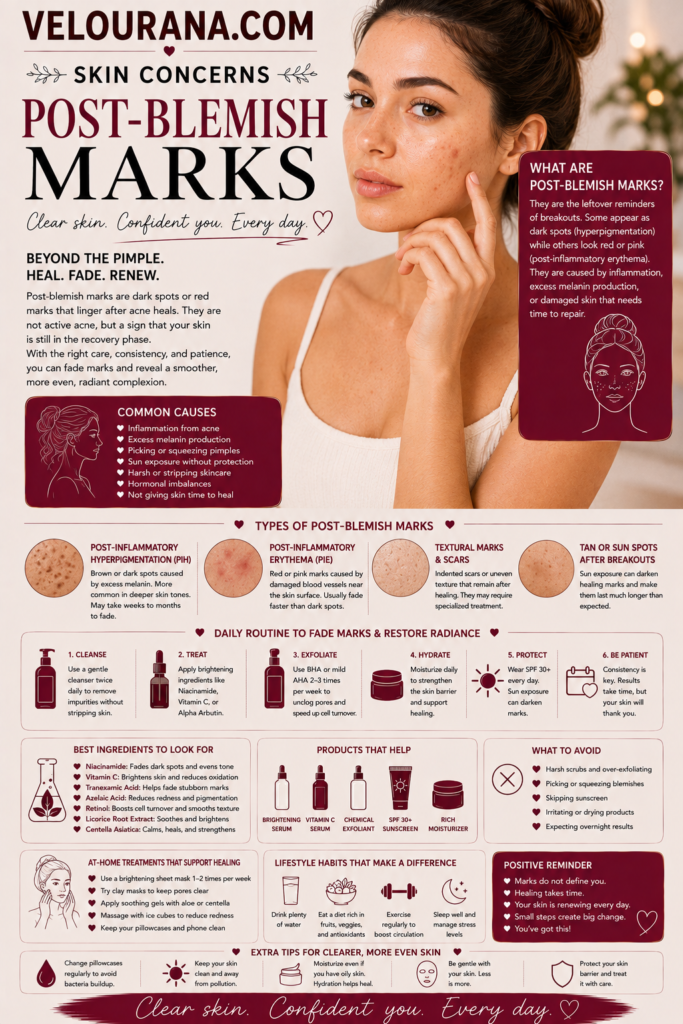
CATEGORY: Post-Blemish Marks
One of the most frustrating characteristics of acne is that it does not always leave when the blemish leaves. The swelling may disappear, the tenderness may resolve, and the surface of the skin may become smooth again, yet a visible reminder remains precisely where the inflammation once occurred. Sometimes it is pink or red. Sometimes it becomes brown, purple, grey, or a shade that seems deeper than the surrounding complexion. What lasted only a few days as an active blemish can remain noticeable for weeks or months afterward.
This imbalance between the relatively short life of a breakout and the much longer life of its aftermath can make post-blemish marks feel strangely permanent. They are usually not. In many cases, the skin is moving through a slow biological recovery rather than remaining frozen in a damaged state.
Understanding that recovery is important because it changes the way post-blemish marks should be treated. The temptation is to regard lingering colour as something sitting on top of the skin that must be scrubbed, peeled, or chemically erased. In reality, the visible mark often reflects processes occurring within living tissue: inflammatory signalling, vascular changes, altered pigment production, epidermal renewal, and the gradual restoration of normal skin behaviour.
The mark is not simply a stain.
It is evidence of what happened during the blemish and of what the skin is still doing afterward.
Acne Does Not End at the Surface
A blemish is easy to think of as a surface event because that is where we see it. A pore appears blocked, a bump develops, redness becomes visible, and eventually the lesion flattens. Yet acne originates within the pilosebaceous unit, the structure consisting of the hair follicle and its associated sebaceous gland.
Changes in sebum production, follicular keratinisation, microbial activity and inflammatory responses interact inside this structure. By the time a blemish becomes clearly visible, biological activity has already been taking place beneath the surface.
Inflammation is particularly important to what happens afterward.
The immune system responds to the developing lesion with chemical signals and cellular activity intended to contain the disturbance and begin repair. Blood flow can increase. Blood vessels become more noticeable. Pigment-producing cells may respond to inflammatory mediators. Tissue can become damaged if inflammation is sufficiently intense or deep.
When the raised blemish finally subsides, these processes do not necessarily reverse at the same speed.
Imagine removing scaffolding from a building renovation. The most obvious evidence of construction may disappear quickly, while finishing work continues inside. Skin behaves in a similarly layered way. The disappearance of the bump tells us that one stage has ended. It does not prove that every consequence of the inflammatory event has already resolved.
This explains why judging recovery exclusively by whether a blemish is flat can be misleading.
The surface may have recovered before colour has normalised.
Inflammation Can Change the Behaviour of Pigment Cells
Melanin is not an unwanted substance that exists merely to create pigmentation problems. It is an essential biological pigment produced by specialised cells called melanocytes. It contributes to skin, hair and eye colour and plays an important protective role against ultraviolet radiation.
The difficulty begins when inflammatory signals alter the normal regulation of pigment production.
During and after acne inflammation, melanocytes can become stimulated and produce increased amounts of melanin. Pigment may then accumulate in the affected area, leaving a darker macule after the active blemish has resolved. This phenomenon is known as post-inflammatory hyperpigmentation.
The intensity of the original blemish matters, but it is not the only factor. Individual skin biology strongly influences how readily pigmentation develops.
Two people can experience visually similar blemishes and emerge with very different aftermaths. One person's skin may return quickly to its baseline colour. Another person's skin may produce a dark mark after almost every inflammatory lesion.
Natural skin tone also influences how visible and persistent post-inflammatory pigmentation can become. In skin containing greater baseline melanin activity, inflammatory stimulation can produce particularly noticeable colour changes. This is why post-acne pigmentation is such an important consideration in darker skin tones and why acne treatment strategies should aim not only to clear lesions but also to minimise unnecessary irritation.
There is an important practical consequence here.
If inflammation helped create the mark, provoking additional inflammation is unlikely to be a sensible way to remove it.
Why Some Marks Are Red Instead of Brown
Not every lingering post-blemish mark is caused primarily by melanin.
A pink or red area can remain after acne because the vascular component of inflammation has not completely settled. Small blood vessels and inflammatory vascular changes can remain visible after the original lesion has flattened. This is commonly described as post-inflammatory erythema or post-acne erythema.
The distinction between erythema and hyperpigmentation can sometimes be obvious, but not always.
On lighter complexions, vascular marks may appear pink or bright red. On deeper complexions, they may appear darker red, burgundy, violet, or purplish and can be mistaken for pigment. Lighting further complicates perception. A bathroom mirror illuminated from above may make a mark appear entirely different from the same skin beside a window.
Some marks may also contain overlapping vascular and pigmentary changes.
This is one reason simplistic promises about a single "dark spot" ingredient can be disappointing. If the visible problem is substantially vascular, a treatment focused exclusively on melanin production is addressing only part—or perhaps very little—of what is creating the colour.
The behaviour of the mark can sometimes provide clues. Vascular redness may become more noticeable when the skin is hot, after exercise, following a hot shower, or whenever blood flow increases. Pigmentation tends to behave differently.
These observations cannot replace professional diagnosis, but they illustrate an important principle: colour is a symptom, not a complete diagnosis.
Pigment Has Depth
Even when a mark is genuinely post-inflammatory hyperpigmentation, not all pigment sits at the same depth.
Some excess melanin remains predominantly within the epidermis, the outermost major layer of the skin. Because epidermal cells continuously progress toward the surface and are eventually shed, pigment located here can gradually become less visible as normal turnover proceeds.
Other inflammatory processes can disrupt the boundary between the epidermis and deeper tissue sufficiently for pigment to become associated with the dermis. Deeper pigment tends to behave differently and may appear grey, blue-grey, or unusually persistent.
This helps explain why two dark marks of apparently similar size can fade at dramatically different speeds.
One may become noticeably lighter over several weeks. Another can remain for many months despite receiving the same skincare.
The difference does not necessarily mean that the second mark is being treated incorrectly. Its biology may simply make it slower to resolve.
This is one of the reasons skincare comparisons between individuals are so unreliable. A friend may report that a particular serum eliminated a mark within a month. Someone else may use the same product faithfully and experience a much slower change.
Neither experience establishes a universal timetable.
Pigmentation is influenced by its depth, the degree of inflammation that created it, natural skin tone, ongoing ultraviolet exposure, repeated irritation, age, treatment consistency and whether new acne continues to develop.
Skin does not fade according to a calendar printed on a product box.
Cell Turnover Is Gradual, Not an Overnight Reset
Beauty language often refers to "cell turnover" as though the skin periodically replaces itself in one coordinated event. The reality is continuous.
New keratinocytes form in deeper portions of the epidermis and gradually mature as they migrate toward the surface. Eventually they become part of the stratum corneum and are shed.
When excess pigment is distributed within epidermal cells, this ongoing movement contributes to gradual improvement.
But there is no midnight reset during which old skin disappears and pristine skin suddenly emerges.
The process is incremental, and its visible effect can therefore be difficult to recognise.
Suppose a mark becomes fractionally lighter each week. Looking at it every morning is unlikely to reveal a dramatic difference because today's appearance is being compared with yesterday's almost identical appearance. Compare a photograph taken today with one taken three months earlier under similar lighting, however, and the accumulated change may become obvious.
This difference between biological progress and human perception contributes substantially to frustration.
People frequently change routines because they believe nothing is happening when the treatment may not yet have been given enough time to demonstrate its full effect.
Constantly replacing products creates another problem: it becomes impossible to determine what the skin actually tolerates and what is helping.
A post-blemish routine needs enough stability for patterns to emerge.
Sun Exposure Can Keep the Pigment Conversation Going
Once inflammation has stimulated excess pigmentation, ultraviolet exposure can complicate the fading process.
Melanin production is naturally responsive to ultraviolet radiation. This is one of the skin's protective mechanisms. But when the objective is to allow an area of excess pigment to become less conspicuous, repeated stimulation of melanogenesis works against that objective.
For this reason, sunscreen is not merely an optional addition to a pigmentation routine.
It is part of the treatment environment.
A person can use carefully selected brightening ingredients every evening yet repeatedly expose the skin to substantial ultraviolet radiation during the day. The result is a routine with opposing biological signals: one part attempts to reduce uneven pigmentation while another continues stimulating pigment production.
Photoprotection helps remove that contradiction.
Broad-spectrum protection is particularly relevant because both UVA and UVB radiation matter to skin health, while visible light can also contribute to pigmentation in some skin types. Tinted sunscreens containing iron oxides may therefore be useful in certain pigmentation-focused routines, particularly for people with deeper skin tones.
Yet practical usability should not be forgotten.
A sunscreen that theoretically offers excellent protection but feels so uncomfortable that it is rarely worn provides little real-world benefit. Acne-prone skin may prefer lighter fluids, gels, emulsions, or other non-heavy formulations, although individual preferences vary enormously.
The best sunscreen for post-blemish care is ultimately one that provides appropriate protection and can be used consistently.
Picking Changes the Injury
There is a moment during the development of many blemishes when squeezing seems irresistible. The lesion feels temporary, visible, and removable. The fingers promise immediate action.
Unfortunately, manipulating a blemish can transform the nature of the inflammatory event.
Pressure may rupture follicular contents into surrounding tissue. Fingernails can damage the surface. Repeated squeezing can create additional swelling, bleeding, crusting, and inflammation. What began as acne becomes acne plus mechanical trauma.
The skin must then repair both.
This can increase the likelihood of persistent discoloration and potentially contribute to scarring when deeper tissue is damaged.
The consequences are especially frustrating because picking often creates the opposite of the intended cosmetic result. The person squeezes a blemish because they want it gone quickly, only to produce a mark that remains visible far longer than the original lesion would have.
This does not mean every touched blemish inevitably scars or pigments. Biology is more variable than that. But reducing unnecessary manipulation removes one controllable source of additional inflammation.
Hydrocolloid patches can sometimes be useful in this context, not because they magically cure every form of acne, but because covering a lesion can create a physical barrier between the blemish and restless fingers.
Sometimes the most effective treatment is preventing ourselves from becoming an additional source of injury.
Why Over-Exfoliation Can Make Marks Look Worse
Exfoliation has an understandable appeal when dealing with discoloration.
If excess pigment exists in epidermal cells, encouraging turnover appears logical. Alpha hydroxy acids, beta hydroxy acids and retinoids can indeed have useful roles in routines addressing acne, texture and uneven pigmentation.
The mistake is assuming that increasing intensity indefinitely produces proportionally faster fading.
Skin has tolerance limits.
Excessive exfoliation can cause burning, stinging, peeling, redness, dryness and barrier impairment. In skin prone to post-inflammatory pigmentation, the resulting irritation can itself become another inflammatory stimulus.
A person can therefore enter an unfortunate cycle.
A dark mark causes concern. Strong acids are applied frequently. The skin becomes irritated. More pigmentation develops or existing colour appears more prominent against inflamed surrounding skin. The person interprets this as treatment failure and exfoliates even more aggressively.
The solution is not necessarily abandoning effective active ingredients. It is using them within a routine the skin can tolerate.
Frequency matters. Concentration matters. Formulation matters. Combining ingredients matters. Individual sensitivity matters.
There is no universal requirement to feel burning, peeling, or tightness for a treatment to be effective.
Discomfort is not proof of progress.
The Barrier Determines How Much Treatment the Skin Can Carry
Healthy skin is not passive packaging around active ingredients.
Its barrier influences hydration, sensitivity, resilience and the ability to tolerate treatment. When the barrier is repeatedly disrupted, even normally gentle products may begin to sting.
This has important consequences for post-blemish care because pigmentation routines often involve ingredients that can be irritating, particularly when introduced too quickly.
Moisturizer therefore deserves a more serious role than simply making the face feel soft.
Humectants can help attract and retain water. Emollients can smooth spaces between surface cells. Occlusive components can reduce excessive water loss. Different moisturizers combine these functions in different proportions, allowing people with oily, dry, combination or sensitive acne-prone skin to find textures appropriate to their needs.
A well-supported barrier can make it possible to use acne and pigmentation treatments consistently.
That consistency is frequently more important than maximum intensity.
Consider two routines. The first uses several powerful active products but causes irritation every few weeks, forcing treatment to stop until the skin recovers. The second uses fewer actives at tolerable frequencies and continues uninterrupted for months.
The second routine may ultimately accomplish far more.
Skincare is cumulative. Reliability has power.
Treating New Acne Is Part of Treating Old Marks
Post-blemish marks are often approached as though they exist independently from acne.
In practice, the two problems remain connected.
If someone develops a new inflammatory lesion every few days, the complexion accumulates marks faster than older ones can disappear. Even if every individual mark is gradually fading, the overall number of visible spots may remain constant or increase.
This creates the impression that pigmentation treatment does not work.
The underlying arithmetic is simple.
Fading must eventually exceed formation.
Controlling acne therefore changes the entire trajectory of post-blemish recovery. Once fewer new lesions appear, the skin has an opportunity to reduce the accumulated backlog of discoloration.
This is why ingredients with activity relevant to both acne and pigmentation can be particularly useful in appropriately selected routines.
Azelaic acid is one example because of its anti-inflammatory, acne-related and pigmentation-related properties. Retinoids can also play a dual role by helping prevent comedonal acne while influencing epidermal turnover and pigmentation. Salicylic acid may assist with clogged pores while providing exfoliation.
These ingredients are not interchangeable, and not every person needs all of them.
The broader lesson is more important than the specific ingredient: a post-blemish routine should not become so obsessed with yesterday's marks that it neglects tomorrow's blemishes.
Brightening Ingredients Work Through Different Pathways
The phrase "brightening ingredient" can create the impression that all pigmentation products perform essentially the same function.
They do not.
Different ingredients intervene at different points in the pigmentation process.
Some influence tyrosinase, an enzyme involved in melanin synthesis. Others affect inflammatory pathways. Some influence pigment transfer between cells. Others encourage epidermal turnover, gradually changing how pigment is distributed through the outer skin.
Vitamin C is widely used because of its antioxidant properties and its role in approaches to uneven pigmentation, although formulation stability and tolerability can vary significantly.
Niacinamide has become popular partly because it can support barrier function while also influencing pigmentation pathways.
Azelaic acid is valuable in acne-prone contexts because it can address more than one dimension of the problem.
Retinoids influence cellular turnover and have extensive use in acne management, although irritation must be controlled.
Alpha hydroxy acids such as glycolic or lactic acid can contribute to exfoliation and improvement in uneven surface pigmentation, but stronger or more frequent use is not necessarily superior.
Dermatologists may also prescribe stronger depigmenting treatments when appropriate.
The intelligent way to combine these approaches is not to collect as many mechanisms as possible. It is to identify a manageable strategy that addresses the major problem without destabilising the skin.
A carefully designed routine may contain one principal treatment active rather than five competing ones.
Why New Products Should Be Introduced Slowly
There is another practical advantage to simplicity: diagnosis.
Suppose someone begins using a retinoid, vitamin C serum, exfoliating toner and azelaic acid during the same week. Ten days later, the skin becomes red and irritated.
Which product caused it?
Perhaps one ingredient was responsible. Perhaps the problem was the combination. Perhaps each product would have been tolerated individually but the cumulative load became excessive.
Now imagine the opposite outcome: pigmentation begins improving significantly after eight weeks.
Which treatment deserves credit?
Again, it is impossible to know.
Introducing products gradually allows the skin's response to be observed. It also makes it easier to distinguish temporary adjustment from persistent intolerance and to identify combinations that are simply too demanding.
This is especially important for people whose skin has already become reactive through years of aggressive acne treatment.
The objective is not to prove how much treatment the skin can survive.
It is to discover the least complicated routine that produces meaningful improvement.
Hormonal and Recurrent Acne Can Change the Timeline
For some people, post-blemish marks are not difficult primarily because individual spots fade unusually slowly. They are difficult because new inflammation continues appearing in predictable cycles.
Hormonal acne is a common example.
Recurring lesions around the jawline, chin, lower face or other characteristic areas can continually renew pigmentation. One month's marks begin fading just as the next month's lesions appear.
Topical brightening products may improve the aftermath without addressing the driver of repeated inflammatory acne.
Persistent, painful, cystic, nodular, scarring or otherwise difficult-to-control acne deserves medical assessment rather than endless experimentation with cosmetic products.
Dermatologists have access to topical and systemic treatments that target acne more directly. Depending on the individual, these may include prescription retinoids, antimicrobial approaches, hormonal therapies or other medications.
Addressing the source of recurrent inflammation can sometimes do more for long-term pigmentation than adding another brightening serum.
Prevention is not less sophisticated than correction.
In acne care, prevention is often the most powerful form of correction available.
Texture Requires a Different Conversation
A mark that refuses to disappear is frustrating. A depression that remains after the colour fades presents a different problem.
Structural acne scars occur when the repair process alters collagen architecture. Atrophic scars form when tissue volume is lost, producing indentations. Hypertrophic or keloid scars involve excessive tissue formation and appear raised.
Topical skincare can improve general skin quality and may soften the visual contrast around mild irregularities, but it cannot be expected to reconstruct significant deep scarring in the way a targeted medical procedure may.
Dermatological scar treatments can include microneedling, subcision, chemical reconstruction techniques, fractional lasers, fillers and other approaches selected according to scar type.
This is precisely why the early distinction between marks and scars matters.
A person can spend years attempting to "fade" something that is actually a shadow created by an indentation. No amount of pigment inhibition can remove a shadow produced by altered skin architecture.
Likewise, someone may assume that flat brown marks are permanent scars when they are actually pigmentation capable of substantial natural and treatment-assisted fading.
Correct identification prevents both unnecessary pessimism and unrealistic expectations.
Progress Is Better Measured Monthly Than Daily
Post-blemish recovery challenges the way humans naturally monitor change.
We are excellent at noticing sudden differences and poor at perceiving extremely gradual ones.
Looking closely at the face every morning can therefore create an inaccurate impression of stagnation. Yesterday's mark looks almost identical today. Tomorrow it will probably look almost identical again.
But small differences accumulate.
A useful way to evaluate a routine is to take occasional photographs under approximately the same conditions: similar time of day, similar lighting, similar camera distance, and no filters or beauty processing.
The purpose is not obsessive documentation. It is the opposite.
It allows the skin to be judged across meaningful intervals rather than subjected to constant inspection.
Progress should also be evaluated through more than pigment intensity.
Are fewer inflammatory blemishes appearing? Are existing lesions healing faster? Is the skin less irritated? Are old marks becoming less sharply defined? Is makeup requiring less coverage? Does the complexion look more even from normal conversational distance?
These are all meaningful signs.
A skincare routine should improve the behaviour of the skin, not merely satisfy a daily close-up examination.
When Waiting Is Sensible and When It Is Not
Patience is valuable in post-blemish care, but patience should not become an excuse to ignore problems that deserve professional attention.
Flat marks that are gradually becoming lighter may simply require time and consistent management.
Marks that are changing unexpectedly, bleeding, crusting repeatedly, growing or behaving unlike ordinary post-acne discoloration should not automatically be assumed to be acne remnants.
Persistent severe acne, deep nodules, frequent cysts and developing scars are also reasons to seek dermatological assessment earlier rather than waiting until substantial scarring has accumulated.
Likewise, pigmentation that remains extremely persistent despite appropriate care may benefit from professional evaluation. A dermatologist can distinguish between different pigmentary and vascular conditions and recommend stronger treatment when justified.
Professional advice is particularly valuable before aggressive procedures, strong peels or energy-based treatments.
Skin tone matters when selecting these interventions because the risk of treatment-induced pigmentation varies. A procedure that creates controlled inflammation must be carefully calibrated in someone whose skin readily responds to inflammation by producing additional pigment.
The objective is improvement without exchanging one problem for another.
Slow Fading Is Still Fading
The language of modern skincare often makes gradual improvement sound like failure.
Products promise rapid transformation. Before-and-after photographs compress months into seconds. Social media encourages constant switching from one trending active ingredient to another.
Skin biology remains unimpressed by the marketing calendar.
Post-blemish marks often require time because the processes that created them occurred within living tissue and the processes that resolve them must also occur within living tissue.
Inflammation must settle. Vascular changes must normalise. Pigment production must become regulated. Melanin already present must be redistributed or gradually removed. Epidermal cells must continue their natural progression. The barrier must remain sufficiently stable to tolerate treatment. Meanwhile, new acne must be controlled so that the skin is not continually receiving fresh inflammatory injuries.
Seen this way, slow fading stops looking mysterious.
It becomes biologically logical.
The goal is not to force the skin to erase its recent history. It is to stop adding new chapters while allowing old ones to become progressively less visible.
A good post-blemish routine therefore has a quiet quality. It is consistent rather than dramatic. It protects more than it attacks. It uses targeted treatment without treating irritation as evidence of effectiveness. It recognises that acne control, pigmentation management, barrier health and photoprotection are not separate projects but parts of the same recovery process.
Eventually, many marks reach a point where they no longer command attention.
They become lighter, softer at the edges and less distinct from the surrounding complexion. The change may happen too slowly to witness directly, yet photographs reveal it. A spot once examined every morning becomes difficult to locate.
That is the nature of post-blemish recovery.
The skin rarely announces that it has healed.
It simply leaves less and less behind.
The End Velourana
 Discover More From Our Family of Websites
 ZodiacBearing (Astrology, Tarot, Numerology, Angel Numbers & Spiritual Guidance)
 Velourana (Beauty, Makeup, Hair Care, Skincare & Beauty Tips)
 HavenBearing (Home, Living, Organization, Décor & Everyday Inspiration)
 PawBearing (Pet Care, Dog Breeds, Animal Health, Training & Pet Products)
 PsyCatherine (Notes From the Journal of a Psychologist on Real Life)

