CATEGORY: Hyperpigmentation
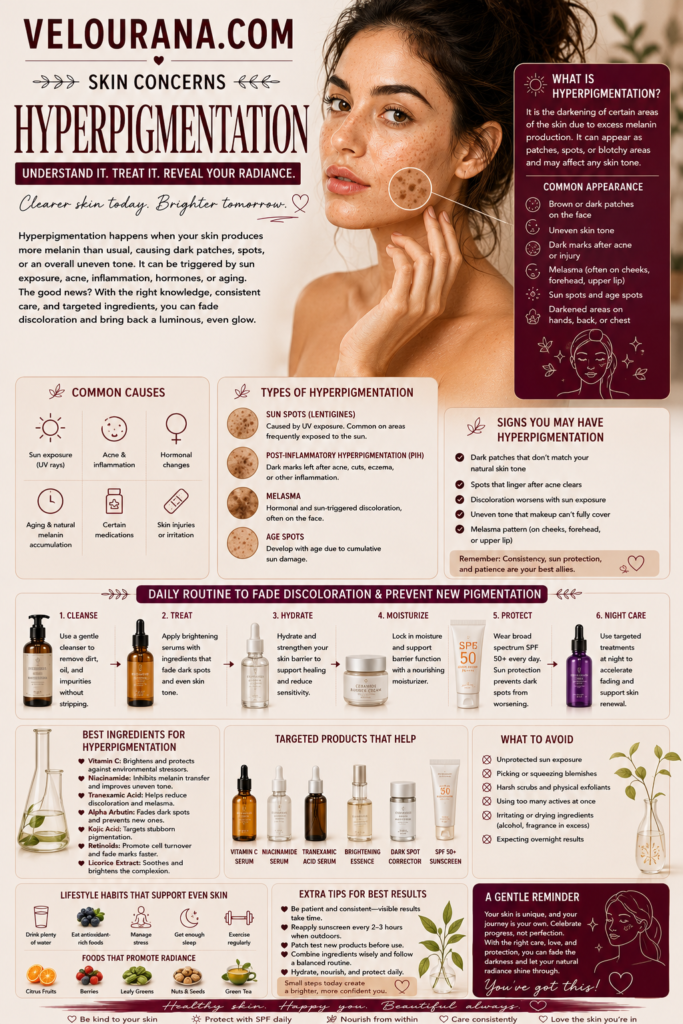
Hyperpigmentation is frequently discussed as though it were a single visual problem with a single ideal solution.
A darker patch appears. A serum is recommended. The expectation is that the colour should gradually disappear.
But skin pigmentation is not that uniform.
Two people can develop marks after apparently similar acne lesions and end up with completely different patterns. One person may notice a light brown mark that fades steadily over several months. Another may develop a deeper grey-brown area that remains visible far longer. A third may find that every minor irritation leaves a noticeable trace.
The difference is not necessarily that one person is taking better care of the skin.
Pigmentation reflects a complex interaction between melanocyte activity, inflammation, skin tone, pigment depth, environmental exposure, hormonal influences, genetics and the repeated behaviour of the skin over time.
This is why hyperpigmentation can look so different from one face to another.
The visible mark is only the surface expression of a much larger biological process.
Skin Tone Changes the Way Pigmentation Behaves
All skin contains melanocytes.
What differs substantially between individuals is not simply the number of these pigment-producing cells but how active they are, how melanin is produced and distributed, and how the skin responds to different stimuli.
In darker skin tones, melanocytes can produce larger and more persistent pigment responses after inflammation.
This is one reason post-inflammatory hyperpigmentation can be particularly noticeable after acne, eczema, burns, procedures or other inflammatory events.
A blemish that disappears relatively quickly may leave behind pigmentation that becomes the more persistent concern.
This creates a different treatment experience from the one often represented in generic skincare advertising.
Someone with pale skin may be primarily concerned with redness after a blemish.
Someone with a deeper skin tone may be more concerned about the brown or grey-brown pigmentation that remains after the redness has resolved.
These are not necessarily the same process.
Understanding the distinction matters because treatment chosen for persistent redness may not address excess melanin, while an excessively aggressive pigmentation treatment can create additional inflammation and ultimately worsen discoloration.
Skin tone therefore changes more than the colour of hyperpigmentation.
It can change how strongly the skin responds to inflammation, how visible that response becomes and how cautiously treatment needs to be approached.
The Colour of a Mark Can Reveal Its Depth
Not all pigmentation sits at the same level within the skin.
Some excess pigment is concentrated primarily in the epidermis, the outer region of the skin.
Other pigmentation extends deeper into the dermis.
This difference can influence both appearance and persistence.
Superficial epidermal pigmentation often appears brown.
Deeper dermal pigment may appear more grey, blue-grey or slate-like because of the way light interacts with pigment located beneath the surface.
This distinction helps explain why two similarly sized marks can respond differently to the same treatment.
Surface-oriented exfoliation may assist epidermal pigmentation by supporting turnover of pigmented keratinocytes.
The same treatment may have a more limited effect on pigment situated deeper in the skin.
That deeper pigment has a different biological context.
When inflammation damages the epidermal-dermal junction, melanin can enter the dermis, where it may be engulfed by macrophages.
Once pigment reaches this deeper location, fading may become much slower.
The visible difference between brown and grey-brown pigmentation is therefore not merely cosmetic.
It can sometimes reflect a meaningful difference in depth.
This is one reason persistent pigmentation may benefit from professional assessment when ordinary topical treatment produces little change.
The Same Acne Lesion Can Leave Different Memories
Acne provides one of the clearest examples of individual pigment response.
Imagine two people developing a similar inflammatory blemish.
Both lesions become red, swollen and tender.
Both eventually heal.
On the surface, the initial event appears almost identical.
Yet the aftermath may be completely different.
One person develops no residual pigmentation.
The other develops a dark mark that remains for months.
Several factors can contribute to this difference.
Skin tone matters.
The intensity and duration of inflammation matter.
Picking or squeezing can increase injury.
Sun exposure can darken existing pigmentation.
Individual melanocyte responsiveness can differ.
The depth of inflammation may also influence the depth at which pigment becomes deposited.
This means that the pigmentation left behind after acne is not a simple measure of acne severity.
A relatively small blemish can occasionally produce disproportionately persistent discoloration in someone whose skin is highly pigment-reactive.
This is why controlling inflammation early can be especially valuable for people who know from experience that every blemish leaves a mark.
In these cases, preventing the inflammatory event may offer more benefit than repeatedly treating the pigmentation afterward.
Genetics Quietly Shape Pigment Behaviour
Skincare culture often encourages the idea that every visible problem can be controlled through the correct product.
Genetics complicate that expectation.
Some people simply have a stronger tendency toward particular pigmentary conditions.
Melasma is a good example.
Family history is common, and genetic susceptibility appears to play an important role in determining who develops it.
This does not mean that pigmentation is genetically predetermined in an absolute sense.
Environmental and hormonal factors still matter.
But genetics influence the background on which those factors act.
Two people can receive similar sun exposure, yet only one develops prominent melasma.
Two people can experience similar inflammation, yet one develops long-lasting PIH.
The difference may partly reflect inherited characteristics of pigment regulation.
Recognising this can change the goal of skincare.
If someone has a strong biological predisposition toward pigmentation, the objective may not be to make the skin behave exactly like skin without that predisposition.
The objective may be to reduce triggers, maintain stability and keep pigmentation as controlled as possible.
That is not a lesser outcome.
It is a more biologically realistic one.
Hormones Can Alter the Pigmentary Landscape
Hormonal influences add another layer of individuality.
Melasma is strongly associated with hormonal factors in some people.
Pregnancy can trigger or intensify pigmentation.
Hormonal contraceptives and other hormonal circumstances can also contribute.
This creates a pattern that may appear mysterious if the skin is considered only from the outside.
A person may use the same skincare routine for years without significant pigmentation.
Then pigmentation develops during pregnancy or after a hormonal change.
The assumption may be that the skincare routine suddenly stopped working.
In reality, the skin's internal signalling environment changed.
This is one reason pigmentation history matters.
When did it begin?
Did it coincide with pregnancy?
Did it worsen after a hormonal medication?
Did it change after menopause?
Does it fluctuate over time?
These questions can reveal patterns that are invisible when attention is limited to the surface appearance of a dark patch.
Pigmentation is not always created by something applied to the skin.
Sometimes the relevant signal originates within the body.
Light Exposure Affects Different Skin Differently
Sunlight is one of the most universal pigmentation triggers, but its visible consequences are not identical in everyone.
Some people freckle.
Some tan.
Some develop solar lentigines after years of cumulative exposure.
Some notice worsening melasma.
Some see existing PIH become darker or more persistent.
The relationship between sunlight and pigmentation also involves more than ultraviolet radiation.
Visible light has become an increasingly important consideration in hyperpigmentation, particularly in darker skin tones and melasma.
This helps explain why tinted sunscreens containing iron oxides are often discussed in pigmentation-focused skincare.
The important principle is that photoprotection should be matched to the problem being managed.
Someone primarily trying to prevent sunburn may have different practical priorities from someone trying to stabilise melasma.
For pigmentation-prone skin, protection needs to be consistent enough to reduce repeated stimulation of melanogenesis.
The routine does not need to become obsessive.
But it does need to acknowledge that light exposure is cumulative.
A brief walk, a commute, outdoor lunch and several hours near daylight may collectively matter more than a single dramatic episode of sun exposure.
This is especially important for people who believe they are "never really in the sun" because they rarely spend entire days outdoors.
Inflammation Is Not Equal in Every Person
Inflammation is another shared biological process that produces highly individual outcomes.
One person's skin can tolerate frequent exfoliation with minimal visible consequences.
Another develops redness, stinging and pigmentation after a few applications.
This difference can be partly explained by barrier resilience, sensitivity and pigment reactivity.
It also means skincare advice cannot be judged only by whether a product is considered effective in general.
A strong acid may have well-established exfoliating effects.
But if it repeatedly irritates a particular person's skin, those theoretical benefits may be outweighed by the pigmentary consequences of inflammation.
This is particularly relevant in darker skin tones, where post-inflammatory pigment changes can be more noticeable and persistent.
The best routine therefore cannot be defined solely by ingredient strength.
It has to account for the individual threshold at which treatment becomes irritation.
That threshold varies enormously.
Some people can introduce a retinoid with relatively little difficulty.
Others need far slower adaptation.
Some tolerate glycolic acid well.
Others develop persistent sensitivity.
The same active ingredient can therefore be helpful for one person's pigmentation and counterproductive for another.
Barrier Condition Changes Treatment Response
The condition of the skin barrier influences how pigmentation treatments are experienced.
When the barrier is healthy, active ingredients may be tolerated more predictably.
When it is compromised, products that were previously comfortable can begin to sting or burn.
This matters because pigment correction often relies on treatments that can themselves be irritating.
Retinoids, alpha-hydroxy acids and certain pigment-targeting agents can all challenge tolerance.
If the skin barrier is already unstable, the same routine can produce disproportionately more inflammation.
This is one reason someone may suddenly become unable to tolerate a product used successfully in the past.
The product has not necessarily changed.
The skin has.
Weather, over-cleansing, previous exfoliation, medication and other factors can alter barrier function.
A routine that ignores those changes may create exactly the kind of inflammatory environment that increases pigment risk.
Moisturising therefore becomes more than a comfort measure.
It can help create the conditions under which corrective treatment remains tolerable.
The best pigmentation routine is not merely active.
It is sustainable.
Location on the Face Can Influence Pigmentation
Pigmentation does not always distribute randomly.
The cheeks, forehead, upper lip, temples and jawline may behave differently because they experience different combinations of light exposure, inflammation, friction and hormonal influence.
Melasma often develops in recognisable facial patterns.
Post-acne pigmentation follows the distribution of acne.
Repeated friction near the jawline or around areas touched by clothing or equipment can contribute to local irritation.
Hair removal may create recurrent inflammation in particular regions.
Even habitual behaviours can influence where pigmentation appears.
This means the map of pigmentation can sometimes provide clues.
A symmetrical pattern across both cheeks suggests something different from a single dark mark left after a blemish.
A cluster of marks in areas prone to shaving suggests a different history from diffuse pigmentation across the forehead.
Pattern recognition does not replace diagnosis.
But it can make pigmentation more understandable.
Instead of seeing scattered dark areas as isolated defects, the distribution may reveal the events that produced them.
Age Changes the Pigment Story
Pigmentation also changes across the lifespan.
Younger skin may primarily experience post-inflammatory marks associated with acne.
Later, cumulative sun exposure becomes increasingly visible.
Solar lentigines and uneven pigmentation can become more prominent.
Hormonal transitions may alter melasma.
Long-standing pigment patterns can coexist with newer ones.
This means that "hyperpigmentation" on mature skin may represent several processes at once.
A person may have old sun spots, post-inflammatory marks and melasma simultaneously.
Trying to treat all of them with a single product may produce disappointing results because each has a different biological background.
Age also changes the skin's tolerance.
A routine that felt comfortable in the twenties may feel excessively drying later.
Barrier recovery can become slower.
This can affect how aggressively pigmentation can be treated.
Again, the lesson is individualisation.
Pigmentation is not static because skin is not static.
Ethnicity and Skin Type Matter Without Defining the Whole Person
Pigmentation is often discussed using broad categories such as darker and lighter skin tones.
These categories are useful biologically, but they should not become simplistic assumptions.
People with similar visible skin tones can respond differently to inflammation and sunlight.
Ethnic background can influence prevalence of certain pigmentary concerns, but individual variation remains considerable.
This is why treatment should not be based entirely on appearance.
History matters.
Past responses matter.
Previous procedures matter.
How the skin reacted to acne matters.
How it reacted to sun exposure matters.
How it responded to acids, retinoids and other actives matters.
A person's own skin history is often one of the best predictors of how cautiously treatment should proceed.
Someone who knows that even minor irritation leaves dark marks should treat that pattern as useful information.
There is no advantage in proving that the skin can tolerate an aggressive routine.
The goal is improvement, not endurance.
Procedures Can Produce Very Different Outcomes
Professional procedures are often marketed as though technology eliminates individual variation.
It does not.
Chemical peels, lasers, IPL and other energy-based treatments can produce excellent results in appropriately selected patients.
But pigment response remains highly individual.
A procedure that produces dramatic improvement in one person can cause post-inflammatory pigmentation in another.
This is why skin tone, diagnosis, device parameters, practitioner experience and previous pigment history matter.
A laser does not simply remove colour.
It creates a biological event in the skin.
The skin then responds to that event.
In pigment-prone individuals, that response needs to be anticipated carefully.
This is particularly important for darker skin tones, where certain procedures require specialist expertise to reduce the risk of unwanted pigment changes.
Professional treatment should therefore be based on selection, not enthusiasm.
The fact that a device can treat pigmentation does not mean it is automatically suitable for every type of pigmentation or every skin tone.
Why Comparing Results Online Can Be Misleading
Hyperpigmentation is especially vulnerable to unrealistic comparison because transformation photographs are visually powerful.
A dramatic before-and-after image can suggest that everyone should achieve similar improvement within the same period.
But the photograph rarely reveals the complete biological context.
Was the pigmentation epidermal or dermal?
Was it PIH, melasma or sun-induced pigmentation?
What was the person's skin tone?
What treatments were used previously?
How much sun exposure occurred?
Were professional procedures involved?
How long had the pigmentation existed?
Was the photograph taken under identical lighting?
Without those details, comparison becomes almost meaningless.
Two marks that look similar in photographs may behave differently because their biological histories are completely different.
This is why someone else's six-week transformation should not become the timetable for your own skin.
Pigmentation treatment needs a personal baseline.
The Best Routine Is the One Built Around Your Pattern
Instead of searching for the universally perfect pigmentation routine, it is more useful to identify the pattern your own skin follows.
Does pigmentation appear mainly after acne?
Does it worsen in summer?
Does it appear symmetrically?
Does irritation create new marks?
Does pregnancy or hormonal change influence it?
Does the pigmentation look predominantly brown or more grey-brown?
Does it fade naturally or remain for years?
Do strong treatments consistently cause setbacks?
These observations can guide strategy.
If acne is the main trigger, preventing inflammatory lesions deserves priority.
If melasma is suspected, photoprotection and professional assessment become especially important.
If irritation repeatedly creates marks, barrier stability needs greater emphasis.
If pigmentation remains unchanged despite months of appropriate topical treatment, deeper pigment or a different diagnosis may need to be considered.
Personalisation does not require an enormous routine.
It requires paying attention to the pattern.
Uniform Advice Fails Because Skin Is Not Uniform
The beauty industry naturally prefers simple messages.
Use this ingredient.
Apply this serum.
Exfoliate twice a week.
Wear sunscreen.
Some of these recommendations are useful.
The problem appears when universal advice is mistaken for universal response.
Biology is variable.
One person needs more active treatment.
Another needs less.
One needs to control acne.
Another needs to manage melasma.
One responds well to exfoliation.
Another develops PIH from over-exfoliation.
One sees improvement in several months.
Another requires a much longer timeline.
This variability should not be interpreted as unpredictability.
It means the strategy needs to be matched to the skin.
Hyperpigmentation Is Personal Biology Made Visible
A dark mark is easy to see.
Its history is not.
Behind that mark may be inflammation, sun exposure, hormones, friction, genetics, barrier disruption, medication or years of cumulative environmental influence.
Sometimes several of these factors act together.
This is why hyperpigmentation looks different on every face.
The colour may differ.
The depth may differ.
The cause may differ.
The speed of fading may differ.
The risk of recurrence may differ.
The response to treatment may differ.
Understanding these differences removes much of the pressure to find a universal miracle product.
The more useful goal is to understand your own pigment pattern well enough to treat it intelligently.
For some people, the central task is fading old marks.
For others, it is preventing inflammation.
For others, it is controlling melasma.
For others, it is reducing years of cumulative sun-related pigmentation.
And for many people, it is a combination of several things.
Hyperpigmentation becomes easier to manage once it stops being treated as a generic flaw.
It is a biological response.
And like most biological responses, it makes more sense when viewed in context.
The End Velourana
 Discover More From Our Family of Websites
 ZodiacBearing (Astrology, Tarot, Numerology, Angel Numbers & Spiritual Guidance)
 Velourana (Beauty, Makeup, Hair Care, Skincare & Beauty Tips)
 HavenBearing (Home, Living, Organization, Décor & Everyday Inspiration)
 PawBearing (Pet Care, Dog Breeds, Animal Health, Training & Pet Products)
 PsyCatherine (Notes From the Journal of a Psychologist on Real Life)