
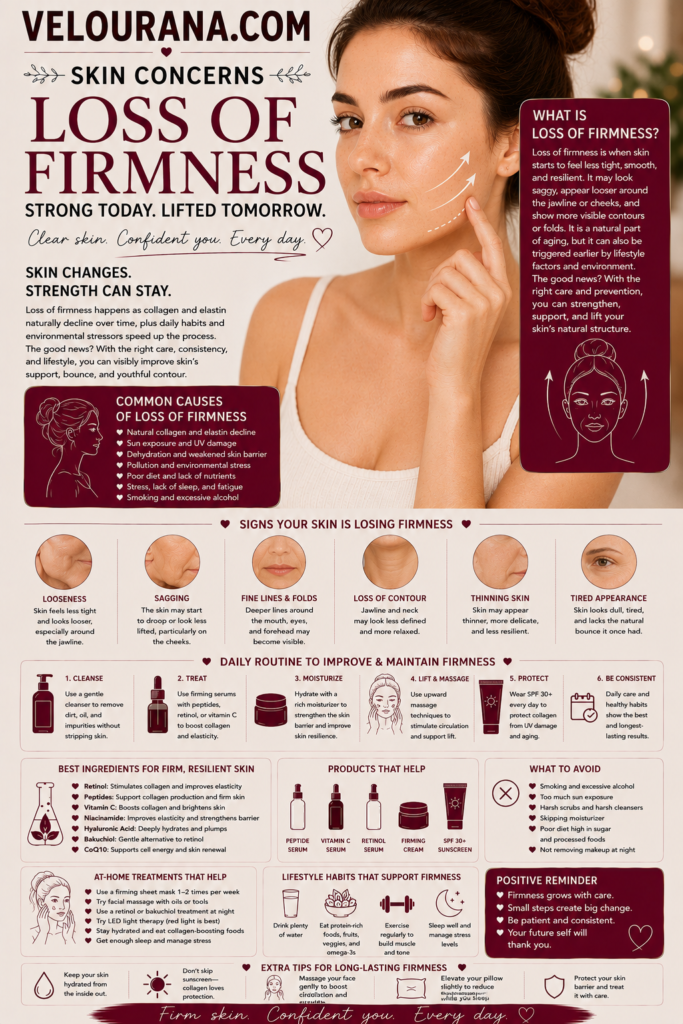
CATEGORY: Loss of Firmness
There is a particular moment in facial aging that many people notice before they can explain it. The skin may still be smooth. There may be no dramatic increase in wrinkles, no sudden pigmentation and no obvious change in complexion. Yet the face seems subtly different. The cheeks do not catch the light in quite the same way. The jawline appears softer in photographs. The transition between the chin and neck seems less sharply defined. Makeup that once emphasized familiar contours now seems to sit on a slightly altered landscape.
It is tempting to describe all of this as loose skin, but that explanation is incomplete.
The visible contours of the face are created by several anatomical layers working together. Skin is only the outermost one. Beneath it lie fat compartments, connective tissues, muscles and bone, all contributing to the shape that eventually appears in the mirror. Aging affects each of these structures differently and at different rates. What looks like a simple loss of firmness at the surface can therefore represent a much broader transformation underneath.
This matters enormously when choosing skincare.
If every contour change is interpreted as a collagen problem, almost every solution will be aimed at the dermis. Firming creams, collagen serums and tightening treatments will appear to be the obvious answer. Yet collagen is only part of the story. A face can lose definition because the skin has become less resilient, because facial volume has changed, because deeper support has altered, or because several of these processes are occurring simultaneously.
Understanding this layered architecture does not make skincare less valuable. It makes skincare more rational. It allows us to distinguish between improving the quality of the skin and attempting to alter the structure of the face itself.
And that distinction may be the single most important concept in understanding loss of firmness.
The Face Is a Structure, Not a Surface
Beauty is usually discussed from the outside inward.
We talk about complexion, pores, fine lines, pigmentation and texture because these are the things we can immediately see. But facial shape originates much deeper.
Bone provides the fundamental framework. Over it sit muscles and connective structures. Fat occupies distinct anatomical compartments rather than existing as one uniform layer. The skin covers this complex arrangement and moves with it.
The youthful appearance of a cheek, for example, is not created by youthful skin alone. It depends upon projection from the underlying skeleton, the distribution and volume of facial fat, the integrity of supporting tissues and the mechanical qualities of the skin itself.
The same is true of the jawline.
A clearly defined jaw does not result simply from having more collagen. Its appearance depends on the relationship between the mandible, surrounding soft tissue, fat distribution, skin thickness and tissue support. When any of these relationships changes, the visible contour can change with it.
This explains why two people with similarly healthy skin can age in very different ways.
One person may retain strong facial contours but develop extensive fine lines and pigmentation. Another may have relatively smooth, even skin while experiencing considerable changes in the lower face. Neither face is aging incorrectly. Their anatomy, genetics and environmental histories are simply producing different patterns.
It also explains why the word "firmness" can be misleading.
When someone says, "My skin has lost firmness," they may actually be describing three separate experiences: the skin itself feels less elastic, the face has lost some of its former volume, and the relationship between the facial tissues has changed.
Those experiences overlap visually, but they are not biologically identical.
Why the Cheeks Often Reveal Change First
The cheeks occupy a central position in facial architecture, which makes even modest changes there surprisingly influential.
In youth, the cheek tends to have a characteristic distribution of fullness and projection. Light falls across this volume and creates transitions between the lower eyelid, cheekbone, mid-cheek and lower face.
As the face ages, those transitions can change.
Some facial fat compartments may lose volume while others become more prominent or appear differently positioned relative to surrounding structures. The underlying skeletal framework also changes gradually. At the same time, the overlying skin experiences its own decline in collagen organization and elastic resilience.
The result is not necessarily a dramatic descent of tissue. Early changes can be much quieter.
The upper cheek may appear slightly flatter. The area beneath the eyes may look more hollow. The fold extending from the nose toward the mouth can become more noticeable because surrounding volume has changed. The lower cheek may seem heavier even when body weight has remained stable.
This is one reason photographs sometimes reveal aging before the mirror does.
Humans are extremely good at recognizing faces but relatively poor at identifying the small structural changes occurring in our own faces every day. Because we see ourselves continuously, gradual changes are absorbed into familiarity.
A photograph from several years earlier creates a more abrupt comparison. Suddenly the position of highlights and shadows becomes obvious.
People often interpret this as evidence that their skin has "fallen."
Sometimes skin laxity contributes. But frequently the apparent movement reflects changes throughout the entire midface.
No cream can recreate lost skeletal projection or substantially restore depleted facial fat. Yet improving skin quality can still make the surface covering that architecture look healthier and more resilient.
The distinction between those goals is essential.
The Jawline Is Where Several Aging Processes Meet
Few areas generate more interest in firming skincare than the jawline.
It is easy to understand why. The jaw creates one of the clearest boundaries of the face. When that boundary becomes softer, the change can alter the perceived shape of the entire lower face.
But the jawline is also precisely where simplistic explanations fail.
Changes in the lower face may involve declining skin elasticity, alterations in superficial and deeper fat, changing muscular forces, connective tissue changes and remodeling of the underlying skeleton. Gravity interacts with these tissues continuously, but gravity alone is not the explanation. Gravity was present when the face was twenty-five as well.
What changes is the ability of the anatomical system to maintain its earlier configuration.
A younger collagen-rich dermis has different mechanical properties from an older one. Fat distribution changes. Structural support changes. The skeleton itself does not remain completely static throughout adulthood.
As these processes accumulate, the smooth transition along the mandibular border can become interrupted. Tissue may become more noticeable around the lower cheek and jaw, producing what is commonly described as jowling.
At this point, consumers often begin purchasing products specifically labelled for the jawline.
There is nothing inherently wrong with applying skincare to this area. Sunscreen should certainly include it, and treatments that improve skin quality can be used there where appropriate.
The problem lies in expecting a topical formula to reposition deeper tissue.
A moisturizer may temporarily improve surface plumpness. A retinoid may gradually support aspects of dermal remodeling. Sunscreen can reduce further ultraviolet damage. These are meaningful effects.
But none is mechanically equivalent to moving tissue back to an earlier anatomical position.
Understanding this can save years of frustration and considerable expense.
The Neck Does Not Age Exactly Like the Face
The neck is frequently included in conversations about facial firmness, but its skin deserves individual consideration.
Neck skin differs from much of the central face in ways that influence both aging and treatment tolerance. It is often thinner and may be less tolerant of aggressive active ingredients. It is also subjected to constant movement.
We turn our heads, look downward, sleep in different positions and repeatedly fold the skin through ordinary movement. Horizontal neck lines can therefore appear even in relatively young people and should not automatically be interpreted as advanced aging.
With time, however, changes in collagen, elasticity, subcutaneous tissue and deeper structures can make the neck appear less firm.
Sun exposure can intensify these changes, particularly because the neck is frequently exposed while receiving less sunscreen than the face.
Many people carefully apply sun protection to the forehead, cheeks and nose and stop at the jaw. Years later, the difference between protected facial skin and repeatedly exposed neck and upper chest skin may become increasingly noticeable.
The response is often to treat the neck aggressively once aging becomes visible.
This can backfire.
A retinoid concentration comfortably tolerated on the face may irritate the neck. Frequent exfoliation can produce persistent redness and dryness. Fragranced products may become uncomfortable on sensitized skin.
The neck therefore rewards restraint.
Protection from ultraviolet exposure is foundational. Moisturization supports barrier function. Active ingredients can be introduced carefully rather than assuming that the neck should receive exactly the same routine as the face.
The objective is not to force the neck into behaving like facial skin. It is to work with the biology of the area.
Volume Loss Can Masquerade as Loose Skin
Imagine a fitted fabric stretched smoothly over a three-dimensional form. If the underlying form becomes smaller, the fabric may no longer appear equally supported even if the fabric itself has not changed dramatically.
This imperfect analogy helps explain why volume matters to facial aging.
Facial fat is not simply unwanted tissue. In appropriate locations, it contributes to youthful contour, smooth transitions and structural fullness.
Aging can alter this volume.
The effect is particularly visible around the temples, cheeks and eyes. Areas that once transitioned smoothly into one another may become more sharply divided. Hollows can appear. Shadows deepen.
At the same time, other regions may appear heavier.
This creates one of the apparent contradictions of facial aging: the face can simultaneously look depleted in one place and fuller in another.
Someone may therefore look at the lower face and conclude that excess loose skin has appeared, when part of the visible change actually originates from reduced support higher in the face.
This is why skincare claims involving "restoring facial volume" require careful interpretation.
Topical hydration can make the outermost layers of skin appear temporarily plumper. Certain ingredients can improve skin quality over time. But a moisturizer cannot recreate a meaningful volume of lost subcutaneous fat.
When genuine volume change is a major component of the concern, the relevant conversation moves beyond ordinary skincare.
That does not automatically mean treatment is necessary. Aging facial volume is normal. But anyone considering aesthetic intervention benefits from understanding what is actually changing before attempting to correct it.
Bone Quietly Participates in Facial Aging
Perhaps the least intuitive aspect of facial aging is that the adult skeleton continues to change.
We tend to imagine the bones of the face as permanent architecture established in early adulthood. In reality, bone undergoes remodeling throughout life.
Age-related changes in facial bone can affect the orbit around the eyes, the midface, jaw and other regions. These changes alter the foundation supporting the soft tissues above.
The visible consequences are subtle because bone is hidden.
A person does not look in the mirror and see skeletal remodeling. They see a different relationship between the eye and cheek, a changed jawline, altered projection or increased shadowing.
Skincare advertising rarely discusses this because no cosmetic cream can meaningfully modify the shape of facial bone.
Yet acknowledging it is important because it prevents an unrealistic expectation that all visible aging originates within the skin.
This is also why simply "adding collagen" cannot restore a face to its exact appearance decades earlier.
Even if it were possible to return the dermis to some previous state, the tissues underneath would not necessarily be identical to their younger configuration.
The face ages as an integrated anatomical system.
Once this principle is understood, the limitations of topical firming products become much easier to accept without dismissing skincare altogether.
What Collagen Loss Actually Contributes
If deeper structures matter so much, does collagen still matter?
Absolutely.
The mistake is not emphasizing collagen. The mistake is treating it as the only component of firmness.
Collagen contributes tensile strength to the dermis. With age, collagen production becomes less efficient while existing collagen becomes increasingly fragmented and disorganized. Chronic ultraviolet exposure accelerates deterioration of the dermal matrix.
The result is skin that has less of the dense, organized structural environment associated with youth.
This contributes to fine lines, wrinkles, reduced mechanical strength and diminished resilience.
The relationship between collagen and facial contour is therefore genuine but limited.
Improving the condition of the dermis may make skin look smoother and more substantial. It may improve certain fine wrinkles and aspects of elasticity. It may help the surface look better supported.
But improved dermal collagen does not restore lost fat compartments, reverse skeletal remodeling or reposition deeper tissues.
The most credible firmness strategy therefore treats collagen as one important target within a much larger system.
Photoprotection helps reduce avoidable collagen degradation.
Retinoids have evidence supporting their role in improving features of photoaged skin and stimulating collagen-related processes.
Adequate moisturization improves the environment of the outer skin and helps maintain tolerability of long-term treatment.
Beyond these fundamentals, additional ingredients may have supportive roles, but they should be judged according to the quality of evidence behind them rather than the sophistication of their marketing language.
Elasticity Is Different From Tightness
The words firm, tight and elastic are often used as though they mean the same thing.
They do not.
Elasticity describes the ability of tissue to deform and then recover toward its previous state. Tightness can simply describe a sensation. Dry skin often feels tight, but that does not mean it has become structurally firmer.
This distinction is particularly useful when evaluating products that produce an immediate tightening sensation.
Film-forming ingredients can contract slightly as they dry on the surface. Certain masks create a temporary feeling of tautness. Cleansers that remove too much surface oil can make skin feel extremely tight.
None of these sensations necessarily indicates improved elasticity.
In fact, uncomfortable tightness after cleansing often suggests that the skin barrier has been disturbed rather than rejuvenated.
Healthy firmness should therefore not be judged by how rigid the skin feels.
Youthful skin is flexible. It moves easily and recovers. It does not need to feel stretched.
This is why hydration and barrier care belong within a firmness routine. Supple skin may feel softer than dehydrated skin, yet function more normally.
The cosmetic vocabulary surrounding firmness sometimes encourages people to chase sensations rather than biological improvements.
A burning treatment feels active. A tightening mask feels effective. Peeling appears to prove renewal.
But skin biology is not obligated to announce progress through discomfort.
Often the most useful long-term interventions are almost imperceptible from day to day.
Why Weight Changes Can Alter the Appearance of Firmness
Facial appearance can also change considerably with fluctuations in body weight.
When weight increases or decreases, facial fat may change as part of that process, although the distribution varies greatly between individuals.
Substantial or rapid weight loss can sometimes make existing laxity more visible because the volume supporting the skin has changed. Conversely, increased facial fullness may temporarily soften certain lines while altering contours elsewhere.
This is one reason before-and-after photographs of firming treatments require careful interpretation.
If lighting, facial expression, camera distance, weight, makeup or head position has changed, the apparent result may not reflect the treatment alone.
For an individual evaluating their own skin, the same principle applies.
A jawline that appears different after a significant weight change should not automatically be attributed to a skincare failure.
Nor should weight be manipulated purely as a cosmetic treatment for facial firmness.
The face is only one part of the body, and health considerations are far more important than preserving a particular facial volume.
The useful lesson is simply that facial contours respond to multiple variables.
Skin quality is one of them, not the entirety.
Menopause and the Changing Dermal Environment
For many women, changes in skin quality become more noticeable around menopause.
Hormonal changes influence the skin, including its collagen content, thickness, hydration and barrier characteristics. The transition may therefore coincide with increased dryness, reduced resilience and more visible changes in firmness.
This can feel surprisingly rapid compared with the slower progression of earlier aging.
The important point is not to interpret every post-menopausal facial change as a cosmetic problem requiring aggressive treatment.
Skin may need more supportive care than it did previously. A moisturizer that once felt too rich may suddenly become comfortable. Cleansing habits may need adjustment. Active ingredients previously tolerated every evening may require a different frequency.
At the same time, long-term strategies such as photoprotection remain important.
Anyone experiencing significant skin changes alongside other menopausal concerns can discuss them with an appropriate medical professional. Decisions regarding hormone therapy belong within a medical conversation based on the person's overall health and symptoms, not within a cosmetic attempt to improve facial firmness.
Skincare can adapt to hormonal aging.
It should not pretend to replace medical care.
Why Facial Exercises Are More Complicated Than They Appear
The idea of exercising the face is intuitively appealing.
If resistance training can strengthen muscles in the body, perhaps facial exercises can lift aging skin by strengthening the muscles underneath.
The anatomy is more complicated.
Facial muscles differ from many skeletal muscles elsewhere because they are intimately involved with facial expression and often attach into soft tissues. Repeated muscular movement is also one of the contributors to dynamic expression lines.
This does not mean that every facial exercise is harmful, nor that facial movement should somehow be avoided. Normal expression is part of being human.
It means that claims promising a dramatic nonsurgical facelift through a few minutes of daily facial exercise deserve caution.
Research in this area is far less extensive than marketing and social media enthusiasm might suggest. Small studies may produce interesting observations, but they do not establish that a particular online routine can reliably reverse structural facial aging.
The same caution applies to massage tools.
Massage can feel pleasant. It may temporarily influence fluid distribution and puffiness. A cool roller may provide a soothing sensation.
But moving a stone or roller upward across the jaw does not permanently relocate facial tissues.
Temporary visual changes should not be mistaken for anatomical remodeling.
There is nothing wrong with enjoying a ritual because it feels good. The difficulty begins when relaxation is sold as reconstruction.
The Problem With the Word "Lift"
Few words in anti-aging skincare carry more expectation than "lift."
It suggests movement.
If something has descended, lifting implies that it will be returned upward.
For a topical cosmetic, this is an extraordinarily ambitious promise.
Some formulations can create temporary tightening or smoothing effects through hydration or film formation. Improved skin quality can make contours appear somewhat cleaner. Long-term treatment of photodamage may improve aspects of the dermal structure.
But physically lifting substantial facial tissue requires a different scale of intervention.
This does not mean every product using the language of lifting is worthless. It means consumers should translate marketing vocabulary into plausible biological effects.
When a moisturizer says "lifting," ask whether the likely benefit is hydration and temporary plumping.
When a serum says "firming," ask whether it contains ingredients with evidence relevant to aging skin and whether the claim is based on meaningful human testing.
When a product says it "redefines facial contours," consider whether the photographs might be influenced by lighting, expression, hydration or temporary cosmetic effects.
The more dramatic the anatomical promise, the more evidence should be required.
Healthy skepticism is not cynicism.
It is simply a way of protecting both expectations and money.
When Skincare Can Make a Visible Difference
After discussing all these limitations, it would be easy to conclude that skincare cannot meaningfully affect firmness.
That conclusion would also be wrong.
Skin quality matters enormously to the appearance of the face.
Well-hydrated skin reflects light differently from dry, rough skin. Improved texture can make contours appear cleaner. Reducing photodamage can improve the overall impression of aging skin. Retinoids can improve fine lines and other characteristics associated with photoaging. Consistent sunscreen can help prevent additional ultraviolet-related deterioration.
These changes may not reposition the face, but they can meaningfully improve how the skin covering that face looks.
There is also enormous value in preservation.
A person beginning sensible photoprotection at thirty-five may not see a dramatic transformation next month. The benefit becomes more meaningful across years of reduced cumulative exposure.
This is one of the frustrating realities of good preventive skincare: its greatest success is partly invisible.
You cannot photograph the damage that did not occur.
Similarly, maintaining a stable routine that supports the barrier and incorporates evidence-based treatment may produce gradual improvements that are less dramatic than advertising campaigns but more sustainable.
The aim should therefore be better skin rather than impossible anatomy.
Knowing When the Concern Has Become Structural
A useful question when evaluating loss of firmness is whether the concern changes when the skin itself is gently manipulated.
If the primary problem is surface dryness, roughness or fine creasing, skincare may have considerable room to improve appearance.
If the concern involves substantial changes in facial volume, pronounced jowling or significant tissue laxity, topical products will have more limited influence.
At that point, someone who wants a larger change may choose to consult a qualified dermatologist, plastic surgeon or appropriately trained aesthetic physician.
The purpose of consultation is not automatically to have a procedure.
It is to identify the anatomy responsible for the concern.
Different problems require different approaches. A treatment intended to improve skin texture is not the same as one intended to restore volume. A procedure stimulating dermal remodeling is not the same as surgery that physically repositions tissue.
Understanding the distinction prevents the common mistake of repeatedly escalating within the wrong category.
Buying a stronger cream will not solve a problem the cream cannot physically reach.
Likewise, an invasive procedure may be unnecessary when the concern is primarily mild photodamage that could be managed conservatively.
Matching the intervention to the actual problem is more sophisticated than simply choosing the strongest available treatment.
The Most Rational Strategy Is Layered Too
Because facial aging occurs in layers, a sensible response should acknowledge those layers.
At the surface, maintain the barrier and hydration.
Within the skin, use appropriate evidence-supported ingredients to address photoaging and other concerns.
From the environment, reduce unnecessary ultraviolet exposure.
For deeper structural changes, accept the limitations of topical skincare and decide individually whether professional treatment is desirable.
This approach removes much of the panic from firmness-focused skincare.
There is no need to chase every new ingredient claiming to rebuild collagen. There is no need to perform increasingly elaborate massage rituals because a video promises to move the cheeks upward. There is no need to interpret every change in facial contour as a skincare failure.
The face is aging because it is living.
Bone remodels. Fat changes. connective structures evolve. Collagen becomes less abundant and organized. Elastic fibres accumulate damage. Hormonal environments change. Gravity continues acting upon tissues whose mechanical properties are no longer exactly what they were decades earlier.
No single jar could realistically reverse that entire process.
But skincare does not need to reverse everything to be worthwhile.
Firmness Is Better Understood as Preservation of Quality
The desire for firmer skin often begins with a wish to recover an earlier facial outline.
Yet the most successful long-term strategy may involve changing the question.
Instead of asking, "How do I make my face look exactly as it did fifteen years ago?" it is more useful to ask, "How do I preserve and improve the quality of the skin I have now?"
That question has meaningful answers.
Protect it from excessive ultraviolet exposure.
Keep the barrier functioning well.
Use treatments with credible evidence rather than relying exclusively on marketing language.
Avoid unnecessary irritation.
Allow enough time for slow biological processes to respond.
Recognize when deeper anatomy rather than skin quality is driving the concern.
And if professional treatment is being considered, choose it according to anatomy rather than trends.
Facial contours are not drawn onto the surface of the skin. They emerge from the relationship between every layer beneath it. This is why loss of firmness can never be completely understood by looking only at collagen, only at elastin or only at the latest firming cream.
The cheek that appears flatter, the jawline that becomes softer and the neck that seems less taut are telling a larger story.
It is the story of a changing structure.
Once that structure is understood, skincare becomes both more modest and more useful. It stops promising to rebuild an entire face from the surface and begins doing what good skincare can genuinely do: protect, support and improve the quality of living skin as it moves through time.
That may sound less dramatic than a promise to lift everything overnight.
But it is a far more intelligent foundation for caring for aging skin.
The End Velourana
 Discover More From Our Family of Websites
 ZodiacBearing (Astrology, Tarot, Numerology, Angel Numbers & Spiritual Guidance)
 Velourana (Beauty, Makeup, Hair Care, Skincare & Beauty Tips)
 HavenBearing (Home, Living, Organization, Décor & Everyday Inspiration)
 PawBearing (Pet Care, Dog Breeds, Animal Health, Training & Pet Products)
 PsyCatherine (Notes From the Journal of a Psychologist on Real Life)

