
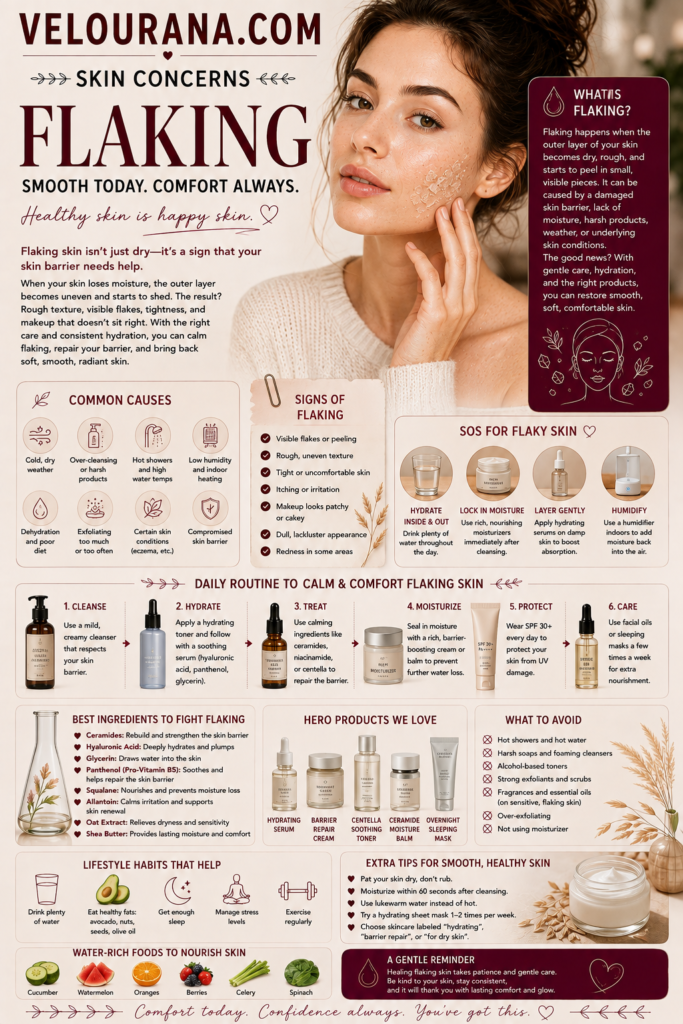
CATEGORY: Flaking
Flaking skin has an irritating habit of returning.
A dry patch appears beside the nose or across the cheeks. Moisturizer is applied generously, the loose scales settle, and for a while the surface looks better. Then the following morning—or perhaps several days later—the same roughness reappears. Foundation catches on it again. The skin feels tight after cleansing again. Another layer of cream goes on, yet the improvement seems temporary.
This recurrence can make flaking feel mysterious. If moisturizer helped, why did the problem come back?
The answer often lies in the difference between making dry skin temporarily feel comfortable and changing the conditions that repeatedly make it dry.
Flaking is part of the skin's shedding process becoming unusually visible. When the outer barrier loses water, becomes irritated, or is repeatedly disturbed, surface cells can separate in larger, more noticeable groups. Moisturizer may soften those scales and improve hydration, but if the routine or environment continues stressing the barrier, the same process can begin again.
This is why recurring flaking deserves a broader perspective than simply asking which cream is richest.
The useful question is not only, "How do I moisturize this?"
It is, "Why does my skin keep reaching the point where it flakes?"
The Difference Between Relief and Recovery
A moisturizer can make flaky skin look dramatically better within minutes.
This immediate change is genuine, but it should not be confused with complete recovery.
When emollient ingredients coat and soften rough surface cells, the irregular edges of dry skin become less obvious. Humectants help support water content within the stratum corneum, while more occlusive ingredients can reduce the rate at which that water escapes. The surface becomes more flexible and light reflects from it more evenly.
The skin looks smoother.
But the underlying barrier may still be vulnerable.
This distinction explains why someone can apply moisturizer at night, wake with comfortable skin, cleanse in the morning and immediately feel dry again. The moisturizer did not necessarily fail. The conditions producing excessive dryness simply returned.
Perhaps the cleanser is too aggressive for the person's current skin condition. Perhaps the water is very hot. Perhaps several active products are being layered afterward. Perhaps indoor heating is creating a particularly dry environment. Perhaps the moisturizer itself is too light to compensate for the degree of water loss occurring.
The American Academy of Dermatology recommends a combination of measures for dry skin rather than relying on moisturizer alone, including limiting bathing time, using warm rather than hot water, choosing gentle cleansers and applying moisturizer promptly after washing.
That broader approach reflects an important principle.
Barrier recovery is not a single product event.
It is the cumulative result of reducing unnecessary stress while repeatedly supporting the skin's ability to retain water.
How the Outer Barrier Holds Itself Together
To understand why flaking can recur, it helps to look more closely at what healthy surface skin is trying to accomplish.
The stratum corneum forms the outermost layer of the epidermis. It contains flattened corneocytes surrounded by a lipid-rich extracellular matrix. This structure is often compared to bricks and mortar: the corneocytes resemble bricks, while lipids help form the material around them.
Like most simplified biological analogies, it is imperfect. But it captures something important.
A resilient skin surface depends on both its cellular structure and the materials surrounding those cells.
Ceramides, cholesterol and fatty acids are among the lipids involved in the organization of the stratum corneum. Within the corneocytes themselves, compounds collectively associated with natural moisturizing factor help maintain hydration.
Together, these systems allow the outer skin to remain flexible while limiting excessive transepidermal water loss.
When this balance deteriorates, the surface becomes less supple.
Dry corneocytes do not behave exactly like adequately hydrated ones. The enzymes and processes involved in orderly desquamation are also influenced by the water environment within the stratum corneum.
Instead of cells being released individually and invisibly, groups may remain attached and become visible as scale.
That is the fundamental reason recurring flaking should not be viewed merely as excess dead skin.
The skin is always producing and shedding cells.
The unusual feature is that you can suddenly see the process happening.
The Morning Cleanse Can Undo the Night Before
One of the clearest examples of recurring barrier stress occurs in the familiar cycle of nighttime moisturization followed by morning cleansing.
Imagine skin that is dry enough to flake.
At night, a rich moisturizer is applied. Over several hours, the surface becomes softer and better hydrated. By morning, much of the obvious roughness has diminished.
Then comes a long cleanse with hot water and a strongly degreasing cleanser.
The face is rinsed repeatedly. A towel is rubbed across it. An exfoliating toner follows because a few flakes remain. Then perhaps a treatment serum and another active product are applied.
Within an hour, the face feels tight again.
The moisturizer is blamed.
But the moisturizer may have been doing exactly what it was capable of doing. The problem is that every morning the routine recreates the conditions it is expected to repair every night.
Cleansing is necessary, but maximum cleansing is not necessarily better cleansing.
Dermatologists recommend gentle, non-abrasive cleansing and caution against scrubbing the face. For dry or sensitive skin, reducing unnecessary irritation becomes particularly relevant.
Some people also discover that their skin does not require the same degree of cleansing at every point in the day. What is appropriate after wearing makeup and water-resistant sunscreen may not be necessary first thing in the morning.
There is no universal rule that everyone with flaky skin must skip morning cleanser. Individual needs vary considerably.
The more useful principle is proportionality.
Cleaning the skin should not routinely leave it feeling stripped, uncomfortable or dramatically tighter than it felt beforehand.
The Problem With Chasing a Squeaky-Clean Feeling
For decades, cleanliness in beauty has often been associated with sensory cues: foam, fragrance, a taut surface and the unmistakable feeling that every trace of oil has disappeared.
For dry skin, these cues can be misleading.
Sebum is not merely dirt.
Although excessive oil can contribute to concerns in some complexions, surface lipids are also part of the environment that helps protect the skin. Removing unnecessary amounts repeatedly can make already dry skin more difficult to manage.
A cleanser therefore does not need to produce dramatic tightness to be effective.
Indeed, tightness immediately after washing can be useful feedback.
The same applies to body skin. Hands, shins, elbows and other areas can become persistently flaky when frequent washing, harsh soaps or environmental exposure repeatedly removes protective surface materials faster than the skin can compensate.
This is particularly apparent in professions or lifestyles involving frequent handwashing.
The hands may be moisturized several times a day, yet if they are washed dozens of times, exposed to detergents or subjected to cold weather without protection, the balance remains unfavorable.
The lesson extends to facial skincare.
Whenever flaking repeatedly returns, examine what happens between moisturizer applications.
Those hours may explain more than the moisturizer itself.
Active Ingredients Can Create an Invisible Threshold
Modern skincare has made powerful ingredients widely accessible.
Retinoids and retinol products, exfoliating acids, acne treatments, brightening ingredients and concentrated serums can all have legitimate places in a routine. Problems arise when tolerance is treated as unlimited.
Skin does not assess products individually.
Suppose one exfoliating product is tolerated three evenings per week. A retinol formula is also tolerated several evenings per week. A strong cleanser seems acceptable on its own. A clay mask produces no obvious problem when used occasionally.
It is tempting to conclude that all four can therefore coexist at maximum frequency.
Biology is rarely so cooperative.
Each intervention contributes to the total environment experienced by the skin. Several moderately challenging steps can collectively cross the threshold between tolerable and irritating.
Flaking may be the first obvious sign.
This phenomenon helps explain why people sometimes say, "But I've used this product for months."
The product may indeed have been tolerated previously. What changed could be the rest of the routine, the weather, frequency of application, another newly introduced treatment, or the condition of the skin itself.
Tolerance is contextual.
This is why troubleshooting recurring flaking is often more successful when products are considered collectively rather than searching immediately for one villain.
More Exfoliation Can Create More of What You Are Trying to Remove
Few skincare loops are as persistent as the exfoliation-flaking cycle.
The surface looks rough.
Exfoliation removes the roughness.
For a day, the skin appears smoother.
Then additional flaking develops.
The conclusion is that the exfoliation was not strong enough.
So it is repeated more frequently.
The surface becomes increasingly sensitive, and still more flakes appear.
The cycle can continue because each individual exfoliation session produces an immediate cosmetic reward. Loose material is removed. Texture feels temporarily polished. The longer-term consequences arrive later.
Chemical exfoliation deserves the same caution as physical scrubbing.
The absence of abrasive particles does not mean a product cannot irritate an already compromised barrier. Acids alter the processes holding surface cells together. That can be useful when appropriately used, but actively irritated or peeling skin may need recovery rather than accelerated shedding.
This does not make exfoliation bad.
It makes timing important.
Healthy skincare is not about maximizing cellular turnover at every opportunity. It is about creating a routine in which desired treatments remain compatible with barrier function.
When the skin is visibly protesting, temporarily reducing the intensity of the routine can be more rational than adding another corrective step.
Why Moisturizer Sometimes Seems to Stop Working
People often describe a moisturizer as though the skin has developed immunity to it.
"It used to work."
"My skin got used to it."
"I need something stronger now."
Sometimes a different moisturizer really is appropriate. But the explanation is not necessarily that the skin has somehow become resistant to the old one.
The environment may have changed.
A lightweight lotion that performs beautifully in humid weather may be inadequate during winter. Air conditioning or central heating may increase dryness. A newly introduced treatment may increase the skin's need for moisturization. More frequent cleansing may alter the balance.
Age can influence skin dryness as well. The American Academy of Dermatology notes that skin tends to become drier with age and that many adults eventually require changes in how they moisturize and cleanse.
The routine may therefore need adaptation without the original product having become objectively worse.
Application technique also matters.
A small amount spread thinly over completely dry skin may not provide the same effect as a more generous application soon after washing. The AAD recommends applying moisturizer while skin is still damp because this helps trap water within the skin.
Frequency can matter too.
Someone experiencing significant dryness may need moisturizer more consistently than someone whose skin is naturally comfortable.
The right question is therefore not simply whether a moisturizer "works."
It is whether the entire moisturizing strategy is sufficient for the skin's current circumstances.
Humectants Need an Environment in Which to Work
Hydration-focused skincare frequently emphasizes humectants.
Glycerin and hyaluronic acid are familiar examples. They help attract and retain water and can contribute significantly to comfortable, hydrated skin.
But a humectant serum should not be mistaken for an entire barrier strategy.
Someone with pronounced flaking may layer a beautifully formulated hydrating serum onto the face and still experience dryness because the water being supported within the surface is not being retained sufficiently.
This is where moisturizers combining different functional ingredient categories become useful.
Humectants support hydration.
Emollients improve softness and flexibility.
Occlusive ingredients reduce water evaporation.
A well-designed moisturizer may combine all three approaches in varying proportions.
The balance that feels elegant on oily or mildly dehydrated skin may not be enough for visibly dry, flaky skin. Conversely, an extremely occlusive formula may feel unnecessarily heavy for someone whose flaking is mild and temporary.
Skincare therefore resists simple rankings.
"More hydrating" is not always a meaningful comparison unless we specify what the skin needs and under what conditions.
A watery serum and a rich barrier cream are not necessarily competitors.
They perform different jobs.
Why Nighttime Can Be Valuable for Barrier Support
Night skincare attracts extravagant claims, many of which go well beyond what can reasonably be promised by cosmetics.
Yet nighttime does offer one very practical advantage for dry skin.
It provides several uninterrupted hours during which moisturizer can remain on the surface without being washed away, covered with makeup or repeatedly exposed to daytime cleansing and environmental changes.
For persistently flaky areas, this period can be useful.
A richer moisturizer may be comfortable at night even if the same texture feels too heavy during the day. Particularly dry localized areas may sometimes benefit from a thin occlusive layer over moisturizer, provided the ingredients are appropriate for the individual and do not cause irritation.
Petrolatum is a classic example of an occlusive ingredient. Dermatologists frequently recommend it for very dry skin because it can help reduce moisture loss.
Occlusion, however, is not a substitute for understanding what is causing irritation.
Applying an occlusive layer over a product that the skin does not tolerate can potentially intensify exposure to that product. Someone using irritating actives should therefore not assume that sealing everything beneath a heavy layer will automatically repair the problem.
Again, the routine must be considered as a whole.
Nighttime recovery works best when the skin is being supported rather than challenged and then covered.
The Weather Can Quietly Change the Rules
Recurring flaking often follows the calendar.
A routine works for months, then suddenly fails in late autumn. The moisturizer seems weaker. The cheeks become rough. The skin around the mouth begins peeling.
Nothing in the bathroom cabinet changed.
The air did.
Cold outdoor conditions and low humidity can increase the challenge of maintaining skin hydration. Indoors, heating can make the environment drier still. The repeated transition between the two adds another layer of stress.
The American Academy of Dermatology identifies cold weather, low humidity and indoor heating among common contributors to dry skin and recommends measures such as moisturizing more frequently and using a humidifier when appropriate.
Summer can create a different set of challenges.
Air conditioning can produce dry indoor environments. Frequent swimming exposes skin to chlorinated or salt water. Increased showering can mean more contact with cleansers. Travel may involve long periods in air-conditioned aircraft cabins.
There is no single "dry skin season" that applies universally.
The more useful approach is to notice patterns.
If flaking appears every winter, preventive adjustments can begin before the skin becomes severely dry.
If it appears during travel, a simplified travel routine may help.
If air conditioning seems to be a trigger, moisturizer requirements may differ on days spent almost entirely indoors.
Prevention becomes easier once the pattern is recognized.
The Mouth and Nose Are Frequent Trouble Spots for a Reason
Flaking rarely distributes itself perfectly across the face.
The sides of the nose, corners of the mouth, chin and areas around the nostrils are common places to notice it.
These regions experience considerable movement, cleansing and incidental contact.
The nose is wiped.
The mouth is washed after eating.
Toothpaste reaches surrounding skin.
Tissues create friction during colds or allergies.
Saliva may repeatedly contact the lip area.
Strong skincare products can collect in facial creases.
This makes localized flaking particularly informative.
If the entire face is comfortable except for one small recurring area, the cause may be local rather than evidence that every product in the routine is wrong.
Observation becomes valuable.
Does the patch coincide with where an active treatment is applied?
Does it worsen after blowing the nose repeatedly?
Does it sit precisely where toothpaste or saliva often contacts the skin?
Does a makeup product repeatedly accumulate there?
These questions do not diagnose dermatological disease, but they can expose behavioral patterns that a search for "the best moisturizer for flaky skin" would miss.
At the same time, persistent scaling around the nose, eyebrows or scalp can have causes other than ordinary dryness. Recurrent localized flaking that does not respond to gentle care may therefore warrant professional assessment rather than endless experimentation.
Fragrance and Sensitivity Complicate the Picture
A product can feel luxurious and still be poorly suited to compromised skin.
Fragrance is a good example.
Many people use fragranced skincare without difficulty. Others develop irritation or allergic contact reactions to certain fragrance components. When skin is already dry and vulnerable, minimizing unnecessary potential irritants can make troubleshooting easier.
The American Academy of Dermatology recommends fragrance-free rather than merely "unscented" products for very dry skin, noting that unscented products can still contain fragrance-related ingredients used to mask odors.
That distinction is easy to overlook.
"Unscented" describes the sensory result.
"Fragrance-free" is intended to indicate that fragrance has not been included for scent.
Even then, no cosmetic label can guarantee universal tolerance. Botanical extracts, preservatives and many other ingredients can cause reactions in susceptible individuals.
This is why persistent flaking accompanied by burning, itching or redness should not automatically be treated as a moisture problem.
The skin may be reacting to something.
Adding more products makes that puzzle harder to solve.
The Body Often Reveals the Same Pattern More Clearly
Facial flaking receives more attention because it is visible and interferes with makeup, but the same barrier principles can be observed across the body.
Consider the shins in winter.
They may develop a fine white scale and feel increasingly rough. Long hot showers continue every morning. A strongly fragranced body wash is used generously. The legs are towel-dried vigorously. Lotion is applied occasionally, usually only once the dryness becomes uncomfortable.
This pattern makes recurring dryness almost predictable.
Changing the sequence can produce a different result.
Shorter, warm rather than very hot showers reduce unnecessary stress. Gentle cleansing is concentrated where needed rather than aggressively washing every centimetre of already dry skin. Moisturizer is applied promptly afterward. Consistency prevents the skin from repeatedly reaching an extreme state before treatment begins.
The same principle applies to hands.
A hand cream used once before bed may be unable to compensate for dozens of washing cycles during the day. Moisturizing after washing, choosing gentler cleansing where appropriate, and using protective gloves for wet work can change the cumulative balance.
Recurring flaking is often about arithmetic.
How many times is the barrier disrupted?
How many times is it supported?
The answer accumulates over days.
Barrier Repair Is Not the Same as Product Accumulation
The beauty industry has understandably embraced the language of barrier repair.
It is useful language because barrier function genuinely matters.
But it can create another misunderstanding: that repairing the barrier requires purchasing a specialized collection of products all carrying the word "barrier."
Often, the most important intervention is subtraction.
Stop scrubbing.
Reduce unnecessary exfoliation.
Use less irritating cleansing.
Avoid repeatedly picking at flakes.
Shorten very hot showers.
Temporarily remove products that sting.
Then support the skin with an appropriate moisturizer and sun protection.
A sophisticated formulation can certainly be valuable. Ingredients such as ceramides, glycerin and petrolatum have well-established roles in moisturization and barrier support. But they cannot make an unnecessarily aggressive routine cease to be aggressive.
This is one of the most transferable principles in skincare.
Products matter.
Behavior matters just as much.
When Recurring Flaking Needs a Dermatologist
Ordinary dry skin is common and frequently manageable with changes in skincare and environmental habits.
Recurring flaking, however, should not always be normalized.
Dry, scaly skin can accompany conditions including eczema and psoriasis. Seborrheic dermatitis can produce characteristic scaling in areas such as the scalp and face. Contact dermatitis may arise from exposure to irritating or allergenic substances.
A cosmetic routine cannot determine which of these, if any, is responsible.
Professional evaluation becomes particularly sensible when flaking persists despite a gentle moisturizing routine, repeatedly affects the same locations, becomes significantly red or inflamed, produces intense itching, causes pain, cracks or bleeds, or spreads substantially.
The AAD recommends seeing a dermatologist when dry skin continues despite appropriate self-care or when symptoms become severe.
This is not because every stubborn dry patch represents disease.
It is because persistent symptoms eventually become less suitable for cosmetic guesswork.
There is a point at which buying a seventh moisturizer is less efficient than finding out what the skin is actually doing.
Building a Routine That Does Not Have to Rescue the Skin
The most successful approach to recurring flaking is often preventive.
Instead of allowing the skin to become severely dry and then mounting an intensive rescue operation, the routine is adjusted so the barrier is less likely to reach that state.
That means noticing early signs.
Tightness after washing can be one.
Unexpected stinging can be another.
A slight increase in roughness may appear before obvious scales.
Makeup may begin behaving differently before the naked eye detects significant flaking.
These changes are opportunities.
Reducing exfoliation at the first sign of irritation is easier than recovering from widespread peeling. Switching to a richer moisturizer when the weather becomes dry is easier than waiting until the cheeks crack. Modifying cleansing when the skin begins feeling tight is easier than trying to compensate later with multiple treatments.
Preventive skincare is rarely dramatic enough to become a social-media transformation.
That is precisely why it works.
The best barrier crisis is the one that never becomes a crisis.
The Real Solution Is Consistency
Recurring flaking teaches a useful lesson about skincare because it exposes the limitations of short-term thinking.
One generous layer of moisturizer can soften the surface.
One exfoliation session can remove visible scales.
One hydrating mask can make the face feel more comfortable.
But none of these isolated moments determines what the skin will look like next week.
The pattern does.
If the skin is gently cleansed, consistently moisturized, protected from unnecessary irritation and allowed to recover when signs of stress appear, visible shedding may gradually return to its normal invisible rhythm.
If it is repeatedly stripped, scrubbed, exfoliated and then rescued with moisturizer, the cycle may continue regardless of how impressive the moisturizer is.
The difference is not necessarily a more expensive product.
It is the relationship between stress and recovery.
Flaking becomes much easier to understand once we stop seeing each scale as an isolated imperfection. It is evidence of how the surface is behaving as a system.
And systems rarely change because of one dramatic intervention.
They change because the conditions surrounding them change consistently.
When those conditions improve, moisturizer no longer has to spend every night repairing what the routine recreates every morning.
The skin can finally move from temporary relief toward genuine stability.
The End Velourana
 Discover More From Our Family of Websites
 ZodiacBearing (Astrology, Tarot, Numerology, Angel Numbers & Spiritual Guidance)
 Velourana (Beauty, Makeup, Hair Care, Skincare & Beauty Tips)
 HavenBearing (Home, Living, Organization, Décor & Everyday Inspiration)
 PawBearing (Pet Care, Dog Breeds, Animal Health, Training & Pet Products)
 PsyCatherine (Notes From the Journal of a Psychologist on Real Life)

