
CATEGORY: Cleansing Balms
There was a time when removing makeup seemed relatively straightforward. A little cleanser, some water, perhaps a separate eye-makeup remover, and the face was considered ready for the night. Modern skincare has complicated that picture considerably. Sunscreens are increasingly sophisticated and persistent. Foundations are designed to remain intact through heat and long working days. Primers improve adhesion, mascaras resist water, lip colors resist transfer, and multiple skincare layers can sit beneath cosmetics from morning until evening.
The better these products become at remaining on the skin, the more carefully they must eventually be removed.
This is the environment in which cleansing balms make particular sense. Their popularity is sometimes attributed to their luxurious texture or the satisfaction of watching makeup apparently melt beneath the fingertips. Those qualities certainly contribute to their appeal, but they are not the fundamental reason the format works. Cleansing balms solve a practical problem: much of what we want to remove from the face at night is not particularly interested in dissolving in water.
A balm begins by meeting those materials in an oily environment. Only later does water enter the process.
That reversal changes the character of cleansing. Instead of immediately trying to wash a complex collection of oils, waxes, pigments, polymers and sunscreen films away with water, the balm first loosens and disperses them. Its emulsifying system then allows the combined material to be rinsed from the skin.
Understanding this process reveals why cleansing balms can be particularly effective for sunscreen and makeup—and why using one correctly matters just as much as choosing one.
The Products Designed to Stay Put Eventually Have to Come Off
Many of the products applied during a morning routine are intentionally engineered to resist ordinary daily conditions.
Sunscreen is an obvious example. A sunscreen cannot provide reliable protection if its film disappears from the skin immediately after application. Formulators therefore work to create products capable of spreading evenly and remaining sufficiently stable on the surface. Water-resistant sunscreens go further, using film-forming technologies specifically intended to improve persistence during exposure to water or perspiration.
Cosmetics often pursue the same objective for different reasons.
A foundation that disappears after several hours is usually considered disappointing. Mascara should remain on the lashes rather than beneath the eyes. Eyeliner is expected to maintain definition. Lip products increasingly promise long wear or reduced transfer. Primers are designed partly to help other products adhere more effectively.
The result is a face covered in materials whose successful daytime performance is partly defined by their resistance to accidental removal.
Even relatively minimal routines can create surprisingly persistent layers. Someone wearing only moisturizer and sunscreen may still be carrying a substantial film by evening, particularly if sunscreen has been reapplied. Add complexion products, powder, eye makeup and lip color, and cleansing becomes a considerably more demanding exercise.
This does not mean every trace of cosmetic material is dangerous if it survives the first splash of water. It means that an evening cleanse should be capable of reliably removing the day's accumulation without requiring excessive friction.
The distinction matters.
If the cleansing product cannot efficiently loosen the material, the hands, cloth or cotton pad often compensate through rubbing.
Cleansing balms shift more of that work back to the cleanser.
Oil Changes the Starting Point
The defining characteristic of a cleansing balm is not merely that it feels rich.
It is that the formula begins with a substantial oil-soluble phase.
Depending on the formulation, this phase may contain cosmetic oils, esters, hydrocarbons, waxes, butters and other lipophilic ingredients arranged into a solid or semi-solid structure. The balm remains relatively stable in the jar but softens when exposed to body heat and mechanical movement.
Once spread across dry skin, it behaves much more like a cleansing oil.
This matters because many cosmetic residues contain oil-compatible ingredients. Sebum itself is oily. Makeup frequently contains oils, waxes, silicones and pigments dispersed in hydrophobic systems. Sunscreens can contain oil-soluble UV filters, film-forming polymers and water-resistant components.
An oil-rich cleanser can interact readily with much of this material.
The simplified principle often described as “like dissolves like” provides a useful starting point. Lipophilic substances tend to mix more readily with other lipophilic substances than with plain water. The reality of cosmetic chemistry is more complicated, but the practical effect is easy to observe: massage a suitable cleansing balm over foundation or sunscreen and the previously coherent film begins to lose its structure.
Foundation colors the balm.
Mascara disperses into it.
Lip color becomes mobile.
Sunscreen loses the continuous film that helped it remain on the face.
The balm is not making these materials disappear. It is incorporating them into itself.
That difference becomes important when water is introduced.
Melting Makeup Is Only Half the Job
The visual disappearance of makeup during balm massage can create the impression that cleansing is already complete.
It is not.
At this stage, the face may actually contain more material than before: the original makeup and sunscreen are now mixed with the cleansing balm. Unless that combined layer is removed, very little has been accomplished.
This is why a true rinse-off cleansing balm requires more than an oily base.
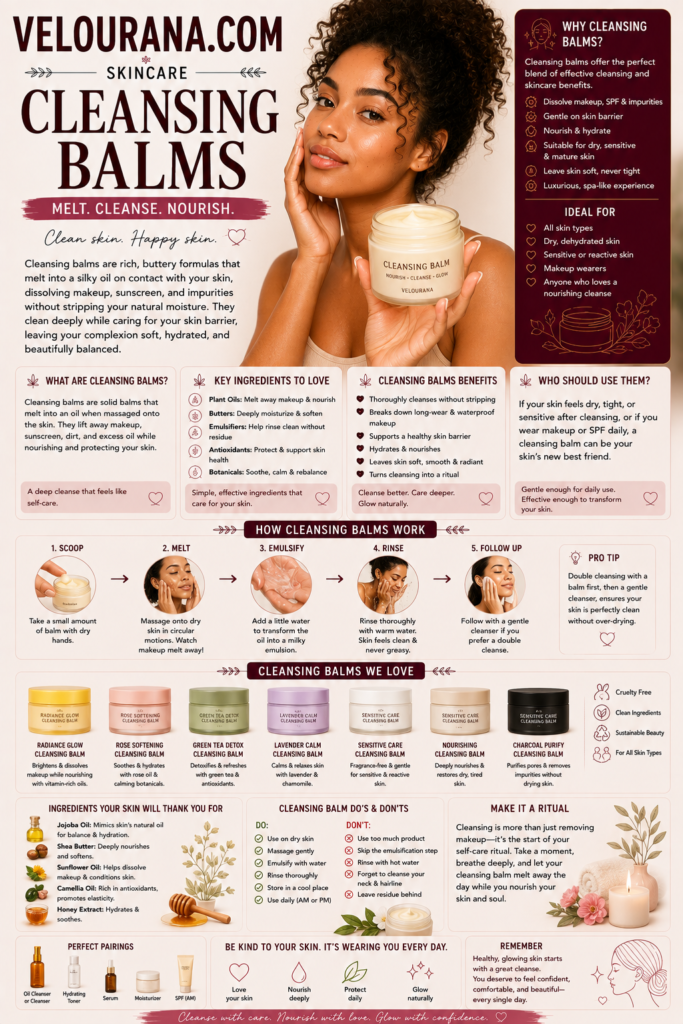
Emulsifying ingredients allow the oily mixture to disperse when water is added. As wet fingers move across the face, the transparent or oily-looking balm often turns cloudy or milky. This visible change reflects the formation of an emulsion in which the oily phase has become dispersed through water.
The mixture can then leave the skin much more readily during rinsing.
The quality of emulsification is one of the most important characteristics of a cleansing balm, even though consumers often focus more heavily on ingredients that sound nourishing or luxurious.
A beautifully textured balm that dissolves makeup but refuses to rinse efficiently has completed only part of its task.
By contrast, a carefully formulated balm can hold an impressive amount of dissolved cosmetic material and then transform quickly once water is introduced. Dermatological descriptions of cleansing balms emphasize precisely this combination of oil-based cleansing ingredients with surfactants or emulsifiers that permit water removal.
This two-stage mechanism explains why balms can feel both powerful and gentle.
Their effectiveness does not have to come from an aggressive final wash. Much of the difficult work occurs before the rinse.
Sunscreen Is One of the Strongest Arguments for Thoughtful Evening Cleansing
The modern emphasis on daily sunscreen has changed skincare for the better, but it has also changed what evening cleansing needs to accomplish.
A sunscreen is not simply another lightweight serum.
Its protective function depends on establishing an adequate and reasonably uniform film across the skin. Depending on the formulation, that film may contain organic UV filters, mineral particles, oils, silicones, polymers, powders and other ingredients designed to create acceptable protection, spreadability and wear.
Water-resistant sunscreens create an additional challenge because resistance to water is one of their intended properties.
The obvious question is whether sunscreen always requires an oil cleanser.
Not necessarily.
A capable conventional cleanser may adequately remove many sunscreens, especially lighter non-water-resistant formulas. Cleansing effectiveness depends on both the sunscreen and the cleanser rather than on a universal rule that sunscreen can only be removed with oil.
But an oil-based first cleanse can be extremely useful when the sunscreen is particularly tenacious, heavily reapplied or combined with makeup.
The difference may be experienced most clearly around areas where sunscreen tends to accumulate: beside the nose, around the hairline, beneath the jaw and near the ears. These are also places that people frequently rush during cleansing.
A balm's extended slip encourages deliberate coverage.
That does not mean the cleanser should be massaged indefinitely. It means the user has enough working time to distribute it across the entire sunscreen film before rinsing.
For someone who takes daily sun protection seriously, evening removal deserves similar attention. Applying sunscreen carefully in the morning while treating its removal casually at night creates an oddly incomplete routine.
Heavy Makeup Reveals the Advantage More Dramatically
Sunscreen removal may be subtle. Makeup removal is visually obvious.
A balm massaged into foundation quickly changes color. Pigments become suspended through the oily cleanser. Blush, bronzer and contour lose their boundaries. Lip products begin to dissolve. Eye makeup gradually breaks apart.
This visual transformation makes cleansing balms particularly satisfying, but it also demonstrates something important about cleansing efficiency.
Imagine trying to remove a long-wearing foundation exclusively by repeatedly wiping the skin. Every pass creates friction. If the product remains strongly adhered, additional pressure may seem necessary. Delicate areas around the eyes and mouth can receive considerable mechanical stress before the makeup is fully removed.
A cleansing balm changes the sequence.
Instead of beginning with force, it begins with dissolution.
The fingers distribute the balm over the cosmetic layer and allow the formula to soften it. Mechanical movement still contributes, but the purpose of massage is primarily to increase contact between cleanser and makeup rather than to physically scrape makeup away.
This distinction becomes especially valuable with waterproof eye products.
Waterproof mascara is designed to resist moisture. Trying to remove it by repeatedly pulling at the lashes is an inefficient response to the formulation. A suitable oil-based cleanser can instead be allowed to contact the mascara, giving the oily phase time to loosen waxes and other resistant materials before gentle movement carries them away.
Patience can therefore replace pressure.
The result is not merely a more luxurious experience. It can be a more intelligent use of cleansing chemistry.
The Eye Area Requires Restraint, Not Enthusiasm
Cleansing balm demonstrations frequently show dramatic black streaks spreading across the face as mascara and eyeliner dissolve. It makes compelling imagery, but the eye area deserves a more measured approach in real life.
The skin surrounding the eyes is thin and easily irritated by repeated rubbing.
Lashes can also be stressed by unnecessary pulling. If waterproof mascara is reluctant to move, aggressive massage is rarely the best solution.
Instead, a balm that is specifically suitable for eye makeup can be gently distributed over closed eyes. Brief contact gives the formula time to interact with the cosmetic film. Small, controlled movements can then help release the product.
More balm is not necessarily better.
Using excessive amounts around the eyes increases the likelihood of oily material migrating into them. Temporary blurred or cloudy vision can occur when oily cleanser reaches the ocular surface. Persistent burning, redness or irritation should not be accepted as a normal part of cleansing.
Fragrance and botanical ingredients can also matter more around sensitive eyes.
A balm may smell beautiful and feel perfectly comfortable across the cheeks while proving unsuitable around the eyelids. This is one reason product instructions deserve attention. Not every balm marketed for facial cleansing is necessarily intended to remove eye makeup.
Effective cleansing respects anatomical differences.
The same pressure appropriate for massaging the jaw is not automatically appropriate for the eyelids.
The Dry-Skin Rule Is Functional, Not Ceremonial
Most cleansing balms instruct users to begin with dry skin and dry hands.
This is one of the rare skincare instructions whose logic becomes obvious once the formulation is understood.
Before water is introduced, the balm exists predominantly in its oil-cleansing state. It can spread directly through oily sunscreen, sebum and makeup without immediately forming an emulsion.
Adding water too early changes the system.
The emulsifiers begin interacting with water and the formula starts transitioning toward the rinse-off stage. It can still cleanse, but the period during which the oil-rich phase has unrestricted contact with resistant cosmetic material becomes shorter.
This does not mean a single drop of water ruins the process.
It means the most efficient sequence usually follows the product's design: dry application first, emulsification second, thorough rinsing third.
There is an elegant simplicity to this order.
First, dissolve.
Then, disperse.
Finally, remove.
Understanding the reason behind the steps makes them easier to remember than treating balm cleansing as a ritual with arbitrary rules.
Emulsification Should Be Deliberate
Once makeup and sunscreen have loosened, many users move immediately from massage to splashing the face repeatedly with water.
A more deliberate transition can improve the experience.
Wet the fingertips first.
Massage that small amount of water into the balm.
Watch or feel the texture change.
Add a little more water and continue briefly.
Then rinse thoroughly.
This staged emulsification allows the water and oily phase to mix progressively rather than forcing a thick layer of balm directly beneath running water.
The exact appearance varies by formula. Some balms produce a dramatic white milk. Others simply become thinner and slightly cloudy. A lack of theatrical whitening does not automatically indicate poor emulsification.
The important question is whether the formula becomes easier to remove as water is incorporated.
If the balm remains stubbornly greasy despite repeated emulsification, that may be an intentional characteristic of a very rich formula—or it may simply not suit someone who prefers a cleaner finish.
Technique should not have to fight the product indefinitely.
A good match between formulation and preference makes cleansing feel intuitive.
The Second Cleanse Should Have a Reason
The association between cleansing balms and double cleansing has become so strong that the two are sometimes treated as inseparable.
They are not.
Double cleansing originated from a sensible functional distinction. An oil-based cleanser handles oil-soluble and persistent material, while a water-based cleanser can follow to remove remaining residue, sweat and other water-compatible material.
For a face covered in long-wear makeup, repeated sunscreen applications or a particularly persistent balm, this sequence can be excellent.
But skincare routines have a tendency to transform useful techniques into universal rules.
If a balm emulsifies beautifully, removes the day's sunscreen and makeup, rinses cleanly and leaves the skin comfortable, a second cleanser may contribute very little.
For some dry or reactive skin, it may contribute unnecessary exposure to cleansing agents.
On the other hand, if visible makeup remains, the hairline still feels coated, or the balm leaves a film that the user dislikes, a second gentle cleanser makes obvious sense.
The condition of the skin after cleansing matters as well.
If double cleansing consistently produces tightness, burning or pronounced dryness, the routine deserves adjustment. The answer might be a milder second cleanser, less product, shorter cleansing time, or eliminating the second step on lighter-makeup days.
The purpose of double cleansing is completeness, not endurance.
There is no prize for using two cleansers when one has already done the job.
More Cleansing Is Not Necessarily Cleaner Skin
The skincare industry has spent years teaching consumers to add steps.
Cleansing balms can accidentally become part of that escalation.
First comes the balm. Then a foaming cleanser. Then perhaps an exfoliating toner. Soon the evening routine contains several consecutive processes capable of removing, dissolving or altering material at the skin surface.
Each individual product may be reasonable. The cumulative routine may not be.
Skin cleansing research has long recognized that cleanser interactions with the stratum corneum can influence barrier function, dryness and irritation. The objective in modern formulation is therefore not simply maximal removal but effective cleansing with controlled impact on the skin.
This principle is particularly relevant for people using retinoids, exfoliating acids, acne treatments or other potentially irritating leave-on products.
Their skin may already be experiencing significant biological activity from treatment. Beginning the routine with unnecessarily aggressive cleansing can reduce tolerance for products that actually need to remain on the skin.
A cleansing balm can help by making the removal stage efficient.
But only if the user allows efficiency to reduce aggression rather than treating the balm as an additional step layered on top of an already excessive cleansing routine.
What About Pores?
Cleansing balms are often marketed with claims about “deep cleaning” pores, extracting impurities or removing sebaceous filaments.
These claims deserve careful interpretation.
Pores are openings associated with hair follicles and sebaceous glands. They are not empty containers that can simply be opened, vacuumed and closed.
A balm can certainly remove surface sebum, sunscreen, makeup and other oily material around follicular openings. Prolonged massage may also loosen some superficial material, which can create a satisfying impression of deep purification.
But cleansing balms do not permanently shrink pores, and they should not be treated as substitutes for evidence-based acne or comedonal treatments.
Blackheads and other comedones involve changes within the follicle, including accumulation of sebum and keratinized cells. Ingredients such as salicylic acid and retinoids play very different roles from a rinse-off oil cleanser when managing these concerns.
The balm's job is more modest and more useful than exaggerated pore language suggests.
It cleans the surface effectively.
That alone can support a good routine without requiring claims that the cleanser is extracting hidden toxins from the skin.
Can You Massage a Cleansing Balm for Too Long?
The sensory pleasure of balm cleansing has encouraged a trend toward extended facial massage.
A minute becomes five minutes. Five becomes ten. Some routines turn cleansing into an elaborate nightly facial.
There is nothing inherently wrong with enjoying a brief gentle massage, but cleansing performance does not increase indefinitely with massage time.
Once sunscreen and makeup have dissolved, additional manipulation offers diminishing returns.
Meanwhile, friction continues.
This becomes especially relevant for skin experiencing active inflammation, rosacea-like sensitivity, acne lesions or barrier disruption. Repeated mechanical movement can increase redness and discomfort even when the cleanser itself is mild.
The presence of excellent slip reduces friction but does not eliminate it.
The objective should therefore be sufficient contact rather than maximal contact.
Massage until the products being removed have loosened. Pay attention to commonly missed areas. Then emulsify and rinse.
Skincare does not become more sophisticated merely because every step takes longer.
Why the Hairline, Jaw and Nose Matter
Incomplete cleansing rarely occurs uniformly across the face.
Certain areas are disproportionately neglected.
The hairline is one. Sunscreen and foundation can extend into the edges of the hair, where quick rinsing may leave residue behind. Repeated accumulation can be particularly noticeable for people who wear substantial complexion products.
The jawline is another.
Skincare and sunscreen are increasingly—and correctly—applied beyond the central face, yet evening cleansing does not always follow the same territory. Product applied beneath the jaw should eventually be removed from beneath the jaw.
The sides of the nose deserve attention because makeup and sunscreen can collect in creases.
So do the eyebrows, where brow gels, pencils and sunscreen may coexist.
Ears can be forgotten completely despite increasingly common advice to apply sunscreen around them.
A cleansing balm is particularly convenient for these areas because it remains workable long enough to move systematically around the face.
The lesson is simple: cleansing should cover the same geography as application.
If the morning routine extends protection beyond the cheeks, the evening routine should extend removal beyond them as well.
Choosing a Balm According to What You Actually Wear
The ideal cleansing balm for someone wearing full-coverage makeup every day may be unnecessarily rich or powerful for someone who wears only lightweight sunscreen.
This is why product selection should begin with lifestyle rather than abstract skin-type labels.
Heavy makeup wearers need excellent dissolving capacity, adequate working time and reliable emulsification. Eye-makeup compatibility may be particularly important.
Daily sunscreen users who rarely wear makeup may prioritize fast emulsification and a clean rinse.
Dry skin may favor a more emollient after-feel, provided residue does not become uncomfortable.
Oily or congestion-prone skin may prefer lighter esters and a particularly efficient rinse, although no ingredient list can guarantee that a formula will never contribute to breakouts.
Sensitive skin may benefit from minimizing unnecessary fragrance or aromatic ingredients.
None of these are rigid laws.
They are ways of connecting product design with actual use.
A cleanser is a tool. The correct tool depends partly on the material it is expected to remove.
The Morning Routine Determines the Evening Routine
Skincare is often divided into isolated products: cleanser, toner, serum, moisturizer, sunscreen.
A more useful way to think about it is as a cycle.
What is applied in the morning affects what needs to happen at night.
A lightweight moisturizer and indoor day may require very little evening removal. Multiple sunscreen applications followed by foundation, setting spray and waterproof mascara create a different cleansing problem.
Similarly, what happens during cleansing influences what the skin can comfortably tolerate afterward.
If cleansing leaves the face calm and comfortable, treatment and moisturizing products begin on a relatively stable surface.
If cleansing produces immediate tightness and irritation, the rest of the routine begins in recovery mode.
This relationship makes cleansing more important than its position at the beginning of the routine might suggest.
It is not merely preparation for skincare.
It is part of skincare.
A Better Definition of Clean
Perhaps the most useful contribution of cleansing balms is that they challenge an old sensory definition of cleanliness.
Clean skin does not need to feel squeaky.
It does not need to feel dramatically matte.
It does not need to feel stretched across the cheekbones immediately after rinsing.
Those sensations indicate changes at the skin surface, but they are not reliable measures of whether sunscreen and makeup have been appropriately removed.
A better definition of clean is functional.
The day's cosmetic films are gone. Sunscreen has been removed. Makeup is no longer visible around the hairline or eyes. The surface does not feel coated with cleanser. At the same time, the skin feels comfortable enough that moisturizer is a continuation of the routine rather than an emergency response to washing.
That is a much more sophisticated target than simply removing as much oil as possible.
Cleansing as the Closing Act of Sun Protection
Sunscreen is usually discussed as a morning behavior.
In reality, responsible sunscreen use has an evening counterpart.
The protective film that was carefully established in the morning has completed its purpose. Any reapplications, makeup layers and accumulated environmental material now need to leave.
A cleansing balm offers one particularly elegant way to accomplish that transition.
It begins where water struggles, using an oil-rich environment to loosen materials designed to resist easy removal. It gives makeup and sunscreen time to lose their adhesion without demanding aggressive rubbing. Then, through emulsification, it changes character and allows those materials to be carried away.
The process feels luxurious because the texture is pleasurable, but luxury is not the central achievement.
Efficiency is.
A well-chosen balm reduces the conflict between thorough cleansing and comfortable skin. It recognizes that modern cosmetic technology has become remarkably good at keeping products attached to the face and responds with equally thoughtful removal.
The best evening cleanse does not announce itself through tightness, redness or an aggressively polished sensation.
It simply leaves the day's layers behind.
And when cleansing accomplishes that quietly, the rest of the skincare routine can begin with exactly what it needs most: skin that is genuinely clean, comfortably intact and ready for what comes next.
The End Velourana
 Discover More From Our Family of Websites
 ZodiacBearing (Astrology, Tarot, Numerology, Angel Numbers & Spiritual Guidance)
 Velourana (Beauty, Makeup, Hair Care, Skincare & Beauty Tips)
 HavenBearing (Home, Living, Organization, Décor & Everyday Inspiration)
 PawBearing (Pet Care, Dog Breeds, Animal Health, Training & Pet Products)
 PsyCatherine (Notes From the Journal of a Psychologist on Real Life)

