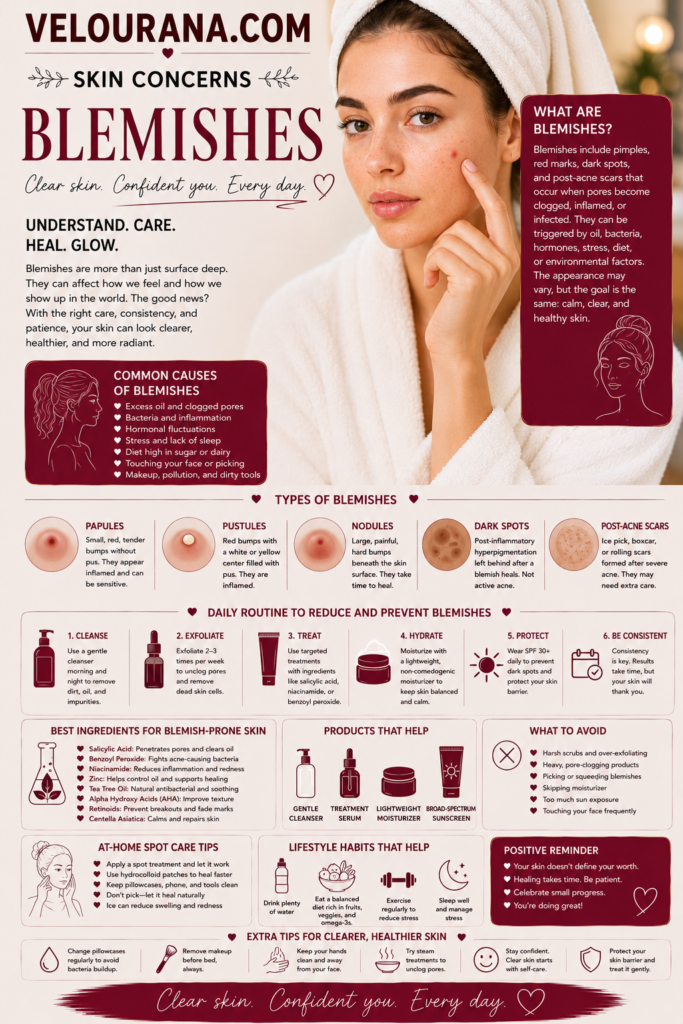
CATEGORY: Blemishes
One of the most discouraging experiences in blemish-prone skincare occurs just when the skin appears to be improving. An inflamed spot finally settles. The swelling disappears, the surface becomes smooth again, and the routine seems to have worked. Then another blemish develops a few centimetres away. A third appears several days later. Before the marks from the first breakout have faded, a new generation has already begun.
This pattern can create the impression that the skin is continually returning to the beginning.
It can also encourage a particular kind of skincare escalation. If blemishes keep appearing, perhaps the cleanser is not cleansing deeply enough. Perhaps exfoliation should happen more frequently. Perhaps the treatment has become ineffective. Perhaps a stronger serum is required. Each new spot seems to demand a new response.
But recurring blemishes make more sense when acne is understood as a continuing biological process rather than a sequence of unrelated emergencies.
The pimple visible today did not necessarily begin today. Changes inside a follicle can develop before anything is obvious at the surface. At the same time, other follicles may be moving through different stages of the same process. One lesion is becoming inflamed while another is healing and another remains microscopic.
What looks like a succession of independent blemishes can therefore represent overlapping stages of one underlying acne tendency.
This distinction changes the objective of skincare. Treating today's visible spot remains useful, but it cannot be the entire strategy. If the conditions encouraging new lesions continue, successfully calming one pimple simply creates space for the next one to attract attention.
The more meaningful objective is to change the pattern: fewer new lesions, less inflammation when they occur, less trauma during healing and fewer persistent marks afterward.
That transformation rarely happens overnight because the process it is trying to influence does not happen overnight either.
The Blemish You See Today Started Earlier Than You Think
A blemish can feel astonishingly sudden.
The skin looks relatively clear before bed. By morning, a tender raised area has appeared. By evening it may be red, obvious and impossible to ignore.
From the outside, the event appears to have occurred within hours.
Inside the follicle, however, the story began earlier.
Acne develops within the pilosebaceous unit, which includes the hair follicle and its associated sebaceous gland. Sebum is continually produced, while cells associated with the follicular lining are continually renewed. When material accumulates and normal follicular shedding becomes disrupted, a microscopic obstruction can begin forming.
At this stage, there may be nothing meaningful to see in the mirror.
As the process develops, the follicle may become a visible comedo. In other circumstances, inflammation becomes increasingly important and the lesion emerges as a red papule, pustule or deeper acne lesion.
The apparent overnight pimple is therefore often the moment at which an existing process becomes visible rather than the moment at which the process began.
This has an important implication for skincare.
A treatment applied only after a blemish has become obvious is arriving relatively late in the lesion's development.
Spot treatment can still have value. But if blemishes are recurring, prevention needs to operate across the acne-prone area and over time rather than waiting for each follicle to announce itself.
This is why successful acne management often looks less dramatic than emergency blemish treatment.
Prevention produces no satisfying moment when something visibly disappears.
Its success is measured partly by events that stop happening.
Why Several Stages of Acne Can Exist on the Same Face
The face does not experience acne in synchronized cycles.
One follicle may contain a small closed comedo. Another may be developing inflammation. A third may contain an obvious pustule. A fourth may already be healing. Nearby, a flat brown or red mark may represent a lesion that disappeared weeks earlier.
All of these can be visible simultaneously.
This creates the impression of a face covered in one category of problem called "blemishes," when in reality several biological stages are present.
The distinction matters because the same intervention is not necessarily appropriate for every stage.
A comedonal treatment is intended to address congestion and the formation of clogged follicles. An inflammatory lesion requires care that respects the inflammation already present. A flat post-inflammatory mark is no longer an active pimple. A depressed scar represents structural change rather than active acne.
Treating all four identically can lead to considerable confusion.
Someone may apply a drying spot treatment repeatedly to a brown mark because it remains visually associated with acne. Nothing happens, so the product is judged ineffective.
The product may simply be treating a problem that is no longer there.
Meanwhile, new comedones elsewhere on the face continue developing because treatment remains focused on individual visible spots rather than the acne-prone region.
Understanding the stages allows the routine to become more strategic.
It also helps reveal improvement that might otherwise go unnoticed.
If the face contains many residual marks but only a few active lesions, the current acne may be substantially better than the mirror initially suggests. The historical record is simply still visible.
Sebum Contributes to the Cycle Without Being the Whole Explanation
Blemish-prone skin is frequently oily, and that association encourages the belief that controlling acne means controlling oil as aggressively as possible.
Sebum does matter.
Sebaceous activity contributes to the environment in which acne develops, and hormonal influences on sebaceous glands help explain why acne often becomes prominent during puberty and can fluctuate during adulthood.
But acne cannot be reduced to the simple equation of more oil equals more pimples.
Follicular keratinization, microbial activity and inflammation are also involved. Individual susceptibility varies considerably.
This is why someone with visibly oily skin may experience relatively little acne while another person with less obvious shine develops persistent blemishes.
It is also why repeatedly removing surface oil cannot guarantee clear skin.
A strong cleanser can make the face matte for several hours. Blotting papers can remove shine. Powder can alter the appearance of oiliness. None of these actions permanently changes the processes occurring within acne-prone follicles.
The danger comes when temporary surface dryness is mistaken for biological control.
The person sees oil returning and assumes the treatment has failed.
Cleansing becomes stronger.
The face becomes tighter.
More mattifying products are introduced.
Yet blemishes continue because the strategy is addressing one visible characteristic of acne-prone skin rather than the complete process.
A more sophisticated routine accepts that some sebum belongs on healthy skin.
The goal is not an oil-free face.
It is a follicular environment less likely to produce persistent obstruction and inflammation.
Hormones Help Explain Why Blemishes Can Return Despite an Unchanged Routine
There are periods when the same skincare routine seems to produce different skin.
Nothing obvious has changed in the bathroom. The cleanser is the same. The moisturizer is the same. The sunscreen is the same. Yet blemishes suddenly become more frequent.
Internal biology can help explain this apparent inconsistency.
Hormonal signals influence sebaceous glands and acne development. This is most dramatic during puberty, but hormonal influence remains relevant well into adulthood.
Some people notice recurring breakouts associated with particular stages of a menstrual cycle. Others experience changes during pregnancy, after changes in hormonal contraception, during perimenopause or in association with medical conditions affecting hormonal balance.
This does not mean every breakout should be self-diagnosed as "hormonal acne."
It means the skin exists within the body.
A skincare routine cannot completely isolate it from internal changes.
Recognizing this can prevent unnecessary product switching.
If a familiar routine has been well tolerated and generally effective, a temporary breakout does not automatically prove that every product has stopped working.
The pattern matters.
Recurring lesions concentrated around particular regions, significant changes in acne severity or acne accompanied by other symptoms may justify medical assessment.
This is especially important when someone has spent months attempting to correct a biologically driven pattern by continually buying stronger cosmetics.
There are limits to what a skincare shelf can control.
Inflammation Determines How Large a Small Problem Can Become
A clogged follicle is one stage of acne.
Inflammation can transform it.
As inflammatory processes develop, a lesion becomes redder, more swollen and potentially tender or painful. The surrounding tissue becomes involved, and the visible blemish may expand considerably beyond the original follicular opening.
This is why inflammation deserves attention not merely as an unpleasant symptom but as an important part of the blemish's future.
More inflammation can mean a more obvious lesion.
It can also increase the likelihood of a noticeable aftermath.
Post-inflammatory redness and pigmentation may persist after the active acne has resolved. Deeper inflammatory acne can increase the risk of permanent scarring.
This makes the instinct to squeeze particularly problematic.
A small inflamed lesion already involves tissue responding to injury and follicular disruption. Adding substantial mechanical pressure can intensify the local disturbance.
The person may succeed in making the lesion temporarily flatter while increasing the area of redness around it.
A pimple that might have resolved with a small residual mark can become a larger injured area.
The immediate appearance can therefore be deceptive.
Flattening is not always the same as healing.
Picking Can Turn Recurring Blemishes Into Recurring Marks
There is an understandable impatience associated with visible acne.
A blemish sits at the centre of the face, and waiting several days for biology to resolve it feels unreasonable when fingers can potentially change its appearance in seconds.
But squeezing creates a trade.
The immediate relief of removing visible material is exchanged for a greater risk of irritation, tissue damage and lingering marks.
For people prone to post-inflammatory hyperpigmentation, this trade can be especially costly.
The active pimple may disappear relatively quickly.
The pigmentation created or intensified by inflammation can remain for months.
Repeated picking can therefore produce a strange visual effect: the acne itself may be moderate, but the accumulated aftermath makes the face appear continuously covered in blemishes.
The person responds by treating more aggressively.
More irritation follows.
The cycle becomes self-reinforcing.
Breaking it requires redefining what successful treatment looks like.
A blemish that heals gradually without being squeezed may temporarily remain raised for longer than one that has been forcibly emptied.
But if it leaves less pigmentation, less redness and no scab, the slower route may produce the better overall cosmetic result.
Skincare needs to be judged by what the skin looks like after the entire healing process, not merely ten minutes after intervention.
Why the Location of Recurring Blemishes Can Provide Useful Clues
Breakout maps that claim every region of the face corresponds neatly to a particular internal organ are not a reliable way to diagnose acne.
But distribution can still provide useful practical information.
Blemishes concentrated along the hairline may encourage a review of hair products. Pomades, oils, leave-in conditioners and styling products can repeatedly contact nearby skin.
Breakouts beneath equipment, helmets, masks or areas of repeated friction may suggest that mechanical occlusion and irritation are contributing.
Blemishes in areas frequently touched by hands or devices may encourage attention to contact patterns, although acne should not be reduced to hygiene.
Persistent lower-face acne in an adult may have a hormonal component in some cases, particularly when other features of the pattern support that possibility.
The useful approach is observation rather than superstition.
Where does acne repeatedly appear?
What touches that area?
When did the pattern begin?
Does it fluctuate predictably?
Did a new product, medication or routine coincide with the change?
These questions can reveal information that another exfoliating serum cannot.
The Skin Barrier Can Determine Whether a Good Treatment Becomes a Bad Routine
Blemish treatment often concentrates so heavily on the acne that the surrounding skin becomes almost invisible.
Yet every active ingredient is being applied to an entire skin environment.
If that environment becomes chronically irritated, treatment becomes harder.
Strong cleansers, exfoliating acids, retinoids, benzoyl peroxide and other acne-focused products can all contribute to dryness or irritation depending on formulation, frequency and individual tolerance.
The answer is not to avoid effective treatments.
It is to use them within a routine the skin can sustain.
This is where the barrier becomes strategically important.
When the skin is comfortable, treatment can be used consistently.
When the skin is constantly burning, peeling or stinging, products are stopped, restarted, replaced and layered unpredictably.
The routine loses stability.
A suitable moisturizer can therefore contribute to acne management even though it is not directly an acne medication.
It supports the environment in which the acne treatment has to function.
This principle is easily overlooked because moisturizers do not create dramatic before-and-after moments.
But successful skincare often depends on the products that prevent the dramatic moments from becoming necessary.
Why Drying Out a Blemish Is Not the Same as Healing It
The phrase "drying out a spot" has become embedded in acne culture.
It makes intuitive sense. Pimples can appear oily or contain fluid, so a treatment that makes them dry and flat seems to be accelerating their disappearance.
Surface dryness, however, is not equivalent to resolution of the underlying inflammatory process.
A harsh treatment may create a dry, flaky layer over a lesion while inflammation remains beneath it.
The surrounding skin can become irritated at the same time.
This may make concealer more difficult to apply and can prolong visible redness.
The objective should therefore be treatment rather than desiccation.
An acne product should be chosen because its mechanism is relevant to acne, not simply because it creates the strongest sensation of dryness.
This is another example of how sensory feedback can mislead.
Burning feels active.
Tightness feels cleansing.
Peeling looks like renewal.
None of these sensations proves that the acne is being treated optimally.
The skin does not need to demonstrate suffering before a treatment can be considered effective.
Preventive Treatment Changes the Mathematics of Blemishes
Suppose a person develops ten inflammatory blemishes every month.
Each one takes approximately a week to settle, and several leave marks that remain visible for months.
Even if every individual blemish is treated successfully after it appears, the face can remain continuously marked because new lesions arrive before old evidence disappears.
Now imagine the number of new lesions falls from ten to three.
The improvement extends beyond those seven pimples that never appear.
There are also seven fewer opportunities for picking, seven fewer inflammatory events and potentially seven fewer residual marks.
Over several months, the difference compounds.
This is why prevention is so powerful.
It changes not only active acne but the future burden of post-inflammatory changes.
Treatments such as topical retinoids are important partly because they can address comedone formation and contribute to preventing new acne lesions. Salicylic acid can be useful for clogged pores. Benzoyl peroxide can play an important role in inflammatory acne.
The appropriate choice depends on the acne pattern and the individual.
The strategic principle is universal: reducing new lesions is more efficient than continually managing their aftermath.
Why a Routine Needs Enough Time to Reveal Its Direction
Acne encourages premature judgment.
A product is introduced on Monday.
A blemish appears on Thursday.
The product is declared ineffective.
But the lesion becoming visible on Thursday may have begun developing before the treatment was introduced.
This is why acne treatments generally need weeks rather than days to be evaluated meaningfully.
During the early period, existing microcomedones can continue becoming visible. Residual marks remain. Natural fluctuations occur.
The face may therefore fail to provide immediate reassurance even when the routine is moving in a useful direction.
A better measure is the trend.
Are fewer new inflammatory lesions appearing after several weeks?
Are blackheads and closed comedones becoming less prominent?
Do existing blemishes resolve with less manipulation?
Is the skin tolerating treatment?
Are fewer new marks accumulating?
These questions reveal more than whether one pimple appeared yesterday.
Patience in acne care does not mean continuing indefinitely with something clearly causing significant irritation or worsening symptoms.
It means giving an appropriate, tolerable treatment enough time to demonstrate what it can actually do.
The Difference Between a Breakout and a Reaction Matters
When new bumps appear after introducing a product, people sometimes describe the event as "purging."
The term can be useful in limited contexts, particularly with ingredients that affect cell turnover and comedonal processes.
But it can also become an excuse for continuing products that are simply irritating or unsuitable.
Not every breakout after a new product is a purge.
Irritant reactions, allergic contact dermatitis, occlusive formulations and ordinary acne fluctuations can all produce changes that someone might incorrectly interpret as evidence that impurities are being pushed out.
The location and character of the reaction matter.
A sudden eruption in areas where acne rarely occurs deserves more caution than familiar comedones temporarily becoming more noticeable in an acne-prone region after introduction of an appropriate treatment.
Significant burning, itching, swelling or widespread redness should not be romanticized as purification.
When uncertainty persists, professional advice is more useful than trying to force every reaction into an online skincare rule.
Post-Inflammatory Marks Can Make Acne Look Worse Than It Currently Is
A person may say, "My face is covered in blemishes," while only a fraction of the visible marks represent active acne.
The rest may be historical.
This happens because inflammation can leave colour behind after the lesion itself has resolved.
Post-inflammatory hyperpigmentation produces darker areas following inflammation, particularly in skin that is prone to pigmentary responses.
Post-inflammatory erythema can leave persistent red or pink marks.
These changes are flat.
There is no active pimple to extract.
No follicular plug necessarily remains beneath the mark.
The skin is recovering from a previous event.
Recognizing this can be unexpectedly encouraging.
A face containing fifteen visible marks but only two active lesions is not experiencing fifteen simultaneous pimples.
The acne may already be substantially controlled.
The next phase is allowing the visual record of previous breakouts to fade while preventing new records from being created.
Pigmentation Makes Prevention Even More Important
For someone whose blemishes routinely leave dark marks, every new inflammatory lesion carries a second consequence.
The pimple itself is temporary.
The pigmentation may not be.
This changes the value of preventive acne care.
Preventing one pimple can mean preventing months of residual colour.
It also changes the importance of squeezing.
Mechanical trauma can increase inflammation, potentially making the aftermath more noticeable.
The desire to make a blemish disappear faster today can therefore make its evidence remain longer tomorrow.
This is particularly relevant for deeper skin tones, in which post-inflammatory hyperpigmentation can be a major component of the overall acne burden.
A routine focused solely on active lesions may underestimate what the person actually wants to improve.
The goal is often not merely fewer pimples.
It is a more even complexion after the pimples have healed.
Sun Protection Is Part of the Recovery Stage
Sunscreen does not feel like an acne treatment because its effect is preventive and indirect.
Yet when residual pigmentation is part of the blemish cycle, ultraviolet and visible-light exposure become relevant to the way marks persist and appear.
Daily sun protection therefore supports the recovery phase.
It also protects the broader health of skin being treated with active ingredients.
The practical challenge is finding a sunscreen someone with blemish-prone skin actually wants to wear.
A formula that feels extremely heavy may discourage consistent application.
Fortunately, sunscreens exist in many textures, including fluids, gels and lighter emulsions that may suit oily skin better.
The objective should not be to find a sunscreen that somehow treats every blemish.
It should be to find effective protection that integrates comfortably enough into the routine to be used consistently.
Stress Can Influence the Cycle Without Being the Sole Cause
Stress is often blamed for breakouts in a way that can sound dismissive.
"You're just stressed" is not an adequate explanation for acne.
But stress and acne can interact.
Physiological stress responses may influence processes relevant to acne, while stress also changes behaviour in ways that affect the skin.
Sleep may deteriorate.
Skincare becomes inconsistent.
People may touch or pick their faces more often.
Exercise, eating patterns and daily routines can change.
A blemish that would normally be ignored may become the focus of prolonged mirror inspection during an anxious period.
The relationship is therefore complex.
Reducing stress is not a replacement for evidence-based acne treatment.
But understanding the broader environment in which recurring breakouts occur can help explain why skin sometimes changes even when the products remain identical.
Diet Should Be Considered Without Turning Food Into an Enemy
Acne and diet are frequently discussed in absolutes.
One person eliminates dairy and reports dramatic improvement.
Another eats dairy every day without difficulty.
Chocolate, sugar, greasy foods and carbohydrates are repeatedly placed on trial.
Research has investigated associations between acne and dietary patterns, including high-glycaemic diets and some forms of dairy consumption, but acne is multifactorial and individual responses differ.
This is not a strong foundation for indiscriminate food restriction.
If a person notices a consistent relationship between particular dietary patterns and breakouts, discussing it with an appropriate healthcare professional may be reasonable.
But a blemish appearing after a single meal does not establish causation.
The time delay involved in acne formation itself should make simplistic conclusions suspicious.
Food should not become another thing to fear every time the skin changes.
Sleep, Exercise and Daily Life Matter Mostly Because Skin Is Part of a Body
Skincare can become so product-focused that the face is treated as though it exists independently from the person.
It does not.
Sleep, stress, exercise, medication, hormones, occupation and environmental exposure all form part of the context in which the skin functions.
Sweating during exercise does not automatically cause acne, but leaving sweat, occlusive clothing or equipment against acne-prone skin for prolonged periods may contribute to irritation or follicular problems in some circumstances.
Poor sleep is not a direct explanation for every breakout, but chronic disruption can interact with stress and general health.
The point is not to construct a lifestyle purity test for clear skin.
It is to remember that the skincare routine is only one influence among many.
This perspective is particularly valuable when a previously successful routine suddenly appears less successful.
Before replacing everything, consider what else changed.
Makeup Can Coexist With Blemish-Prone Skin
People with acne are sometimes advised to avoid makeup completely, as though foundation automatically prevents skin from recovering.
That is unnecessarily broad.
Many people with blemish-prone skin use makeup without significant difficulty.
The relevant questions concern formulation, tolerance and removal.
Products described as non-comedogenic may be useful starting points, although no label can guarantee identical results for every individual.
Heavy or occlusive formulations may be less suitable for some acne-prone skins, particularly in warm conditions.
At the end of the day, makeup and sunscreen should be removed adequately without aggressive scrubbing.
This is where cleansing should become thorough rather than harsh.
A person wearing long-wear foundation may need a different evening cleansing approach from someone wearing no makeup at all.
The routine should adapt to reality rather than impose an unnecessary rule that blemish-prone skin must remain bare.
When the Routine Itself Becomes the Trigger for Irritation
The desire to prevent blemishes can produce a routine filled almost entirely with active products.
An exfoliating cleanser is followed by an acid toner, a pore serum, a retinoid and a drying spot treatment.
Several times a week, a peel or clay mask is added.
Every product has a blemish-related justification.
Together, they can create chronic irritation.
This matters because irritated skin can become red, rough and covered with small bumps that complicate the original acne picture.
The person sees more texture and responds by exfoliating more.
Eventually it becomes difficult to determine which lesions are acne and which symptoms are consequences of treatment.
Simplification can therefore be diagnostic as well as restorative.
Removing unnecessary duplication allows the skin to settle and makes the effect of the essential treatments easier to evaluate.
There is a profound difference between a comprehensive routine and an overloaded one.
A comprehensive routine covers the skin's needs.
An overloaded routine repeatedly covers the same need.
When Recurring Blemishes Deserve Professional Assessment
Not every breakout requires a dermatologist.
But persistent acne should not have to become severe before professional care is considered legitimate.
Deep, painful lesions deserve attention.
Acne that is producing scars deserves attention.
Persistent inflammatory acne that does not respond adequately to appropriate over-the-counter treatment deserves attention.
Sudden changes in acne pattern may also warrant evaluation.
Adult acne associated with other possible hormonal symptoms can justify medical assessment rather than endless cosmetic experimentation.
A dermatologist can determine whether the problem is predominantly comedonal, inflammatory, hormonal or potentially something other than acne.
Prescription treatments may provide options unavailable through ordinary cosmetics.
Professional guidance can also help simplify routines that have become unnecessarily complicated.
Sometimes the most useful prescription is accompanied by permission to stop six other things.
Progress Should Be Measured in Fewer New Blemishes, Not Perfect Days
Acne-prone skin can have good days and bad days even while improving overall.
Judging treatment according to the condition of the face every morning therefore creates unnecessary volatility.
A single new blemish can make a successful month feel unsuccessful.
A better measure is frequency and severity over time.
Perhaps the person once developed twelve inflammatory lesions each month and now develops four.
Perhaps the remaining blemishes are smaller.
Perhaps they heal without being squeezed.
Perhaps fewer dark marks are accumulating.
Perhaps the skin is less irritated because the routine has become simpler.
These are meaningful changes even if the face is not permanently spotless.
Progress in blemish care is often statistical before it becomes visually dramatic.
Fewer lesions accumulate into clearer skin.
Breaking the Cycle Requires Treating Tomorrow's Skin
Recurring blemishes are frustrating because they make skincare feel reactive.
There is always another spot to treat.
Another mark to fade.
Another clogged pore to inspect.
The way out of that cycle is not necessarily a stronger response to each individual lesion.
It is reducing how many lesions enter the cycle in the first place.
That means understanding acne as a process occurring over time.
A follicle begins changing before the blemish becomes visible. Inflammation determines how dramatic the lesion becomes. Manipulation can influence how much trauma is added. Healing continues after the bump has disappeared. Pigment or redness may remain. Meanwhile, another follicle may already be beginning the same journey.
A successful routine intervenes at several points without attempting to overwhelm the skin.
Cleansing removes what belongs on the surface without trying to strip the face into submission.
An appropriate acne treatment addresses congestion, inflammation or both according to the pattern.
Moisturizer supports tolerance.
Sunscreen protects recovering skin.
Hands are kept away from lesions as much as realistically possible.
Professional treatment enters when the severity of the condition demands more than home skincare can provide.
The routine becomes preventive rather than punitive.
The Difference Between Clearer Skin and Skin Under Constant Surveillance
There is another cycle worth breaking.
The more blemishes someone experiences, the more closely they may begin examining the face.
The more closely the face is examined, the more imperfections become visible.
A tiny closed comedo that would be invisible at conversational distance becomes obvious under magnification.
A fading red mark becomes intolerable under bright bathroom lighting.
A normal follicular opening begins looking clogged.
Every discovery creates another opportunity for intervention.
The skin becomes a project that is never finished.
This level of surveillance can make genuine improvement difficult to recognize because the standard becomes increasingly microscopic.
Healthy skin is not featureless.
It has follicles, fine hairs, pigment variation and texture.
Blemish treatment should reduce acne without redefining normal anatomy as disease.
Sometimes the clearest sign that a routine is working is not that the mirror contains nothing to inspect.
It is that the person feels less compelled to inspect it.
A More Sustainable Understanding of Recurring Blemishes
Recurring blemishes do not necessarily mean the skin is dirty, neglected or resistant to every treatment.
They usually mean that the biological tendency producing acne is still active to some degree.
That tendency may involve sebaceous activity, follicular keratinization, microbial factors, inflammation, hormonal influences, genetics and environmental circumstances. Skincare can influence several parts of that system, but it cannot make living skin biologically static.
This is why blemish management is better understood as control rather than conquest.
The goal is to change the pattern.
New lesions become less frequent.
Inflammation becomes less severe.
Picking decreases.
Healing becomes calmer.
Fewer marks accumulate.
The skin barrier remains comfortable enough for treatment to continue.
Occasional blemishes may still occur.
Their existence does not erase the progress surrounding them.
Once this perspective becomes established, the arrival of one new pimple no longer requires an entirely new routine.
It is simply one event within a much larger trend.
That is the advantage of understanding the hidden cycle behind blemishes.
It replaces urgency with strategy.
The visible spot stops being the entire problem and becomes one stage in a process that can be influenced before, during and after its appearance.
And ultimately, that is where clearer skin is built—not in the few minutes spent attacking today's blemish, but in the weeks and months spent creating conditions in which tomorrow's blemish is less likely to appear at all.
The End Velourana
 Discover More From Our Family of Websites
 ZodiacBearing (Astrology, Tarot, Numerology, Angel Numbers & Spiritual Guidance)
 Velourana (Beauty, Makeup, Hair Care, Skincare & Beauty Tips)
 HavenBearing (Home, Living, Organization, Décor & Everyday Inspiration)
 PawBearing (Pet Care, Dog Breeds, Animal Health, Training & Pet Products)
 PsyCatherine (Notes From the Journal of a Psychologist on Real Life)