
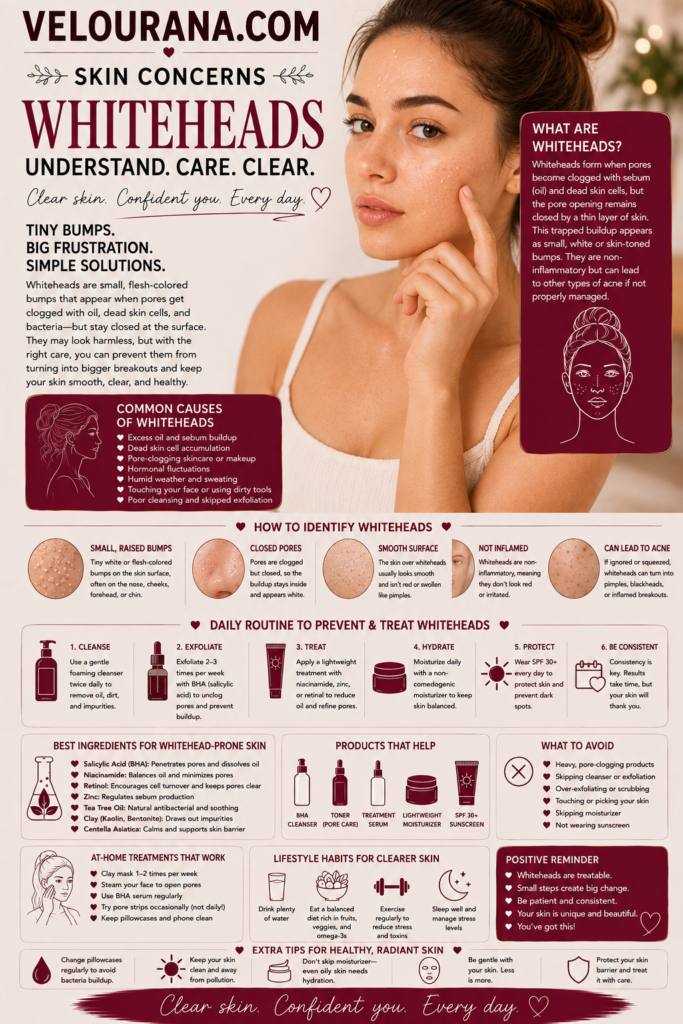
CATEGORY: Whiteheads
Whiteheads are among the least dramatic forms of acne, yet they can be some of the most persistent. They rarely announce themselves with the redness, tenderness, or swelling associated with an inflamed pimple. Instead, they sit beneath the surface as small, pale or skin-coloured elevations, subtly changing the texture of the complexion. Under direct light they may become suddenly obvious. Beneath makeup they can create an uneven finish. Along the forehead, chin, cheeks, or jawline, they can appear in clusters that seem to return almost as quickly as they disappear.
Their quiet appearance can make whiteheads seem superficial, as though the skin simply needs stronger cleansing or more aggressive exfoliation. Biologically, however, a whitehead is the visible result of a process taking place inside the follicle. Dermatologists describe whiteheads as closed comedones: follicles in which oil and cellular material have accumulated while the follicular opening remains covered. Understanding that distinction changes the way whiteheads should be approached.
The goal is not to scrub away something sitting on top of the skin. It is to influence how material accumulates and moves through the follicle so that congestion becomes less likely to form in the first place.
That makes whitehead care less a matter of extraction and more a matter of consistency. The most successful approach is usually neither harsh nor complicated. It is a patient strategy built around keeping follicles functioning normally while preserving the surrounding skin barrier.
The Whitehead Begins Before You Can See It
A whitehead does not suddenly appear overnight, even when it seems to.
Long before a small bump becomes visible, changes are occurring inside the pilosebaceous unit—the structure containing a hair follicle and its associated sebaceous gland. Sebum is naturally released into this environment, while cells lining the follicle are continually shed. Under normal circumstances, this mixture travels toward the surface without causing a problem.
Acne-prone follicles behave differently.
Cells can accumulate rather than separating and leaving the follicle efficiently. Sebum becomes incorporated into this material, gradually creating a plug. DermNet describes comedones as arising through increased keratinisation within the sebaceous duct together with increased sebum production, ultimately producing debris that obstructs the follicle.
At an extremely early stage, this developing blockage may be microscopic. Dermatologists refer to these invisible precursors as microcomedones. They matter because the bump eventually seen in the mirror is only a later stage in a process that has already been developing beneath the surface.
If the follicular opening remains closed, the accumulating material produces a closed comedo—a whitehead. If the opening becomes exposed to the air, an open comedo or blackhead develops instead.
This explains why whiteheads and blackheads belong to the same biological family even though they look so different.
It also explains why repeatedly removing individual visible whiteheads can become frustrating. Extraction addresses an existing plug. It does not necessarily change the conditions that allowed multiple microcomedones to develop around it.
Effective whitehead management therefore has two objectives: helping existing congestion resolve and reducing the formation of the next generation of blockages.
Why Whiteheads Are Not Simply “Dirty Pores”
The language surrounding acne has historically encouraged an unfortunate association between blemishes and cleanliness.
A person sees blocked pores and logically assumes that something has not been cleaned properly. More cleansing seems like the obvious solution. If normal cleansing fails, stronger cleansing follows. Scrubs, brushes, cleansing devices, drying toners, repeated washing, and increasingly aggressive exfoliation may all enter the routine.
The premise is misleading.
Whiteheads are not tiny pockets of ordinary surface dirt. They are closed follicular plugs composed principally of biological material such as sebum and keratinised cells. Their formation reflects events within the follicle rather than evidence that someone has failed to wash adequately.
This is an important distinction because acne-prone skin can simultaneously be congested and irritated.
Scrubbing harder does not necessarily remove material trapped beneath a closed follicular opening. Instead, excessive friction can disrupt the skin surface, produce irritation, and make an already difficult complexion feel tighter, rougher, or more reactive. Dermatological guidance specifically discourages abrasive treatment and picking as approaches to acne.
The better question is therefore not, “How can I make my skin cleaner?”
It is, “How can I create conditions in which follicles are less likely to become obstructed?”
That shift from cleanliness to follicular behaviour is one of the most useful conceptual changes anyone dealing with recurring whiteheads can make.
A gentle cleanser still has an important role. It removes sunscreen, makeup, excess surface oil, perspiration, pollution, and other material accumulated during the day. But cleansing should prepare the skin for a well-designed routine rather than function as an assault on the pore.
Clean skin and aggressively stripped skin are not the same thing.
Why Some Complexions Congest More Easily
Two people can use similar cosmetics, live in the same climate, and follow comparable routines while experiencing very different levels of congestion. That is because whiteheads do not arise from one universal cause.
Sebum production is part of the picture. Oilier areas of the face often correspond with regions where comedonal acne is particularly noticeable, including the forehead and chin. DermNet notes that comedonal acne commonly affects these areas. Yet oil alone does not adequately explain the condition. Plenty of people have oily skin without extensive whiteheads, while others experience congestion despite describing their skin as combination or even dry.
The way cells behave inside the follicle is equally important.
When cellular shedding becomes disorganised, material can accumulate rather than exiting normally. Add sebum, the structure of the individual follicle, hormonal influences, inflammation, environmental conditions, and external products, and the tendency toward congestion becomes much easier to understand.
Hormonal changes can influence sebaceous activity, which is one reason acne may fluctuate through adolescence, menstrual cycles, adulthood, pregnancy, or other hormonal transitions. Adult acne can also remain predominantly comedonal, sometimes including larger closed comedones.
Climate can matter as well. Heat and humidity alter the environment surrounding the skin, while occlusive layers of skincare, makeup, sweat, and sunscreen may feel very different in midsummer than they do in winter. DermNet identifies humid conditions and oily or occlusive cosmetics among factors capable of aggravating comedonal acne in susceptible people.
None of these factors means that a single moisturiser, foundation, hormonal fluctuation, or humid afternoon automatically “causes” whiteheads. Acne is more complex than that. What matters is the cumulative environment of a follicle already predisposed to blockage.
This is why identifying patterns is usually more productive than searching for one villain.
The Difference Between Congestion and Inflammation
Whiteheads are generally classified as non-inflammatory acne lesions, but the phrase can be misleading if interpreted too literally.
Modern understanding of acne recognises that inflammatory processes can be involved early in comedone development, even before a lesion becomes visibly red and swollen. The practical distinction is that a typical whitehead does not display the obvious inflammation seen in papules, pustules, nodules, or cystic lesions.
That difference matters when building a skincare strategy.
A complexion dominated by closed comedones requires particular attention to follicular obstruction. A complexion dominated by painful inflammatory lesions may need a broader approach targeting inflammation and acne-associated bacteria as well as congestion. Many people, of course, experience both simultaneously.
A whitehead can also change.
A quiet closed comedo may remain relatively stable, gradually disappear, or eventually become inflamed. Once the follicular environment becomes increasingly disturbed, the lesion may progress into the red, tender territory people more readily recognise as a conventional pimple.
This is another reason prevention matters.
Treating comedonal acne is not simply cosmetic maintenance for smoother-looking skin. Reducing follicular blockage can interrupt an earlier stage of the acne process.
Salicylic Acid and the Logic of Unclogging
Among widely available skincare ingredients, salicylic acid has become closely associated with congested and acne-prone skin for good reason.
The American Academy of Dermatology describes salicylic acid as an ingredient that opens clogged pores and exfoliates the skin and identifies it as effective for whiteheads.
Its usefulness is not based on making the skin peel as dramatically as possible.
The purpose of an exfoliating ingredient in whitehead-prone skin is to encourage more orderly removal of accumulated cellular material and reduce the conditions that favour persistent obstruction. Used appropriately, salicylic acid can therefore become part of a long-term strategy rather than an emergency treatment applied only when a bump becomes visible.
This distinction is important because aggressive exfoliation can easily become counterproductive.
Someone frustrated by congestion may combine a salicylic cleanser, exfoliating toner, acid serum, peeling solution, scrub, retinoid, and clarifying mask, assuming that each additional layer increases the probability of success. Instead, the routine can become increasingly irritating while the underlying acne remains.
More exfoliation is not automatically better exfoliation.
A successful routine should be tolerable enough to continue. If an ingredient leaves the face persistently burning, intensely peeling, or painfully tight, the resulting irritation may make consistency impossible.
Whiteheads tend to reward controlled repetition rather than intensity.
Retinoids and the Prevention Mindset
If whitehead treatment has a conceptual centre, topical retinoids occupy an important place within it.
Retinoids influence cellular turnover and help prevent follicles from remaining clogged. The American Academy of Dermatology specifically recommends retinoids for blackheads and whiteheads and notes that topical retinoids can also be used as maintenance therapy after acne has been brought under control.
This preventative dimension is what makes them particularly relevant to recurring comedonal acne.
Imagine a complexion with twenty visible whiteheads. A purely reactive strategy concentrates on those twenty lesions. A preventative strategy recognises that additional microcomedones may already be developing invisibly. The objective becomes changing the follicular environment across the acne-prone area rather than chasing individual blemishes.
That is why acne treatments are often applied over the affected region rather than exclusively to whatever happens to be visible that morning. DermNet similarly advises applying comedolytic topical treatments across affected areas.
Retinoids also illustrate one of the central tensions in acne care: an effective ingredient can still be poorly tolerated when introduced too aggressively.
Dryness, flaking, and irritation may occur, particularly during the early stages of treatment. A routine therefore needs supporting elements—gentle cleansing, appropriate moisturisation, and daytime sun protection—rather than treating the active ingredient as though everything surrounding it were irrelevant.
Pregnancy requires particular caution. People who are pregnant, planning pregnancy, or uncertain about whether an acne treatment is suitable for them should seek appropriate medical guidance before using retinoids or other acne medications. The American Academy of Dermatology specifically advises consultation before self-treating acne during pregnancy.
The broader lesson extends beyond retinoids: acne treatment works best when effectiveness and tolerability are considered together.
Why Moisturiser Still Belongs on Congested Skin
One of the most persistent contradictions in acne skincare is the fear of moisturiser.
When pores appear clogged and the skin already feels oily, applying moisture can seem illogical. The instinct is often to remove as much oil as possible and avoid putting anything back.
Yet hydration and oiliness are not interchangeable concepts.
A complexion can produce substantial sebum while simultaneously having a compromised or dehydrated surface. Acne treatments themselves may increase dryness and irritation. If every stage of the routine is designed to degrease, exfoliate, and dry the skin, tolerability can deteriorate quickly.
Moisturiser therefore serves a practical purpose. It supports the skin barrier and can make an evidence-based acne routine easier to sustain.
The formulation matters more than the idea of moisturisation itself.
A person prone to whiteheads may prefer lightweight products that do not leave a persistently heavy or greasy film. Labels such as “non-comedogenic” or “oil-free” can provide useful starting points, although no label can guarantee that every formulation will suit every individual complexion.
DermNet recommends oil-free cosmetics for comedonal acne and notes that oily cosmetics can aggravate congestion in susceptible skin.
The objective is not to deprive acne-prone skin of comfort. It is to choose supportive products without unnecessarily increasing occlusion.
This becomes especially important when active treatments are introduced. A routine containing an effective retinoid or exfoliating acid may ultimately accomplish more when paired with a suitable moisturiser than when surrounded by harsh products intended to make the face feel completely oil-free.
Skin does not need to feel stripped to be properly treated.
The Cosmetic Layer: Makeup, Sunscreen, Hair Products and Everyday Occlusion
When whiteheads repeatedly appear in a particular area, the geography of the breakout can provide useful clues.
Congestion concentrated near the hairline may invite examination of styling products, conditioners, oils, or pomades that repeatedly contact the skin. Forehead congestion can sometimes coexist with bangs, hats, helmets, perspiration, or heavy hair products. Breakouts around areas covered by cosmetics may encourage a closer look at foundation, primer, sunscreen, or skincare layering.
This does not justify blaming every cosmetic product.
“Comedogenicity” is not a perfectly predictable property outside laboratory conditions. Formulation, concentration, the amount applied, the other products layered with it, climate, frequency of cleansing, and the individual's skin all affect real-world experience.
Nevertheless, external occlusion can matter. DermNet includes certain oily cosmetics and pomades among recognised aggravating factors for comedonal acne.
A useful response is simplification rather than panic.
If congestion has suddenly increased after several new products were introduced simultaneously, it becomes difficult to identify which change matters. Returning temporarily to a simpler routine can make observation easier. Products can then be assessed methodically rather than discarded at random.
Sunscreen deserves particular care in this discussion because acne-prone individuals sometimes abandon it after experiencing heaviness or congestion with one formula.
The solution is generally to find a sunscreen texture that works better for the complexion, not to conclude that sun protection itself is incompatible with acne-prone skin. This becomes particularly important when exfoliating ingredients or retinoids are part of the routine.
The same principle applies to makeup.
Whiteheads do not automatically require giving up foundation, concealer, or other complexion products. Instead, attention can be paid to formulation, the number of layers being applied, cleansing at the end of the day, and whether a particular product consistently corresponds with worsening congestion.
Extraction: Immediate Satisfaction, Limited Strategy
Few skincare actions are as immediately tempting as squeezing a visible whitehead.
The bump looks contained. The solution appears mechanical. If something is trapped inside, why not simply remove it?
Because the follicle and surrounding tissue are more vulnerable than they appear.
Pressure applied with fingers or nails may damage the follicular wall and surrounding skin. Instead of producing a clean resolution, squeezing can increase inflammation, prolong healing, and contribute to post-blemish marks or scarring. The American Academy of Dermatology explicitly advises against picking whiteheads because doing so can worsen acne and contribute to scars.
Professional comedone extraction is different from casual squeezing.
Dermatologists may use sterile instruments and controlled techniques for selected persistent comedones. The AAD notes that extraction can be considered for stubborn whiteheads and blackheads, particularly when appropriate treatment has not cleared them.
Even professional extraction, however, does not replace prevention.
Removing one closed comedo solves the physical presence of that particular lesion. It does not prevent neighbouring follicles from forming new plugs.
This is why the mirror can become a poor guide to acne management. The most satisfying intervention is not always the most important one. Extraction produces an immediate visible event. Preventative skincare works gradually and often invisibly.
Yet over several months, prevention can transform the complexion far more profoundly than repeatedly removing whatever appears next.
The Problem With Treating Whiteheads Too Quickly
Acne skincare is unusually vulnerable to impatience because the treatment and the condition operate on different timelines.
A new product is applied tonight. Naturally, the user looks for evidence tomorrow morning.
Whiteheads do not work that way.
Because visible lesions emerge from a process developing within the follicle, meaningful improvement requires time. Dermatological sources consistently emphasise that acne treatments often need several weeks or months before their effects become convincing. The NHS notes that acne treatments may require two to three months before improvement becomes apparent, while DermNet states that noticeable changes commonly require at least several weeks.
This delay creates a dangerous cycle.
A product is used for ten days. Whiteheads remain. A second active is added. The skin becomes dry. A new cleanser replaces the old one. A peel is introduced. Irritation develops. Moisturiser is stopped because the complexion now feels “clogged.” The barrier becomes increasingly uncomfortable, while no individual treatment has been given enough time to demonstrate what it can actually do.
Eventually the routine contains so many variables that neither improvement nor deterioration can be interpreted confidently.
A more intelligent approach is deliberately uneventful.
Introduce purposeful changes. Observe the skin over an appropriate period. Adjust according to tolerance and results. Resist the temptation to redesign the entire routine every time a new bump appears.
Acne fluctuates naturally. A single good day does not prove that a treatment has succeeded, just as one new whitehead does not prove that it has failed.
Progress is better judged as a trend.
Are fewer new bumps forming? Does the forehead feel smoother than it did six weeks ago? Are existing comedones gradually resolving? Are inflammatory lesions becoming less frequent? Can the routine be used consistently without persistent irritation?
Those questions reveal more than daily inspection under a magnifying mirror.
A Routine Should Be Built Around Functions, Not Product Count
The beauty industry can make acne care appear dependent on owning an elaborate sequence of specialised products.
In reality, a whitehead-focused routine is easier to understand when divided by function.
Cleansing removes the material accumulated on the skin surface. Treatment addresses the biological processes contributing to follicular congestion. Moisturisation supports barrier comfort and tolerance. Sunscreen protects the skin during the day.
Everything beyond those functions should earn its place.
That does not mean toners, essences, masks, serums, or other cosmetic categories are inherently inappropriate. It means they should not be added simply because an acne routine feels incomplete without them.
For some complexions, additional products provide hydration or improve comfort. For others, elaborate layering makes it harder to identify irritation or congestion triggers.
A particularly important distinction exists between skincare that makes skin feel temporarily smooth and treatment that alters the tendency to form comedones.
A scrub may produce immediate softness by polishing the surface. A clay mask may temporarily reduce surface oil. Neither sensation necessarily means the follicular process responsible for recurring whiteheads has been corrected.
By contrast, a well-tolerated comedolytic treatment may initially feel far less dramatic while gradually reducing new congestion.
The best routine is therefore not necessarily the one that creates the strongest sensation.
It is the one whose components have clear jobs and can coexist long enough to work.
When Whiteheads Are Not Really Whiteheads
Not every tiny pale bump on the face is a closed comedo.
This distinction becomes particularly important when a carefully constructed acne routine seems to make absolutely no difference.
Milia, for example, are small keratin-filled cysts that may resemble whiteheads but are biologically different. They are often firm, pearly, and commonly appear around the eye area or upper cheeks. Sebaceous hyperplasia can create small flesh-coloured or yellowish bumps associated with enlarged sebaceous glands. Folliculitis and other follicular conditions may also create acne-like eruptions.
Texture can have still other explanations.
This is one reason self-diagnosis based exclusively on photographs can become unreliable. The word “whitehead” is often used casually for almost any small pale bump, while dermatology uses the term more specifically for a closed comedo.
Location, appearance, duration, associated redness or itching, age of onset, and response to treatment all contribute to distinguishing one condition from another.
If dozens of apparently identical bumps persist despite a sensible acne regimen, suddenly appear in an unusual pattern, itch significantly, or behave unlike ordinary acne, professional assessment may save months of unsuccessful experimentation.
Good skincare begins with treating the correct condition.
When Professional Treatment Becomes the Better Route
Mild comedonal acne can often respond to appropriate topical care, but there is no virtue in continuing unsuccessful self-treatment indefinitely.
A dermatologist can assess whether the bumps are genuinely comedones, evaluate the overall type and severity of acne, identify contributing factors, and prescribe stronger or more specialised treatment when necessary.
Professional assessment becomes particularly important when whiteheads coexist with painful nodules, widespread inflammatory acne, significant scarring, or persistent pigmentation. The NHS recommends medical evaluation for moderate or severe acne, acne that has not responded to pharmacy treatment, painful nodules, or acne associated with scarring.
Persistent adult acne may also justify investigation when other symptoms suggest an underlying hormonal issue.
The purpose of seeking professional care is not simply to obtain a stronger product. It is to replace trial and error with diagnosis and a coordinated treatment plan.
Dermatologists may use prescription retinoids, combination topical therapies, hormonal approaches in appropriate patients, systemic medications for more significant acne, or carefully performed procedures for resistant comedones. Current American Academy of Dermatology guidelines support several topical acne therapies, including retinoids, benzoyl peroxide, salicylic acid, and azelaic acid, with systemic options available when clinically appropriate.
The appropriate choice depends on the person, the acne pattern, medical history, pregnancy considerations, other medications, and severity. What works beautifully for one complexion may be unsuitable for another.
Professional treatment becomes especially valuable when acne begins to leave permanent consequences. Preventing scars is generally easier than correcting established scars later.
The Quiet Discipline of Clearer Skin
Whiteheads illustrate something fundamental about skincare: what is visible on the surface is often only the final expression of a process that began earlier and deeper.
A closed comedo is small, but its formation involves the interaction of follicular cells, sebum, keratinisation, inflammation, hormonal influences, and the surrounding environment. That complexity explains why aggressive cleansing rarely solves the problem and why squeezing one bump after another can become an endless ritual.
The more useful strategy is preventative.
Cleanse without attacking the skin. Use treatments capable of addressing follicular congestion. Support the barrier sufficiently to tolerate them. Pay attention to cosmetics and other sources of unnecessary occlusion without becoming afraid of every product. Protect the skin from the sun. Allow enough time to distinguish genuine progress from daily fluctuation.
Above all, resist the assumption that successful acne care should feel aggressive.
A routine does not become more sophisticated because it contains more acids, more steps, or stronger sensations. In many cases, sophistication means knowing what not to add.
Whiteheads often improve through repetition of relatively simple decisions: gentle cleansing tonight, appropriate treatment again tomorrow, moisturiser when needed, sunscreen in the morning, and hands away from the bumps that invite interference.
Over time, the objective becomes larger than removing what can currently be seen.
The real transformation occurs when fewer invisible plugs are developing beneath the surface, fewer closed comedones are emerging to replace those that disappear, and the complexion gradually becomes more stable rather than merely temporarily clearer.
That is the central logic of treating whiteheads.
The smoothest-looking skin is not created by constantly fighting its surface. It is created by understanding the follicular process beneath it and giving that process enough time, consistency, and restraint to change.
The End Velourana
 Discover More From Our Family of Websites
 ZodiacBearing (Astrology, Tarot, Numerology, Angel Numbers & Spiritual Guidance)
 Velourana (Beauty, Makeup, Hair Care, Skincare & Beauty Tips)
 HavenBearing (Home, Living, Organization, Décor & Everyday Inspiration)
 PawBearing (Pet Care, Dog Breeds, Animal Health, Training & Pet Products)
 PsyCatherine (Notes From the Journal of a Psychologist on Real Life)

