
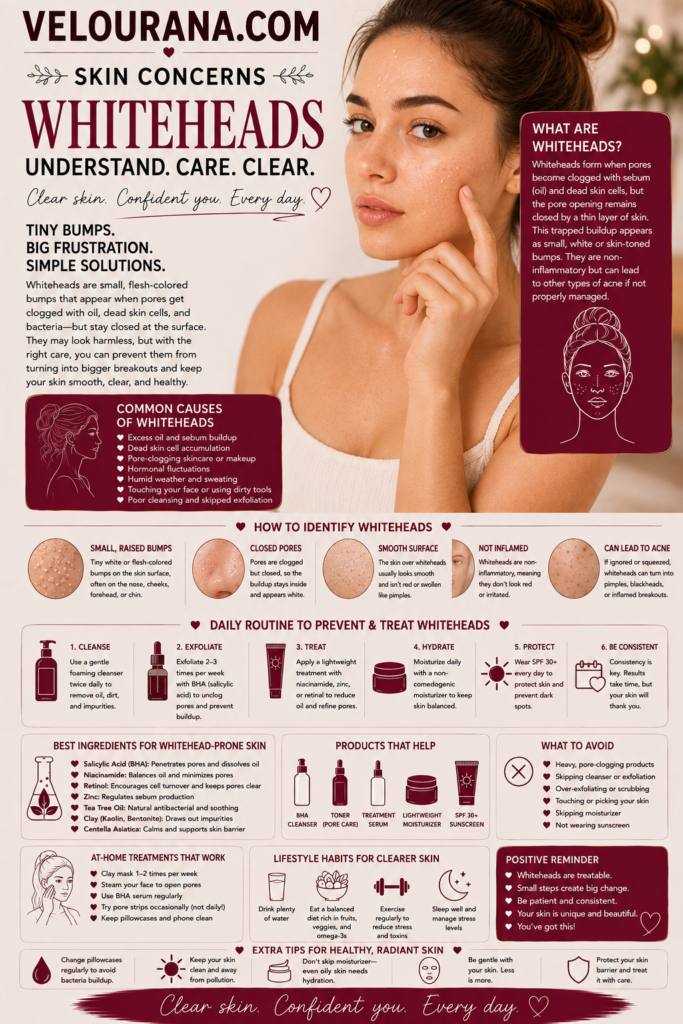
CATEGORY: Whiteheads
Whiteheads create a misleading visual message.
They look as though the skin contains too much of something. Too much oil. Too much residue. Too much buildup. Too much product. The natural response is subtraction: cleanse more thoroughly, exfoliate more often, choose lighter textures, avoid moisturiser, remove every trace of shine.
For some people, that instinct becomes the foundation of their entire acne routine.
The skin is washed until it feels tight. Toners are chosen for their ability to make oil disappear. Moisturiser is applied sparingly or eliminated altogether. Exfoliating acids are layered because congestion appears to demand greater intensity. Any sensation of dryness is interpreted as proof that the routine is finally controlling the oil responsible for the whiteheads.
Yet acne-prone skin is not improved simply by making it as dry as possible.
A whitehead forms because material becomes trapped within a follicle whose opening remains closed. Sebum is part of that process, but so is abnormal accumulation of keratinised cells and the behaviour of the follicular lining itself. The skin barrier, meanwhile, performs an entirely different job: it limits water loss, protects underlying tissue, and helps maintain the surface environment in which skincare treatments must operate.
These systems interact, but they are not interchangeable.
It is entirely possible to have an oily forehead filled with closed comedones and simultaneously have a compromised, dehydrated surface. It is possible for a person to produce abundant sebum while experiencing stinging, flaking, and tightness. It is possible to treat congestion so aggressively that the routine intended to clear the skin becomes too irritating to maintain.
The challenge of whitehead care therefore lies in balance.
The skin needs enough intervention to reduce follicular blockage, but not so much that treatment constantly destabilises the surrounding barrier. Understanding that tension is one of the most important steps toward building an acne routine that works beyond the first few enthusiastic weeks.
Oil Is Part of the Story, Not the Whole Story
Sebum has an unfortunate reputation.
In acne discussions, it is often described almost as a contaminant: something greasy, pore-clogging, and inherently undesirable. The ideal complexion is imagined as one in which oil production has been reduced almost to zero.
But sebum is a normal biological substance.
It is produced by sebaceous glands and contributes to the lipid environment of the skin surface. The problem in acne is not the mere existence of sebum. Rather, increased sebaceous activity can combine with abnormal follicular keratinisation and other biological processes to create conditions favourable to comedone formation.
This distinction matters because otherwise every trace of shine becomes evidence of failure.
A person with naturally oily skin may never achieve a permanently matte complexion, nor should that necessarily be the objective. The meaningful goal is reducing pathological congestion and inflammation while allowing the skin to function normally.
Whiteheads illustrate this particularly well.
If oil alone caused them, the oiliest skin would always be the most comedonal and dry skin would never develop them. Real skin does not behave so neatly. Some highly oily complexions have relatively clear follicles. Others with combination skin develop persistent closed comedones along the forehead or jaw.
The follicle is a biological environment, not a simple container filling with grease.
That means treatment needs to influence the way material forms and moves within that environment rather than focusing exclusively on stripping oil from the surface.
The Difference Between Oily Skin and Dehydrated Skin
Oiliness and hydration are frequently confused because both influence how the face feels.
Oil refers primarily to lipids, including sebum.
Hydration refers to water.
A complexion can have plenty of one and too little of the other.
This is why someone can complain that their face becomes shiny by midday while also describing tightness after cleansing. The sebaceous glands continue producing oil, but the outer layers of the skin may be losing water efficiently enough to feel uncomfortable.
This combination becomes especially common in acne routines built around repeated degreasing.
A strong cleanser removes surface oils.
An alcohol-rich toner follows.
Several exfoliating ingredients are applied.
The skin becomes tight.
Moisturiser is avoided because the person fears clogging.
By afternoon, oil has returned, yet the surface still feels dehydrated.
The user then concludes that the skin is extraordinarily oily and requires even stronger cleansing.
What has actually happened is more complicated.
The routine is attacking oil while failing to support hydration and barrier function.
The resulting complexion may feel both greasy and dry, a combination that seems contradictory only if oil and water are assumed to be the same thing.
Why the Skin Barrier Matters in Acne Care
The phrase “skin barrier” has become so common in beauty marketing that it can sound vague or fashionable.
Biologically, however, the concept is fundamental.
The outermost layer of the epidermis, particularly the stratum corneum, helps regulate water loss and protects the tissue beneath from environmental stressors. It contains corneocytes embedded within a lipid matrix often compared to bricks and mortar.
When this system functions well, the skin retains water efficiently and tolerates environmental exposure with relatively little discomfort.
When it becomes disrupted, transepidermal water loss can increase. The skin may become dry, irritated, sensitive, tight, or flaky.
For a person treating whiteheads, this matters for a practical reason: most effective acne routines require consistency.
If the skin becomes so irritated that treatment must constantly be stopped, consistency becomes impossible.
An active ingredient that could have improved comedonal acne over several months may never get the opportunity because the surrounding routine is too harsh.
The barrier therefore does not compete with acne treatment.
It supports the ability to continue acne treatment.
The Tight-Skin Fallacy
Many people interpret tightness after cleansing as evidence that the face is exceptionally clean.
The sensation is psychologically satisfying.
Oil has disappeared. The skin feels squeaky. Every trace of residue seems gone.
But tightness is not a reliable measure of cleanliness.
It can instead indicate that the cleanser has removed more surface lipids than the skin comfortably tolerates.
This matters because whiteheads encourage frequent cleansing. Someone who believes their pores are clogged may wash the face three or four times a day, especially when the skin becomes oily again.
The cycle can become self-reinforcing.
Cleansing temporarily removes oil.
The skin looks matte.
Sebum gradually returns because sebaceous glands continue functioning.
The return of shine is interpreted as dirtiness.
Another wash follows.
Over time, the skin may become increasingly irritated while the closed comedones remain largely unchanged because their obstruction exists within the follicle rather than as ordinary surface grease.
Gentle cleansing can therefore be more sophisticated than aggressive cleansing.
The goal is to remove what genuinely needs to be removed—makeup, sunscreen, sweat, pollutants, and excess surface oil—without turning every wash into a barrier challenge.
Why Over-Drying Can Make Texture Look Worse
Whiteheads already create visible elevation.
Add dehydration and flaking, and the surface can become dramatically more irregular.
This creates a particularly frustrating visual paradox.
A person increases exfoliation because the skin looks textured.
The increased exfoliation causes dryness.
Dryness produces additional roughness and flaking.
The complexion now appears even more textured.
More exfoliation follows.
Eventually, the person may be treating two separate forms of unevenness at once: closed comedones beneath the surface and treatment-induced dryness above it.
Makeup reveals the problem mercilessly.
Foundation catches around flakes, settles into dehydrated lines, and exaggerates the edges of tiny bumps. Powder emphasises rough patches. The face looks less smooth despite increasingly aggressive attempts to make it smoother.
This is one of the clearest examples of why visual feedback can be misleading in acne care.
Not all roughness is congestion.
Sometimes part of what looks like worsening whiteheads is actually barrier damage surrounding existing whiteheads.
Moisturiser Is Not the Enemy of Comedonal Skin
Fear of moisturiser often becomes strongest in people with closed comedones.
Cream appears physically similar to the substances they imagine blocking their follicles. The logic seems intuitive: if the pore is already filled, why put more material onto the skin?
But moisturiser does not simply pour into follicles and become a whitehead.
Formulation matters, of course. Some textures may feel too heavy or occlusive for a particular complexion. Acne-prone individuals often prefer lighter products designed with their skin type in mind.
Yet moisturisation itself serves an important function.
It supports the water content and barrier comfort of the outer skin, which becomes particularly valuable when active acne treatments increase dryness.
This is why moisturiser can indirectly improve the success of a whitehead routine even though it is not the primary comedolytic treatment.
If moisturiser allows someone to tolerate a retinoid regularly rather than abandoning it after ten days, it has contributed meaningfully to acne control.
The same applies to acids.
A balanced routine does not divide products into those that “fight acne” and those that merely feel pleasant.
Barrier-supportive products can make acne treatments usable.
That usability is part of efficacy.
Choosing Texture Without Becoming Afraid of Ingredients
People with whiteheads often become ingredient detectives.
Every cosmetic component is researched. Online lists divide ingredients into safe and dangerous categories. If congestion appears, one named ingredient is blamed immediately.
This approach can provide a sense of control, but it has limitations.
Finished formulations behave differently from isolated ingredients. Concentration matters. The interaction between ingredients matters. The amount applied matters. The skin of the individual matters.
A lightweight lotion containing one supposedly suspicious ingredient may perform beautifully, while a product that looks perfect on paper may still feel too occlusive.
Real-world observation therefore matters as much as theoretical ingredient analysis.
For whitehead-prone skin, it is often practical to begin with products described as suitable for acne-prone or non-comedogenic skin and then evaluate performance over time.
The most informative question is not whether a single ingredient appears on an internet blacklist.
It is whether the complete formula repeatedly corresponds with worsening congestion in that particular person.
This approach is slower but more accurate.
Why Layering Can Matter More Than Any Single Product
A moisturiser may be perfectly reasonable on its own.
A sunscreen may also be reasonable.
So may a primer, foundation, concealer, and setting product.
But the complexion experiences them as layers.
This is particularly important in hot or humid conditions, when multiple cosmetic films can feel substantially more occlusive than they did in cooler weather.
Someone may focus intensely on identifying one “pore-clogging” product while overlooking the cumulative effect of six layers applied over the same region.
Again, this does not mean cosmetic layering automatically causes whiteheads.
Many acne-prone people wear multiple products without difficulty.
The point is that the entire routine creates the environment in which the skin exists for many hours each day.
When recurring congestion becomes difficult to explain, simplification can reveal whether the cumulative load is contributing.
Sometimes reducing one unnecessary serum, choosing a lighter moisturiser for summer, or using a sunscreen that doubles as a comfortable daytime base can make the routine feel less heavy without sacrificing essential functions.
The strategy is not deprivation.
It is efficiency.
The Acne Routine as an Ecosystem
Skincare is often marketed as a sequence of individual hero products.
One cleanser clears pores.
One serum controls oil.
One cream repairs the barrier.
One treatment resurfaces the skin.
But skin does not experience products independently.
It experiences the combined routine.
A highly effective active can be undermined by a harsh cleanser.
A gentle cleanser can be overwhelmed by simultaneous use of several irritating treatments.
A beautiful moisturiser can feel too heavy when layered beneath another rich cream and a dense sunscreen.
A sunscreen that works perfectly in winter may feel uncomfortable in humid summer conditions.
This is why routine design matters more than collecting individually impressive products.
For whitehead-prone skin, every component should support the overall objective: keeping follicles clearer while maintaining enough barrier stability for treatment to continue.
The cleanser should not create unnecessary irritation.
The acne treatment should address the actual pathology.
The moisturiser should support comfort without feeling excessively occlusive.
The sunscreen should protect the skin in a texture the person will actually wear.
Additional products should add genuine value rather than simply complexity.
The Special Challenge of Combination Skin
Combination skin exposes the limitations of one-size-fits-all routines.
The forehead and nose may be oily and prone to whiteheads.
The cheeks may be normal or dry.
The area around the mouth may become irritated easily.
Using the same amount of every product across the entire face can therefore be unnecessary.
A lightweight moisturiser may work everywhere, while richer support is needed only on drier areas.
An acne treatment may be concentrated across the regions where comedones repeatedly form rather than applied heavily to sensitive areas that rarely break out.
This does not mean constructing an impossibly complicated facial map.
It means recognising that skin is regional.
Sebaceous gland density varies.
Exposure varies.
Friction varies.
Product contact varies.
The face is not one biologically uniform surface.
This perspective can make routines both simpler and more comfortable because products are used according to need rather than habit.
Whiteheads in Humid Weather
Summer creates a particular challenge for congested skin.
Heat increases perspiration.
Humidity alters evaporation.
Sunscreen is often applied more heavily and reapplied.
People may spend more time outdoors.
Hair products and sweat may migrate onto the forehead.
Makeup can remain in contact with warm skin for extended periods.
Products that felt elegant in January may feel heavy in August.
This is not evidence that moisturiser suddenly became harmful or that sunscreen should be abandoned.
It is evidence that formulation preferences can be seasonal.
A gel-cream or lighter lotion may be more comfortable during humid weather than a rich cream.
A sunscreen with a lighter finish may reduce the urge to skip protection entirely.
Night-time routines can also be adjusted to maintain hydration without creating unnecessary layering.
Seasonal adaptation is not inconsistency.
It is responsiveness.
Whiteheads in Cold Weather
Winter creates the opposite problem.
Cold outdoor air, indoor heating, wind, and lower humidity can increase dryness.
Someone who successfully uses a lightweight routine in summer may discover that the same routine becomes uncomfortable in winter.
The common mistake is to ignore this change because acne is still present.
The person assumes that adding moisture will worsen congestion and continues using an increasingly drying regimen.
The barrier deteriorates.
Retinoids become difficult to tolerate.
The complexion develops flaking.
Treatment adherence declines.
A richer but still acne-compatible moisturiser, or more strategic application of existing moisturiser, may make more sense than abandoning the active ingredient that is actually controlling the whiteheads.
The objective remains the same throughout the year.
The supporting routine may change.
Retinoids Reveal the Importance of Barrier Strategy
Retinoids are among the clearest examples of why barrier management matters.
They can be extremely useful for comedonal acne because they influence the cellular processes involved in follicular plugging.
But they may also cause dryness, peeling, and irritation, especially when introduced too quickly.
A person eager for results may apply a retinoid every night from the beginning, combine it with exfoliating acids, and use a strong cleanser because the skin remains oily.
Within days, the face becomes uncomfortable.
The retinoid is blamed.
It is discontinued.
Months later, another attempt begins.
This pattern can repeat indefinitely.
Often, the problem is not that the treatment could never be tolerated. It is that the entire routine was built around maximum intensity rather than adaptation.
Gradual introduction, appropriate moisturisation, and restraint with competing irritants can transform tolerability.
The most powerful acne treatment is useless if the routine makes its continued use impossible.
Salicylic Acid and the Problem of Exfoliation Stacking
Salicylic acid is another effective ingredient that can become problematic through enthusiasm.
It appears in cleansers, toners, serums, pads, masks, and spot treatments.
Someone can therefore use it several times within the same routine without consciously realising how much cumulative exfoliation is occurring.
Then another acid is added.
Perhaps glycolic acid for texture.
Then lactic acid for hydration.
Then a weekly peel.
Every product has a plausible explanation.
Together, they may create unnecessary irritation.
This is why active ingredients should be considered by function, not simply by product category.
A cleanser containing an exfoliating acid is still an exfoliating treatment.
A toner containing acids is not merely a hydrating water step.
A resurfacing mask is still part of the total exfoliation load.
Routine planning becomes easier when these functions are recognised honestly.
Barrier Repair Does Not Require Abandoning Acne Treatment
When irritation appears, people often swing from one extreme to another.
For several weeks, the routine contains multiple active ingredients.
Then every active is removed and the skin enters a period of “barrier repair.”
Once the face feels better, all treatments return simultaneously.
Irritation returns.
The cycle repeats.
Sometimes temporary reduction is appropriate, particularly when the skin is significantly irritated. But long-term success usually requires integrating barrier support into the acne routine rather than treating it as a separate emergency programme.
This is a more mature approach.
Instead of constantly alternating between attack and recovery, the routine aims for sustainable treatment from the beginning.
Moisturiser is not reserved for crisis.
Gentle cleansing is not introduced only after damage occurs.
Sunscreen is not optional when the skin feels sensitive.
The supporting structure exists every day.
Sunscreen Has a Place Even When Whiteheads Are the Main Concern
People with congested skin often struggle to find sunscreen they enjoy using.
Some formulas feel heavy.
Others become shiny.
Certain products pill beneath makeup.
The temptation to skip sunscreen can therefore be strong, especially when the routine already feels crowded.
But acne treatment does not occur in isolation from ultraviolet exposure.
Post-blemish marks can become more persistent or visibly darker with sun exposure. Some acne treatments increase sensitivity or make sun protection particularly important.
The solution is not to choose between clear pores and sunscreen.
It is to find a sunscreen formulation that works within the routine.
For some people, this becomes the product category worth testing most patiently because texture preferences vary dramatically.
A formula that feels elegant enough to wear consistently is more useful than one with impressive claims that remains untouched in a drawer.
When the Barrier Is Telling You to Reduce Intensity
Skin communicates irritation through patterns.
Persistent stinging when bland products are applied.
Burning during cleansing.
Visible flaking.
Increasing tightness.
Redness that was not previously present.
Sudden sensitivity to products that were once comfortable.
These signs deserve attention.
They do not necessarily mean every acne treatment must be permanently stopped, but they suggest that the current balance is wrong.
Continuing to escalate because whiteheads remain visible can deepen the problem.
The complexion may need fewer simultaneous actives, less frequent application, a gentler cleanser, better moisturisation, or professional guidance.
The key is to interpret irritation as information.
Pain is not proof of effectiveness.
Peeling is not the objective.
Redness is not a necessary payment for clearer pores.
When Oil Control Becomes an Obsession
Whiteheads can turn ordinary shine into an emotional trigger.
A person begins checking the forehead constantly.
Blotting papers are used repeatedly.
Powder is reapplied throughout the day.
Any visible oil is interpreted as the beginning of another breakout.
This can encourage increasingly extreme control measures.
But sebum production is not entirely under cosmetic control.
The skin will continue producing oil according to genetics, hormones, age, environment, and other biological factors.
A routine can reduce excess surface oil and improve acne without transforming naturally oily skin into permanently dry skin.
Accepting that reality can reduce unnecessary intervention.
The aim is not to eliminate every reflection from the forehead.
It is to reduce pathological congestion while maintaining comfortable, functional skin.
The Difference Between Comfort and Complacency
Supporting the barrier does not mean treating whiteheads timidly.
There is a danger in moving too far in the opposite direction and avoiding effective acne treatment because the skin might become dry.
Comedonal acne often requires purposeful intervention.
Gentle cleansing and moisturising alone may improve comfort but may not adequately prevent follicular obstruction.
The balance lies between two unhelpful extremes.
One extreme attacks the skin relentlessly.
The other protects the barrier so carefully that the primary acne process is never treated.
A thoughtful routine does both jobs.
It uses an evidence-based treatment strong enough to address congestion and a supporting regimen gentle enough to make that treatment sustainable.
Why Fewer Products Can Produce Better Results
Complexity often feels reassuring.
A ten-step routine creates the impression that every possible mechanism has been addressed.
But each product introduces another variable.
Another potential irritant.
Another texture.
Another layer.
Another opportunity for interaction.
For persistent whiteheads, simplicity can therefore become a strategic advantage.
A stable routine creates a clear baseline.
Changes can be evaluated.
Irritation becomes easier to trace.
Products have time to demonstrate their actual effects.
This does not mean everyone must use exactly four products forever.
It means complexity should be earned.
If an additional serum clearly improves hydration without worsening congestion, it may deserve a place.
If another treatment addresses a specific concern and can be tolerated, it may be useful.
But adding products simply because the routine feels incomplete can obscure what the skin genuinely needs.
A Better Definition of Balanced Skin
Balanced skin is often imagined as a complexion that is neither oily nor dry.
Biology is more complicated.
For someone naturally oily and prone to whiteheads, balance may still include visible sebum by afternoon.
For someone using a retinoid successfully, balance may include occasional mild dryness that is manageable with moisturiser.
For combination skin, balance may mean different textures in different regions.
The more useful definition is functional.
Balanced skin can tolerate its routine.
It is not persistently inflamed by treatment.
It is not chronically stripped.
Whiteheads are gradually becoming less frequent.
The barrier remains comfortable enough for preventative treatment to continue.
That form of balance is far more meaningful than whether the forehead looks matte at 4 p.m.
When Professional Guidance Helps
Persistent whiteheads accompanied by severe irritation create a difficult situation.
The skin needs treatment, but the treatments tried so far cannot be tolerated.
This is exactly the kind of scenario where professional guidance can be valuable.
A dermatologist can confirm the diagnosis, assess acne severity, identify whether another skin condition is contributing, and adjust treatment strength or formulation.
Prescription options may offer advantages that cannot be achieved simply by buying stronger cosmetic acids.
Professional care is also important when acne is widespread, increasingly inflammatory, leaving scars, or significantly affecting quality of life.
There is no benefit in repeatedly damaging the barrier while trying to solve a problem that requires medical treatment.
The Long-Term Goal Is Stability, Not Dryness
Whiteheads encourage a war against oil.
The more useful objective is stability.
Stable skin may still produce sebum.
It may still develop an occasional clogged pore.
It may still require maintenance treatment.
What changes is the pattern.
Congestion becomes less persistent.
The forehead develops fewer clusters.
The chin feels smoother.
Treatments can be used without constant cycles of burning and recovery.
Makeup sits more comfortably because the surface is no longer simultaneously bumpy and flaky.
The person stops redesigning the routine every week.
That is a much more meaningful form of improvement than simply achieving temporary dryness.
The healthiest approach to whiteheads is therefore neither aggressive nor passive.
It is controlled.
Treat the follicle.
Protect the barrier.
Use enough moisturisation to maintain tolerance.
Choose textures appropriate for the climate and complexion.
Avoid unnecessary layering.
Allow effective treatments time to work.
And remember that oil itself is not evidence of failure.
Clearer skin does not require becoming hostile to the natural substances that skin produces.
It requires understanding which biological processes actually create congestion and treating those processes without damaging everything around them.
When that balance is achieved, whitehead care becomes far less dramatic.
The routine stops swinging between stripping and repairing.
The skin stops being treated as an enemy.
And gradual, sustainable improvement becomes much more likely.
The End Velourana
 Discover More From Our Family of Websites
 ZodiacBearing (Astrology, Tarot, Numerology, Angel Numbers & Spiritual Guidance)
 Velourana (Beauty, Makeup, Hair Care, Skincare & Beauty Tips)
 HavenBearing (Home, Living, Organization, Décor & Everyday Inspiration)
 PawBearing (Pet Care, Dog Breeds, Animal Health, Training & Pet Products)
 PsyCatherine (Notes From the Journal of a Psychologist on Real Life)

