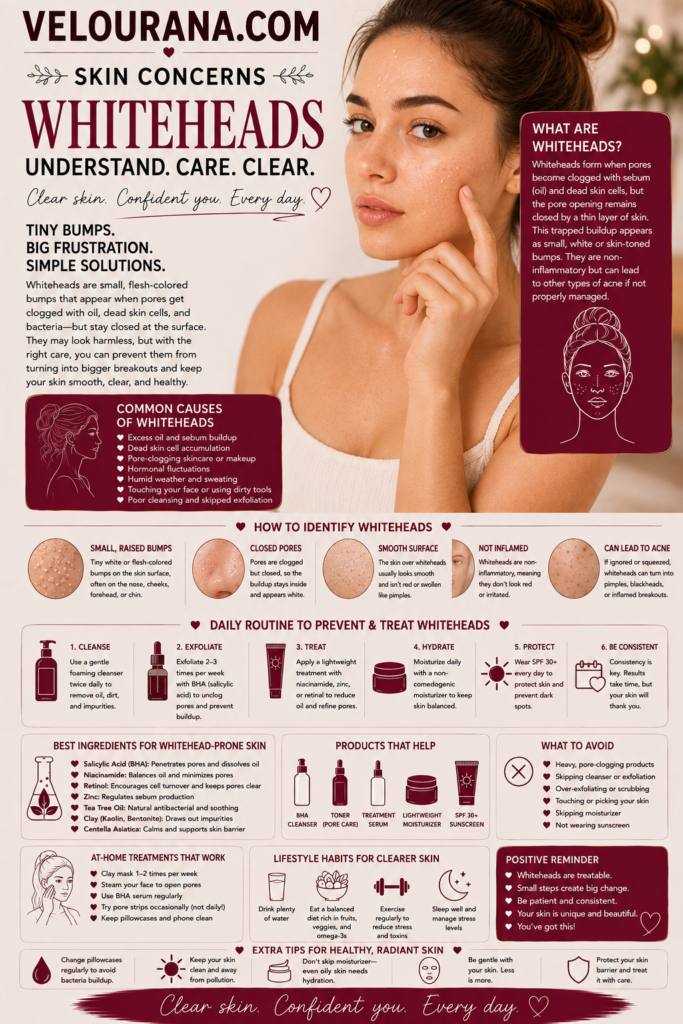
CATEGORY: Whiteheads
Whiteheads are often discussed in the language of acne, but many people first experience them as a texture problem.
The skin may not look inflamed. There may be no painful cysts, no obvious redness, and no large pustules. Yet under daylight, the forehead looks uneven. Makeup catches around tiny bumps. The chin feels grainy despite careful cleansing. Photographs taken from the side suddenly reveal a landscape of miniature elevations that were almost invisible from the front.
This is one of the peculiar characteristics of closed comedones. They can alter the visual quality of the complexion without creating the dramatic signs people normally associate with acne.
That can make them disproportionately frustrating.
A red pimple is easy to identify as temporary inflammation. A field of small whiteheads may instead create the impression that the skin itself has become coarse, congested, or somehow fundamentally uneven. The problem begins to feel less like a handful of blemishes and more like a change in the character of the entire face.
Understanding why whiteheads affect texture so strongly helps separate what is actually happening from what lighting, makeup, and close inspection can make it seem is happening.
The surface may look rough, but the origin of the problem often lies within the follicle.
Texture Is a Visual Effect Before It Is a Diagnosis
When people describe “textured skin,” they can mean many different things.
They may be referring to closed comedones, enlarged pores, sebaceous filaments, dehydration lines, acne scars, milia, flaking, follicular prominence, or simply the normal microscopic architecture of human skin.
The term is useful descriptively but imprecise medically.
This distinction matters because different forms of texture require different responses. A routine designed for closed comedones may not resolve milia. Aggressive exfoliation intended to smooth acne-prone skin may worsen flaking caused by barrier damage. Treatments aimed at active acne will not erase established atrophic scars.
Whiteheads have their own characteristic texture because they create small elevations over follicles whose openings remain covered.
When numerous closed comedones develop close together, the cumulative visual effect can be much greater than the size of any individual lesion would suggest. A single one-millimetre bump is barely noticeable. Fifty scattered across a forehead can significantly alter how light moves across the skin.
This is why texture often appears worse under directional light.
Light coming from the side creates tiny shadows around each elevation. The same skin viewed in diffuse frontal light may look relatively smooth.
The bumps have not changed.
The geometry of illumination has.
This simple fact can have a surprisingly large effect on how people judge their skin from hour to hour.
Why Whiteheads Can Look Worse in Makeup
Foundation does not necessarily create texture, but it can reveal it.
Liquid or cream complexion products settle over the contours already present on the skin. Where the surface is smooth, the finish appears continuous. Where small comedones create elevations, pigment and light can collect differently around them.
Matte formulas may emphasise this effect because they reduce the reflective quality that can visually soften irregularities. Heavy powder can settle around tiny elevations or areas of dryness, making them appear more prominent.
At the same time, trying to conceal texture by applying more product can sometimes create the opposite effect.
The thicker the cosmetic layer, the more clearly it may follow every contour beneath it.
This can lead to a frustrating cycle in which congestion causes heavier makeup application, while heavier application makes the congestion more visually obvious.
The solution is not necessarily abandoning makeup.
It is recognising that cosmetic camouflage has limits when the underlying problem is three-dimensional.
Colour can conceal redness and pigmentation. It cannot completely flatten an elevated follicle.
This distinction can be liberating because it shifts the goal.
Rather than searching endlessly for a foundation capable of erasing every bump, attention can return to improving the follicular process gradually while choosing cosmetic textures that sit comfortably over the skin in the meantime.
The Difference Between Whiteheads and Sebaceous Filaments
Many people trying to improve facial texture accidentally treat normal sebaceous filaments as acne.
Sebaceous filaments are normal structures associated with the movement of sebum through follicles. They are particularly visible around the nose, central cheeks, and chin and may appear as tiny pale, grey, or yellowish dots.
They are not the same as closed comedones.
A whitehead is a blocked follicular lesion. A sebaceous filament is part of normal follicular anatomy.
This distinction matters because sebaceous filaments naturally return even after temporary removal. Squeezing or using pore strips may make them appear less obvious for a short time, but the follicle continues performing its normal function.
Someone trying to achieve a completely poreless appearance may therefore begin attacking normal skin structures.
This can result in repeated extraction, over-exfoliation, and irritation without ever reaching the impossible visual endpoint being pursued.
Closed comedones, by contrast, represent abnormal follicular obstruction and can be treated as part of an acne strategy.
Learning to distinguish the two prevents unnecessary treatment.
It also introduces a broader truth about skin texture: not every visible dot or bump needs to be eliminated.
Why Whiteheads Often Cluster
Closed comedones frequently appear in groups rather than as perfectly isolated lesions.
The forehead is a classic example. Instead of one or two bumps, an entire area may develop a subtle field of congestion. The chin can behave similarly. Along the jawline, clusters may emerge in recurring patterns.
This clustering reflects the fact that neighbouring follicles are exposed to similar biological and environmental conditions.
They may respond to the same hormonal signals. They may share similar sebaceous activity. They are exposed to the same skincare products, climate, perspiration, cosmetics, and friction.
If one follicle in a highly sebaceous area is prone to obstruction, nearby follicles may be prone to it as well.
That makes whitehead texture different from a random scattering of unrelated imperfections.
A cluster can represent a regional tendency.
This is one reason acne treatments are often used across an affected area rather than dabbed exclusively onto the most visible lesions.
Treating only the bumps that can already be seen ignores neighbouring follicles in earlier stages of congestion.
The goal is to improve the behaviour of the region.
The Forehead Has Its Own Ecology
Few areas reveal closed comedones as clearly as the forehead.
Its broad relatively flat surface makes tiny elevations visible under side lighting. It is also naturally rich in sebaceous glands, making it biologically well suited to comedonal acne.
But the forehead is influenced by more than sebaceous activity.
Hair rests against it.
Shampoo and conditioner rinse across it.
Styling products may migrate downward.
Hats, helmets, headbands, and fringes can create friction or occlusion.
Perspiration can remain trapped there during heat or exercise.
Sunscreen and makeup may be layered over several skincare products.
The forehead therefore operates as an intersection between facial skincare, scalp care, haircare, climate, and lifestyle.
Persistent whiteheads in this region deserve an equally broad analysis.
This does not mean blaming hair products automatically. It means considering everything that repeatedly contacts the area.
A routine can be technically excellent and still overlook one environmental factor that keeps reappearing.
The Chin and the Problem of Persistent Graininess
The chin presents its own challenge.
Many people describe this region not as visibly acneic but as permanently rough. When the tongue presses against the inside of the lower lip and chin, tiny plugs may suddenly become more visible. Under close inspection, numerous small bumps appear that seem impossible to remove completely.
Some of these may be comedones. Others may be sebaceous filaments or normal follicular structures.
The temptation to squeeze is particularly strong because the area is easy to manipulate.
Repeated squeezing can turn minor texture into persistent inflammation.
The chin is also exposed to frequent touching. Hands rest there during work. Phones may contact the lower face. Food, saliva, lip products, shaving, and cosmetic products can all interact with the skin in this region.
Again, the correct approach is not to declare any one of these factors responsible.
It is to understand that persistent regional texture often reflects more than one influence.
A good strategy therefore combines treatment with observation.
Where does the texture occur?
What repeatedly touches the area?
Does it fluctuate with hormones?
Does it become worse under certain cosmetic routines?
Does it improve when treatment remains consistent?
Those patterns tell a richer story than the existence of individual bumps.
Why Scrubbing Feels Logical but Usually Misses the Point
Texture invites mechanical correction.
If skin feels rough, smoothing it physically seems natural. Scrubs, cleansing brushes, textured cloths, exfoliating gloves, and abrasive tools all promise an immediate sensory result.
And they can create one.
After surface cells are removed, the skin may feel temporarily softer.
But a closed comedo is not simply a rough flake sitting on top of the epidermis.
Its core problem is follicular obstruction.
Mechanical exfoliation therefore addresses the sensation of roughness more directly than the biological mechanism producing the whitehead.
This is why scrubbing can become addictive without solving the underlying problem.
The skin feels smoother tonight.
The bumps remain tomorrow.
More scrubbing follows.
Eventually irritation develops.
The user may then interpret the resulting redness and flaking as evidence that even more exfoliation is needed.
This is how a texture problem can gradually become a barrier problem.
Chemical exfoliants and retinoids work differently because they influence cellular turnover and follicular behaviour rather than merely polishing the surface.
That does not mean stronger is always better.
It means treatment should match the location of the problem.
Whiteheads Can Coexist With Dehydrated Skin
One of the more confusing presentations of comedonal acne occurs when the skin is both congested and dehydrated.
The forehead may contain small whiteheads while also showing fine dehydration lines.
The cheeks may feel tight after cleansing.
Foundation may cling to flaky areas while the T-zone still becomes oily by midday.
This combination can seem contradictory because acne is frequently associated with excess oil, while dehydration is associated with dryness.
But oil production and water content are different variables.
Skin can produce substantial sebum and still lack adequate surface hydration.
This becomes particularly likely when acne treatments are used aggressively.
Strong cleansers, acids, retinoids, alcohol-heavy formulas, and repeated washing can all increase dryness or irritation.
The result is a complexion that feels rough from two directions at once: follicular bumps beneath and dehydration above.
Treating only one component may therefore produce disappointing results.
More exfoliation may intensify dryness.
More heavy occlusion may feel uncomfortable on congested areas.
The balance lies in maintaining effective comedonal treatment while supporting barrier function with a suitable moisturiser.
The objective is not to make acne-prone skin greasy.
It is to prevent unnecessary dehydration from complicating an already textured surface.
Why Strong Lighting Can Distort Perception
Modern skin inspection takes place under conditions previous generations rarely experienced.
High-resolution smartphone cameras, magnifying mirrors, LED bathroom lighting, ring lights, and social-media close-ups expose the face to intense visual scrutiny.
Under these conditions, perfectly normal skin can look dramatically irregular.
Closed comedones become especially visible because they cast tiny shadows.
The danger lies not in seeing the skin accurately but in interpreting every visible feature as abnormal.
Human skin is not polished glass.
It contains follicles, fine hairs, pores, natural lines, colour variation, and microscopic elevation.
Even after acne improves significantly, some texture remains because texture is part of skin.
This is important psychologically because an impossible visual standard can make successful treatment feel unsuccessful.
A person may reduce a forehead from fifty closed comedones to five and still feel dissatisfied because a magnifying mirror reveals those five with extraordinary clarity.
From ordinary conversational distance, the transformation may be substantial.
Treatment goals should therefore be rooted in healthy function and meaningful improvement rather than absolute optical perfection.
The Role of Salicylic Acid in Textural Improvement
Salicylic acid is particularly useful when texture is created by clogged follicles.
As a beta-hydroxy acid used in acne care, it helps exfoliate within the environment of the pore and supports the removal of accumulated material contributing to congestion.
Over time, this can improve both the number of visible whiteheads and the broader sensation of unevenness.
But the process is gradual.
Salicylic acid does not function like sandpaper.
Its effectiveness should not be judged by how dramatically the skin peels.
Indeed, excessive use may create enough surface irritation to make texture look temporarily worse.
Flaking catches light.
Dehydrated cells create roughness.
Redness emphasises irregularities.
The user may then apply even more acid in an attempt to correct what the acid itself has aggravated.
This illustrates an important principle: a treatment for texture can worsen perceived texture when used beyond the skin's tolerance.
The ideal amount is the amount that can be used consistently without creating chronic irritation.
Retinoids and the Slow Remodelling of Congested Skin
Retinoids play a central role in comedonal acne because they influence the abnormal keratinisation that contributes to follicular blockage.
From a texture perspective, they are valuable not because they instantly smooth the skin but because they gradually change the environment from which closed comedones emerge.
This is a deeper form of correction.
Instead of polishing bumps after they appear, the strategy attempts to reduce how frequently those bumps are formed.
The visual change can be subtle at first.
One week may look almost identical to the next.
Then, over time, makeup applies more evenly. Side lighting reveals fewer bumps. The forehead begins to feel smoother when washed.
This delayed transformation is exactly why retinoid treatment requires patience.
Early irritation can also complicate the picture.
Dryness and peeling may temporarily make the complexion look rougher. That does not mean persistent irritation should simply be endured. Frequency, formulation, moisturisation, and professional guidance can all matter.
The goal is controlled long-term treatment.
Why Pore Size and Whiteheads Are Different Problems
Another common confusion involves pores.
A person clears several whiteheads but remains unhappy because the pores are still visible. The treatment is judged unsuccessful.
But a visible pore and a closed comedo are not the same thing.
Pores are anatomical openings associated with follicles. Their apparent size is influenced by genetics, sebum production, age, sun exposure, and the surrounding skin structure.
A whitehead is a follicle that has become obstructed beneath a closed surface.
Clearing the obstruction does not erase the existence of the follicle.
This distinction matters because skincare advertising often collapses several different concerns into one promise of “poreless” skin.
The realistic goal is clearer follicles, not absence of follicles.
Visible pores can sometimes appear less prominent when congestion and excess oil are better controlled, but they do not literally disappear.
Understanding this prevents treatment from chasing a moving target.
When Texture Is Actually Milia
Milia are frequently mistaken for whiteheads because they appear as small pale bumps.
They are particularly common around the eyes and upper cheeks, where they may look like tiny pearls beneath the skin.
Unlike closed comedones, milia are small keratin-filled cysts.
Their biological structure and treatment are different.
This is especially relevant when someone applies acne products for months without seeing any change in a cluster of stubborn bumps around the eye area.
The problem may not be acne at all.
Aggressively treating delicate periocular skin with acids or retinoids in an attempt to remove presumed whiteheads can create irritation without resolving the underlying lesions.
Persistent uncertainty is therefore a good reason to seek professional evaluation.
Correct diagnosis is always more efficient than escalating the wrong treatment.
Cosmetic Simplification Can Reveal What the Skin Actually Needs
When texture becomes frustrating, routines often become increasingly elaborate.
A smoothing primer is added.
Then an exfoliating toner.
Then a clarifying serum.
Then a pore-refining essence.
Then a resurfacing mask.
Then a barrier serum to compensate for the irritation caused by everything above.
Complexity begins generating its own problems.
Simplification can therefore function almost like an experiment.
By reducing the routine to a gentle cleanser, a suitable treatment, moisturiser, and daytime sunscreen, the skin becomes easier to interpret.
If congestion improves, one of the removed variables may have been unnecessary or poorly tolerated.
If nothing changes, treatment can be adjusted from a clearer baseline.
This is not an argument against sophisticated skincare.
It is an argument for purposeful skincare.
Every product should have a role.
Why Progress Often Appears First as Less New Texture
People understandably focus on whether existing bumps have disappeared.
But one of the earliest signs of improvement may be that fewer new ones are appearing.
The distinction matters.
Existing comedones may take time to resolve. Some may persist for weeks. If treatment is working preventatively, however, the background rate of new blockage can begin to decline before the complexion looks completely smooth.
This is why progress should be evaluated longitudinally.
The useful question is not simply, “Do I still have whiteheads?”
It is, “Do I have fewer than before, and are fewer developing?”
A complexion can still contain visible texture while already moving in the right direction.
The Limits of Surface Perfection
There is a point at which skincare stops treating disease and begins chasing the natural architecture of the skin.
That boundary is important.
Closed comedones are real lesions and can deserve treatment.
Persistent inflammatory acne deserves treatment.
Scarring deserves professional attention.
But visible follicles, subtle unevenness, fine lines, and microscopic texture are normal.
The goal should not be a completely featureless surface.
Such skin exists primarily in edited photographs, filtered video, and artificial rendering.
Healthy skin is alive, and living tissue has structure.
Recognising this does not mean lowering standards.
It means setting standards that biology can actually meet.
When Texture Deserves Dermatological Assessment
Professional evaluation becomes especially valuable when facial texture remains unexplained after a reasonable skincare trial.
A dermatologist can distinguish closed comedones from milia, folliculitis, sebaceous hyperplasia, keratosis-related conditions, and other disorders.
This diagnostic clarity matters because treatments can diverge significantly.
Medical care is also appropriate when comedonal acne is extensive, persistent, becoming inflammatory, leaving marks or scars, or causing substantial distress.
Prescription treatments may provide more effective control than repeatedly adding cosmetic products.
There is no prize for spending years trying to solve a dermatological problem entirely through over-the-counter experimentation.
Sometimes the shortest route to clearer skin begins with confirming exactly what is being treated.
Texture Improves When the Follicle Improves
Whiteheads teach a useful lesson about the difference between appearance and mechanism.
The problem appears on the surface.
The process develops inside the follicle.
That is why polishing, squeezing, concealing, and constantly examining the surface can consume enormous effort without changing the source of the texture.
Meaningful improvement usually comes from a quieter strategy.
Support normal follicular turnover.
Reduce persistent obstruction.
Use comedolytic treatments consistently.
Avoid unnecessary irritation.
Choose cosmetics thoughtfully.
Keep the barrier comfortable enough to tolerate treatment.
Allow months rather than days to judge the trend.
And remember that the final goal is not an airbrushed face.
It is skin that behaves more predictably, develops fewer closed comedones, feels smoother, tolerates its routine, and no longer demands constant intervention.
When that happens, texture stops being the defining feature of the complexion.
It becomes what healthy skin texture should be: present, natural, and no longer a source of constant attention.
The End Velourana
 Discover More From Our Family of Websites
 ZodiacBearing (Astrology, Tarot, Numerology, Angel Numbers & Spiritual Guidance)
 Velourana (Beauty, Makeup, Hair Care, Skincare & Beauty Tips)
 HavenBearing (Home, Living, Organization, Décor & Everyday Inspiration)
 PawBearing (Pet Care, Dog Breeds, Animal Health, Training & Pet Products)
 PsyCatherine (Notes From the Journal of a Psychologist on Real Life)