
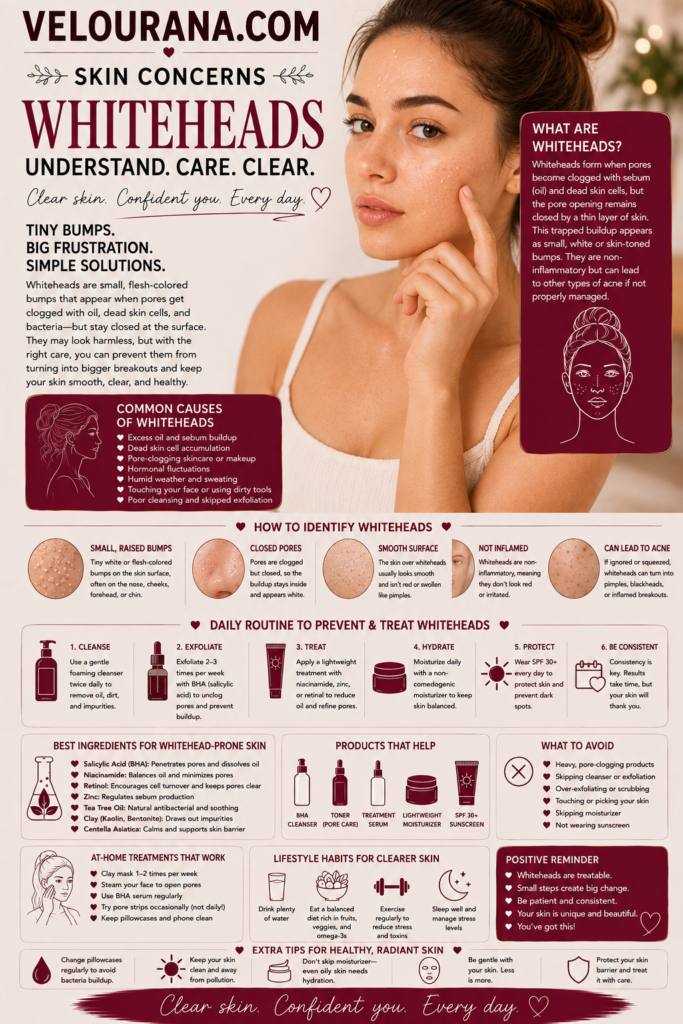
CATEGORY: Whiteheads
Whiteheads often seem to appear without explanation.
A forehead that looked reasonably clear begins developing a scatter of small bumps. The chin suddenly feels rough. Tiny closed lesions appear along the hairline even though nothing obvious has changed. The first instinct is usually to search for one culprit: a moisturiser, a foundation, a food, a cleanser, a hormonal fluctuation, or perhaps a failure to exfoliate often enough.
The difficulty is that whiteheads rarely obey such simple cause-and-effect logic.
Closed comedones develop when material accumulates within follicles and the follicular opening remains covered. Sebum, keratinised cells, the behaviour of the follicular lining, hormonal influences, inflammation, genetics, cosmetics, climate, friction, and daily habits can all shape the environment in which this process takes place. For some people, one factor becomes especially important. For others, several relatively minor influences overlap.
This is why two people can use exactly the same moisturiser and have completely different experiences. One may find it comfortable and uneventful. The other may notice progressively worsening congestion. Neither experience automatically proves that the product is universally good or universally pore-clogging.
Whitehead-prone skin requires a more observational way of thinking.
Instead of asking which single thing “caused” the breakout, it is often more useful to examine patterns: where the congestion appears, when it changes, what repeatedly touches those areas, which products have recently been introduced, how the climate has shifted, and whether the basic acne routine has remained stable long enough to work.
The everyday environment matters, but understanding it requires more nuance than simply blaming whatever touched the face most recently.
The Follicle Lives in an Environment
It is easy to imagine a pore as a tiny isolated tunnel.
In reality, every follicle exists within a complex biological and environmental setting. Sebaceous glands are active beneath the surface. Cells are constantly being produced and shed. Hormones influence sebaceous activity. The outer skin encounters cosmetics, sunscreen, sweat, pollution, heat, cold, friction, and cleansing.
None of these factors acts independently.
A heavy cosmetic product may feel completely comfortable during a dry winter but become unpleasant when combined with heat, humidity, perspiration, and repeated sunscreen application in summer.
A hair product may never create noticeable trouble when hair is tied back but correspond with congestion when a fringe repeatedly rests against the forehead.
A retinoid may control whiteheads successfully until the rest of the routine becomes so irritating that its use has to be reduced.
The follicle therefore behaves within a system.
This systems perspective is useful because it discourages the search for magical explanations.
Whiteheads do not necessarily mean the face is dirty.
They do not necessarily mean moisturiser is too rich.
They do not necessarily mean the skin needs stronger exfoliation.
They do not necessarily mean the most recently introduced product is responsible.
They mean that one or more follicles have become obstructed.
The task is to understand why the tendency toward obstruction is persisting.
Haircare Is Often Closer to the Face Than We Realise
The forehead is one of the most common sites of closed comedones, and it is also one of the areas most heavily influenced by hair.
Shampoo moves across the forehead during rinsing.
Conditioner may contact the hairline.
Leave-in treatments remain on strands for hours.
Styling creams, oils, waxes, sprays, and serums can transfer from hair onto surrounding skin.
A fringe sits directly against the forehead.
Pillows can carry residual hair product onto the face during sleep.
This does not mean haircare products inherently cause acne.
The relationship is more individual.
Some formulas may be perfectly well tolerated. Others may feel excessively oily or occlusive when they repeatedly contact acne-prone skin. The amount used matters. Hair length matters. Styling habits matter. Climate matters.
The most useful clue is often distribution.
If whiteheads repeatedly form along the temples and hairline while the central cheeks remain clear, it is reasonable to examine what regularly touches those regions.
Observation is more useful than panic.
There is no need to throw away every hair product at the first sign of a bump. Instead, changes can be made methodically. Hair can be kept away from the forehead for a period. Styling products can be applied more carefully. The skin around the hairline can be gently cleansed at the end of the day.
If congestion gradually improves, the pattern becomes informative.
Makeup Can Reveal and Influence Congestion
Makeup has a complicated relationship with whiteheads because it can affect both appearance and environment.
First, it can make existing texture more visible.
Foundation follows the contours of the skin. Closed comedones create small elevations. Heavy powder or matte formulas may emphasise those elevations, particularly under directional light.
This can create the impression that makeup has suddenly “caused” dozens of bumps when in fact it has simply made existing texture easier to see.
Second, makeup remains on the skin for hours.
For most people, this causes no serious problem when suitable products are used and removed appropriately. But acne-prone skin may respond differently to particularly heavy, oily, or occlusive formulas.
The entire cosmetic system matters.
Primer, foundation, concealer, cream blush, powder, fixing spray, sunscreen, moisturiser, and several serums may all be present simultaneously.
Each product may be acceptable alone.
The combined layer may nevertheless feel substantial.
This becomes particularly relevant in warm weather.
The question is therefore not whether makeup is “bad for acne.”
It is whether the makeup routine being used suits the skin beneath it.
A person prone to closed comedones may benefit from avoiding unnecessarily heavy layering, removing makeup thoroughly at night, and observing whether particular formulas consistently correspond with worsening congestion.
The solution need not be cosmetic abstinence.
It can simply be better compatibility.
Sunscreen Should Be Optimised, Not Abandoned
Sunscreen is sometimes blamed when whiteheads appear because protective formulas can feel richer than ordinary skincare.
Someone finds a sunscreen uncomfortable, notices several new bumps, and concludes that acne-prone skin cannot tolerate sun protection.
That conclusion creates a larger problem.
Sun protection remains important, particularly when acne treatments such as retinoids or exfoliating acids are part of the routine. Ultraviolet exposure can also make post-blemish pigmentation more persistent and visually prominent.
The better response is formulation matching.
Some people prefer fluid sunscreens.
Others tolerate gels, emulsions, or lightweight creams better.
A person with oily, congested skin may dislike a rich formula designed for very dry skin, while someone using a drying acne treatment may find an ultralight mattifying sunscreen uncomfortable.
The correct product is therefore not simply the lightest available.
It is the one that fits the entire routine.
This is a recurring theme in whitehead management: suitability is contextual.
Cleansing at Night Matters More Than Cleansing Aggressively
By evening, the face may contain sunscreen, makeup, perspiration, oil, environmental particles, and the remnants of multiple skincare layers.
Removing that accumulation is reasonable.
But effective cleansing and aggressive cleansing are different concepts.
A person who fears whiteheads may wash repeatedly, use very hot water, scrub with brushes, or choose highly stripping cleansers because they create a powerful sensation of cleanliness.
The result may be irritation without meaningful improvement in follicular obstruction.
The objective of evening cleansing is simpler.
Remove what has accumulated on the surface without creating unnecessary damage.
For people wearing substantial makeup or water-resistant sunscreen, a double-cleansing approach may be useful if both stages are gentle and well tolerated. For others, one appropriate cleanser may be entirely sufficient.
There is no universal prize for performing more cleansing steps.
The effectiveness of cleansing should be judged by whether the skin is clean, comfortable, and prepared for treatment—not by whether it feels stripped.
Pillowcases Are Not a Complete Acne Explanation
Pillowcases receive enormous attention in online acne discussions.
The logic is easy to understand. The face rests against fabric for many hours. Oil, sweat, skincare residue, hair products, and environmental debris can accumulate on bedding. Changing pillowcases regularly is therefore a perfectly reasonable hygiene practice.
But pillowcases are rarely a complete explanation for persistent whiteheads.
Someone with recurring comedonal acne should not expect that changing bedding every night will correct abnormal follicular keratinisation.
The broader lesson is useful.
Good hygiene supports skincare.
It does not replace acne treatment.
This distinction prevents minor environmental factors from becoming obsessions.
Clean bedding is sensible.
A well-designed acne routine remains more important.
Phones, Hands and the Habit of Touching the Face
The human face is touched constantly.
People rest their chin on a hand while reading.
They rub the forehead while concentrating.
They adjust glasses.
They hold phones against the cheek.
They scratch, press, inspect, and squeeze without always noticing.
Touch is more relevant to inflammatory irritation than to the core biological formation of every whitehead, but repeated contact can still alter the local environment.
Pressure and friction may aggravate acne-prone regions.
Hands can also transform a small closed comedo into a much more visible lesion through manipulation.
The most important distinction is between ordinary accidental contact and repeated picking.
Whiteheads tempt extraction because they look contained.
A small bump appears to offer a simple mechanical problem: press until the contents emerge.
But closed comedones are not always ready to empty cleanly.
Pressure can injure surrounding tissue, trigger inflammation, and leave a mark much more noticeable than the original bump.
This is why one of the simplest daily habits—leaving lesions alone—can significantly improve the visual outcome of acne even when it does not prevent the original comedone from forming.
Exercise, Sweat and the Myth That Perspiration Is Dirty
Exercise can complicate whitehead management because perspiration changes how the face feels.
Sweat mixes with sunscreen, makeup, oil, and environmental material. The resulting film may feel sticky or heavy.
It is easy to interpret this sensation as pores becoming clogged in real time.
Sweat itself is not equivalent to acne.
The more relevant issues are prolonged occlusion, friction, repeated touching, and the products present on the skin while sweating.
A heavy foundation worn during intense exercise may feel very different from bare skin.
A tight helmet or headband can create friction.
Hair products may run onto the forehead.
The practical response is usually straightforward: cleanse or rinse appropriately after significant sweating, avoid unnecessarily heavy cosmetic layers during exercise when possible, and keep frequently used equipment reasonably clean.
Again, moderation matters.
Exercise should not become surrounded by an elaborate anti-acne ritual.
The objective is simply to avoid leaving a heavy mixture of sweat and products sitting unnecessarily on acne-prone skin for long periods.
Heat and Humidity Change the Behaviour of a Routine
A skincare routine does not exist in a laboratory.
Weather changes how products feel and how skin behaves.
In humid summer conditions, perspiration increases and evaporation changes. Sebum may become more noticeable. Sunscreen may be reapplied more often. Rich moisturisers may feel heavier. Makeup can remain on warm skin for hours.
A routine that felt perfectly balanced in winter may suddenly seem excessive.
This does not necessarily mean the products became comedogenic.
Their context changed.
Seasonal adaptation can therefore be sensible.
A lighter moisturiser may replace a richer one.
An unnecessarily complex morning routine may be simplified.
A sunscreen with a more comfortable finish may reduce the urge to skip protection.
Night-time hydration can be maintained without duplicating several heavy layers.
The guiding principle is functional equivalence.
The skin still needs cleansing, treatment, moisturisation when necessary, and daytime protection.
The textures used to perform those functions can change with the season.
Cold Weather Can Create the Opposite Mistake
Winter often produces a different problem.
The skin becomes dry and uncomfortable.
Retinoids sting.
Flaking appears around the mouth and nose.
Yet whiteheads remain visible.
Someone who fears congestion may refuse to increase moisturisation because they assume any richer product will clog pores.
The result can be chronic irritation.
This illustrates why whitehead care cannot be built around one static idea such as “lighter is always better.”
Acne-prone skin still needs barrier support.
A slightly richer moisturiser during cold weather may improve treatment tolerance without necessarily increasing congestion.
The correct question is not whether a product is rich or light in isolation.
It is whether the formulation works for the skin under the current conditions.
Friction and Occlusion Can Shape Regional Breakouts
Whiteheads can appear in areas exposed to repeated physical contact.
Helmets.
Hats.
Headbands.
Tight clothing around the jaw or neck.
Protective masks.
Sports equipment.
Even the repeated pressure of a hand beneath the chin.
Friction and occlusion can alter the local environment and may aggravate acne in susceptible individuals.
This does not mean people should avoid necessary protective equipment.
It means that regional breakout patterns deserve contextual interpretation.
If congestion appears almost exclusively beneath a frequently worn item, that distribution is worth noticing.
Keeping equipment clean, reducing unnecessary friction where possible, and cleansing appropriately after prolonged wear may help.
The important word is “may.”
Acne rarely allows absolute certainty from one observation.
Patterns become useful when they repeat.
Shaving Creates Its Own Set of Variables
The lower face can be difficult to interpret because several conditions can coexist.
Whiteheads may occur alongside shaving irritation, ingrown hairs, or folliculitis.
A person may assume every bump is acne and respond with stronger acids, while part of the problem is actually mechanical irritation.
Shaving technique, razor condition, hair direction, product choice, and skin sensitivity all influence the area.
This is another reason diagnosis matters.
True closed comedones are treated differently from ingrown hairs.
If bumps consistently follow shaving and appear centred around hairs, the problem may deserve closer evaluation rather than automatic escalation of acne products.
The more persistent or unusual the eruption, the more valuable professional assessment becomes.
Diet Is More Complicated Than “Chocolate Causes Pimples”
Food and acne have attracted myths for generations.
The simplistic version claims that one indulgent meal directly produces a whitehead the next morning.
Skin biology does not operate with such convenient immediacy.
Research has nevertheless suggested that dietary patterns may influence acne in some people, particularly high-glycaemic dietary patterns and possibly certain dairy exposures in susceptible individuals. The strength and relevance of these associations vary, and diet is not a universal explanation for acne.
This nuance matters.
A person should not feel compelled to eliminate large categories of food based on a few coincidental blemishes.
Nor should dietary patterns be dismissed entirely if a strong personal association repeatedly appears.
The best approach is evidence rather than superstition.
If someone suspects a dietary relationship, systematic observation over time is more informative than blaming the most memorable meal preceding a breakout.
Whiteheads are slow-developing lesions.
The follicular process began before the bump became visible.
That biological delay should always be remembered before assigning blame.
Stress Can Influence Acne Without Being a Moral Explanation
Stress is another factor frequently discussed too simplistically.
People are told that acne is caused by stress, then become stressed about being stressed.
The relationship is more nuanced.
Stress can influence hormonal and inflammatory pathways and may aggravate acne in some individuals. It can also change behaviour indirectly.
Sleep becomes irregular.
People touch or pick their skin more often.
Meals change.
Skincare routines become inconsistent.
Exercise changes.
The cumulative effect may alter the complexion.
But a whitehead appearing during a difficult week does not mean the person failed to remain calm enough.
Acne is not a measure of emotional discipline.
Stress is one possible biological and behavioural influence among many.
Hormonal Patterns Deserve Their Own Attention
When whiteheads recur with remarkable timing, hormones may be part of the explanation.
Sebaceous glands respond to androgenic signalling, and hormonal changes can alter oil production and acne activity.
For some women, congestion and inflammatory lesions fluctuate across the menstrual cycle.
Others develop persistent adult acne concentrated around the lower face.
Puberty, pregnancy, discontinuation or initiation of hormonal contraception, and other hormonal transitions can all change the complexion.
This does not mean every jawline whitehead is hormonal.
Location alone cannot diagnose an endocrine problem.
But persistent acne accompanied by other signs of hormonal disturbance deserves medical attention.
Topical skincare can improve follicular behaviour.
It cannot independently correct every internal hormonal driver.
Recognising that limitation prevents people from blaming themselves or endlessly changing cosmetics when the larger biological context needs attention.
Introducing Several New Products at Once Hides the Truth
One of the easiest ways to make whiteheads impossible to understand is to start an entirely new routine simultaneously.
New cleanser.
New toner.
New serum.
New moisturiser.
New sunscreen.
New foundation.
Two weeks later, congestion worsens.
Which product did it?
There is no reliable answer.
Perhaps one formula was unsuitable.
Perhaps the combination was too occlusive.
Perhaps an active caused irritation.
Perhaps the acne was already developing before the routine changed.
Perhaps the worsening is unrelated.
Changing multiple variables destroys interpretability.
This is why gradual product introduction is valuable, particularly for reactive or acne-prone skin.
It is not merely cautious.
It is scientifically useful.
When one change is made against a stable background, the skin's response becomes easier to observe.
The Difference Between Correlation and Cause
Skin invites false conclusions because acne naturally fluctuates.
Suppose someone begins a new moisturiser on Monday.
On Thursday, three whiteheads become visible.
The moisturiser is immediately blamed.
But those whiteheads may have begun developing before Monday.
Now imagine the moisturiser is stopped.
A week later, the bumps improve.
This still does not prove causation, because comedones can resolve naturally over time.
True patterns become more convincing when they recur.
A product is introduced.
Congestion gradually increases over several weeks in previously clear areas.
The product is removed while the rest of the routine remains stable.
Congestion improves.
Later, the same product is reintroduced and the same pattern returns.
That sequence is more informative.
Most real-world skincare experiments will never be perfectly controlled, but thinking in this way reduces unnecessary product blame.
Why Simplification Is Such a Powerful Diagnostic Tool
When whiteheads become difficult to interpret, simplification can reveal more than another treatment.
A routine containing twelve products produces twelve obvious variables plus countless interactions between them.
A routine containing four essential functions is easier to understand.
Gentle cleansing.
One purposeful acne treatment.
A suitable moisturiser.
Daytime sunscreen.
This simplified structure can provide a baseline.
Once the complexion stabilises, additional products can be introduced deliberately if they serve a genuine purpose.
This does not mean elaborate skincare is inherently bad.
Some people tolerate complex routines beautifully.
The issue is diagnostic clarity.
When something is going wrong, complexity makes the reason harder to find.
Whiteheads and the Temptation to Treat Every Area the Same
The face is not biologically uniform.
The forehead may be oily.
The cheeks may be comfortable.
The sides of the nose may become congested.
The area around the mouth may be sensitive.
The jawline may fluctuate hormonally.
Using every treatment everywhere at the same intensity can therefore create unnecessary irritation.
Regional thinking can be useful.
An acne treatment may be needed primarily across the forehead and chin.
A richer moisturiser may be applied more generously to drier cheeks.
Exfoliation may be reduced around sensitive areas.
This does not require an elaborate facial map.
It simply acknowledges that local conditions differ.
Whiteheads themselves often provide clues through distribution.
Why Spot Treatment Alone Usually Fails Persistent Comedones
A spot treatment makes sense psychologically.
One lesion appears.
One product is applied.
The lesion disappears.
But recurring whiteheads are rarely just one-lesion problems.
When a region repeatedly develops closed comedones, treatment often needs to address the acne-prone area rather than only the bumps already visible.
This is where preventative ingredients become important.
Retinoids and salicylic acid are commonly used in comedonal acne because they influence the processes involved in follicular obstruction.
Their value lies partly in treating what cannot yet be seen.
This preventative logic explains why maintenance matters even after the skin improves.
Stopping everything the moment the forehead becomes smooth may simply allow the original tendency to re-establish itself.
When the “Trigger” Is Actually Inadequate Treatment
It is tempting to keep searching for environmental explanations because they offer something concrete to remove.
Perhaps it is the pillowcase.
Perhaps the phone.
Perhaps dairy.
Perhaps sunscreen.
Perhaps hair oil.
Sometimes, however, the simplest explanation is that the acne itself is not adequately controlled.
A person can eliminate countless supposed triggers and still develop whiteheads because abnormal follicular plugging remains active.
This is why trigger hunting should never replace treatment.
Lifestyle adjustments can support an acne strategy.
They rarely substitute for one when comedonal acne is persistent.
When the “Trigger” Is Actually the Wrong Diagnosis
There is another possibility.
The bumps may not be whiteheads.
Milia can resemble closed comedones.
Folliculitis can create small uniform bumps.
Sebaceous hyperplasia may appear as flesh-coloured elevations.
Ingrown hairs can mimic acne.
Certain forms of dermatitis or keratosis can alter facial texture.
If a sensible acne routine has made no meaningful difference after an appropriate period, continuing to search for a hidden trigger may waste time.
The diagnosis deserves reconsideration.
Professional dermatological assessment can be especially useful when lesions are unusually uniform, itchy, persistent, concentrated in an atypical location, or completely unresponsive to ordinary comedonal treatment.
The Value of a Skin Diary Without Becoming Obsessive
For difficult recurring whiteheads, a simple record can reveal patterns that memory misses.
The purpose is not to document every pore.
It is to record meaningful changes.
A new product was introduced.
Weather became unusually humid.
A hormonal cycle reached a particular phase.
A new hair treatment began.
A retinoid frequency changed.
Congestion worsened after several weeks rather than several hours.
Over time, patterns may emerge.
The diary should remain simple because excessive monitoring can make normal skin fluctuations feel pathological.
The aim is to improve interpretation, not increase anxiety.
What Everyday Whitehead Prevention Actually Looks Like
Preventing closed comedones is less dramatic than most people expect.
It does not require disinfecting every object that approaches the face.
It does not require washing pillowcases every few hours.
It does not require avoiding all makeup.
It does not require eating an impossibly restrictive diet.
It does not require keeping the skin permanently matte.
Instead, prevention usually develops from a series of ordinary decisions repeated consistently.
Products that repeatedly contact acne-prone areas should suit the complexion.
Haircare should be kept from unnecessary facial transfer where possible.
Makeup and sunscreen should be removed appropriately.
The skin should be cleansed without being stripped.
An evidence-based treatment should address follicular congestion.
The barrier should be supported enough for that treatment to continue.
Picking should be minimised.
Climate and seasonal changes should be respected.
Patterns should be observed over weeks, not judged by individual mornings.
None of these actions is spectacular.
Together, they create a stable environment.
Knowing When to Stop Experimenting
There is a point at which self-experimentation becomes inefficient.
Someone has changed cleansers repeatedly.
They have simplified makeup.
They have replaced hair products.
They have used appropriate over-the-counter treatments consistently.
Whiteheads remain extensive.
Perhaps inflammatory acne is developing alongside them.
Perhaps marks or scars are appearing.
At that stage, professional treatment becomes the more rational next step.
A dermatologist can determine whether the lesions are truly closed comedones and whether prescription therapy is appropriate.
The objective is not simply stronger treatment.
It is greater diagnostic and therapeutic precision.
The Pattern Matters More Than the Individual Bump
Whiteheads are easiest to understand when attention moves away from individual lesions and toward the environment producing them.
One bump tells very little.
A repeated cluster along the hairline tells more.
A predictable monthly flare tells more.
Congestion that began several weeks after introducing a heavy cosmetic routine tells more.
A forehead that improves after months of consistent comedonal treatment tells more.
Skin rarely offers perfect experimental evidence, but patterns can become persuasive.
This is why patience is such an important diagnostic tool.
Rapid product switching destroys patterns before they can be recognised.
The Goal Is Not to Live in Fear of Triggers
Perhaps the most important lesson in understanding everyday whitehead triggers is knowing when to stop looking for them.
Acne-prone skin can make ordinary life feel dangerous.
A new moisturiser becomes suspicious.
A dessert becomes suspicious.
A pillow becomes suspicious.
A hot day becomes suspicious.
Makeup becomes suspicious.
Hair becomes suspicious.
Eventually the person may feel that clear skin depends on controlling every variable perfectly.
It does not.
Human skin is adaptable, imperfect, and biologically active.
An effective acne strategy should make life easier, not narrower.
The objective is to identify genuinely meaningful patterns while ignoring random noise.
If one hair product repeatedly corresponds with forehead congestion, changing it is sensible.
If a particular heavy routine consistently worsens whiteheads, simplifying it is sensible.
If heat and humidity make rich textures uncomfortable, seasonal adjustment is sensible.
But one new bump does not require a complete investigation.
Whiteheads Improve When the Whole System Becomes More Predictable
The most successful whitehead routines often become boring.
That is a compliment.
The cleanser remains stable.
The treatment remains stable.
The moisturiser works.
The sunscreen feels comfortable.
Cosmetic products are chosen without constant fear.
Haircare is used thoughtfully.
The skin is no longer squeezed every evening.
Seasonal changes lead to minor adjustments rather than complete routine reconstruction.
New products are introduced one at a time.
Progress is judged over months.
The result is not necessarily a completely poreless complexion.
It is a complexion whose behaviour becomes more predictable.
Fewer closed comedones appear.
Clusters become smaller.
Texture becomes less noticeable.
Occasional whiteheads stop triggering panic because they are no longer part of a relentless cycle.
This is what everyday acne management ultimately seeks.
Not perfect control over every possible trigger.
Not permanent dryness.
Not endless exfoliation.
Not a bathroom full of corrective products.
Instead, the aim is a stable relationship between effective treatment, a supported skin barrier, suitable cosmetics, realistic observation, and ordinary life.
Whiteheads may be influenced by many everyday factors, but they do not require living defensively.
The more clearly the patterns are understood, the less power each individual bump has to dictate the next decision.
And when the skin is treated according to patterns rather than panic, it becomes far easier to distinguish the habits that genuinely matter from those that never deserved the blame.
The End Velourana
 Discover More From Our Family of Websites
 ZodiacBearing (Astrology, Tarot, Numerology, Angel Numbers & Spiritual Guidance)
 Velourana (Beauty, Makeup, Hair Care, Skincare & Beauty Tips)
 HavenBearing (Home, Living, Organization, Décor & Everyday Inspiration)
 PawBearing (Pet Care, Dog Breeds, Animal Health, Training & Pet Products)
 PsyCatherine (Notes From the Journal of a Psychologist on Real Life)

