
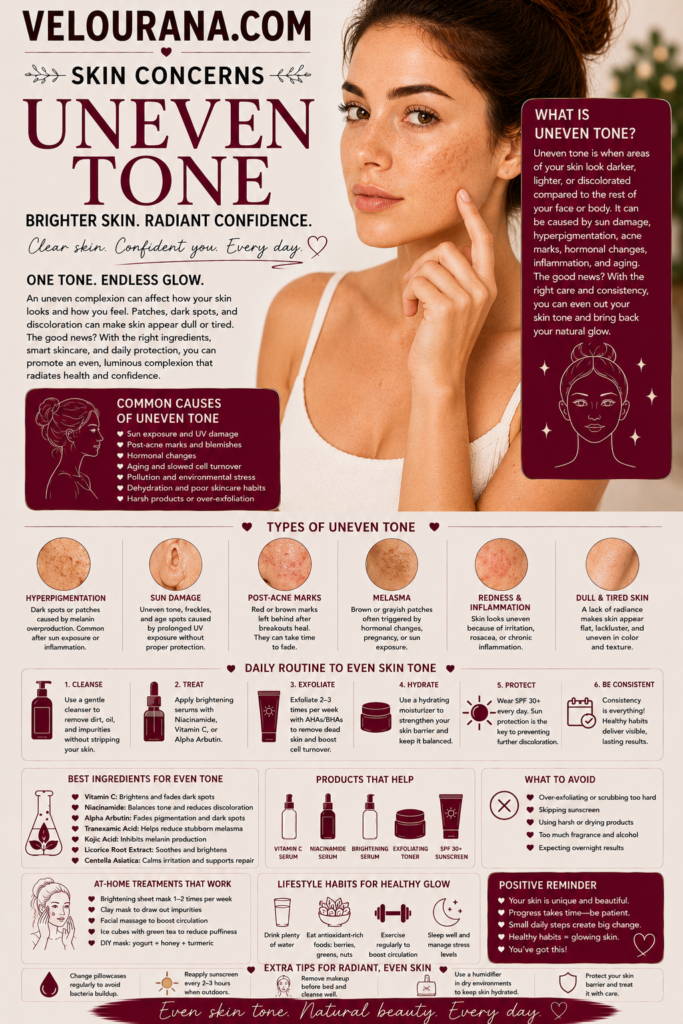
CATEGORY: Uneven Tone
Uneven tone is often treated as though it were a purely pigmentary problem, a question of where the skin has become darker and what can be applied to make those areas fade. Yet the appearance of an uneven complexion is usually more complex. Pigment is only one part of the visual picture. Redness, inflammation, dehydration, textural roughness, vascular changes, accumulated sun exposure, and the condition of the skin barrier can all influence whether the face appears clear and harmonious or fragmented into areas of different color and brightness.
This becomes increasingly relevant with age because the complexion is carrying a longer history. Decades of sunlight, blemishes, irritation, hormonal shifts, environmental exposure, cosmetic experimentation, and ordinary biological change gradually alter how different areas of the face behave. A younger complexion may recover quickly from a period of inflammation and return to its usual baseline. Mature skin can sometimes hold onto the evidence for longer. A blemish leaves a mark. A harsh product creates redness that takes days to settle. A summer of inconsistent sun protection produces pigmentation that remains into winter. Dryness makes the skin reflect light irregularly, emphasizing every difference in tone.
The result may be described simply as dull, blotchy, patchy, or uneven, but those words compress several processes into a single cosmetic complaint.
That matters because treatment becomes much more effective when the complexion is understood as a system rather than a collection of spots.
If pigmentation is being created by inflammation, treating only the existing dark marks is incomplete. If the barrier is compromised, aggressively adding acids may worsen the visual unevenness. If ultraviolet exposure continues daily, brightening ingredients are working against an ongoing stimulus. If redness contributes as much to the irregularity as brown pigmentation, a routine focused exclusively on melanin may produce limited satisfaction even when some spots lighten.
Uneven tone therefore asks for a broader question: what is making the complexion lose its visual continuity?
The answer often lies in the interaction between light, inflammation, pigment, and the skin's ability to protect itself.
The Complexion Is a Mosaic of Biological Signals
What we call skin tone is not produced by one pigment alone.
Melanin contributes enormously, but the final appearance of the complexion also reflects blood vessels beneath the surface, the thickness of the epidermis, the degree of hydration, the amount and distribution of pigment, the presence of inflammation, and the way surface texture reflects light.
This explains why someone can have very little hyperpigmentation and still describe their skin as uneven.
Persistent redness around the nose can create contrast with the cheeks. Dry patches can look lighter or duller than well-hydrated areas. Fine scaling can scatter light differently, making the surface look gray or rough. Shadows created by textural irregularities may resemble pigmentation in certain lighting. Areas that are inflamed can appear red, violet, brown, or deeper depending on skin tone.
The eye does not separate these variables.
It simply registers inconsistency.
This is why cosmetic tone correction becomes more convincing when multiple contributors improve together. Better hydration can make the surface more reflective. Reduced inflammation can diminish redness and lower the risk of new post-inflammatory pigmentation. Sun protection can reduce one of the strongest external triggers for further discoloration. Targeted active ingredients can gradually influence existing pigment.
No single element needs to become perfect.
The complexion improves when the relationships between them become more balanced.
Inflammation Can Quietly Redesign the Complexion
Inflammation is one of the most underestimated forces behind uneven tone.
People naturally recognize inflammation when the skin is obviously swollen, painful, or covered in active blemishes. Chronic low-level inflammation can be much less dramatic.
The face may simply feel slightly sensitive. The cheeks flush more easily. Certain products sting. The skin develops small patches of redness. A blemish appears and leaves behind a persistent mark. Repeated exfoliation creates a background of irritation that is accepted as normal because it never becomes severe enough to look like an obvious injury.
Yet pigment-producing cells can respond to inflammatory signaling.
This is why post-inflammatory hyperpigmentation can follow acne, eczema, burns, injuries, irritation, and other inflammatory events. The original disturbance may be temporary while the pigmentary aftermath persists.
The relationship becomes especially important when treatment itself causes inflammation.
Consider a person who develops several dark marks after blemishes. Wanting them gone quickly, they begin using an exfoliating cleanser, glycolic acid toner, strong vitamin C serum, retinoid, and weekly peel. Within days, the skin feels tight and sensitive. Because the marks have not faded, the person assumes the routine is not strong enough.
More exfoliation is added.
At that point the skin may be receiving enough irritation to perpetuate the very pigmentary problem being treated.
The issue is not that these ingredients are inherently harmful. Many can be extremely useful when properly selected and introduced. The problem is cumulative intensity.
Skin does not evaluate products one bottle at a time.
It experiences the total routine.
Barrier Damage Can Make Tone Look Worse Before Pigment Changes
The skin barrier is often discussed in relation to dryness, but its visual consequences extend far beyond moisture.
A healthy barrier helps regulate water loss, protects against irritants, and supports the skin's ability to maintain a stable environment. When that barrier becomes disrupted, the complexion can become dry, rough, sensitive, and reactive.
Each of those changes can influence perceived tone.
Dry skin reflects light unevenly. Small flakes create microscopic shadows. Irritated areas become redder. Products that once felt comfortable may begin stinging. People then compensate by exfoliating more aggressively because the surface looks dull or rough.
This can create another self-perpetuating cycle.
Barrier disruption produces roughness. Roughness is interpreted as dead skin. More exfoliation produces additional barrier disruption.
In mature skin, this cycle can be particularly counterproductive because natural lipid production and barrier resilience may already be changing.
Moisturization therefore deserves a more sophisticated place in an uneven-tone routine.
It is not simply the comforting step used after the "real" treatments.
A well-formulated moisturizer can improve hydration, support barrier function, reduce the visual roughness that exaggerates pigmentation, and make active ingredients easier to tolerate consistently.
A product that allows someone to use a retinoid comfortably for six months may contribute more to long-term improvement than an aggressive peel that produces dramatic short-term smoothness followed by weeks of irritation.
Light Creates Pigment, but It Also Reveals It
The relationship between light and uneven tone operates in two different ways.
First, light exposure can stimulate biological processes associated with pigmentation.
Ultraviolet radiation is a major driver of photoaging and irregular pigmentation. Visible light can also contribute to certain pigmentary conditions, particularly melasma.
Second, light determines how pigmentation is seen.
The same face can appear relatively even in diffuse morning light and much more irregular beneath strong overhead illumination. Dry areas cast tiny shadows. Fine lines interrupt reflections. Raised or depressed areas change contrast. Redness appears stronger in some environments. Pigment looks deeper when surrounding skin is pale after winter and less pronounced after generalized tanning.
This optical dimension is important because it explains why improvements in hydration and texture can change the appearance of uneven tone even before measurable pigment reduction has occurred.
When skin becomes smoother and better hydrated, light is reflected more uniformly.
The complexion appears clearer.
This does not mean the pigmentation was imaginary. It means that perceived skin tone is produced by both color and surface architecture.
Effective anti-aging skincare often improves both.
Sun Protection Changes the Direction of the Process
There are treatments that correct and treatments that prevent.
Sun protection does both indirectly.
By reducing ultraviolet exposure, sunscreen helps limit one of the central signals involved in photoaging and excess pigmentation. It also protects progress made by other treatments.
This distinction becomes especially powerful when uneven tone has accumulated over decades.
The most visible spots may have developed slowly, but new pigmentation is still being created whenever susceptible skin receives enough stimulation. A person can therefore spend years attempting to fade the past while continually adding new material to the future.
Consistent sun protection changes that trajectory.
The objective is not to eliminate daylight or create anxiety around ordinary outdoor life. It is to reduce unnecessary cumulative exposure.
Broad-spectrum sunscreen used daily on exposed skin establishes the foundation. Hats, shade, clothing, and sensible timing strengthen it.
For people dealing with melasma or significant pigmentation concerns, a dermatologist may recommend additional strategies such as tinted sunscreens containing iron oxides to provide protection against visible light.
The important concept is continuity.
A high-protection sunscreen used only during summer holidays is less valuable for long-term tone management than reliable daily protection integrated into normal life.
Redness and Pigmentation Often Coexist
When people say their skin looks uneven, they often point immediately to brown areas.
Look more closely and another color may be equally important.
Redness can create some of the strongest contrasts on the face.
The sides of the nose, cheeks, chin, and central forehead may appear pink or red while other regions remain neutral. In deeper skin tones, inflammation may appear less bright red and more violet, brown, or dusky, making the distinction between vascular and pigmentary changes less obvious.
This matters because brown-pigment treatments do not necessarily correct redness.
Someone may spend months successfully reducing hyperpigmentation and still feel that the complexion is uneven because vascular or inflammatory contrast remains.
Persistent facial redness can have many causes, ranging from simple irritation to rosacea, dermatitis, and other conditions. Chronic redness should not automatically be self-diagnosed.
But from a skincare perspective, one principle remains consistent: irritating the complexion more aggressively rarely improves persistent redness.
Gentle cleansing, barrier support, careful ingredient selection, and avoiding unnecessary friction often provide a better foundation while the underlying cause is evaluated when needed.
Tone correction sometimes begins by making the skin quieter.
The Myth of Scrubbing Away Discoloration
There is something deeply intuitive about the idea that discoloration can be removed physically.
If a mark is visible on the surface, perhaps scrubbing should polish it away.
This misconception survives despite the biology being very different.
Melanin is contained within skin cells. It is not dirt sitting on top of the complexion. While normal exfoliation and cellular turnover contribute to the gradual movement of epidermal pigment, aggressive physical scrubbing does not selectively remove dark marks.
Instead, excessive friction can irritate the skin.
That irritation may worsen redness and, in pigment-prone complexions, contribute to post-inflammatory hyperpigmentation.
The same principle applies to aggressive brushes, abrasive scrubs, rough cleansing cloths, and compulsive rubbing with towels.
A mature complexion benefits from mechanical respect.
Cleansing should remove sunscreen, makeup, oil, and debris without turning the process into resurfacing.
The skin has its own renewal machinery.
Skincare should support it rather than repeatedly abrading it.
Chemical Exfoliation Is a Tool, Not a Philosophy
Chemical exfoliants can be useful for uneven tone because they influence the shedding of surface cells and can improve texture.
But their value depends on dosage, frequency, formulation, and the condition of the skin.
Glycolic acid and other alpha hydroxy acids may help improve superficial discoloration and roughness. Yet the assumption that more exfoliation equals faster correction leads quickly to problems.
Exfoliation is not the central purpose of skincare.
It is one intervention among many.
Once the surface is being renewed adequately, adding additional acid does not necessarily produce proportionally better results. Instead, the margin between effective stimulation and irritation becomes narrower.
A thoughtful routine therefore treats exfoliation like seasoning rather than the main ingredient.
Some complexions tolerate it several times a week.
Others need considerably less.
People using retinoids may require even more restraint because both treatments influence renewal and can become irritating when combined carelessly.
Skin provides useful feedback.
Persistent burning, significant peeling, prolonged redness, tenderness, or increasing sensitivity are not signs that a treatment is working unusually well.
They are signs that the routine may be exceeding the skin's tolerance.
Retinoids Can Improve the Environment Around Uneven Tone
Retinoids are often introduced in anti-aging routines for fine lines and texture, but their relevance to tone is broader.
They influence cellular turnover and can support improvement in certain pigmentation irregularities while also addressing several visible features associated with photoaging.
This makes them particularly valuable when uneven tone exists alongside roughness, fine lines, and textural change.
Yet retinoids also demonstrate the importance of balancing efficacy with tolerability.
Initial dryness and mild irritation can occur. Introducing a retinoid too aggressively can produce enough inflammation to undermine the visual improvement being sought.
A gradual approach often performs better.
Lower frequency at the beginning gives the skin time to adapt. Moisturizer can be used strategically to support comfort. Other potentially irritating products can be reduced rather than layered automatically.
The result may feel slower during the first few weeks.
Over months, however, consistency becomes far more important than intensity.
Anti-aging skincare is rarely won through a spectacular first week.
Niacinamide Fits Where Tone and Barrier Meet
Some ingredients are valuable precisely because they do not force a choice between correction and support.
Niacinamide is one example.
It is commonly used in skincare designed for uneven tone, barrier support, and overall skin conditioning. Its versatility can make it useful in routines that are already managing multiple concerns.
This is particularly relevant for mature skin because a pigmentation routine that ignores barrier health is often less sustainable.
Niacinamide does not need to be treated as a miracle ingredient to be useful.
Its strength lies in compatibility.
A well-formulated niacinamide product can sit comfortably within a broader routine built around sun protection, moisturization, and a principal corrective active such as a retinoid or azelaic acid.
That kind of supportive role is often undervalued because skincare marketing favors dramatic hero ingredients.
In real routines, however, the ingredients that make stronger treatments easier to tolerate can be extremely important.
Azelaic Acid Connects Inflammation With Pigmentation
Azelaic acid occupies an interesting position because it can be relevant where blemishes, inflammation, redness, and pigmentation overlap.
This makes it particularly useful conceptually for understanding uneven tone.
Instead of treating the complexion as a set of independent problems—one product for acne, another for dark marks, another for redness—some ingredients can address more than one contributing pathway.
This can simplify the routine.
Simplification matters because every additional product introduces another formulation, another potential irritant, another cost, and another variable.
A concise routine makes it easier to determine what actually works.
For some people, azelaic acid may be incorporated alongside appropriate moisturization and sun protection. Others may use it under dermatological guidance for specific conditions.
As always, tolerability matters.
Even ingredients regarded as relatively gentle can irritate certain individuals.
No treatment earns permanent membership in a routine merely because it is popular.
Vitamin C Can Improve Tone Without Carrying the Entire Routine
Vitamin C has become a symbol of brightening skincare.
Its antioxidant properties and role in pigmentation-focused routines make it a logical component for many people, particularly in the morning.
But it works best when its responsibilities remain realistic.
Vitamin C cannot compensate for chronic unprotected ultraviolet exposure.
It cannot correct inflammation caused by an overloaded routine.
It cannot diagnose a dark lesion.
It cannot repair every aspect of an impaired barrier.
Placed appropriately within a balanced routine, however, it can complement sun protection and contribute to a brighter, more even-looking complexion.
Formulation becomes important because vitamin C products vary considerably in concentration, stability, derivative, texture, and tolerability.
A product that oxidizes rapidly or repeatedly irritates the skin may provide little practical benefit regardless of the ingredient's theoretical advantages.
Again, the product that works consistently wins over the product that appears most impressive on paper.
Mature Skin Often Benefits From Fewer Simultaneous Experiments
One reason uneven tone becomes difficult to manage is that frustration encourages constant change.
A new serum is used for two weeks. No dramatic improvement appears, so another is added. Then a peel is introduced. A social-media recommendation suggests a new toner. A stronger retinol replaces the previous one.
Within three months, the routine has changed so many times that nobody could reasonably determine which intervention helped or harmed the skin.
Pigmentation does not cooperate with this pace.
It changes slowly.
Meaningful evaluation therefore requires stability.
A carefully selected routine used consistently for several months produces much more useful information than a sequence of aggressive experiments.
This does not mean continuing a product that is clearly irritating.
It means distinguishing between lack of immediate transformation and genuine treatment failure.
Dark marks often need time.
So does the skin barrier.
So does texture.
So does the visual coherence of the complexion.
Hydration Changes More Than Comfort
Hydration is easily dismissed as cosmetic because its visible effects can appear temporary.
Yet temporary does not mean meaningless.
When the outer layers of the skin contain adequate water, the surface can appear smoother and more flexible. Fine dehydration lines become less obvious. Light reflects more evenly. Makeup sits differently. Rough patches become less prominent.
These changes can significantly influence perceived tone.
A well-hydrated face may appear more luminous and uniform even if the amount of pigment has changed very little.
This makes hydration an important part of any strategy designed around visual harmony.
Humectants can help attract water. Emollients smooth the spaces between surface cells. Occlusive ingredients reduce water loss. The optimal balance depends on skin type, climate, product preference, and other treatments being used.
Mature skin often appreciates a little more richness than it once did.
The key is not finding the heaviest possible cream.
It is creating an environment in which the skin remains comfortable enough to tolerate the rest of the routine.
Nighttime Recovery Is an Active Process
A skincare routine does not need a corrective active every night.
This idea can be surprisingly difficult to accept because doing nothing powerful feels unproductive.
Recovery nights have value.
On those evenings, the routine may consist only of gentle cleansing and moisturizer. No acids. No retinoid. No peel. No attempt to accelerate anything.
The skin is still functioning.
Barrier lipids are being maintained. Water balance is being supported. Inflammation can settle. The cumulative stress from previous active treatments decreases.
For someone whose complexion has become reactive, these quieter evenings may be what allows the rest of the routine to succeed.
The concept is especially relevant when uneven tone is partly driven by irritation.
You cannot calm inflammation while provoking it every night.
Makeup Can Reveal What the Skincare Problem Actually Is
One interesting way to understand uneven tone is to observe how much correction makeup requires.
If a small amount of sheer foundation creates a dramatic improvement, the underlying issue may be primarily color contrast rather than severe texture.
If foundation emphasizes flakes and rough patches, barrier and hydration issues may be playing a larger role.
If concealer corrects brown areas but redness still dominates, vascular contrast may be significant.
If makeup appears patchy despite good coverage, surface irregularity may be affecting light reflection and product adherence.
This is not a diagnostic method.
It is simply a useful reminder that "uneven tone" can represent several visually different problems.
The more precisely the appearance is understood, the less likely someone is to treat everything with the same brightening serum.
Professional Treatments Should Respect the Cause of Unevenness
When home skincare produces limited improvement, professional procedures may become appropriate.
Chemical peels, laser treatments, intense pulsed light, microneedling, and other dermatological or aesthetic procedures can address aspects of pigmentation and texture depending on the indication.
But professional treatment should not be interpreted as simply stronger skincare.
The risks also increase.
Any procedure that creates significant inflammation can potentially produce pigmentary complications, particularly in people prone to post-inflammatory hyperpigmentation. Some energy-based devices require careful settings and practitioner experience across different skin tones.
Melasma can also respond unpredictably to aggressive treatment and may recur if the underlying triggers remain.
Professional intervention therefore works best when it follows proper assessment.
What type of pigmentation is present?
How deep does it appear?
Is inflammation contributing?
What is the person's skin tone and pigmentary risk?
Is the lesion definitely benign?
Has sun protection already been optimized?
These questions matter more than selecting whichever procedure is currently fashionable.
A Changing Lesion Is Not an Uneven-Tone Project
There is a dangerous temptation to classify every new brown mark appearing with age as an age spot.
Most may indeed be benign.
That assumption should never replace observation.
A lesion that changes in size, shape, border, color, surface, or symptoms deserves medical attention. Bleeding, crusting, persistent itching, ulceration, rapid growth, or a mark that simply looks significantly different from the others should not be treated casually with brightening products.
The goal is not to create fear around ordinary pigmentation.
It is to preserve the distinction between cosmetic self-care and medical evaluation.
Skincare can improve the appearance of many benign pigmentary concerns.
It cannot safely diagnose them.
The Most Effective Routine Often Looks Boring
There is a version of uneven-tone skincare that looks almost disappointingly simple.
Morning: gentle cleansing if needed, one supportive antioxidant or brightening treatment, moisturizer, sunscreen.
Evening: cleansing, one principal corrective treatment on appropriate nights, moisturizer.
Occasional exfoliation if tolerated.
Recovery periods when needed.
No constant product rotation.
No weekly attempt to reinvent the routine.
No physical scrubbing.
No assumption that every tingling sensation indicates effectiveness.
This routine lacks drama.
It also has one enormous advantage: it can be followed for years.
That is the timeframe in which aging skin is actually managed.
Improvement Begins When New Damage Slows Down
When someone first begins correcting uneven tone, the visible marks naturally receive all the attention.
But one of the earliest meaningful changes may be invisible.
New pigmentation stops appearing so quickly.
Old blemishes leave lighter marks.
The complexion does not become dramatically more uneven after summer.
Redness settles faster.
Skin feels less reactive.
Dryness decreases.
These changes indicate that the environment producing unevenness is becoming more stable.
Once the rate of new damage falls, the existing pigmentation has a chance to improve without constantly being replaced.
This is when progress can begin to accumulate rather than disappear.
Tone Becomes More Even When the Skin Becomes More Stable
The deepest lesson in uneven-tone care is that visual harmony is often the consequence of biological stability.
A complexion repeatedly exposed to irritation, ultraviolet radiation, inflammation, dehydration, and aggressive treatment has little opportunity to look uniform.
A stable complexion behaves differently.
Its barrier is supported.
Its inflammatory episodes are less frequent.
Its exposure to unnecessary ultraviolet radiation is lower.
Corrective ingredients are used consistently rather than impulsively.
Products are selected for tolerability as well as theoretical strength.
Professional assessment is sought when pigmentation behaves unusually.
Over time, the visual result begins to reflect that stability.
Brown areas soften.
Redness becomes less dominant.
Texture becomes smoother.
Light travels more evenly across the surface.
The face looks clearer not because every natural variation has disappeared, but because fewer areas are competing for attention.
That is an important distinction.
Mature skin does not need to become visually blank.
It needs to become balanced enough that its natural color, texture, and luminosity can coexist without one irregularity overwhelming the rest.
Uneven tone is therefore not best approached as a battle against pigment.
It is better understood as the restoration of order.
Protect the skin from the signals that repeatedly disturb pigmentation. Reduce inflammation. Maintain the barrier. Correct existing discoloration patiently. Preserve hydration. Use strong interventions strategically rather than habitually.
The complexion will not forget every year it has lived.
Nor should it.
The aim is simply to help those years sit more gracefully together on the surface.
The End Velourana
 Discover More From Our Family of Websites
 ZodiacBearing (Astrology, Tarot, Numerology, Angel Numbers & Spiritual Guidance)
 Velourana (Beauty, Makeup, Hair Care, Skincare & Beauty Tips)
 HavenBearing (Home, Living, Organization, Décor & Everyday Inspiration)
 PawBearing (Pet Care, Dog Breeds, Animal Health, Training & Pet Products)
 PsyCatherine (Notes From the Journal of a Psychologist on Real Life)

