
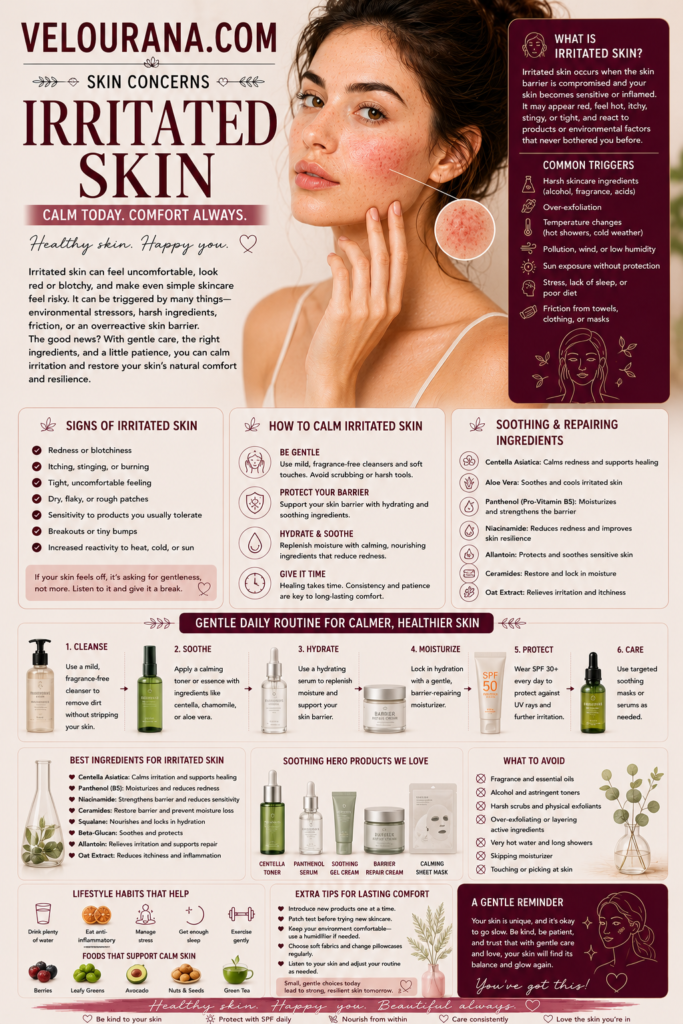
CATEGORY: Irritated Skin
Skin irritation is one of those experiences that seems perfectly simple until it happens. The face feels hot. A familiar moisturizer suddenly stings. Redness appears around the nose, across the cheeks, or along the jaw. Skin that looked comfortable yesterday becomes tight, itchy, rough, tender, or strangely reactive today. The instinctive response is often to search for something powerful enough to make the problem disappear: a calming serum, a repairing mask, a new active ingredient, perhaps an entire routine designed for sensitive skin.
Yet irritated skin frequently needs the opposite.
It needs less.
Irritation is often the skin's way of communicating that the balance between exposure and tolerance has been disturbed. Sometimes there is one obvious cause—a new cosmetic, an aggressive peel, excessive sun exposure, friction, or a fragranced product. At other times irritation develops through accumulation. Individually reasonable habits become collectively excessive: cleansing too thoroughly, exfoliating a little too often, introducing several active ingredients simultaneously, using water that is too hot, spending hours in dry indoor air, and then attempting to correct the resulting discomfort with still more products.
Understanding irritated skin therefore begins with a change in perspective. Instead of asking only, “What should I put on it?” it is often more useful to ask, “What is my skin being asked to tolerate?”
That question turns irritation from a cosmetic inconvenience into something much more intelligible: a relationship between the skin barrier, inflammation, environmental exposure, product formulation, physical friction, and individual susceptibility. Once that relationship is understood, the path back to comfortable skin often becomes considerably simpler.
Irritation Is a Symptom, Not a Skin Type
People commonly describe themselves as having “irritated skin” as though irritation were a permanent category comparable with oily or dry skin. In reality, irritation describes a condition or response rather than a single skin type.
Naturally dry skin may become irritated. Oily skin can become irritated. Acne-prone skin can be simultaneously oily, congested, and irritated. Mature skin may become increasingly reactive to routines it previously tolerated. Even skin that has historically been resilient can enter a temporary period during which products that once caused no difficulty suddenly sting.
This distinction matters because irritation has many possible origins.
Contact dermatitis, for example, can occur when something touching the skin directly irritates it or produces an allergic reaction. The American Academy of Dermatology notes that soaps, fragrances, hair products, cosmetics, and numerous environmental substances may be involved, and identifying the cause is not always straightforward because reactions can develop even to products someone has previously used.
Other redness and discomfort may accompany conditions such as eczema or rosacea, while some irritation is simply the consequence of an overwhelmed barrier after excessive skincare.
The visible result can look deceptively similar.
Redness does not tell you precisely why redness exists. Stinging does not identify the ingredient responsible. Flaking does not automatically mean that skin simply needs exfoliation. A rough surface may actually be a warning that additional exfoliation is exactly what should be avoided.
This is why irritated skin rewards observation rather than aggression. Its appearance is information, but that information has to be interpreted in context.
The Skin Barrier Changes Everything
To understand why irritation develops, it helps to think about the outermost layers of skin not merely as a surface but as a protective boundary.
A healthy barrier performs an elegant balancing act. It helps limit excessive water loss while reducing penetration by environmental substances that the body would rather keep outside. When barrier function becomes compromised, that arrangement becomes less efficient. Moisture escapes more readily, while potential irritants can interact more easily with vulnerable skin.
The result can become cyclical.
Barrier disruption contributes to dryness and sensitivity. Dry, vulnerable skin becomes easier to irritate. Inflammation and scratching or rubbing can then contribute to additional disruption. The National Eczema Association describes this relationship particularly clearly in eczema, where weakened barrier function can contribute to dryness and inflammation while allowing irritants and allergens to create further difficulty.
This does not mean that every irritated complexion has eczema. Rather, eczema provides an especially visible example of a broader principle: barrier integrity matters enormously to how comfortably skin interacts with its environment.
Imagine the difference between applying lemon juice to intact skin and applying it over a tiny cut. The substance has not changed; the condition of the surface has.
Skincare can behave similarly. A formula that feels completely uneventful when the barrier is comfortable may suddenly burn when skin has been over-exfoliated, weathered, scrubbed, or otherwise stressed.
This explains one of the most confusing experiences in skincare: “I have used this product for months. Why does it suddenly sting?”
The answer may not always lie entirely in the product. The skin receiving it may have changed.
How a Good Routine Quietly Becomes Too Much
Modern skincare encourages activity.
There is always another problem to correct and another ingredient associated with correcting it. Acids promise smoother texture. Retinoids are associated with renewal and signs of aging. Vitamin C is used for brightness. Cleansing removes oil, makeup, sunscreen, pollution, and debris. Masks exfoliate, hydrate, clarify, or refine. Toners, essences, boosters, serums, spot treatments, moisturizers, facial oils, and overnight products each appear to have their own logical place.
Individually, many of these categories can be useful.
The difficulty is that skin does not experience a routine as a collection of marketing categories. It experiences the cumulative chemical and physical environment created by everything applied to it.
A cleanser may be perfectly acceptable twice daily. An exfoliating acid may be well tolerated several times per week. A retinoid may work beautifully on alternate evenings. But combining a strong cleanser, frequent acid exfoliation, a retinoid, an abrasive cleansing device, and repeated experimentation with new formulas can create a level of exposure that exceeds what one person's skin comfortably tolerates.
The threshold differs between individuals and can change over time.
Weather matters. Humidity matters. Hormonal changes may matter. Existing dermatological conditions matter. The frequency and quantity of application matter. Shaving, masks, exercise, swimming, sun exposure, air conditioning, heating, and even the way a towel is used can contribute to the total burden.
Irritation therefore does not necessarily mean that someone has chosen a single “bad” product.
Sometimes the routine itself has become too ambitious.
When that happens, adding a sophisticated calming treatment without reducing the original sources of stress can resemble turning up the air conditioning while leaving every window open. The intervention may be reasonable, but the underlying problem remains.
Why Stinging Deserves Attention
Beauty culture has occasionally normalized discomfort in a way that deserves reconsideration.
People are told that tingling means a product is “working,” that peeling proves exfoliation is effective, or that temporary burning is simply the price of transformation. There are circumstances in dermatological treatment where some expected irritation may occur, and prescribed therapies should be managed according to professional guidance. But as a general philosophy of everyday cosmetic skincare, deliberately pursuing discomfort is questionable.
Skin does not need to hurt to benefit from care.
Persistent burning, pronounced stinging, increasing redness, swelling, itching, cracking, or worsening tenderness should not be interpreted as badges of effectiveness. They are signals worth respecting.
The challenge is that irritation can begin subtly.
Perhaps cleanser leaves the cheeks slightly tight. Then moisturizer produces a brief sting that disappears after thirty seconds. Foundation starts catching on tiny flakes around the mouth. An exfoliating toner that once felt refreshing begins to feel unusually intense. The skin looks unusually shiny—not from oil, but from a smooth, tight, almost polished appearance associated with over-treatment.
None of these signs necessarily proves serious damage, but together they can suggest that tolerance is declining.
At that point, restraint becomes strategic rather than passive.
Reducing unnecessary exposure early may prevent a mildly reactive complexion from progressing into a much more uncomfortable state.
The Hidden Irritants in Everyday Life
Skincare products receive most of the blame for facial irritation because they are obvious suspects, but the skin encounters far more than skincare.
Heat is one example. Very hot showers and baths may feel relaxing, particularly during cold weather, yet prolonged exposure to hot water can be unhelpful for dry or vulnerable skin. Dermatological guidance for eczema-prone skin generally favors lukewarm rather than hot water, gentle cleansing, minimal rubbing, and moisturizing soon afterward.
Physical friction deserves equal attention.
A rough towel dragged repeatedly across the face, vigorous cleansing with washcloths, aggressive facial brushes, habitual rubbing around the eyes, scratching, shaving without sufficient lubrication, and repeatedly touching inflamed areas can all increase discomfort. The National Eczema Association specifically advises against scrubbing vulnerable skin and recommends gentle patting after bathing.
Then there is the environment.
Cold wind can make exposed skin feel raw. Low humidity can intensify dryness. Indoor heating and air conditioning may create environments in which water loss becomes more noticeable. Sweat can sting already irritated areas. Chlorinated swimming pools may bother some people. Extended sun exposure adds another form of stress. Clothing, pillowcases, helmets, masks, scarves, and other objects can repeatedly rub the same locations.
Haircare can also enter the equation. Shampoo, conditioner, styling sprays, fragrances, and hair dye can come into contact with the forehead, ears, neck, or sides of the face.
The point is not to become suspicious of everything touching the body.
It is to recognize that irritated skin exists inside an environment. When a reaction appears, examining that environment can reveal patterns that focusing exclusively on facial serums may miss.
Fragrance, Actives and the Importance of Context
Ingredient discussions can easily become unnecessarily absolute. One ingredient is declared miraculous; another is declared dangerous. Real skin is less cooperative with simple categories.
Tolerance depends on formulation, concentration, frequency, combination, exposure, and individual susceptibility.
Nevertheless, when skin is already reactive, simplifying exposure to common potential irritants is reasonable. Dermatologists advising people with rosacea, for example, recommend fragrance-free products and identify ingredients including fragrance, alcohol, camphor, menthol, glycolic acid, and lactic acid among substances that may irritate rosacea-prone complexions.
That does not mean glycolic or lactic acid is inherently inappropriate for everyone. Both have legitimate cosmetic uses. The relevant point is that an ingredient can be useful under one set of circumstances and poorly tolerated under another.
The same principle applies to fragrance.
Fragrance contributes enormously to the sensory experience of beauty. A luxurious scent can transform cleansing or moisturizing into ritual. But for reactive or eczema-prone skin, dermatological organizations commonly recommend fragrance-free formulations. The American Academy of Dermatology also makes an important distinction between “fragrance-free” and “unscented”: an unscented product can still contain substances used to mask odors.
When the objective is to calm an irritated complexion, sensory luxury may temporarily need to become secondary to predictability.
This is not an argument for fearing ingredients. It is an argument for matching the complexity of the routine to the condition of the skin.
Resilient skin may comfortably accommodate experimentation.
Irritated skin often benefits from fewer variables.
The Recovery Routine: Why Simplicity Can Be Sophisticated
When skin becomes irritated after cosmetic over-treatment, many people feel compelled to construct a special recovery routine containing numerous soothing products.
There is an irony here.
If excessive intervention helped create the problem, excessive intervention may not be the most logical solution.
A temporary recovery routine can instead be built around three ideas: gentle cleansing, appropriate moisturization, and protection from avoidable exposure.
Cleansing should accomplish what cleansing actually needs to accomplish. It should remove the substances that need to be removed without turning the process into a daily resurfacing treatment. For reactive skin, this often means a mild cleanser, comfortable water temperature, fingertips rather than aggressive tools, thorough but gentle rinsing, and minimal friction.
The American Academy of Dermatology's guidance for rosacea similarly emphasizes gentle cleansing, fingertips rather than rough handling, warm water, complete rinsing, and gentle drying.
After cleansing comes moisturization.
Moisturizer is sometimes treated as the unglamorous step between expensive serums and sunscreen. For compromised or dry skin, however, it can become the central event.
Moisturizers help reduce water loss and support the protective function of the outer skin. The National Eczema Association describes creams and ointments as particularly useful for retaining moisture in very dry, eczema-prone skin and notes that barrier-oriented formulations may contain lipids such as ceramides.
Texture should still suit the individual. A rich ointment that is excellent for extremely dry areas may feel intolerable to someone who dislikes heavy occlusion, while a comfortable cream may encourage more consistent use. The best theoretical product is not particularly useful if its sensory qualities make someone avoid applying it.
During recovery, consistency generally matters more than novelty.
The routine does not need to feel exciting.
Comfort is the objective.
Moisture Is Not Merely About Adding Water
The language of hydration can make moisturization sound as though the goal were simply to pour more water into skin.
Barrier care is more nuanced.
The skin is constantly negotiating water movement between the body and the external environment. Effective moisturization therefore involves both supplying or attracting moisture and reducing unnecessary loss from the surface.
This helps explain why timing matters.
Applying moisturizer after washing, while the skin retains some moisture, can help reduce subsequent water loss. Dermatological guidance for eczema consistently emphasizes moisturizing after bathing and whenever the skin becomes dry.
For irritated skin, this principle can be especially valuable because dryness and irritation frequently reinforce one another.
As the surface becomes drier, it may feel tighter and itchier. Itching encourages touching or scratching. Flaking encourages exfoliation. Tightness encourages repeated product application. Each response can introduce another opportunity for friction or chemical exposure.
Breaking that sequence often requires making dryness less dramatic.
This is where humble ingredients and uncomplicated formulations can outperform a crowded shelf of treatments. Glycerin, petrolatum, ceramides, and other commonly used moisturizing or barrier-supportive components may not generate the excitement associated with fashionable actives, but the biological problem being addressed is not fashionable either.
Skin needs an effective boundary.
When that boundary is struggling, rebuilding comfort becomes more important than chasing immediate cosmetic perfection.
The Exfoliation Paradox
Few situations illustrate misunderstanding of irritated skin better than visible flaking.
A person notices rough patches and thinks: dead skin.
Dead skin suggests exfoliation.
Exfoliation promises smoothness.
So the person reaches for an acid, scrub, peel, exfoliating pad, brush, or combination of several of them. The flakes disappear temporarily. The skin feels smoother for a short period. Then tightness, redness, or flaking returns—sometimes more intensely.
The mistake lies in assuming that every rough surface needs to be removed.
Sometimes visible flaking accompanies excessive dryness and barrier disruption. In that situation, aggressively stripping away the surface can worsen the conditions producing the flakes.
The American Academy of Dermatology specifically warns that people may make the mistake of exfoliating dry, peeling skin when moisturization is the more appropriate priority.
This does not make exfoliation inherently undesirable.
Healthy, tolerant skin may benefit cosmetically from carefully chosen exfoliation. The problem is timing. A technique can be beneficial during stability and counterproductive during irritation.
One of the most useful skincare skills is therefore knowing when not to pursue an otherwise reasonable goal.
Smoothness can wait.
Clarity can wait.
Brightness can wait.
When the skin is actively uncomfortable, restoring tolerance deserves priority.
Reintroducing Active Skincare Without Restarting the Problem
Eventually, irritated skin may begin to feel normal again.
The temptation at this stage is to celebrate by immediately returning to the full routine.
That can make it difficult to understand what caused the problem in the first place.
A more informative approach is gradual reintroduction.
Once skin has become comfortable and stable, products can be returned individually rather than simultaneously. This creates something skincare routines often lack: diagnostic clarity.
Suppose five products were discontinued during a period of irritation and all five are restarted on Monday. If burning returns on Tuesday, little has been learned.
If products are reintroduced one at a time with sufficient observation between changes, patterns become easier to detect. Perhaps the retinoid is tolerated alone but becomes problematic when used on the same evening as an exfoliating acid. Perhaps a particular fragranced cream produces itching. Perhaps nothing causes difficulty until exfoliation frequency increases. Perhaps the issue was not a particular ingredient at all but the cumulative intensity of the routine.
Testing products before broad facial use can also be useful for people who are especially reactive. Both the American Academy of Dermatology and National Eczema Association recommend testing unfamiliar products on a limited area when sensitivity is a concern.
The objective is not to transform skincare into a laboratory experiment.
It is simply to stop changing so many variables that the skin's response becomes impossible to interpret.
When “Sensitive Skin” May Actually Need a Diagnosis
There is a point at which cosmetic troubleshooting should stop.
Persistent redness, recurring rashes, swelling, significant itching, cracking, bleeding, pain, pronounced burning, blistering, oozing, or irritation that repeatedly returns deserves professional assessment rather than endless product experimentation.
This is especially important because several conditions can masquerade as generic sensitivity.
Rosacea may produce persistent redness, flushing, visible vessels, bumps, burning, or sensitivity. Atopic dermatitis can involve dryness, itching, inflammation, and barrier dysfunction. Irritant contact dermatitis can follow direct exposure to damaging substances, while allergic contact dermatitis involves an immune response to a substance contacting the skin.
These problems may require different management.
A moisturizer cannot diagnose them.
Neither can an online ingredient trend.
Dermatologists can evaluate the distribution and character of a reaction, review exposures, consider underlying conditions, and when appropriate investigate potential allergies or prescribe treatment.
Seeking professional care is particularly sensible when symptoms are severe, worsening, affecting the eyes, interfering with sleep or everyday activity, showing signs of infection, or failing to improve despite removal of suspected irritants.
There is also an important psychological advantage to diagnosis. Without one, people with chronically reactive skin can spend years moving from product to product, believing they simply have an unusually difficult complexion.
Sometimes the problem is not that they have failed to discover the perfect cosmetic.
They have been trying to cosmetically manage something that requires medical identification.
Learning the Difference Between Maintenance and Treatment
One of the most useful distinctions in skincare is the difference between maintaining healthy-looking skin and treating disease.
Cosmetics can cleanse, moisturize, protect, improve appearance, support comfortable skin, and provide many legitimate aesthetic benefits. But skincare content becomes irresponsible when every persistent rash, burning sensation, inflammatory condition, or unexplained redness is treated as though the correct serum must be hiding somewhere on a shelf.
Sometimes skincare is enough.
Sometimes it is supportive.
Sometimes it is not treatment at all.
Understanding this boundary does not diminish the value of cosmetics. It actually makes good skincare more intelligent.
A gentle cleanser has value precisely because it does not need to behave like medication. A well-formulated moisturizer can be valuable because maintaining hydration and reducing exposure to irritants can support the skin barrier. Sunscreen has an important protective role. A simplified routine can reduce unnecessary variables while a medical problem is being evaluated.
Good skincare knows what it can do.
Excellent skincare education also acknowledges what it cannot.
The Quiet Art of Leaving Skin Alone
There is a broader lesson hidden inside irritated skin.
Modern beauty routines are built around intervention. We cleanse, tone, exfoliate, brighten, clarify, resurface, renew, firm, refine, correct, hydrate, seal, mask, massage, and protect. There is pleasure in ritual and genuine usefulness in many of these practices.
But skin is not an unfinished project requiring constant correction.
It is living tissue with its own cycles, protective mechanisms, immune activity, and capacity for recovery. Supporting those processes sometimes means doing something. At other times it means removing obstacles.
This is why the recovery of irritated skin can feel almost disappointingly uneventful.
There may be no dramatic overnight transformation. Instead, cleansing stops hurting. The cheeks gradually feel less hot. Moisturizer no longer stings. Flaking diminishes. Makeup begins sitting normally again. The urge to touch the face disappears because the face no longer demands attention.
These are quiet improvements.
They are also meaningful ones.
The goal of barrier-conscious skincare is not to create skin that can survive unlimited aggression. It is to create a routine whose intensity remains within the skin's capacity to tolerate it.
That capacity is personal.
One person may comfortably use several active ingredients. Another may thrive with cleanser, moisturizer, and sunscreen. Neither routine is automatically more advanced. Complexity is not a measure of sophistication.
Appropriateness is.
Calm Skin Is Built Through Consistency
Irritated skin often encourages urgency because discomfort is difficult to ignore. Yet urgency can lead directly to the behaviors that prolong the problem: changing several products at once, applying increasingly elaborate treatments, exfoliating visible flakes, scrubbing away roughness, or interpreting every temporary improvement as permission to restart an aggressive routine.
A calmer approach begins by observing rather than attacking.
Consider what changed before irritation appeared. Examine new products, increased frequencies, environmental exposure, friction, cleansing habits, active ingredients, and combinations. Reduce unnecessary variables. Treat the skin gently. Use lukewarm rather than very hot water. Avoid scrubbing. Choose uncomplicated, fragrance-free products when sensitivity is prominent. Moisturize consistently. Allow comfort to become established before gradually rebuilding complexity.
And recognize the point at which persistent irritation belongs in the dermatologist's office rather than the cosmetics aisle.
The most important transformation is conceptual.
Irritated skin is not necessarily asking for a stronger solution.
Very often, it is asking for fewer demands.
Once that message is heard, skincare becomes less about forcing the complexion toward an ideal and more about creating the conditions in which the skin can function comfortably again. That is not a retreat from effective beauty care. It is one of its most intelligent forms.
The End Velourana
 Discover More From Our Family of Websites
 ZodiacBearing (Astrology, Tarot, Numerology, Angel Numbers & Spiritual Guidance)
 Velourana (Beauty, Makeup, Hair Care, Skincare & Beauty Tips)
 HavenBearing (Home, Living, Organization, Décor & Everyday Inspiration)
 PawBearing (Pet Care, Dog Breeds, Animal Health, Training & Pet Products)
 PsyCatherine (Notes From the Journal of a Psychologist on Real Life)

