
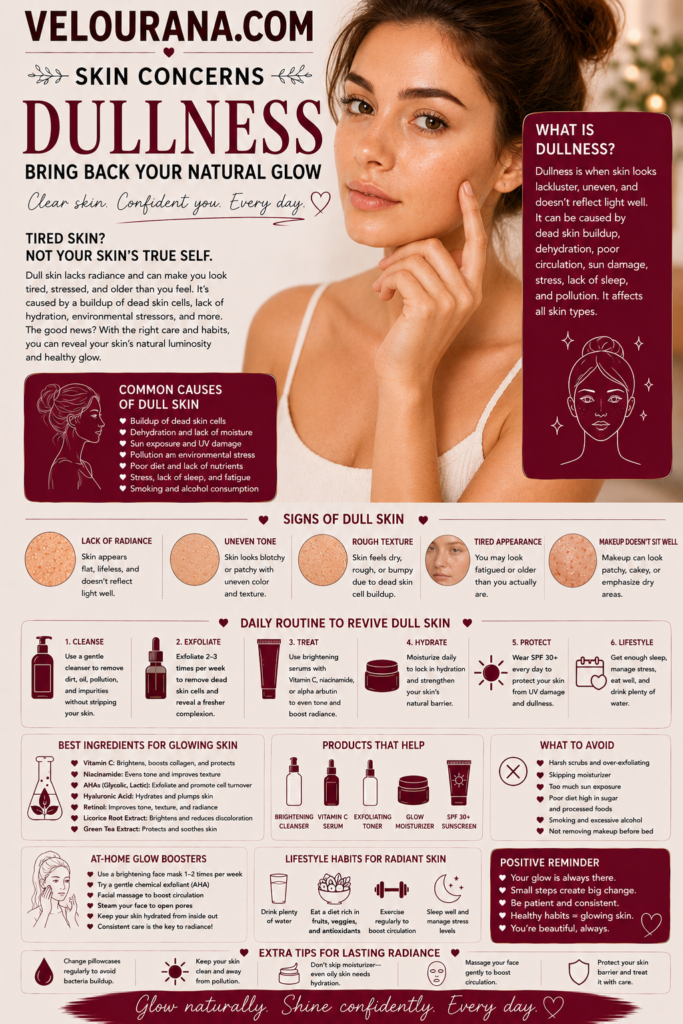
CATEGORY: Dullness
There is a particular change in the complexion that can be difficult to define because nothing appears dramatically wrong. The skin may not be severely dry. There may be no obvious breakout, rash, or sudden pigmentation problem. Yet the face seems to have lost something. Light no longer travels across it in quite the same way. Makeup looks flatter. Features appear more tired. The complexion that once seemed naturally clear and luminous can begin to look muted, uneven, or almost grey beneath certain lighting.
We call this dullness, but the word makes the problem sound simpler than it really is.
Dull-looking skin is rarely the result of one isolated process. Particularly as the skin ages, it is more useful to think of dullness as the visible outcome of several gradual changes occurring simultaneously: slower renewal at the surface, increasing dryness, accumulated ultraviolet damage, uneven pigmentation, changes in texture, and a weakened ability to maintain the smoothness that allows light to reflect evenly. Dermatologists recognize that intrinsic ageing naturally brings thinner and drier skin, while environmental influences—especially ultraviolet exposure—can accelerate visible ageing and contribute to blotchiness and uneven tone.
This is why chasing “glow” with increasingly aggressive products can be disappointing. The surface may briefly become smoother, yet the complexion soon looks tired again because the underlying conditions have not changed. Restoring luminosity is less about polishing the face until it shines and more about creating healthier conditions in which the skin can look smooth, hydrated, even, and resilient.
The distinction matters. Mature radiance does not mean making older skin imitate the skin of adolescence. It means helping ageing skin reflect its healthiest version of itself.
Dullness Is Really About the Way Skin Interacts With Light
What we perceive as glow is partly an optical phenomenon.
A relatively smooth, hydrated surface reflects light more evenly. When that surface becomes rough, flaky, dehydrated, irregularly pigmented, or textured, incoming light is scattered in different directions. Instead of producing the visual impression of clarity and luminosity, the complexion can appear flat.
This helps explain why dullness can sometimes become noticeable before deeper wrinkles do. Tiny changes that seem insignificant individually—microscopic roughness, dry patches, slightly uneven pigmentation, subtle textural irregularities—can collectively change the appearance of the entire face.
The outermost layers of skin are continuously renewing themselves. Older surface cells are eventually shed and replaced as newer cells move upward. With ageing, this process changes. Cleveland Clinic notes that natural shedding, known as desquamation, slows with age, which can contribute to dry patches, fine lines and uneven pigmentation.
This does not mean that ageing skin is simply covered by a removable layer of “dead skin” waiting to be scrubbed away. That popular description encourages precisely the kind of over-exfoliation that can make an ageing complexion look worse. The outer skin is also an essential protective structure. Removing too much of it too aggressively can increase irritation and dryness, undermining the smoothness and hydration required for luminosity.
The goal is therefore not maximum exfoliation. It is balanced renewal.
That balance becomes increasingly important because dullness often sits at the intersection of several ageing processes. A person may have slower surface turnover, slightly reduced oil production, decades of cumulative sun exposure and emerging pigmentation at the same time. Treating only one of those factors may improve the complexion, but it may not completely transform it.
Understanding dullness as a composite sign rather than a single condition is the beginning of treating it intelligently.
Why Ageing Skin Can Gradually Look Less Luminous
Intrinsic ageing—the changes that occur simply because time is passing—affects the architecture and behaviour of skin. Skin tends to become thinner and drier, while changes in collagen and other structural components influence firmness and texture.
Dryness has an especially immediate relationship with radiance.
You can observe the principle outside skincare: a smooth wet surface reflects light differently from a dry, rough one. Skin behaves similarly. When the outer layers contain sufficient water and the surface is relatively smooth, the complexion tends to look more supple. When hydration decreases and microscopic roughness increases, light reflection becomes less uniform.
This is one reason moisturiser can sometimes make mature skin look noticeably better almost immediately, even though it has obviously not reversed biological ageing in several minutes. Moisturisers help trap water in the skin, and dermatologists note that this can soften the appearance of fine lines while making the complexion look brighter and younger.
But the gradual loss of luminosity is not exclusively a moisture problem.
Surface renewal also matters. Pigment distribution matters. Sun exposure matters. Lifestyle can matter. Smoking, for example, is associated with accelerated skin ageing and a dull or sallow complexion.
This complexity explains an experience many people have in their forties, fifties and beyond: the moisturiser they have used for years still prevents obvious tightness, but it no longer seems sufficient to make the complexion look vibrant.
Nothing necessarily went wrong with the moisturiser. The skin around it changed.
An effective strategy for dullness therefore has to evolve with the complexion rather than simply adding richer and richer creams to the same routine.
The Long Shadow of Sun Exposure
If one factor deserves special attention in any discussion of ageing and dullness, it is ultraviolet exposure.
Photoaging is the term used for premature skin ageing caused by accumulated ultraviolet damage. Over time, sun exposure can contribute to wrinkles, age spots, blotchy pigmentation, textural changes and other visible alterations. The American Academy of Dermatology describes sun protection as the foundation of an anti-ageing skincare plan and recommends broad-spectrum SPF 30 or higher as part of daily protection.
Dullness associated with sun damage is particularly complicated because UV exposure can affect several of the characteristics that determine luminosity simultaneously.
Pigmentation becomes less uniform. Texture may become rougher. Dryness may become more noticeable. Fine lines create tiny variations across the surface. Areas of discoloration interrupt visual clarity. The result may not simply be “darker” skin; it may be skin that looks less homogeneous.
This is why treating pigmentation while continuing to accumulate unnecessary UV exposure is an inefficient strategy. A brightening serum may be working on one part of the problem while unprotected sunlight continues encouraging the conditions responsible for unevenness.
Sunscreen is sometimes discussed as though it belongs exclusively to prevention, while serums and treatments belong to correction. In ageing skincare, that division is misleading. Protection is part of correction because maintaining improvements requires reducing the environmental pressure that helped create the problem.
Daily sunscreen will not create dramatic overnight radiance. Its importance is quieter and more consequential. It helps prevent the complexion from continually accumulating additional photodamage while other parts of the routine address existing dryness, texture and uneven tone.
For someone trying to restore luminosity, protecting tomorrow's skin is inseparable from improving today's.
Exfoliation Can Reveal Brightness—Until It Begins Taking It Away
Few skincare ideas are as closely associated with dullness as exfoliation.
There is logic behind the association. When surface cells accumulate irregularly and the skin feels rough, appropriate exfoliation can improve smoothness and make the complexion appear fresher. Exfoliation removes some of the cells at the outer surface, and ageing-related slowing of natural shedding can contribute to roughness and dull appearance.
The difficulty is that visible results can encourage escalation.
If a mild exfoliant makes the skin look smoother, it is tempting to assume that a stronger product, more frequent use, or the addition of another exfoliating ingredient will make it twice as luminous. Biology rarely rewards that arithmetic.
An ageing complexion may already be becoming drier and more sensitive to disruption. Excessive exfoliation can create irritation, redness, tightness, peeling and increased sensitivity. Once the surface is inflamed and dehydrated, the original objective—smooth, luminous skin—moves farther away.
The more sophisticated approach is to view exfoliation as controlled assistance rather than a stripping process.
Alpha hydroxy acids, for example, are frequently used in products designed to improve surface texture. Other exfoliating formulations may target different skin concerns. The appropriate strength and frequency depend on the person's skin, the rest of the routine and the presence of sensitivity or dermatological conditions.
Mechanical exfoliation deserves similar restraint. The satisfying sensation of a coarse scrub does not prove that it is improving the skin. Dermatologists routinely recommend gentle cleansing rather than scrubbing, particularly because irritation itself can make ageing skin look worse.
A useful principle is that successful exfoliation should make the rest of the routine easier, not force the rest of the routine to repair the exfoliation.
When the skin repeatedly burns when moisturiser is applied, feels unusually tight after cleansing, becomes persistently red, or develops obvious flaking, increasing exfoliation is unlikely to be the answer. These signs suggest that the pursuit of brightness may have become counterproductive.
Radiance depends on an intact surface as much as it depends on shedding the old one.
Hydration Creates the Background Against Which Radiance Becomes Visible
Brightening products receive enormous attention because they promise transformation. Moisturiser seems comparatively ordinary.
For ageing dullness, ordinary can be powerful.
As skin ages, dryness becomes more common. The American Academy of Dermatology specifically emphasizes daily moisturising in skincare for people in their forties and fifties because moisturiser traps water in the skin and can make fine lines less apparent while helping the complexion look brighter.
A well-hydrated surface looks different before any pigment-correcting ingredient has had time to produce a biological change.
The small irregularities associated with dehydration become less conspicuous. Skin may feel more flexible. Makeup is less likely to catch dramatically on dry patches. The surface can appear smoother and therefore interact with light more evenly.
This is not fake radiance. It is an optical improvement produced by better surface condition.
Ingredients such as humectants can help attract and retain water, while emollients soften and smooth the spaces between surface cells. Occlusive components can reduce water loss. Ceramides are particularly relevant in barrier-focused formulations because they are components of the skin's natural barrier structure.
The ideal moisturiser does not have to feel exceptionally rich. A person with combination or oily mature skin may prefer a lighter texture, while someone with dry mature skin may need a more substantial cream. The objective is not to cover the face with the heaviest possible layer. It is to leave the skin comfortable and consistently hydrated.
This is also why cleansing deserves more attention than it receives in conversations about glow.
A cleanser that repeatedly leaves the face tight can undermine the benefits of an expensive routine. Hot water, harsh surfactants and aggressive scrubbing can make dryness more noticeable. Dermatologists recommend gentle cleansing with warm rather than hot water and caution against scrubbing the skin.
Sometimes the most effective brightening decision is not adding another serum.
It is stopping the routine from unnecessarily dulling the skin in the first place.
Retinoids and the Longer Strategy of Skin Renewal
If exfoliation primarily changes what is happening at the surface, retinoids belong to a broader conversation about ageing skin.
Retinoids are vitamin A derivatives with extensive use in dermatology. Depending on the formulation, they can influence cell turnover, pigmentation and collagen-related processes. The American Academy of Dermatology notes that retinoids can improve uneven tone, pigmentation, texture, fine lines and wrinkles, while DermNet describes topical retinoids as capable of improving some features of photoaging and photodamage.
Those effects make them particularly relevant when dullness is part of a larger ageing picture rather than simply temporary dehydration.
Yet retinoids illustrate one of the central paradoxes of brightening skincare: an ingredient capable of improving texture and tone over time can make the complexion look considerably worse when introduced too aggressively.
Dryness, peeling and irritation are well-recognized effects.
The solution is not to endure unlimited irritation in the belief that suffering proves efficacy. Dermatologists commonly recommend beginning cautiously and allowing the skin to adapt rather than immediately using the strongest available formulation every night. Moisturiser can be used to help reduce dryness, and daytime sun protection is particularly important.
This slower philosophy is especially suitable for mature skin.
A routine should be judged by what the complexion looks like after months of sustainable use, not by how intense the skin feels during the first week.
Retinoids are also not appropriate for everyone. Significant sensitivity, inflammatory skin conditions and other individual circumstances may require professional guidance, and topical retinoids are generally avoided during pregnancy.
The larger lesson extends beyond retinoids. Effective ageing skincare is often cumulative rather than dramatic. The ingredients with the strongest rationale frequently need consistency, patience and tolerability more than aggressive application.
Vitamin C and the Difference Between Brightening and Bleaching
The vocabulary of beauty can make “brightening” sound as though healthy skin should become lighter.
That is not the objective.
Every natural skin tone can be luminous. Brightening should refer to improving the appearance of unevenness, dullness and loss of clarity—not attempting to erase the complexion's natural pigmentation.
Vitamin C is frequently included in routines designed around this goal. It functions as an antioxidant, and appropriately formulated topical vitamin C has evidence supporting a role in protecting against aspects of photoaging. Dermatological guidance also recognizes vitamin C as an ingredient used for concerns including dark spots and visible skin ageing.
Formulation matters enormously, however.
The presence of “vitamin C” on packaging does not guarantee that every formula will perform identically. Stability, concentration, formulation chemistry and packaging can influence how useful a topical antioxidant ultimately is. DermNet specifically notes that some marketed antioxidant formulations may contain concentrations that are too low or may not be absorbed effectively.
This is an important corrective to ingredient-name shopping.
Skincare increasingly encourages consumers to assemble routines as though ingredients were collectible objects: vitamin C, retinol, acids, peptides, niacinamide, ceramides and more. But a complexion does not benefit simply because every fashionable ingredient appears somewhere on the bathroom shelf.
The overall formula, compatibility with the skin and consistency of use matter.
For a person concerned about ageing-related dullness, vitamin C may fit naturally into a morning routine beneath moisturiser and sunscreen, while a retinoid or other renewal treatment occupies the evening. But this is a framework rather than a requirement. Sensitive skin may benefit from a simpler approach.
A good routine is not the one containing the greatest number of active ingredients.
It is the one the skin can tolerate long enough for those ingredients to matter.
When More Skincare Produces Less Radiance
Modern routines can become extraordinarily complicated.
A cleanser is followed by an essence, exfoliating toner, antioxidant serum, pigment serum, peptide treatment, retinoid, moisturiser, facial oil and occasional peel. Each individual purchase may have sounded rational. Together, however, they can create a routine in which no one knows which product is helping and which is causing irritation.
Ageing dullness is especially vulnerable to this problem because the desire for glow encourages repeated resurfacing and brightening.
Skin does not become healthier simply because it is being treated constantly.
Persistent low-level irritation can present as dryness, roughness, redness, stinging or uneven texture—the same characteristics that make the complexion appear dull. Someone may respond by applying still more exfoliating products, believing the roughness represents additional dead skin. A cycle begins in which treatment creates irritation and irritation is mistaken for an indication that more treatment is required.
Breaking that cycle often means simplification.
A gentle cleanser, effective moisturiser and daily sunscreen create a useful baseline. From there, one well-chosen active can be introduced according to the dominant concern. Once tolerance is established, another element can be considered if there is a genuine reason for it.
This staged approach has another advantage: it makes the skin easier to understand.
If five new products are started on Sunday and irritation appears on Wednesday, identifying the culprit becomes difficult. If one product is introduced into an otherwise stable routine, cause and effect are easier to observe.
The pursuit of radiance should ultimately make the complexion calmer, not busier.
Lifestyle Is Not a Miracle Treatment, but Skin Does Not Exist Separately From the Body
There is a tendency to discuss lifestyle and skin in extremes.
At one extreme, every complexion problem is blamed on diet, sleep or insufficient water. At the other, skincare is treated as though the skin were an isolated sheet disconnected from the rest of human physiology.
Neither position is particularly useful.
Ageing skin is influenced by genetics, environmental exposure and behaviour. Smoking is one of the clearest examples of a lifestyle factor associated with premature ageing and a dull complexion.
Nutrition also contributes to general skin health, although no single food can manufacture glow on demand. DermNet notes associations between dietary patterns rich in vegetables and other antioxidant-containing foods and aspects of skin ageing, while the American Academy of Dermatology recommends a balanced diet containing fruits, vegetables, lean proteins and healthy fats as part of healthy ageing practices.
Sleep, exercise and alcohol consumption can also influence how a person looks and feels, although skincare marketing often exaggerates these relationships into promises that cannot be justified.
The sensible interpretation is less glamorous.
Topical skincare cannot compensate completely for chronic sun exposure or smoking. Conversely, drinking more water will not erase established photodamage, and a salad cannot replace sunscreen.
Healthy skin emerges from overlapping systems. Lifestyle creates the background; skincare manages the surface and certain biological processes; medical treatment addresses concerns that cosmetics cannot adequately correct.
Understanding those boundaries protects consumers from both exaggerated cosmetic promises and exaggerated wellness claims.
When Dullness Is Really Uneven Pigmentation or Texture
Sometimes what appears to be general dullness is actually a different concern viewed from a distance.
A scattering of sun spots may reduce the impression of uniformity. Post-inflammatory hyperpigmentation may remain after breakouts. Fine lines may create shadowing. Enlarged pores or rough texture may scatter light. Persistent redness can interrupt an otherwise even complexion.
This distinction becomes important because “brightening” is too broad a treatment objective.
If pigmentation is dominant, ingredients and procedures directed toward pigment may be appropriate. If roughness is dominant, carefully managed renewal may matter more. If dehydration is the main problem, barrier support may produce the greatest visible change. If extensive photodamage is present, professional treatments may achieve results that cosmetics cannot realistically reproduce.
Dermatologists use several procedures to address different manifestations of sun-damaged skin, including chemical peels, microdermabrasion, laser treatments and intense pulsed light in appropriate patients.
These are not interchangeable “glow treatments.” Each has different indications, limitations and risks.
Skin tone is also relevant when considering procedures. Some treatments carry different risks of post-inflammatory pigment changes depending on skin type and the technology or technique being used. Professional assessment therefore matters more than simply choosing the treatment with the most dramatic before-and-after photographs.
There are also occasions when a rough, scaly or changing area should not be treated as ordinary dullness at all. Cumulative ultraviolet exposure can produce actinic keratoses, which are precancerous lesions requiring appropriate medical evaluation.
A persistent isolated patch, changing lesion, bleeding area or other suspicious skin change belongs in a dermatologist's office, not beneath another layer of exfoliating acid.
Cosmetic awareness should never replace medical awareness.
Building a Routine Around Luminosity Rather Than Aggression
The most successful routine for ageing dullness is often surprisingly coherent.
Morning care can begin with gentle cleansing—or simply rinsing when appropriate for the individual's skin—followed by a chosen antioxidant or tone-supporting treatment if desired. Moisturiser provides hydration according to skin type, and broad-spectrum sunscreen completes the protective side of the routine.
Evening care shifts toward cleansing, renewal and recovery.
A retinoid may be appropriate for some people. Others may use a carefully chosen exfoliating treatment on selected evenings rather than combining multiple resurfacing products simultaneously. Moisturiser remains central because renewal without adequate support can become irritation.
There is no universal requirement to use both retinoids and exfoliating acids. There is no prize for tolerating the strongest formula. And there is no evidence that a twelve-step routine is inherently superior to a carefully constructed four-step one.
Consistency is more important than theatrical complexity.
It is also useful to distinguish immediate cosmetic luminosity from longer-term improvement.
Hydrating products can make the skin look fresher relatively quickly. Light-reflecting makeup can create immediate radiance. Exfoliation may alter surface smoothness within a relatively short period. Improvements in pigmentation, texture and signs of photoaging generally require considerably more patience.
Recognizing these different timelines prevents unnecessary product switching.
A person who expects a retinoid to transform years of uneven texture in five days may abandon an appropriate treatment before it has had a reasonable opportunity to work. Another person who interprets temporary tingling from a strong acid as evidence of effectiveness may continue damaging the barrier because the sensation feels productive.
The complexion does not measure commitment by discomfort.
The best routine is usually the one that can be repeated calmly for months while protecting the skin from additional damage.
Radiance in Mature Skin Should Look Like Health, Not Perfection
Perhaps the most important change in approaching dullness is redefining what luminous skin actually means.
Beauty imagery often represents radiance as poreless, perfectly uniform, glass-like skin without pigmentation, texture or lines. Real skin does not behave that way. Mature skin certainly does not need to erase every sign of age before it can look beautiful.
Healthy luminosity is subtler.
It is skin that looks comfortable rather than tight. Hydrated rather than greasy. Even enough for light to travel naturally across the face, without demanding absolute uniformity. It is texture that has been cared for rather than aggressively sanded away. It is pigmentation protected from unnecessary ultraviolet exposure. It is a barrier strong enough to tolerate an intelligent routine.
Lines can remain and the complexion can still glow.
Freckles can remain. Pores can remain. Natural variation can remain.
The objective is not to turn mature skin into younger skin. It is to reduce the conditions that make it appear unnecessarily tired, rough or depleted.
That distinction creates a far healthier relationship with anti-ageing skincare.
Once dullness is understood as the combined visual expression of hydration, surface renewal, pigmentation, texture, environmental exposure and barrier condition, the solution becomes less mysterious. Gentle cleansing protects what the skin already has. Moisturising restores the water-dependent smoothness that ageing skin increasingly needs. Thoughtful exfoliation can assist an imperfect renewal process without trying to strip it into submission. Ingredients such as retinoids and well-formulated vitamin C can address broader aspects of texture, tone and photoaging. Daily sun protection prevents the routine from fighting an avoidable battle against continuing UV damage.
None of these steps produces eternal youth.
Together, however, they can create something more believable: skin that looks cared for.
And perhaps that is the most useful definition of radiance as the complexion ages. Not brightness manufactured at any cost, not the artificial absence of every mark of time, but a surface whose smoothness, hydration and clarity allow light to return.
Dullness does not need to be attacked.
Very often, the skin simply needs the conditions in which luminosity can become visible again.
The End Velourana.
 Discover More From Our Family of Websites
 ZodiacBearing (Astrology, Tarot, Numerology, Angel Numbers & Spiritual Guidance)
 Velourana (Beauty, Makeup, Hair Care, Skincare & Beauty Tips)
 HavenBearing (Home, Living, Organization, Décor & Everyday Inspiration)
 PawBearing (Pet Care, Dog Breeds, Animal Health, Training & Pet Products)
 PsyCatherine (Notes From the Journal of a Psychologist on Real Life)

