
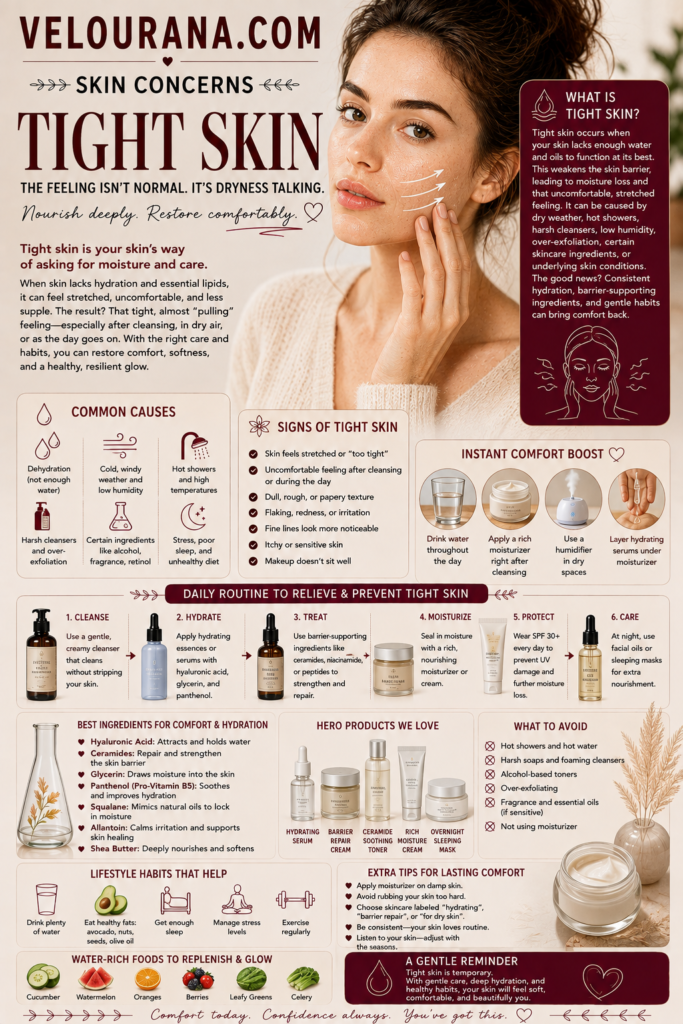
CATEGORY: Tight Skin
There is a particular kind of skin discomfort that is difficult to see but impossible to ignore. The complexion may appear perfectly ordinary in the mirror—perhaps even smooth and clear—yet underneath that appearance is an unmistakable sensation of tension. Smiling feels different. Moving the cheeks seems to pull against the surface. After cleansing, the face can feel as though it has been stretched slightly too tightly across its own contours.
This is what people usually mean when they describe tight skin.
Tightness is strongly associated with dryness, and for good reason. A feeling of tightness is recognized as one of the symptoms that can accompany dry skin, alongside roughness, itching, flaking, scaling and, in more severe cases, cracking. Dryness develops when the outer layers of the skin lose too much water, and everyday factors such as harsh cleansing, frequent bathing, hot water, low humidity and environmental exposure can contribute to that loss.
Yet the sensation deserves more attention than simply calling the skin “dry.” Tightness can be one of the earliest ways the complexion communicates that its relationship with water, lipids, cleansing and the surrounding environment has become unbalanced. It can occur before visible flaking appears. It may disappear quickly after moisturizer or return repeatedly after every wash. Some people experience it only in winter, others after introducing a new cleanser, and others despite applying several hydrating products.
Understanding tight skin therefore requires looking beyond the immediate desire to make the sensation disappear. The more useful question is what has changed in the skin—and what the feeling of tightness is revealing about the condition of its surface.
Tightness Is a Sensation, Not a Skin Type
People frequently describe their complexion as “tight” in the same way they might describe it as oily, dry or combination. But tightness is better understood as a symptom or sensation than as a permanent skin type.
That distinction matters.
Someone with naturally dry skin may experience tightness because the complexion struggles to maintain sufficient moisture and protective lipids. But someone who normally considers their skin oily can experience exactly the same feeling after aggressive cleansing. Combination skin may feel tight across the cheeks while the forehead remains shiny. A person whose complexion is usually comfortable may suddenly develop tightness after cold weather, air conditioning, swimming, travel or a change in skincare.
The sensation therefore tells us something about the skin's current condition rather than providing a complete description of its identity.
This also explains why trying to “treat tight skin” with a single supposedly perfect ingredient can be disappointing. The same symptom can emerge from different combinations of circumstances. One complexion may primarily need gentler cleansing. Another may need richer moisturization. Another may be reacting to an overly complicated routine. Another may be experiencing persistent dryness that deserves professional evaluation.
The feeling is the clue. The surrounding circumstances help reveal the cause.
The Outer Layer of Skin Has an Important Job
To understand why skin begins to feel tight, it helps to consider the outermost portion of the epidermis not as an inert covering but as a highly organized protective interface.
The skin is continually interacting with the environment. Water exists within it, while the surrounding atmosphere may be considerably drier. Cleansers repeatedly contact its surface. Wind, temperature changes, ultraviolet radiation, cosmetics and friction all create additional demands. The outer layer helps regulate this exchange while protecting the tissues underneath.
When that protective system is functioning comfortably, the surface tends to feel flexible. Facial expressions happen without drawing attention to the skin itself. Cleansing does not leave the face immediately uncomfortable. Moisture is retained effectively enough that the complexion does not constantly demand intervention.
When too much water is lost from the outer layer, however, dryness can develop. The American Academy of Dermatology describes dry skin fundamentally in terms of excessive water loss, while dermatology guidance also emphasizes the importance of moisturization in helping restore the outer layer.
This helps explain the strange “too small” sensation associated with tightness.
Skin should be supple enough to accommodate movement comfortably. As the surface becomes dry and less flexible, ordinary movements can make that change more noticeable. Smiling, talking or raising the eyebrows suddenly draws attention to a surface that normally goes unnoticed.
Tightness is therefore not necessarily about the skin literally shrinking. It is the perception of altered comfort and flexibility at the surface.
Why Tightness Often Appears Immediately After Cleansing
For many people, the most revealing moment occurs not at the end of the day but within minutes of washing their face.
The skin feels clean—perhaps exceptionally clean—but shortly afterward the cheeks begin to pull. The area around the mouth feels stiff. There may be an urge to apply moisturizer immediately because leaving the face bare feels uncomfortable.
That reaction should not automatically be interpreted as evidence that the cleanser is working especially well.
Cleansing necessarily removes material from the skin's surface. That is its purpose. Sunscreen, makeup, excess sebum, environmental particles and other residues need to be removed. Problems arise when cleansing becomes more aggressive than the skin comfortably tolerates.
Harsh soaps and detergents can contribute to dryness by stripping moisture and oils from the skin, while frequent washing, scrubbing and prolonged exposure to hot water can intensify the problem.
This creates an important distinction between clean skin and stripped skin.
A satisfying skincare routine does not require the face to feel squeaky, rigid or dramatically degreased. In fact, the cultural association between extreme cleanliness and effective skincare can encourage people to repeatedly remove more from their skin than necessary.
The problem can become particularly confusing for people with oily or blemish-prone complexions. If oil is visible by midday, stronger cleansing seems logical. The face may feel temporarily matte and purified after washing, which reinforces the habit. Yet if that same routine repeatedly leaves the complexion uncomfortable and tight, the cleansing strategy deserves reconsideration.
Oiliness does not make the skin immune to surface dehydration or irritation.
A useful cleanser should remove what needs to be removed without making immediate discomfort feel like the price of cleanliness.
Hot Water Can Turn an Ordinary Routine Into a Drying One
Sometimes the products are blamed when the technique is equally important.
A cleanser that seems tolerable under one set of circumstances may become much more drying when combined with very hot water, prolonged washing or repeated cleansing throughout the day.
Hot showers are especially seductive because they feel relaxing. On cold mornings or after a long day, hotter water can seem almost therapeutic. The skin, however, may experience the routine differently. Dermatology guidance consistently recommends warm rather than hot water for dry skin and advises limiting long showers and baths because these practices can remove natural oils and worsen moisture loss.
The face deserves the same consideration.
There is rarely a need to subject facial skin to very hot water in pursuit of deeper cleansing. Lukewarm or comfortably warm water is generally sufficient for an ordinary skincare routine.
Duration matters as well. More time does not necessarily mean better cleansing. Repeatedly massaging, scrubbing and rinsing the face can turn an otherwise reasonable routine into an unnecessarily demanding one.
This becomes particularly relevant when tightness appears suddenly even though no new products have been introduced. The change may not be sitting in a bottle. Longer showers, colder weather, increased indoor heating, more frequent cleansing or a new habit of using hotter water can alter how familiar products behave in practice.
The Difference Between Dry Skin and Dehydrated Skin
Beauty language frequently uses “dry” and “dehydrated” interchangeably, but the distinction can be useful when thinking about tightness.
Dryness generally describes a condition in which the skin lacks sufficient moisture and may also have inadequate surface lipids. Clinically, dry skin can manifest as roughness, scaling, flaking, itching and tightness.
In cosmetic language, dehydration is often used more specifically to emphasize insufficient water in the skin's upper layers. Unlike a naturally dry skin type, a dehydrated condition can appear temporarily across different skin types.
This is why an oily complexion can still feel tight.
The presence of sebum on the surface does not guarantee that water is being retained optimally. Someone can therefore experience shine and tightness at the same time. This apparent contradiction often leads to inappropriate routines: shine encourages stronger cleansing, stronger cleansing increases discomfort, and the person responds to continued shine by cleansing even more aggressively.
The cycle can become self-reinforcing.
The better response is to observe the skin as a system rather than reducing it to the amount of visible oil. Does it become uncomfortable after cleansing? Does foundation catch around dry areas despite midday shine? Does the face feel noticeably better immediately after moisturizer? Has the environment become colder or drier? Has an active treatment recently been introduced?
These observations are often more informative than the label printed on a product intended for a particular “skin type.”
Environment Can Change the Skin Without Changing Your Products
A routine that performs beautifully in one season may suddenly seem inadequate in another.
This does not necessarily mean the products have stopped working. The environment around the skin has changed.
Low humidity is a well-established contributor to dry skin. Cold weather, indoor heating and dry climates can increase the conditions under which skin loses moisture, while wind and temperature changes may add further stress to an already uncomfortable complexion.
Modern indoor life adds another dimension. Many people spend most of their day in climate-controlled spaces. Heating during winter and air-conditioned environments can create long periods in relatively dry air. Travel can produce an abrupt change in humidity. A person may leave a humid coastal environment, spend hours in an aircraft cabin and arrive somewhere considerably colder without changing a single skincare product.
The skin nevertheless experiences a completely different day.
Seasonal tightness therefore calls for flexibility rather than loyalty to an identical routine throughout the year.
A lightweight moisturizer that feels elegant during warm, humid months may no longer provide sufficient comfort when the air becomes colder and drier. Conversely, the rich cream that feels perfect in winter may become unnecessarily heavy in summer.
Skincare is often presented as though finding the right routine means discovering a fixed collection of products and repeating them indefinitely. In reality, responsive skincare is more intelligent. The routine can remain fundamentally simple while adjusting texture, frequency and richness according to changing conditions.
Moisturizer Does More Than Make Dry Skin Feel Soft
Moisturizer is sometimes treated as the least sophisticated part of skincare.
Serums are associated with concentrated actives. Exfoliants promise renewal. Retinoids are discussed in the language of transformation. Moisturizer, by comparison, can sound almost mundane.
For tight skin, however, it is often the central intervention.
A well-formulated moisturizer supports comfort partly by helping reduce water loss from the skin's surface. Different formulations combine ingredients that attract or hold water with ingredients that soften the surface and ingredients that help create a more protective layer against evaporation.
Dermatology sources commonly identify ingredients such as glycerin, ceramides, hyaluronic acid, petrolatum, dimethicone, shea butter, mineral oil, urea and certain fatty substances as useful components in moisturizers for dry skin, depending on individual needs and formulation.
The formulation matters more than chasing one fashionable ingredient.
A beautifully marketed hydrating serum may provide temporary comfort yet feel insufficient when used alone on persistently tight skin. Conversely, a richer cream may transform comfort because it does a better job of supporting water retention at the surface.
This is also why applying moisturizer to slightly damp skin can be useful. Dermatologists commonly recommend moisturizing soon after washing or bathing, while some moisture remains on the skin.
The principle is straightforward: rather than allowing water on and within the surface to disappear and then trying to compensate afterward, moisturization becomes part of the transition from cleansing back to protection.
For someone who consistently experiences post-cleansing tightness, that timing can make the routine feel very different.
When More Skincare Creates Less Comfort
Tightness sometimes develops not because a person is neglecting their complexion but because they are doing too much to it.
Modern skincare makes accumulation easy.
A routine begins with cleanser and moisturizer. Then comes exfoliation. A retinoid follows. Perhaps vitamin C is added in the morning, an acid toner several evenings per week, a clarifying mask on weekends and a blemish treatment whenever needed.
Individually, many of these categories can have legitimate uses. Collectively, they can create a routine whose intensity exceeds what a particular complexion comfortably tolerates.
The difficulty is that irritation does not always announce itself dramatically.
There may be no obvious rash. Instead, the first changes can be subtle: moisturizer begins to sting, foundation no longer sits smoothly, cleansing produces unusual tightness, or products that previously felt neutral suddenly feel uncomfortable.
At that point, adding yet another “repair” serum may be less useful than examining the total workload being imposed on the skin.
The temptation to solve every skincare problem through addition is one of the defining habits of contemporary beauty culture. Tight skin sometimes asks for the opposite approach.
Simplification can be informative.
A gentle cleanser, appropriate moisturizer and daily sun protection create a comparatively quiet baseline. From there, additional products can be evaluated according to what they actually contribute and how the skin responds.
This does not mean active ingredients are inherently harmful. It means tolerance matters.
A product can be excellent and still be wrong for a particular person, concentration, frequency or moment.
Fragrance, Sensory Pleasure and Sensitive Dry Skin
Skincare is sensory by nature.
Texture, scent, packaging and the ritual of application contribute to enjoyment. There is nothing inherently wrong with wanting products to feel luxurious. Yet when the skin is already tight, uncomfortable or reactive, sensory elegance should not take priority over tolerance.
Fragrance is one example. Many people use fragranced cosmetics without difficulty, but dermatology guidance commonly recommends fragrance-free products for excessively dry or sensitive skin because fragrance can be irritating for some individuals.
The same principle applies more broadly to complicated botanical blends or products selected primarily because they sound natural.
“Natural” is not synonymous with non-irritating.
Plants contain biologically active compounds. Essential oils contain aromatic constituents. Extracts can be useful in some formulations and unsuitable in others. The skin does not evaluate an ingredient according to whether consumers perceive it as natural, clean, luxurious or scientific. It simply responds to the chemical exposure it receives.
When tightness is persistent, reducing unnecessary variables can make it easier to identify what the skin actually tolerates.
The Morning and Evening Routine Do Not Need to Be Identical
Tight skin often benefits from thinking about skincare according to purpose rather than habit.
The evening routine has a clear cleansing role. Sunscreen, makeup, pollutants and the accumulation of the day generally need to be removed. Depending on what has been worn, cleansing may need to be more thorough.
Morning is different.
A person whose complexion becomes very dry after washing may not need exactly the same cleansing procedure after sleeping as after spending an entire day wearing sunscreen and makeup. Some people with sensitive dry skin find that a very gentle morning cleanse—or, where appropriate, simply rinsing—leaves the complexion more comfortable. Mayo Clinic guidance similarly notes that people with sensitive skin may cleanse in the evening and rinse with water at other times.
The principle is not that everyone should stop morning cleansing. Skin needs vary substantially.
The more useful lesson is that routines should have reasons.
If cleansing twice daily leaves the complexion comfortable, there may be no problem to solve. If every morning wash creates immediate tightness, however, repeating it simply because skincare routines traditionally begin with cleanser deserves reconsideration.
The skin's response is useful information.
Tight Skin Under Makeup
Makeup can reveal dryness that is surprisingly difficult to see on bare skin.
Foundation may initially spread normally but begin to separate around the mouth. Concealer may catch beneath the eyes. Powder can exaggerate fine surface lines. Areas around the nose may appear textured even though they looked smooth before makeup was applied.
The instinctive response is often to search for a more hydrating foundation.
Sometimes that helps. But makeup cannot fully compensate for uncomfortable skin underneath.
A better cosmetic result often begins before foundation. If cleansing is gentle, moisturizer has been given time to settle and the surface feels flexible rather than taut, complexion products have a more cooperative base.
This is especially important with powder. Powder has useful functions—it can reduce shine, improve longevity and alter finish—but generous application over already dry areas can make surface texture more obvious.
The objective is not to create artificially wet-looking skin. It is to establish enough comfort and flexibility that makeup is decorating the complexion rather than exposing its distress.
When makeup repeatedly looks dry regardless of which foundation is used, the underlying skincare routine deserves as much scrutiny as the cosmetics.
Why Drinking More Water Is Not the Complete Answer
When someone complains of dry or tight skin, one of the most common pieces of advice is simply to drink more water.
Adequate fluid intake is important for general health, and thirst should obviously not be ignored. But persistent surface dryness is more complicated than treating the skin like an empty container that can be refilled by drinking additional glasses of water.
Dry skin is fundamentally associated with excessive water loss from the outer skin and with factors that impair its ability to maintain a comfortable surface environment. Cleansing practices, humidity, temperature, skin condition, age and the effectiveness of moisturization all matter.
Someone can drink normally and still develop tight skin after long hot showers in a dry winter environment while using a harsh cleanser.
Likewise, increasing water intake does not make an unsuitable skincare routine suddenly gentle.
This distinction prevents a common misunderstanding. Internal hydration and topical skin hydration are related to overall wellbeing but are not interchangeable concepts. For everyday tightness associated with dryness, the condition of the skin's surface and the way it is being treated deserve direct attention.
Age Can Change What the Skin Needs
A skincare routine that worked effortlessly at twenty-five may become insufficient later.
As skin ages, physiological changes affect its ability to maintain moisture and produce some of the substances that support a comfortable surface. Dry skin becomes increasingly common with age; the American Academy of Dermatology notes that dryness is extremely common later in life, while Mayo Clinic identifies aging as a factor because skin becomes thinner and produces less of the oils needed to retain water.
This does not mean tightness should simply be accepted as inevitable.
It means the routine may need to evolve.
A cleanser chosen years ago because it produced a fresh, matte finish may become unnecessarily aggressive. A lotion that once provided enough moisture may need to be replaced or supplemented by a creamier formulation. Exfoliation frequency may require adjustment. Seasonal changes may become more noticeable.
There is an important philosophical shift here.
Good skincare is not about forcing the skin to behave as it did at another age. It is about recognizing its present needs accurately.
That approach is more useful than either fighting every sign of change or abandoning skincare because change is natural.
When Tightness Is Accompanied by Burning, Cracking or Persistent Irritation
Ordinary temporary tightness after a drying experience is one thing. Persistent or worsening discomfort is another.
Very dry skin can progress beyond mild tension into itching, flaking, scaling, cracking, stinging, burning and pain. Cracks can sometimes become deep enough to bleed.
At this point, the issue should not be treated simply as a cosmetic inconvenience.
Several skin conditions can produce significant dryness, including atopic dermatitis and psoriasis, and persistent symptoms may require evaluation to determine whether something more than ordinary environmental dryness is involved.
Professional guidance is particularly appropriate when dryness persists despite reasonable self-care, becomes painful or inflamed, produces open sores, interferes with sleep or everyday activities, or involves substantial areas of peeling or scaling.
This boundary is important because skincare has limits.
Cosmetics can support the appearance and comfort of healthy skin, but they are not substitutes for diagnosis or treatment when a medical skin condition is present.
Rebuilding Comfort Without Turning Skincare Into a Project
When skin suddenly becomes tight, the beauty industry's abundance can make the problem feel more complicated than it needs to be.
There are barrier serums, sleeping masks, facial oils, essences, ampoules, mists, balms and countless products promising hydration. Some may be excellent. Yet purchasing an entire new routine at once makes it difficult to determine what actually helped.
A more measured strategy begins by removing obvious sources of unnecessary stress.
Water temperature can be moderated. Cleansing can become gentler. Scrubbing can be reduced. Moisturizer can be applied promptly after washing. A creamier texture can be considered when a lightweight lotion is clearly insufficient. Fragrance and potentially irritating extras can be minimized when the skin is uncomfortable. Environmental dryness can be addressed where practical; dermatology guidance, for example, includes humidifier use among measures that may help in dry indoor conditions.
Most importantly, changes can be introduced deliberately rather than simultaneously.
The complexion then has an opportunity to become understandable again.
If comfort returns after simplifying the routine, that is useful information. If tightness persists despite gentle care, that is useful information too—and may justify professional assessment.
Skincare becomes easier when the goal is not to own every possible solution but to identify the few interventions the skin actually needs.
Comfortable Skin Is a Better Goal Than Perfect Skin
The beauty conversation tends to emphasize what can be seen.
Pores are visible. Pigmentation is visible. Fine lines are visible. Blemishes are visible. Tightness is different because much of the experience belongs to the person living inside the skin rather than the person looking at it.
That makes comfort an undervalued measure of skin condition.
A complexion does not need to look dramatically damaged before its discomfort deserves attention. If washing consistently leaves the face feeling stretched, if moisturizer stings, if facial movement feels uncomfortable or if dry patches continually return, those sensations are meaningful even when photographs show relatively smooth skin.
Comfort should not be confused with perfection.
Healthy-looking skin can have pores, texture, lines, pigmentation differences and occasional blemishes. None of those automatically means something is wrong. The goal of caring for tight skin is not to erase the evidence that skin is living tissue.
It is to help restore a state in which the skin no longer constantly announces its discomfort.
Listening to the Feeling Beneath the Surface
Tight skin is easy to dismiss because it can seem minor compared with more visible concerns. Yet its subtlety is precisely what makes it valuable.
It is often an early signal.
It may be telling you that cleansing has become too aggressive. It may appear when the weather changes and the old moisturizer is no longer enough. It may accompany excessive water loss from dry skin. It may emerge after too many active products have accumulated in a routine. Or, when persistent and accompanied by inflammation, scaling, cracking or pain, it may indicate that the skin deserves professional attention rather than another cosmetic experiment.
The most effective response begins with observation rather than panic.
Notice when the tightness occurs. Notice whether it follows cleansing, weather changes or a particular product. Notice whether moisturizer relieves it and how long that relief lasts. Notice whether the skin is merely uncomfortable or becoming visibly irritated.
Then simplify the problem.
Treat cleansing as removal rather than punishment. Use comfortably warm rather than very hot water. Moisturize while the skin still retains some dampness. Choose textures substantial enough for the current level of dryness. Protect the complexion from environmental stress and sunlight. Reduce unnecessary irritation instead of continually adding new products.
Above all, remember that skincare is not successful simply because the surface looks polished.
Skin should also feel comfortable inside its own boundaries.
When that familiar sensation of being stretched too tightly begins to fade—when smiling, talking and moving the face become unremarkable again—the improvement may be almost invisible to everyone else.
To the person wearing the skin, however, that quiet return of flexibility can be one of the clearest signs that balance is being restored.
The End Velourana
 Discover More From Our Family of Websites
 ZodiacBearing (Astrology, Tarot, Numerology, Angel Numbers & Spiritual Guidance)
 Velourana (Beauty, Makeup, Hair Care, Skincare & Beauty Tips)
 HavenBearing (Home, Living, Organization, Décor & Everyday Inspiration)
 PawBearing (Pet Care, Dog Breeds, Animal Health, Training & Pet Products)
 PsyCatherine (Notes From the Journal of a Psychologist on Real Life)

