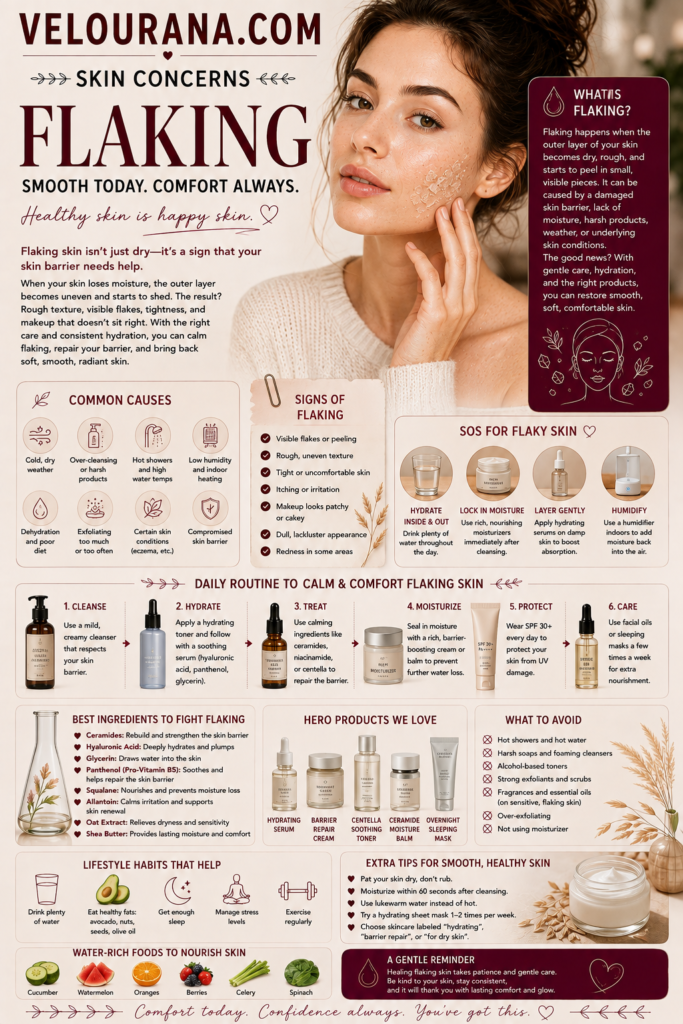
CATEGORY: Flaking
Flaking skin is easy to misunderstand because it looks so simple. A few pale scales around the nose, a rough patch beside the mouth, powdery skin across the forehead, or tiny fragments appearing beneath foundation can seem like little more than a cosmetic inconvenience. The instinctive response is often equally simple: remove the flakes. Scrub them away, exfoliate more thoroughly, polish the surface until it feels smooth again.
Yet visible flakes are rarely the real problem. They are the surface expression of something happening within the outermost layers of the skin.
Healthy skin is constantly shedding cells, but it normally does so so discreetly that the process is almost invisible. When the skin's protective barrier becomes dry, disrupted, irritated, or otherwise unable to maintain its normal balance, those cells may no longer separate individually and imperceptibly. Instead, they remain attached in small groups. What we recognize as flaking is often this altered shedding becoming visible.
This distinction changes the entire approach to flaky skin. If the flakes themselves are treated as the enemy, it is remarkably easy to intensify the conditions that created them. If they are understood instead as a signal from the skin barrier, care becomes less about removing something and more about restoring something.
The goal is not to force the skin to look smooth for several hours. It is to help it become capable of maintaining a smoother surface on its own.
Flaking Is the Visible End of an Invisible Process
The outermost portion of the epidermis, the stratum corneum, is sometimes described as a relatively simple layer of dead cells. In reality, it is a sophisticated protective structure. Flattened cells known as corneocytes are arranged within a lipid-rich environment that helps regulate water loss and protects the living tissues beneath from the outside world.
This barrier must perform two seemingly contradictory tasks. It needs to be strong enough to protect us, yet flexible enough to shed continuously.
Under balanced conditions, old surface cells are released gradually through a process called desquamation. Individual cells detach in such small quantities that we do not ordinarily notice them. Skin therefore renews itself constantly without looking as though it is peeling.
Dryness changes this orderly process.
When the stratum corneum contains insufficient water, and when its lipid organization has been disturbed, groups of corneocytes can partially detach together rather than disappearing individually. DermNet describes scaling as the partial detachment of groups of corneocytes from the skin surface, while also noting that water loss from the stratum corneum contributes to dry skin.
The result can range from an almost invisible roughness to obvious white or gray scales.
This is why flaky skin frequently feels different before it looks dramatically different. There may be tightness after cleansing, increased sensitivity to products that were previously comfortable, a papery texture, or an unusual lack of suppleness. Makeup may begin catching on areas that previously appeared smooth.
The flakes arrive at the end of that story.
Understanding them therefore requires looking beyond what can be brushed from the surface.
Dryness, Dehydration and Flaking Are Related—but Not Identical
The vocabulary surrounding dry skin can become confusing because several terms are often used interchangeably.
Dryness generally refers to a condition in which the skin lacks sufficient components needed to maintain an effective surface barrier, including lipids. Dehydration refers more specifically to insufficient water within the skin. Flaking describes a visible manifestation that can occur when this balance is disturbed.
They overlap, but they are not synonymous.
A naturally oily complexion can become dehydrated. Dry skin can feel tight without producing obvious flakes. Flaking can also occur for reasons extending beyond ordinary cosmetic dryness, including irritation and inflammatory skin conditions.
This matters because simply seeing flakes does not tell us precisely why they are there.
The American Academy of Dermatology notes that excessively dry skin can flake, itch, crack and even bleed. It also emphasizes that persistent dryness can sometimes be associated with conditions such as atopic dermatitis or psoriasis rather than environmental dryness alone.
That is an important boundary between skincare and diagnosis.
Occasional mild flaking after cold weather, excessive cleansing, travel, or a disruptive skincare experiment may respond readily to a gentler routine. Persistent scaling accompanied by significant redness, inflammation, intense itching, pain, cracking, bleeding, or recurrent sharply defined patches deserves a different level of attention.
The appearance may be similar. The underlying causes are not necessarily the same.
Why the Skin Barrier Becomes Vulnerable
Flaking often develops not because of one dramatic event but because several modest stresses accumulate.
Climate is one of the most obvious. Low environmental humidity increases the challenge of retaining water within the stratum corneum. Cold outdoor air combined with heated indoor environments can be particularly difficult for skin that already tends toward dryness. The American Academy of Dermatology notes that low humidity and indoor heating can contribute to dry, chapped skin.
Hot water can add another layer of stress.
A steaming shower feels comforting, especially in winter, but prolonged exposure to hot water can worsen dryness. Strong soaps and aggressive cleansers may remove not only dirt and excess sebum but some of the surface lipids that contribute to barrier function.
Then comes skincare itself.
Modern routines can contain cleansers, exfoliating acids, retinoids, vitamin C products, masks, scrubs, spot treatments and numerous other active formulas. Each may have a legitimate purpose. The problem arises when the skin is expected to tolerate too much, too frequently, without adequate recovery.
This is particularly relevant when flaking appears suddenly after a routine change.
A person may interpret the resulting roughness as evidence that exfoliation is not working sufficiently and increase it. The barrier becomes more irritated. More flakes appear. The response is another exfoliation session.
A self-perpetuating cycle has begun.
Even apparently minor habits can contribute: rubbing the face vigorously with a towel, using cleansing brushes too frequently, washing repeatedly throughout the day, picking at individual flakes, or constantly changing products in search of an immediate solution.
The common thread is cumulative disturbance.
Skin does not experience a routine as separate marketing categories. It experiences the combined biological effect of everything placed on it and everything done to it.
The Exfoliation Paradox
Few skincare situations create a stronger temptation to exfoliate than visible flaking.
The logic appears impeccable. There is unwanted dead skin on the surface. Exfoliation removes dead skin. Therefore, more exfoliation should solve the problem.
Sometimes gentle exfoliation has a place in a well-tolerated routine. But active flaking caused by dryness or irritation demands more restraint than this simple equation suggests.
The American Academy of Dermatology specifically warns that people can make dry, peeling skin worse by exfoliating it when what the skin needs is greater moisturization and protection.
This is one of the most important lessons in managing cosmetic flaking.
There is a difference between skin that has accumulated a slightly dull surface and skin that is visibly shedding because its barrier is struggling.
Scrubbing the second as though it were the first may temporarily produce smoothness. Loose fragments disappear and the face can feel polished. But that immediate visual result does not necessarily represent improvement. Removing fragile surface material can expose skin that is even more vulnerable to water loss and irritation.
The same caution applies to chemical exfoliation.
Alpha-hydroxy acids, beta-hydroxy acids and other exfoliating ingredients can be valuable when appropriately selected and tolerated. Yet an ingredient's usefulness in healthy skin does not automatically make it appropriate during an episode of irritation or active barrier disruption.
Skincare maturity sometimes means knowing when not to treat.
When the face is persistently tight, stinging, visibly peeling or suddenly reactive, simplification can be more intelligent than escalation.
Moisturization Is More Than Adding Water
A common misunderstanding about dry, flaky skin is that it simply needs more water.
Water matters enormously, but effective moisturization involves more than wetting the surface.
A useful moisturizer generally helps the stratum corneum maintain a more favorable water environment through combinations of ingredients that perform different functions. Humectants attract or bind water. Emollients help soften and smooth the spaces between surface cells. Occlusive components reduce evaporation by forming a film that slows water loss.
The distinction explains why splashing water onto flaky skin provides little lasting benefit.
Water placed on the surface can evaporate. Without ingredients that help retain it, the skin may quickly return to feeling tight.
This is also why the timing of moisturizer can matter.
Dermatologists commonly recommend applying moisturizer soon after washing, while the skin remains slightly damp, helping retain some of that water rather than allowing it to evaporate completely.
Texture matters as well.
Light lotions can be elegant and perfectly suitable for many skin types, but more pronounced dryness may benefit from richer creams or ointment-like formulations. The American Academy of Dermatology notes that creams and ointments generally retain more moisture than lotions and recommends them particularly for very dry skin.
This does not mean the richest product available is automatically the best facial moisturizer for everyone. Comfort, acne tendency, climate, sensitivity and the rest of the routine still matter.
The principle is more useful than any universal product rule: when skin is actively flaking from dryness, the routine should provide enough barrier support to match the severity of the dryness.
The Ingredients That Support a Fragile Surface
Ingredient lists can appear overwhelmingly complicated, but the needs of flaky skin are often comparatively straightforward.
Humectants such as glycerin and hyaluronic acid can help support hydration. Emollient ingredients soften the rough sensation associated with dry surface cells. Occlusive substances such as petrolatum or mineral oil can help slow moisture loss, particularly on severely dry areas.
Ceramides deserve special attention because they are related to lipids naturally found within the skin barrier. Moisturizers designed around barrier support often combine ceramides with humectants and other emollient ingredients rather than relying on one celebrated ingredient to do everything.
The American Academy of Dermatology identifies ingredients including glycerin, hyaluronic acid, dimethicone, mineral oil, petrolatum, jojoba oil and shea butter among options found in moisturizers for dry skin. It also discusses ceramides as useful components in moisturization.
Yet ingredient selection is only half of the story.
A beautifully formulated moisturizer cannot fully compensate for a routine that repeatedly strips the skin. If cleansing is excessively aggressive, showers are very hot, exfoliation is constant and irritating products are layered twice daily, moisturizer is being asked to repair damage while the rest of the routine continues creating it.
Barrier care is therefore better understood as a system.
The cleanser matters.
The water temperature matters.
The frequency of washing matters.
The number and intensity of active products matter.
The moisturizer matters.
And perhaps most underestimated of all, consistency matters.
Skin usually responds more predictably to a tolerable routine repeated patiently than to a succession of emergency interventions.
Cleansing Can Quietly Determine Whether Flaking Improves
Cleansing receives enormous attention in skincare, but the emphasis is often placed on how thoroughly a product removes impurities rather than what the skin feels like afterward.
For flaky skin, the aftermath matters.
A face that feels exceptionally tight immediately after washing is providing useful information. The popular idea that skin should feel almost squeaky after cleansing is poorly suited to a compromised dry barrier.
Cleansing should remove what genuinely needs to be removed without unnecessarily disturbing the surface.
The American Academy of Dermatology recommends gentle, fragrance-free cleansers for dry skin and advises using warm rather than hot water. Its facial cleansing guidance also recommends using fingertips instead of abrasive washcloths or sponges and discourages scrubbing.
This does not require abandoning cleansing altogether.
Sunscreen, makeup, pollutants, sweat and accumulated oils still need appropriate removal. The objective is proportionality.
Someone wearing substantial makeup or water-resistant sunscreen may require more cleansing than someone who spent the day indoors with little on the face. Yet even when more thorough cleansing is necessary, the process need not become aggressive.
Technique can be as important as formulation.
Massage rather than scrub.
Rinse rather than scour.
Pat rather than rub.
These distinctions sound minor until the skin is irritated. Then every unnecessary source of friction becomes surprisingly noticeable.
A soft towel pressed gently against the face can perform exactly the same practical function as vigorous rubbing without creating the same mechanical stress.
When flaking is active, gentleness ceases to be an aesthetic preference and becomes part of the strategy.
When a Sophisticated Routine Needs to Become Temporarily Boring
People who enjoy skincare often build elaborate routines for understandable reasons. Different ingredients address different concerns, and experimentation can be enjoyable.
Flaking sometimes requires temporarily abandoning that complexity.
This can feel counterintuitive. When skin looks worse, the natural desire is to do more. Add a hydrating serum. Add an exfoliating toner to remove the flakes. Add an overnight mask. Add oil. Add another cream.
Eventually, the routine designed to rescue the skin becomes difficult to interpret.
If burning or redness appears, which product caused it?
If the skin improves, which product helped?
If flaking becomes worse, is the cause the original dryness or one of the six new formulas introduced in response?
A simplified routine creates clarity.
During an uncomplicated episode of dryness-related flaking, a gentle cleanser when cleansing is needed, a well-tolerated moisturizer, and appropriate daytime sun protection can form a sensible temporary foundation. Additional products can be reconsidered as the skin becomes comfortable again.
The point is not that serums, toners, oils or active treatments are inherently harmful.
They are not.
The point is that an impaired barrier has different priorities from comfortable, resilient skin.
Restoration comes before optimization.
Once tightness, visible scaling and unusual sensitivity have subsided, other products can be reintroduced gradually. Doing this one at a time also makes it easier to identify whether a particular formula was contributing to the original problem.
This is one of the occasions when a shorter routine can provide more information than a longer one.
Makeup Reveals Flaking in a Particularly Unforgiving Way
Some people first become aware of dry patches only after applying foundation.
Bare skin may appear relatively normal. Then complexion makeup settles around the nose, separates across the cheeks or catches on tiny scales that were almost invisible minutes earlier.
This happens because pigment and powder emphasize differences in surface texture.
The response is often to apply additional foundation in an attempt to cover the unevenness. Unfortunately, additional layers can make the contrast stronger. The issue is not insufficient pigment coverage; it is an irregular surface beneath the pigment.
Preparation therefore becomes more important than coverage.
Well-moisturized skin generally provides a more cooperative surface than skin that has been aggressively exfoliated immediately before makeup. Allowing skincare to settle before applying foundation can also reduce unnecessary manipulation.
Formula choice matters. Very matte or highly absorbent complexion products may emphasize dry texture on some people, whereas more flexible or emollient formulas can appear more forgiving. This is not universal—individual formulas behave differently—but it illustrates an important principle.
Makeup cannot permanently correct a barrier problem.
It can disguise discoloration.
It can alter luminosity.
It can soften the visual impression of pores.
But it cannot make partially detached surface cells behave exactly like a smooth, hydrated stratum corneum.
When flakes appear through foundation, the most effective long-term cosmetic strategy is usually improving the condition of the skin beneath it rather than continually increasing coverage.
Not Every Flake Is Ordinary Dry Skin
Because flaking is so common, it is tempting to treat every instance as routine dryness.
That can be a mistake.
Scaling and peeling can occur alongside several dermatological conditions. Atopic dermatitis, psoriasis and other disorders may produce dryness and visible scale. Areas around the scalp, eyebrows and sides of the nose can also behave differently from generalized facial dryness. Contact reactions to skincare, hair products, fragrances or other substances can produce irritation that includes peeling.
This is why context matters.
Where are the flakes?
How long have they been present?
Do they itch?
Is the skin inflamed?
Does it burn?
Are there cracks?
Does the same area repeatedly flare?
Did the problem begin after introducing a new cosmetic, hair product or active skincare ingredient?
Is the scalp affected as well?
A skincare article cannot diagnose the answers, nor should it try.
What it can do is establish the point at which persistent self-treatment stops being sensible.
The American Academy of Dermatology recommends professional assessment when dry skin persists despite appropriate home care or becomes painful, cracked, bleeding, stinging or significantly irritated. It also notes that underlying conditions may require treatment rather than moisturizer alone.
This is particularly important when a person has spent weeks repeatedly exfoliating what they assume is simple dead-skin accumulation.
If reasonable barrier-supportive care does not improve the situation, more force is rarely the logical next experiment.
Seasonal Flaking Requires Seasonal Thinking
A skincare routine does not exist in a laboratory.
It exists in weather.
Skin that behaves beautifully during a humid summer may become tight and flaky in winter. A moisturizer that feels perfect near the sea may feel inadequate after several days in a heated hotel room. Air conditioning, central heating, wind, frequent flights and abrupt changes in climate can all alter how the skin behaves.
Routine loyalty should therefore not become rigidity.
The American Academy of Dermatology recommends adjusting skincare as environmental conditions change and notes that cool-mist humidifiers can be useful where indoor air contributes to dryness.
Seasonal adjustment does not necessarily require replacing everything.
Sometimes the cleanser can remain unchanged while the moisturizer becomes richer.
Sometimes moisturizer needs to be applied more generously or more frequently.
Sometimes exfoliation that was comfortable during a humid season needs to become less frequent during a dry one.
Sometimes the greatest improvement comes not from buying anything new but from shortening very hot showers.
This adaptability is particularly useful for people who describe their skin type as though it were permanent.
Skin type provides a useful baseline, but skin condition changes.
An individual may generally have combination skin and still experience temporary flaking. Someone with oily skin can still develop a disrupted barrier. A person who has always considered their complexion dry may encounter periods when that dryness becomes considerably more pronounced.
The routine should respond to the skin that exists today rather than the label assigned to it years ago.
Flaking on Melanin-Rich Skin Can Look More Dramatic
Dryness does not look identical across all complexions.
On deeper skin tones, tiny pale scales can contrast more visibly against surrounding pigmentation, sometimes producing an ashy or gray appearance even when the underlying degree of dryness is similar to that seen on lighter skin.
The American Academy of Dermatology specifically notes that flaking and the whitish or grayish-white appearance associated with dry skin can be more noticeable on darker skin tones.
This visibility can create pressure to remove every trace immediately.
Again, aggressive removal may work against the skin.
The greater the contrast, the more tempting it becomes to scrub. Yet the biological priority remains barrier restoration.
There is another reason to avoid unnecessary irritation: inflammation can leave visible changes in pigmentation, particularly in skin prone to post-inflammatory hyperpigmentation. Creating additional irritation in pursuit of immediate smoothness can therefore exchange a temporary texture problem for a longer-lasting tone concern.
Gentle treatment is not passive treatment.
Sometimes it is the more strategic intervention precisely because it avoids creating a second problem while addressing the first.
The Recovery Period Is Part of the Treatment
One of the frustrations of flaky skin is that recovery does not always occur at the speed we want.
A rough patch may be created over several days of over-cleansing, harsh weather or excessive active use, yet we expect one night of moisturizer to erase it completely.
Skin biology does not operate according to cosmetic urgency.
The American Academy of Dermatology notes that many cases of environmentally driven dry skin improve with appropriate self-care and that improvement may become apparent over roughly two weeks, although individual circumstances naturally differ.
During that period, improvement may be gradual rather than dramatic.
Stinging may decrease before every flake disappears.
The skin may feel less tight while still looking slightly rough.
Makeup may begin applying better before the surface is completely restored.
These are meaningful changes.
Constantly switching products because the skin is not perfect after twenty-four hours makes it difficult to determine whether a routine is actually working. Worse, introducing new actives during early recovery can restart the cycle.
Patience becomes part of skincare technique.
There is also value in resisting the urge to pick individual flakes. Pulling at a partially detached piece of skin can remove more than the fragment that was ready to shed, leaving the area tender and creating a fresh irregular edge.
What appears to be tidying the surface can become another small injury.
Allowing the skin to release those cells naturally while supporting hydration is less satisfying in the mirror at that exact moment, but it respects the recovery process.
Preventing the Return of Flaking
Once the skin looks smooth again, the temptation is to declare the problem solved and immediately return to the exact routine that preceded it.
That misses the most useful part of the experience.
Flaking can reveal the limits of a particular routine.
Perhaps an exfoliating treatment was being used too often.
Perhaps a cleanser was comfortable during summer but too aggressive during winter.
Perhaps several individually tolerable active products became irritating when layered together.
Perhaps moisturizer was being applied only when the skin already felt dry rather than consistently enough to prevent the problem.
Perhaps long, hot showers were playing a larger role than expected.
The objective after recovery is not to fear every active ingredient. It is to identify the combination of conditions that exceeded the skin's tolerance.
A carefully reintroduced routine can provide that information.
If a product is restarted and the skin remains comfortable, it may not have been responsible. If flaking reliably returns after a particular step is reintroduced, the pattern becomes more informative.
This method is far more useful than changing several products simultaneously.
Preventive care also means accepting that the ideal routine may not be identical throughout the year. A lighter moisturizer may be sufficient in humid weather and inadequate in winter. Exfoliation frequency may need to change. Areas prone to dryness may need targeted support even when the rest of the face feels normal.
The best routine is not necessarily the one that contains the greatest number of sophisticated ingredients.
It is the one the skin can sustain.
Smooth Skin Is Not Created by Force
Flaking exposes one of skincare's most persistent contradictions.
We want the surface to look smooth, so we attack the roughness.
But healthy smoothness is not simply the absence of visible dead cells. It is the consequence of an outer barrier that contains sufficient water, retains its structural integrity and sheds cells in an orderly way.
That kind of smoothness cannot be scrubbed into existence.
It must be supported.
This is why the most effective response to ordinary dryness-related flaking often feels less dramatic than expected: gentler cleansing, less friction, appropriate moisturization, protection from environmental stress and temporary restraint with irritating or excessively exfoliating products.
The strategy is quiet because the skin's repair processes are quiet.
Visible flakes are simply the part we can see.
Beneath them is a barrier negotiating water, lipids, environmental exposure and continuous renewal. Once that barrier is given conditions in which it can function effectively, the shedding process can once again become what it was supposed to be—continuous, orderly and almost invisible.
The flakes were never really asking to be removed.
They were asking us to understand why they had become visible.
The End Velourana
 Discover More From Our Family of Websites
 ZodiacBearing (Astrology, Tarot, Numerology, Angel Numbers & Spiritual Guidance)
 Velourana (Beauty, Makeup, Hair Care, Skincare & Beauty Tips)
 HavenBearing (Home, Living, Organization, Décor & Everyday Inspiration)
 PawBearing (Pet Care, Dog Breeds, Animal Health, Training & Pet Products)
 PsyCatherine (Notes From the Journal of a Psychologist on Real Life)