
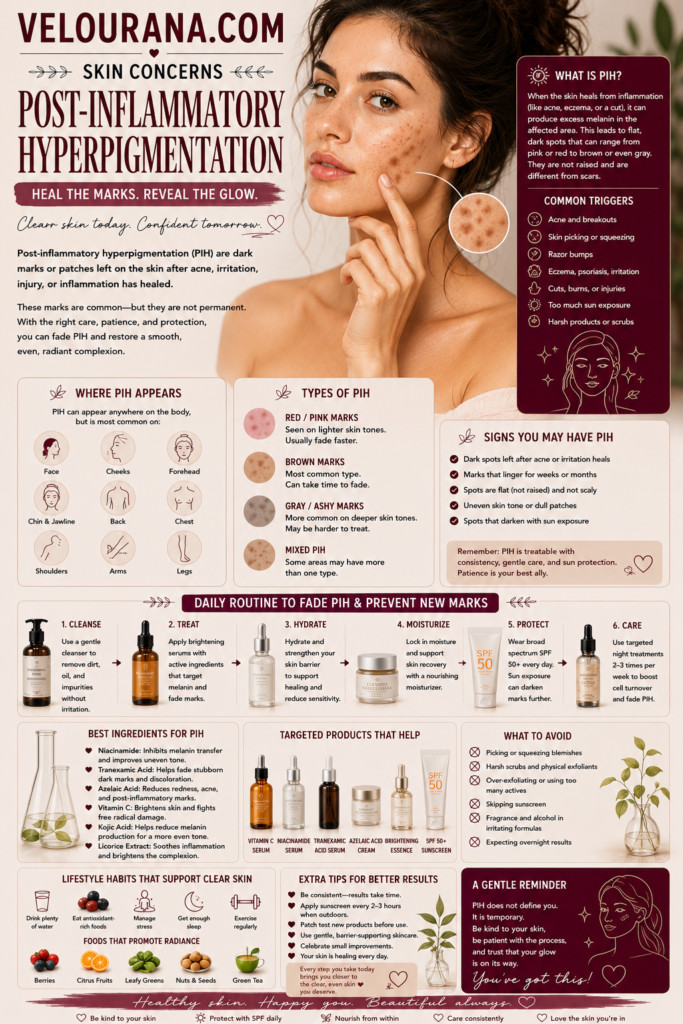
CATEGORY: Post-Inflammatory Hyperpigmentation
Post-inflammatory hyperpigmentation is often discussed as though the story begins with a dark mark.
In reality, the mark is usually the final visible stage of something that began earlier.
There was inflammation first.
Perhaps it came from acne. Perhaps from eczema, shaving, an insect bite, a cosmetic reaction, friction, scratching, a minor burn or an enthusiastic experiment with acids and retinoids. Whatever the trigger, the skin experienced enough irritation or injury to activate inflammatory pathways. In susceptible skin, that inflammation disturbed normal pigment regulation. Melanocytes responded. More melanin was produced or distributed unevenly. The inflammation settled, yet colour remained.
This sequence explains why the skin barrier deserves far more attention in conversations about pigmentation than it usually receives.
The barrier is not glamorous. It does not appear in skincare advertising with the same drama as brightening serums, professional peels or high-strength actives. Yet a compromised barrier can make the skin more vulnerable to irritation, and repeated irritation creates exactly the biological environment in which post-inflammatory hyperpigmentation becomes easier to produce.
For someone prone to PIH, barrier care is therefore not merely about comfort.
It is part of pigment management.
This is particularly important because pigmentation itself can provoke increasingly aggressive behaviour. A stubborn dark mark encourages stronger exfoliation. Stronger exfoliation causes irritation. Irritation compromises the barrier further. The damaged barrier becomes more reactive. More inflammation develops. And the attempt to erase one mark can generate another.
The cycle is easy to miss because each step appears logical when considered alone.
The mark is dark, so exfoliate.
The exfoliation is not working quickly enough, so increase the frequency.
The skin begins flaking, so scrub away the flakes.
The face feels tight, so add another hydrating product without reducing the irritants.
A new patch becomes inflamed.
When it heals, it leaves pigmentation.
At that point the person may conclude that the original pigmentation treatment was ineffective.
The more accurate conclusion may be that the skin was never given enough stability for the treatment to work without creating additional damage.
The Skin Barrier Is More Than a Surface
The outermost layer of the epidermis, the stratum corneum, is often compared with a brick wall.
The analogy is useful because it captures something essential: the barrier is a structured system rather than a passive covering.
Corneocytes act somewhat like the bricks, while lipids—including ceramides, cholesterol and fatty acids—occupy the spaces around them. Together, they reduce excessive water loss and help limit penetration of irritants, allergens and other external substances.
When this system is functioning well, the skin can maintain hydration more effectively and respond to environmental stress with greater resilience.
When it is disrupted, the consequences are not limited to dryness.
Water escapes more easily.
External irritants penetrate more readily.
Ordinary products may suddenly sting.
The skin becomes more reactive.
Inflammatory signalling can increase.
For pigmentation-prone skin, this has obvious significance.
Post-inflammatory hyperpigmentation is not created by dryness alone. But barrier disruption can make inflammation easier to provoke and harder to settle. That places the skin in a state where apparently minor triggers can have disproportionate consequences.
This is why someone can use a strong exfoliant comfortably for months and then suddenly become unable to tolerate products that previously caused no problem. Barrier damage is often cumulative. The skin may compensate for repeated stress until it can no longer do so effectively.
The visible warning signs often arrive late.
By the time burning, persistent flaking or redness appears, the routine may already have been too aggressive for some time.
Why Pigmentation-Prone Skin Cannot Afford Continuous Low-Level Irritation
Not all inflammation is dramatic.
Skin does not need to be visibly swollen or painfully red to be experiencing a meaningful inflammatory response.
Low-level irritation can manifest as subtle tightness, persistent sensitivity, mild stinging, flaky patches, a shiny but dehydrated appearance or increased reactivity to products that normally feel comfortable.
These signs are easy to dismiss because they do not look severe.
Yet chronic low-grade irritation can be strategically important in PIH.
The skin is being repeatedly asked to defend, repair and adapt. If melanocytes are especially responsive to inflammatory signalling, this repeated irritation can contribute to uneven pigmentation over time.
This is one reason some people develop pigmentation not from one obvious event but from a pattern of routine-related stress.
The marks may cluster around areas where actives are overused.
They may appear after repeated hair removal.
They may follow an episode of contact dermatitis from fragrance, essential oils or another sensitising ingredient.
They may develop after persistent rubbing around the mouth, nose, neck or body folds.
In these cases, the person may focus exclusively on the colour without recognising that the inflammatory trigger is still active.
As long as that trigger remains, fading becomes unnecessarily difficult.
The most effective pigment treatment may begin with removing the source of irritation rather than adding another brightening product.
The Difference Between Product Activity and Product Aggression
Skincare culture often confuses sensation with effectiveness.
A tingling product feels active.
A peeling treatment looks active.
A strong acid that leaves the face temporarily red appears to be doing something important.
A gentle serum that produces no sensation can seem almost disappointing.
But sensation is not a reliable measure of useful biological activity.
A treatment can work without burning.
A retinoid can influence epidermal turnover without producing visible peeling.
An acid can support exfoliation without causing the face to feel raw.
A pigmentation serum does not become more effective because the skin stings for twenty minutes after application.
This distinction is particularly important for PIH because excessive aggression can undermine the objective.
The goal is not to produce the maximum possible response from the skin.
The goal is to produce a beneficial response while keeping inflammation within tolerable limits.
That requires a different mindset.
Instead of asking, “What is the strongest product I can use?” ask, “What is the strongest routine my skin can sustain without becoming chronically irritated?”
The second question is much more useful.
A routine that is theoretically powerful but repeatedly interrupted because of irritation may achieve less than a milder routine followed consistently for six months.
In pigmentation care, tolerability is not a compromise.
It is part of the treatment design.
How Over-Exfoliation Creates the Perfect Conditions for More PIH
Exfoliation has a legitimate role in skincare.
Certain exfoliating acids can help improve texture, support epidermal renewal and contribute to a more even-looking complexion.
The problem begins when exfoliation becomes an attempt to physically remove pigment by force.
Post-inflammatory hyperpigmentation can look superficial. The mark is visible, so it is intuitive to imagine that enough exfoliation will simply take it away.
But pigment is not a stain sitting independently on top of the skin.
Epidermal melanin is located within cells. Deeper pigment may extend beyond the epidermis. Scrubbing harder cannot selectively remove it.
What aggressive exfoliation can remove is part of the protective barrier.
Used too frequently, exfoliating acids can increase irritation and transepidermal water loss. Physical scrubs can add friction and microtrauma. Combining exfoliating acids with retinoids, benzoyl peroxide, strong vitamin C preparations and other actives can create a cumulative irritation burden even when each product seems acceptable on its own.
The skin becomes tight.
Flaking begins.
Moisturiser stings.
The person sees the flaking and assumes more dead skin needs to be removed.
Another exfoliating treatment is applied.
The cycle deepens.
For someone prone to PIH, this is precisely the wrong direction.
The inflammatory consequence of over-exfoliation can create new discoloration or prolong existing uneven tone.
The paradox is striking: the person can be exfoliating more and looking more pigmented at the same time.
The answer is not always another exfoliant.
Sometimes the answer is to stop creating the injury that keeps the pigmentary response active.
Retinoids Can Help PIH, but Irritation Changes the Equation
Retinoids are among the most valuable ingredients in modern dermatology and skincare.
They can support acne management, influence epidermal turnover, improve signs of photoageing and contribute to treatment strategies for uneven pigmentation.
For PIH associated with acne, this makes them particularly useful because they can act on both the process creating new blemishes and the pigmentary aftermath.
But retinoids also illustrate the central tension of pigmentation care.
An effective ingredient can become counterproductive if it produces excessive irritation.
Some degree of dryness or transient adjustment may occur when a retinoid is introduced. But persistent burning, painful tightness, pronounced scaling and ongoing inflammation are not goals.
Increasing strength rapidly because the pigmentation remains visible can create more trouble than benefit.
The correct pace depends on the product, the skin, previous retinoid experience and the rest of the routine.
For someone highly prone to PIH, slow introduction can be especially sensible.
This may mean using a retinoid fewer nights per week initially, applying moisturiser strategically, avoiding unnecessary combinations with strong exfoliants and allowing the skin to demonstrate tolerance before increasing frequency.
The purpose is not to dilute the treatment beyond usefulness.
It is to keep the treatment usable.
A retinoid only contributes to long-term improvement if the skin can continue receiving it without being repeatedly pushed into inflammatory distress.
Why Moisturiser Is Not a Passive Step
Moisturiser is frequently treated as an accessory.
The “real” skincare is assumed to happen in the serums.
The moisturiser simply prevents dryness.
This underestimates its role.
A well-chosen moisturiser can support barrier function, improve comfort, reduce water loss and increase tolerance of active ingredients. In a PIH routine, these benefits have strategic value.
If the skin tolerates treatment better, the person is more likely to use it consistently.
If the barrier remains stable, there is less unnecessary irritation.
If irritation decreases, one potential source of post-inflammatory pigmentation is reduced.
The moisturiser therefore contributes indirectly to the pigment strategy even if it contains no classic brightening ingredient.
This is one reason adding another pigment serum is not always the best response when progress seems slow.
Sometimes improving the support structure of the routine allows existing treatments to work more reliably.
Texture and formulation matter here.
Some people do well with lightweight lotions. Others need richer creams, particularly when using retinoids or living in dry environments. Acne-prone skin does not automatically need to avoid moisturiser; the objective is to choose a formulation compatible with the individual's skin rather than abandoning barrier support altogether.
There is no prize for keeping the routine unnecessarily uncomfortable.
Comfort can be functional.
Cleansing Can Quietly Determine Whether the Rest of the Routine Succeeds
Cleansing seems so basic that it is easy to ignore.
Yet an overly harsh cleansing routine can compromise the barrier before any active treatment is even applied.
Foaming alone is not necessarily harmful, and there is no universal cleanser type that suits everyone. The relevant question is how the skin feels afterward.
Persistent tightness is a warning.
A squeaky sensation may feel satisfying, but skin does not need to feel stripped in order to be clean.
Repeated cleansing, very hot water, harsh surfactants or aggressive rubbing with cloths and brushes can increase irritation.
For someone treating PIH, the cleanser should generally prepare the skin rather than challenge it.
Its role is to remove what needs removing—makeup, sunscreen, excess oil, pollution and daily debris—without creating unnecessary inflammation.
This is particularly important when the rest of the routine already contains active treatments.
Every source of irritation adds to the total burden.
A cleanser may appear mild compared with a retinoid or acid, but if it is used twice daily, every day, its cumulative effect matters.
Pigmentation routines are often improved not by discovering a new hero ingredient but by removing one small source of repeated stress.
The Problem with Treating Flaking as Something to Scrub Away
When the skin begins to flake, the visual instinct is to remove the flakes.
This is understandable.
Makeup catches on them. Sunscreen looks uneven. The skin appears rough and dull.
Physical exfoliation seems like an immediate solution.
But flaking caused by irritation is not always an invitation to exfoliate.
It can be a sign that the barrier has been disrupted.
Scrubbing the flakes away may make the surface look temporarily smoother, but it can also remove cells that were already being shed prematurely and increase irritation underneath.
The better response may be to reduce the frequency of irritating actives, increase barrier support and allow the skin to recover.
This is a subtle but important distinction.
Normal exfoliation and irritation-related peeling are not the same event.
Treating them identically can prolong the problem.
When PIH is present, this matters even more because every unnecessary episode of inflammation has pigmentary consequences.
A routine designed to fade marks should not continually generate new opportunities for melanocytes to respond.
Friction Is an Underestimated Cause of Pigment
Not all PIH comes from products.
Mechanical friction can be an important trigger, especially on the body.
Areas exposed to repeated rubbing from clothing, masks, collars, straps, shaving, waxing or habitual scratching can develop inflammation and subsequent discoloration.
The mechanism is straightforward.
Repeated friction creates mechanical stress.
Mechanical stress can provoke irritation.
Irritation can produce inflammation.
Inflammation can stimulate pigmentation.
This is why treating the pigment alone often produces disappointing results if the friction continues.
Consider a darkened area on the neck caused partly by repeated rubbing from clothing. A brightening product may help to some extent, but if the same mechanical irritation occurs every day, the skin is continually being given a reason to maintain the pigmentary response.
The same principle applies to ingrown hairs.
Shaving can create microtrauma. Ingrown hairs produce local inflammation. Picking at them adds more trauma. Each episode may heal with a dark mark.
The visible pigmentation may eventually become more prominent than the original follicular problem.
In these situations, improving technique and reducing inflammation can be as important as treating established discoloration.
Why Sensitive Skin and Pigmentation Often Become Entangled
Sensitive skin is not a single diagnosis.
The term can describe many different experiences: stinging, burning, redness, reactivity, dryness, intolerance to products or a tendency toward inflammatory conditions.
But when sensitivity and PIH occur together, treatment can become challenging.
The ingredients capable of improving pigmentation may be difficult to tolerate.
The person then alternates between aggressive correction and complete withdrawal.
A strong product is introduced.
The skin reacts.
Everything is stopped.
The barrier slowly recovers.
The pigmentation remains.
Another strong product is introduced.
The cycle begins again.
This stop-start pattern can continue for years.
The more useful approach is to build from tolerance rather than intensity.
Begin with a stable base.
Introduce one targeted treatment at a time.
Use lower frequency if necessary.
Observe the skin's response.
Increase only when the barrier remains comfortable.
This can feel conservative, but it often produces more sustained progress.
Pigmentation is a long-term problem.
The treatment plan should be capable of surviving the long term.
When “Purging” Becomes an Excuse for Irritation
The concept of purging is widely discussed in skincare.
Certain ingredients that influence cell turnover can temporarily bring pre-existing microcomedones to the surface more quickly, particularly in acne-prone skin.
But the term is often misused to explain any negative reaction.
Burning is called purging.
A rash is called purging.
Diffuse irritation is called purging.
New breakouts in areas where the person never usually breaks out are called purging.
This can be dangerous for PIH-prone skin because it encourages people to continue using products that may be irritating them.
Not every worsening period should be endured.
If the skin develops widespread redness, itching, burning, persistent scaling or a distribution of lesions inconsistent with the person's usual acne, irritation or contact dermatitis should be considered.
Continuing an offending product under the assumption that the skin must “push through” can prolong inflammation and increase the risk of pigmentary aftermath.
Patience is valuable in skincare.
But patience does not mean ignoring evidence that the skin is being harmed.
The Quiet Value of Introducing One Product at a Time
A new pigmentation routine is often assembled all at once.
New cleanser.
New vitamin C.
New niacinamide serum.
New retinoid.
New acid toner.
New moisturiser.
New sunscreen.
This creates excitement, but it creates poor information.
If irritation develops, which product caused it?
If the skin improves, which products were actually necessary?
If breakouts increase, is the culprit the moisturiser, the sunscreen, an active or the interaction between several products?
When PIH is involved, uncertainty carries a cost because irritation itself may leave marks.
Introducing products gradually creates a clearer feedback system.
The skin has time to respond.
Tolerance becomes easier to assess.
Unnecessary products are easier to identify.
This is particularly important with potent actives.
A pigmentation routine does not need to be complicated to be sophisticated.
Sometimes sophistication is knowing exactly why each product is present.
Why Sunscreen Supports the Barrier Strategy Too
Sunscreen is usually discussed in PIH because ultraviolet radiation can stimulate melanogenesis and contribute to darkening or persistence of pigmentation.
But sunscreen also belongs conceptually within a broader protection strategy.
Pigmentation-prone skin benefits from reducing avoidable external stress.
Photoprotection does exactly that.
The objective is not merely to fade marks but to create conditions in which the skin is exposed to fewer pigment-stimulating signals.
A consistent sunscreen habit supports that environment.
This matters particularly when active ingredients are being used. Some exfoliating treatments and retinoids can increase sensitivity to sun exposure, making photoprotection even more important.
A routine that aggressively treats pigmentation at night and neglects protection during the day is incomplete.
Correction without protection asks the skin to move in two directions at once.
What Barrier Recovery Actually Looks Like
Barrier recovery does not necessarily produce an immediate improvement in pigmentation.
This can make it psychologically difficult.
A person stops strong actives for two weeks, uses a gentle routine and sees that the dark marks are still there.
The temptation is to conclude that the gentler routine is doing nothing.
But the objective of a recovery period is not instant pigment removal.
It is to reduce inflammation and restore tolerance.
Signs of progress may include less stinging, less tightness, fewer flaky areas, reduced redness, better comfort after cleansing and improved tolerance of moisturiser and sunscreen.
These changes matter because they create the foundation for later corrective treatment.
The pigmentation may not yet be lighter.
But the skin is becoming capable of participating in a more sustainable routine.
That is a meaningful change.
When Barrier Repair Alone Is Not Enough
It is equally important not to turn barrier care into a universal explanation.
PIH does not disappear simply because the barrier is healthy.
Once pigmentation has been established, targeted treatment may still be useful.
Barrier support and pigment correction are complementary rather than interchangeable.
A person with stable, comfortable skin and persistent PIH may benefit from a thoughtfully selected active such as a retinoid, azelaic acid, an exfoliating acid, a pigment-modulating serum or a prescription treatment recommended by a dermatologist.
The purpose of barrier care is not to replace effective treatment.
It is to make effective treatment more tolerable and less likely to create new inflammation.
This distinction prevents another form of imbalance.
Too much aggression is counterproductive.
But so is endless caution that never addresses the pigmentation itself.
The ideal routine finds the point between the two.
A Better Way to Think About Strength
Strength in skincare is often measured by concentration.
Ten percent sounds stronger than five.
A prescription sounds stronger than over-the-counter.
Daily sounds stronger than twice weekly.
But effective strength is more complicated.
A product used at high concentration for five days before irritation forces discontinuation may deliver less cumulative benefit than a lower-strength product used consistently for months.
Frequency matters.
Formulation matters.
Vehicle matters.
The rest of the routine matters.
Individual skin sensitivity matters.
True strength is therefore the amount of useful treatment the skin can tolerate over time.
This definition is especially relevant to PIH because time is unavoidable.
Pigment does not reorganise according to marketing schedules.
A sustainable routine wins by remaining operational long enough for biology to respond.
The Skin Barrier as a Form of Pigmentation Prevention
The most powerful insight is perhaps the simplest.
A healthy barrier does not directly guarantee even pigmentation.
But it reduces one important pathway through which unnecessary inflammation can occur.
That makes barrier maintenance a form of prevention.
Every day the skin remains comfortable under treatment is a day without an avoidable inflammatory episode.
Every product removed because it was causing irritation eliminates a possible trigger.
Every shaving technique improved, scratch resisted, overly harsh cleanser replaced or exfoliation schedule reduced may lower the cumulative inflammatory burden.
Individually, these changes can seem trivial.
Together, they alter the environment in which pigmentation develops.
PIH is often treated as a collection of spots.
It is more useful to think of it as a pattern of skin responses.
Change the pattern, and the future marks can change too.
When Professional Assessment Becomes Important
A routine should not be endlessly simplified without understanding what is happening.
If irritation is persistent, recurrent or severe, professional assessment may help determine whether the person is dealing with eczema, allergic contact dermatitis, irritant dermatitis, acne, folliculitis or another condition.
Similarly, pigmentation that appears unusual, changes rapidly or develops without a clear inflammatory trigger should not automatically be assumed to be PIH.
Diagnosis matters because different conditions can require different treatment.
A dermatologist can also help structure a regimen that balances active treatment with barrier tolerance, particularly for people who have already experienced repeated irritation from over-the-counter products.
Professional guidance becomes even more relevant when stronger procedures are being considered.
Chemical peels, lasers and other interventions can be useful in selected cases, but they deliberately interact with the skin's inflammatory and repair pathways.
For someone prone to PIH, that requires careful judgment.
The goal is controlled improvement without provoking the very response being treated.
Pigmentation Often Improves When the Routine Stops Fighting the Skin
There is a tendency to think of pigmentation treatment as a battle.
Attack the melanin.
Strip away the dark cells.
Peel faster.
Use something stronger.
This language encourages confrontation.
But the biology of PIH suggests a different strategy.
The skin has already experienced inflammation.
The pigment is part of its response.
Creating more inflammation in an attempt to erase the response is inherently contradictory.
The better approach is controlled influence.
Reduce the trigger.
Protect the barrier.
Prevent unnecessary irritation.
Use targeted actives within the limits of tolerance.
Protect against ultraviolet exposure.
Allow time.
Escalate thoughtfully when necessary.
This does not mean being passive.
It means making every intervention serve the same biological objective.
The Dark Mark Is Sometimes a Warning About the Routine
A new area of post-inflammatory hyperpigmentation can be interpreted in two ways.
It may be only a cosmetic problem to fade.
Or it may be information.
Perhaps the skin is telling you that acne remains too inflammatory.
Perhaps scratching is still occurring.
Perhaps the shaving method is too traumatic.
Perhaps the exfoliation schedule is excessive.
Perhaps the product combination is stronger than the barrier can tolerate.
Perhaps a dermatitis flare has not been properly controlled.
Seen this way, PIH becomes a diagnostic clue.
The mark shows where inflammation happened.
Instead of focusing only on how to remove the evidence, ask what produced it.
That question can prevent the next mark before it forms.
The Most Effective Pigmentation Routine May Feel Surprisingly Calm
There is a strange moment in good skincare when the routine stops feeling dramatic.
Nothing burns.
Nothing peels.
The face does not become red after treatment.
The moisturiser feels ordinary.
The sunscreen is simply applied.
A targeted active is used on schedule.
Breakouts are becoming less frequent.
New marks appear less often.
Old marks fade so gradually that progress is visible only in photographs taken weeks apart.
This can feel almost anticlimactic.
But calm skin is not inactive skin.
A well-tolerated routine can still be influencing epidermal turnover, reducing acne, modulating pigmentation and protecting against ultraviolet stimulation.
The absence of irritation is not evidence of failure.
For PIH, it may be evidence that the strategy is finally coherent.
Breaking the Cycle Before Fading the Evidence
Post-inflammatory hyperpigmentation begins with inflammation, and inflammation often begins with a trigger that can be modified.
Sometimes the trigger is a medical skin condition.
Sometimes it is acne.
Sometimes it is friction.
Sometimes it is picking.
Sometimes it is an overly ambitious skincare routine.
The visible pigmentation arrives later, but by then the most important question is still upstream.
What keeps inflaming the skin?
If the answer is not addressed, every brightening treatment is working against a continuing source of new pigment.
The skin barrier belongs at the centre of this conversation because it influences how easily irritation develops and how well treatment is tolerated.
A stable barrier does not erase PIH by itself.
But it makes the entire strategy more intelligent.
It reduces unnecessary inflammation.
It improves tolerance.
It allows active ingredients to be used more consistently.
It makes the skin less vulnerable to the cycle in which treatment becomes another source of injury.
And it reframes the goal.
The objective is not to force pigment out of the skin as quickly as possible.
It is to create a skin environment in which fewer inflammatory marks are produced while existing pigmentation is gradually allowed to fade.
That difference is subtle.
But for people caught in the cycle of irritation, exfoliation and worsening discoloration, it can change everything.
The End Velourana.
 Discover More From Our Family of Websites
 ZodiacBearing (Astrology, Tarot, Numerology, Angel Numbers & Spiritual Guidance)
 Velourana (Beauty, Makeup, Hair Care, Skincare & Beauty Tips)
 HavenBearing (Home, Living, Organization, Décor & Everyday Inspiration)
 PawBearing (Pet Care, Dog Breeds, Animal Health, Training & Pet Products)
 PsyCatherine (Notes From the Journal of a Psychologist on Real Life)

