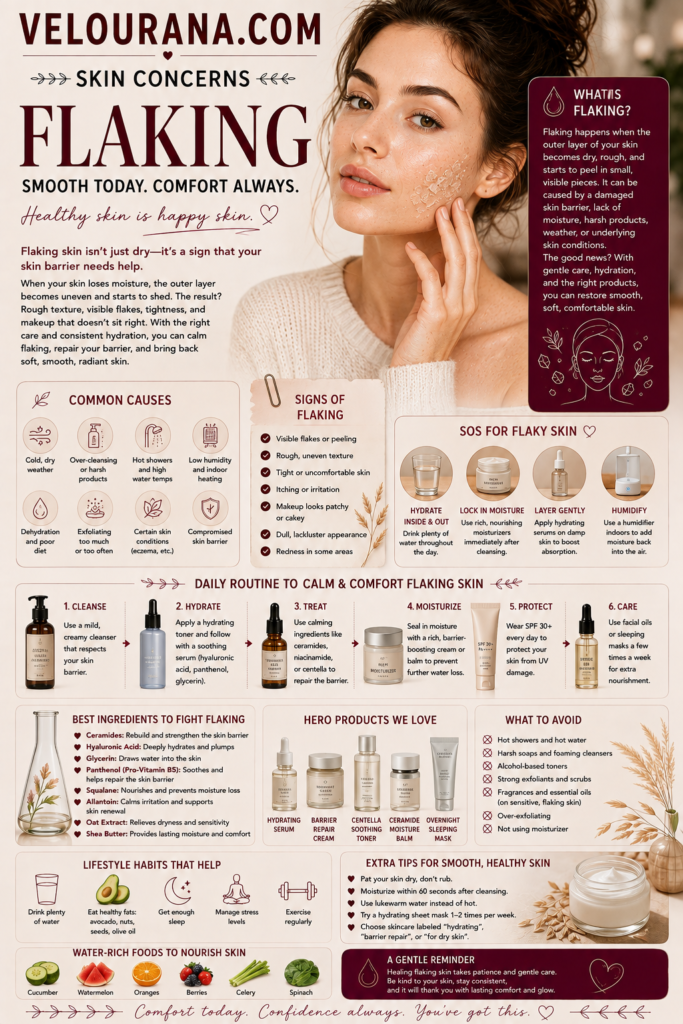
CATEGORY: Flaking
Skincare is supposed to improve the skin.
That expectation is so deeply embedded in the way we think about beauty routines that when the skin becomes rough, tight or visibly flaky, the instinct is usually to add something else. A stronger exfoliant. A richer treatment. A repairing serum. A resurfacing mask. Another layer designed to correct whatever appears to have gone wrong.
Sometimes the problem is not that the routine is missing something.
Sometimes the routine itself has become the problem.
Flaking caused by over-treatment is particularly confusing because it often appears in people who are taking skincare seriously. They cleanse carefully, use targeted ingredients, follow routines consistently and actively try to improve texture, pigmentation, blemishes or visible signs of aging. The very commitment that makes skincare effective can become counterproductive when too many interventions are layered onto the same barrier.
The skin does not judge products by reputation.
It does not distinguish between a fashionable active, a dermatologist-developed formula and an expensive serum when deciding whether it can tolerate the cumulative effect.
It simply responds biologically.
When that cumulative effect exceeds the skin's ability to maintain its protective outer structure, tightness, sensitivity and flaking can begin.
The important question is therefore not whether an ingredient is considered “good.”
It is whether the skin can tolerate that ingredient, at that concentration, at that frequency, in combination with everything else being used.
That distinction changes the way over-treated skin should be managed.
A Routine Can Be Excellent on Paper and Still Be Too Much
Many skincare routines look perfectly reasonable when each product is considered individually.
A gentle cleanser.
An exfoliating toner.
A vitamin C serum.
A retinoid.
A brightening treatment.
An acne product.
A moisturizer.
A weekly mask.
Nothing on that list is inherently irrational.
The difficulty appears when several biologically active steps are used frequently enough that the skin has little opportunity to recover between them.
The mistake is often subtle because skincare education tends to focus on ingredients one at a time.
We learn what retinoids can do.
We learn what alpha-hydroxy acids can do.
We learn what salicylic acid can do.
We learn about vitamin C, niacinamide, benzoyl peroxide and exfoliating masks.
Much less attention is given to what happens when an individual tries to pursue every possible benefit simultaneously.
The face experiences the complete routine, not the marketing claims attached to its separate bottles.
A moderately irritating product used occasionally may be completely manageable. Another moderately challenging product may also be manageable. But together, applied frequently and combined with cleansing, makeup removal, weather exposure and daily friction, they can produce an environment the skin no longer tolerates comfortably.
This is why irritation sometimes seems to appear “out of nowhere.”
The skin may have been approaching its tolerance threshold for days or weeks before visible flaking finally made the problem obvious.
Flaking Is Often a Late Sign, Not the First Sign
People commonly notice over-treatment only once peeling becomes visible.
The earlier signals may have been easier to dismiss.
Perhaps moisturizer began stinging slightly.
Perhaps the face felt unusually tight after cleansing.
Perhaps sunscreen burned around the nose.
Perhaps foundation suddenly stopped sitting smoothly.
Perhaps an area that had always tolerated a serum began feeling warm when it was applied.
Perhaps the skin looked unusually shiny even though it felt dry.
These changes can precede obvious scaling.
The barrier does not necessarily collapse dramatically overnight. It can become progressively less resilient.
A routine that felt comfortable two months ago may gradually become harder to tolerate as environmental conditions change or as application frequency increases.
The skin may compensate for a while.
Then one additional exfoliation session, cold day, long shower or new product pushes the cumulative stress beyond its current tolerance.
Flaking appears.
At that point, it is tempting to focus on the flakes themselves.
Yet the more important story began earlier.
The Skin Barrier Is Not an Obstacle to Skincare
One reason people over-treat the skin is that the outer barrier is sometimes framed as something that needs to be overcome.
Ingredients must “penetrate.”
Dead cells must be removed.
Texture must be resurfaced.
Turnover must be accelerated.
Pores must be cleared.
There is truth within some of these concepts, but the language can create the impression that the stratum corneum is merely an inconvenient layer standing between skincare ingredients and their targets.
It is not.
The outer barrier is one of the skin's essential protective systems.
Its corneocytes and surrounding lipids help control water loss and shield underlying tissues from environmental exposure. An intact barrier is not the enemy of effective skincare. It is one of the conditions that allows skincare to remain tolerable.
When the barrier becomes excessively disrupted, products that once felt comfortable can begin stinging.
This occurs because a more vulnerable surface allows substances to interact differently with the skin beneath.
The result can be a paradox.
A person becomes increasingly aggressive because they want stronger results, yet the barrier becomes so irritated that they are eventually forced to stop the active products entirely.
A slower, more sustainable routine might have produced better long-term consistency.
Exfoliation Is Useful Precisely Because It Changes the Surface
Exfoliation is not inherently damaging.
Used appropriately, it can improve visible roughness, support more even surface shedding and complement routines addressing concerns such as clogged pores or dullness.
But the reason exfoliation works is also the reason it requires restraint.
It changes the way surface cells are held and released.
Chemical exfoliants influence bonds and processes within the stratum corneum. Physical exfoliation mechanically removes surface material.
When the skin is healthy and the intervention is proportionate, this can be well tolerated.
When the barrier is already stressed, however, additional exfoliation may intensify instability.
The most common misunderstanding occurs when exfoliation itself causes peeling.
The user sees flakes and assumes the product is bringing unwanted dead cells to the surface.
More exfoliation is applied.
The flakes increase.
The cycle continues.
This can be reinforced by the immediate tactile effect of exfoliation. After using an acid or scrub, the surface may feel smooth. That short-term smoothness is interpreted as proof that the treatment is helping, even if the skin becomes more irritated several hours later.
Immediate texture and long-term barrier condition are not the same thing.
A routine should be judged by how the skin behaves between treatments, not only by how polished it feels immediately afterward.
Physical Scrubs Can Turn Minor Flaking Into Visible Irritation
Physical exfoliation offers something chemical exfoliation cannot: instant tactile feedback.
Granules move across the skin.
Roughness disappears beneath the fingertips.
The face feels polished.
That sensory satisfaction makes scrubs particularly tempting when visible flakes are present.
The problem is that flaky skin is already physically uneven.
Abrasive particles can catch on partially detached cells and remove them before they would naturally release. Vigorous pressure can also irritate the skin beneath.
The result may initially look better because the visible scale has been removed.
Then redness appears.
The area feels tender.
New flakes develop.
The person scrubs again.
This repeated mechanical disruption can transform a temporary dry patch into a persistent one.
There are situations in which very gentle physical exfoliation is tolerated, but actively irritated, stinging or peeling skin is usually not the ideal canvas for vigorous polishing.
The goal during recovery is not to make the surface perfect immediately.
It is to allow the barrier to regain enough stability that normal shedding becomes less visible on its own.
Acids Can Be Gentle in Reputation and Strong in Practice
Skincare culture often organizes exfoliating acids into simplified categories.
Lactic acid is called gentle.
Mandelic acid is called gentle.
Glycolic acid is considered stronger.
Salicylic acid is associated with oily or acne-prone skin.
These generalizations may be useful as starting points, but they cannot predict individual tolerance.
Concentration matters.
Formula pH matters.
Frequency matters.
The rest of the routine matters.
The condition of the skin matters.
A mild acid applied once weekly to comfortable skin is very different from the same ingredient used nightly alongside a retinoid and a drying cleanser.
Even supposedly gentle ingredients can become irritating when application becomes excessive.
This is why a product's reputation should never override what the skin is actually showing.
If a “gentle” exfoliant produces persistent burning or peeling, the relevant fact is not that the ingredient is considered gentle in theory.
The relevant fact is that the skin is not tolerating the current use pattern.
Retinoids Can Produce a Characteristic Form of Flaking
Retinoids occupy a special place in skincare because they are both exceptionally valuable and frequently associated with initial irritation.
Dryness, peeling and sensitivity can occur when retinoids are introduced, particularly when the application frequency or amount exceeds what the skin currently tolerates.
This early adjustment period is sometimes treated as something that must simply be endured.
That idea deserves caution.
Mild temporary dryness can occur as the skin adapts, but severe irritation is not proof that a retinoid is “working harder.”
Pain, intense burning, significant redness or persistent peeling should not be treated as a desirable milestone.
The ambition to reach nightly use as quickly as possible can be especially counterproductive.
Skincare is not a race.
If a retinoid produces benefits only when used consistently over time, then a frequency that can actually be sustained may be more useful than aggressive use followed by repeated periods of barrier damage and complete discontinuation.
This is a broader principle worth remembering.
Maximum frequency is not automatically maximum effectiveness if it repeatedly makes the routine impossible to continue.
More Product Does Not Mean More Result
Another common path toward flaking is simply using too much.
Skincare marketing often encourages generous application, but active treatments are not always products where doubling the quantity doubles the benefit.
Retinoids, exfoliating acids, acne treatments and other potent formulas can create more irritation when applied excessively.
A person may believe that if a pea-sized amount is recommended, two pea-sized amounts will work faster.
The skin does not operate according to that arithmetic.
Coverage matters.
Consistency matters.
But excessive quantity can simply expose the barrier to more active material than necessary.
This is particularly problematic around facial creases where products can collect.
The sides of the nose, corners of the mouth and areas beneath the eyes may receive disproportionately high exposure as creams and serums migrate.
Localized flaking often reveals this pattern.
The forehead tolerates the routine.
The cheeks tolerate it.
The nostrils peel.
The issue may not be the product itself but the amount and geography of application.
Frequency Is Often the Hidden Variable
People frequently search for product incompatibilities when the simpler explanation is frequency.
A treatment that is well tolerated twice weekly may become irritating at five times weekly.
A cleanser that works beautifully once daily may become drying when used three times.
A clay mask that feels refreshing every other week may become disruptive when used every second day.
The products have not changed.
The schedule has.
Frequency can increase gradually without the user noticing.
A person starts with an exfoliating toner twice weekly. Results seem good, so it becomes every other night. Eventually it is used daily because the skin appears to tolerate it.
Then a retinoid is added.
The exfoliating toner remains daily because it has become habitual.
A month later, the skin begins flaking.
The instinct is to blame the new retinoid exclusively.
Perhaps it contributed.
But the deeper issue may be that the total routine no longer includes enough recovery time.
Sometimes the simplest solution is not replacing products but rearranging the calendar.
Combining Actives Can Be More Important Than Individual Strength
The question “Can I use these ingredients together?” is one of the most common in skincare.
The answer is often technically yes.
But “can” is not the same as “should everyone.”
Several ingredients may have no dangerous chemical interaction and still create too much cumulative irritation for a particular person.
For example, an exfoliating acid and retinoid might both be appropriate within the same broader routine, yet applying them on the same evening may be unnecessarily challenging for someone prone to dryness.
An acne treatment may be entirely compatible with a brightening serum, but the combination may still feel irritating when used twice daily.
The problem is not always ingredient conflict.
It is skin tolerance.
This distinction is important because it prevents skincare from becoming a simplistic compatibility chart.
Two products do not need to “cancel each other out” to be a poor combination for a particular face.
They only need to exceed what that face can comfortably tolerate.
The Cleanser Often Gets Ignored During Active Overload
When a routine contains impressive treatment products, the cleanser can seem unimportant.
It is washed away within seconds.
Surely the serum or retinoid matters more.
Yet cleansing occurs at the beginning of the routine, when the skin is being prepared for everything that follows.
A strongly degreasing cleanser can leave the barrier more vulnerable before active ingredients are even applied.
If the face feels tight immediately after washing, then begins stinging as treatments are layered on top, the cleanser deserves attention.
Double cleansing can create similar issues when performed more aggressively than necessary.
The concept itself is reasonable: an oil-based or balm cleanser can help remove makeup and sunscreen, followed by a water-based cleanser.
The problem is assuming that two cleanses are automatically required every morning and evening regardless of what is on the face.
More cleansing is not inherently more hygienic.
It is simply more cleansing.
The correct amount depends on what needs to be removed and how the skin responds.
Hot Water Quietly Amplifies an Aggressive Routine
Water temperature rarely receives the same attention as active ingredients, but it can significantly influence dry skin.
A long hot shower followed by exfoliation, retinoid use and a lightweight moisturizer creates a very different environment from a short warm cleanse followed by the same treatment.
People often analyze the bottles while ignoring the bathroom.
Yet skin experiences both.
If flaking appears despite apparently careful product choices, examining basic habits can be surprisingly productive.
How hot is the water?
How long is the face being cleansed?
Is the towel rubbed aggressively across the skin?
Is the face washed repeatedly after exercise, commuting or makeup correction?
Routine is more than product selection.
It includes every physical interaction with the skin.
Stinging Moisturizer Is a Warning Worth Respecting
One of the clearest signs that the barrier has become stressed is when a previously comfortable moisturizer begins to sting.
The product may not have changed.
The skin has.
This is useful information.
A moisturizer designed for everyday use should generally not produce persistent burning on healthy skin. When it suddenly does, the barrier may be sufficiently disrupted that ingredients penetrate or interact with the surface differently.
People sometimes respond by assuming the moisturizer has “stopped agreeing” with them and replace it.
That may help if a true sensitivity has developed, but the more important question is what happened before the moisturizer was applied.
Was an acid used?
Was the face scrubbed?
Was the cleanser unusually harsh?
Was the skin exposed to cold wind?
Was a retinoid recently increased?
The moisturizer may simply be revealing damage created earlier in the routine.
During significant irritation, simpler formulations with fewer potential irritants can sometimes be easier to tolerate, but persistent or severe burning deserves professional evaluation rather than endless product switching.
The Shiny-but-Dry Paradox
Over-treated skin can sometimes look strangely glossy.
This is frequently mistaken for oiliness.
The surface reflects light intensely, yet the skin feels tight and may be peeling.
This appearance can occur when the texture becomes unusually smooth in some areas while the barrier is dehydrated or irritated.
The person sees shine and responds with more cleansing, mattifying products or exfoliation.
The dryness worsens.
This is another reminder that visual cues can be misleading.
Shine does not automatically mean the skin has excess oil.
Likewise, oil production does not guarantee adequate hydration.
A complexion can be oily and barrier-impaired at the same time.
Treating every shiny surface as something that must be stripped can therefore deepen the problem.
Acne-Prone Skin Is Especially Vulnerable to Over-Treatment
People managing acne often face the greatest pressure to use multiple active ingredients.
There may be salicylic acid in the cleanser.
Benzoyl peroxide in a treatment.
A retinoid at night.
An exfoliating toner.
A clay mask.
Oil-control products.
Spot treatments.
Each is aimed at preventing or correcting blemishes.
The resulting dryness can then be interpreted as proof that the routine is “drying out the acne.”
This idea is problematic.
Acne-prone skin still needs an intact barrier.
Excessive dryness and irritation do not necessarily improve breakouts and may make adherence to effective acne treatments much harder.
A routine that causes constant flaking may force the user to stop treatments unpredictably.
A more balanced routine, including appropriate moisturization, may allow proven acne treatments to be used more consistently.
The objective should not be to make acne-prone skin as dry as possible.
It should be to treat acne while keeping the skin functional enough to tolerate treatment.
Aging-Skin Routines Can Become Unnecessarily Aggressive
A similar pattern appears in anti-aging skincare.
The desire to address fine lines, pigmentation, dullness and loss of firmness can lead to routines containing multiple exfoliants, retinoids, vitamin C products and concentrated serums.
Every sign of aging becomes a separate treatment target.
Eventually the routine becomes biologically crowded.
Ironically, chronic flaking and irritation can make mature skin look temporarily more lined and uneven.
Dehydrated surface cells reflect light poorly.
Foundation settles into texture.
Fine lines appear more pronounced.
The person responds by intensifying anti-aging treatment.
Again, the loop feeds itself.
Healthy-looking mature skin depends not only on active ingredients but also on maintaining adequate hydration and barrier integrity.
A routine that produces constant irritation is not automatically superior because it contains more scientifically interesting ingredients.
Skincare Trends Can Encourage Accidental Overload
Social media has made skincare education more accessible, but it has also created a culture of constant product rotation.
A new acid becomes popular.
Then a barrier serum.
Then a peeling solution.
Then a retinol.
Then an exfoliating toner.
Then a cleansing device.
Each arrives with compelling before-and-after imagery and persuasive explanations.
The individual viewer may gradually assemble a routine containing products developed for entirely different skin types and goals.
The problem is not misinformation in every case.
Many of the products may genuinely be effective.
The problem is that recommendations are consumed independently while the skin experiences them collectively.
Skincare cannot be optimized by collecting every effective ingredient.
It has to be edited.
The First Step in Recovery Is Usually Less, Not More
When flaking appears after over-treatment, the instinct to add a repair product is understandable.
But the most important intervention is often reducing whatever is creating the stress.
That may mean temporarily pausing exfoliating acids.
Reducing retinoid frequency.
Stopping scrubs.
Simplifying cleansing.
Avoiding clay masks.
Removing products that burn.
The exact adjustments depend on the routine, but the general idea is consistent.
A barrier cannot recover efficiently while the same disruptive pattern continues every day.
This does not mean every active product must be abandoned permanently.
Temporary simplification creates a recovery period and makes it easier to identify which elements are genuinely necessary.
A Recovery Routine Does Not Need to Be Impressive
Barrier recovery is one of the rare moments when a boring routine can be a sophisticated decision.
A gentle cleanser when needed.
A well-tolerated moisturizer.
Daytime sun protection.
Perhaps little else for a period.
For someone accustomed to a ten-step routine, this can feel like doing nothing.
Biologically, it may be exactly what the skin needs.
The absence of actives is not absence of care.
It is reduction of unnecessary challenge.
Moisturizers containing humectants, emollients and occlusive ingredients can help support water retention and surface comfort. Ceramide-containing formulations may also be useful as part of barrier-focused care.
What matters most is tolerance.
A fashionable barrier cream that burns is not automatically better than a simple moisturizer the skin accepts comfortably.
Occlusion Can Help, but It Is Not Magic
The practice often called “slugging”—applying an occlusive layer such as petrolatum over skincare—has become popular as a method of reducing moisture loss.
For uncomplicated dryness, a thin occlusive layer over well-tolerated moisturizer can indeed help reduce evaporation.
But occlusion should not be treated as a universal repair hack.
If irritating active ingredients are underneath, occlusion may prolong or intensify exposure.
Someone whose face is peeling because of excessive retinoid use should not necessarily apply the retinoid and then seal it beneath a heavy occlusive layer expecting the barrier to recover simultaneously.
The logical order is to reduce the source of irritation first.
Protection comes after restraint.
The Skin Needs Time to Show Whether the New Routine Is Working
One of the hardest parts of barrier recovery is tolerating imperfection.
Flakes may not disappear overnight.
The surface may remain rough even after burning has subsided.
Makeup may still catch on some areas for several days.
This does not mean the simplified routine has failed.
Skin recovery is a process.
Constantly introducing new products because improvement is not immediate resets the experiment.
If three new moisturizers, two serums and an oil are introduced within one week, it becomes impossible to know what the skin actually tolerates.
Consistency provides information.
Give the barrier a stable environment long enough to reveal whether comfort is returning.
Reintroducing Active Ingredients Is Where Many People Relapse
The skin finally feels better.
Flaking has stopped.
The face looks smooth again.
The natural reaction is to restart everything.
Exfoliating toner in the morning.
Retinoid at night.
Mask on Sunday.
Acne treatment on Tuesday.
Within days, the peeling returns.
This happens because recovery is mistaken for unlimited tolerance.
A barrier that has just stabilized does not necessarily need the same aggressive routine that disrupted it initially.
Reintroduction works better when it is gradual.
One active product can be restarted at a conservative frequency.
The skin is observed.
If comfort remains, frequency can be adjusted later.
Then another product can be reconsidered.
This approach is slower but far more informative.
If flaking returns immediately after one step is reintroduced, the relationship becomes easier to identify.
Not Every Product Needs to Return
A skincare reset can reveal something uncomfortable: some products were never necessary.
Once the skin recovers with a simplified routine, it may become obvious that three exfoliating products were serving essentially the same purpose.
The weekly peel may add little when a retinoid is already being used.
The harsh foaming cleanser may not be needed alongside an effective makeup remover.
The second acid toner may exist mainly because it was once popular.
Skincare routines often grow by addition.
They rarely shrink unless something goes wrong.
Flaking can therefore become an opportunity to edit.
The goal is not minimalism for its own sake.
It is functional efficiency.
Every product should have a reason to remain.
Barrier Tolerance Changes With Season, Age and Environment
A routine should not be treated as permanently fixed.
Skin tolerance changes.
Winter may make an exfoliating schedule that worked in summer too aggressive.
Travel can alter humidity exposure.
Hormonal changes can affect oil production and sensitivity.
Age can influence dryness.
Medications and dermatological treatments may also change how the skin behaves.
A person who once tolerated daily exfoliation may later find it unnecessary or uncomfortable.
This is not failure.
It is adaptation.
Good skincare responds to present skin rather than remaining loyal to historical tolerance.
Product Pilling Is Not Always Skin Flaking
An additional source of confusion deserves attention.
Sometimes what appears to be flaking is not skin at all.
Products can pill.
When multiple formulas are layered, ingredients may interact physically and roll into tiny fragments on the surface. Sunscreen, silicone-rich primers, gels and serums can sometimes form visible particles when rubbed.
These fragments may resemble dry skin.
The distinction matters.
True flaking tends to remain associated with roughness or partially detached skin even when no products are applied.
Pilling appears primarily during or after product layering and may disappear once the formulations are removed.
A person who mistakes pilling for skin peeling may begin exfoliating unnecessarily.
Before treating every visible fragment as dead skin, notice when it appears.
Makeup Removal Can Be the Final Daily Insult
Even a carefully designed daytime routine can be undermined at night by aggressive makeup removal.
Long-wear foundation, waterproof mascara and durable sunscreen understandably require effective cleansing.
But effective does not require violent friction.
Repeated rubbing with cotton pads, wipes or towels can irritate flaky areas, particularly around the nose, mouth and eyes.
A well-chosen cleansing oil, balm or remover may allow makeup to dissolve with less mechanical force.
The second cleanse, if needed, can then be gentle.
The important principle is reducing friction while still removing products thoroughly enough for comfort and hygiene.
Every evening should not end with the skin feeling punished for having worn makeup.
The Difference Between Purging and Irritation
Skincare discussions often use the concept of “purging” to explain worsening skin after beginning an active product.
Purging can occur with some ingredients that influence cell turnover, particularly in acne-prone individuals, but the term is frequently overextended.
Flaking, burning and widespread redness should not automatically be interpreted as evidence that impurities are leaving the skin.
They can simply indicate irritation.
Calling every negative reaction a purge can encourage people to continue using products their skin is not tolerating.
This is particularly dangerous when discomfort becomes significant.
Skincare should not require ignoring persistent pain.
A product that causes severe burning or marked inflammation deserves reassessment regardless of how promising its active ingredient may be.
When Professional Guidance Becomes Important
Not all flaking caused during a skincare routine is straightforward over-treatment.
Persistent scaling, significant redness, severe itching, cracking, swelling, oozing, pain or recurrent sharply defined patches may indicate a dermatological problem rather than ordinary cosmetic irritation.
Allergic or irritant contact dermatitis can also complicate the picture.
A person may assume they have simply “damaged their barrier” when they are reacting to a specific ingredient.
If symptoms persist despite simplifying the routine and using gentle care, professional assessment becomes increasingly important.
The goal is not to diagnose every dry patch at home.
The goal is to recognize when self-experimentation has stopped providing useful answers.
A Strong Routine Is One the Skin Can Live With
The most effective skincare routines are not necessarily the most intensive.
They are the ones that balance ambition with tolerance.
A retinoid used consistently for years may accomplish more than one used aggressively for six weeks and then abandoned because the face became unbearably irritated.
An exfoliant used thoughtfully may provide better long-term texture than constant resurfacing that produces chronic flaking.
An acne routine that includes adequate moisturization may be more sustainable than one designed to eliminate every trace of oil.
A barrier that remains comfortable allows active ingredients to remain part of the routine.
That makes resilience an asset, not a compromise.
Flaking Can Be the Skin Asking for Editing
When skincare causes flaking, the visible scales are often treated as another cosmetic defect to solve.
But they may be delivering a more useful message.
The routine has become crowded.
The frequency is too high.
The cleanser is too aggressive.
The exfoliation is unnecessary.
The active ingredients are overlapping.
The skin has changed.
The season has changed.
Or perhaps the person has simply mistaken more skincare for better skincare.
The answer is rarely to punish the surface into smoothness.
It is to reconsider the system that produced the roughness.
Once the routine becomes proportionate again, the skin no longer has to spend every day recovering from yesterday's treatments.
The flakes gradually stop being the central problem because the conditions that made them visible have changed.
This is one of the most valuable lessons a compromised barrier can teach.
Skincare works best when it cooperates with the skin rather than constantly trying to overpower it.
The End Velourana
 Discover More From Our Family of Websites
 ZodiacBearing (Astrology, Tarot, Numerology, Angel Numbers & Spiritual Guidance)
 Velourana (Beauty, Makeup, Hair Care, Skincare & Beauty Tips)
 HavenBearing (Home, Living, Organization, Décor & Everyday Inspiration)
 PawBearing (Pet Care, Dog Breeds, Animal Health, Training & Pet Products)
 PsyCatherine (Notes From the Journal of a Psychologist on Real Life)