
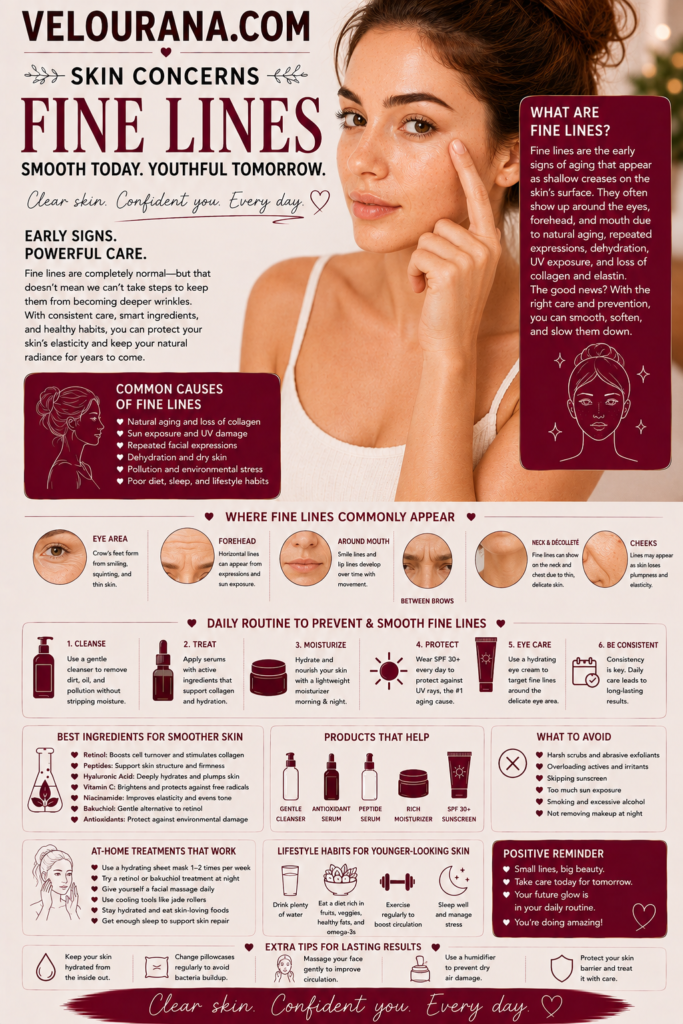
CATEGORY: Fine Lines
There is rarely a precise morning when someone can say that fine lines began. Skin does not cross an obvious boundary from young to aging overnight. Instead, the transition tends to happen quietly. A faint crease beside the eye remains visible for a few seconds after a smile. A horizontal line across the forehead seems slightly more noticeable in bright light. Makeup settles differently beneath the eyes. After a dry week, the entire face appears more finely textured than usual.
Then, at some point, a person notices that a line which once belonged only to an expression has begun to remain when the expression is gone.
This is one of the most revealing stages of visible skin aging because it demonstrates that a line is not simply drawn onto the surface. It develops through the relationship between movement and material: the repeated folding of living tissue whose ability to recover is gradually changing.
Fine lines are therefore better understood as patterns rather than isolated marks.
The face has regions that move constantly and others that move relatively little. It has areas where skin is thinner, areas with greater structural support, places exposed directly to sunlight and places partially protected by facial anatomy. Hydration changes from day to day. Environmental exposure accumulates over decades. Collagen organization changes with age. Hormonal changes can alter dryness and skin characteristics. Genetics influence how quickly and where these effects become apparent.
The resulting map of lines is highly individual.
Understanding why a particular line appears where it does provides a more useful foundation for skincare than treating every visible crease as the same cosmetic problem.
A Face Is Designed to Move
It is easy to forget how mechanically active facial skin is.
Even during an ordinary conversation, the face is continually changing shape. Eyebrows rise and lower. The forehead contracts. The eyelids blink. The corners of the mouth move. Cheeks lift. The skin around the eyes compresses during a genuine smile. The lips form hundreds of different positions during speech.
These movements occur thousands of times without conscious thought.
Facial expression depends on an unusually intimate relationship between muscles and the overlying soft tissues. When muscles contract, particular areas of skin fold along relatively predictable paths. These folds explain why expression lines tend to occur in familiar locations: horizontal forehead lines, vertical lines between the eyebrows, radial lines around the eyes and increasingly visible creases associated with movement around the mouth.
In younger skin, many of these folds disappear rapidly once the underlying muscle relaxes. The tissue possesses substantial resilience, hydration and structural organization, allowing the surface to return toward its previous position.
But repeated folding is only one part of the story.
If movement alone determined wrinkling, people of similar age with similar expressions would develop virtually identical lines. They do not. The condition of the tissue being folded profoundly influences whether a temporary crease eventually becomes a persistent one.
This is where aging, ultraviolet exposure, genetics and skin condition begin to intersect with expression.
A useful analogy is repeatedly folding two different pieces of material. A flexible, well-conditioned material may tolerate repeated movement while returning toward its original form. A material whose structural properties have changed will increasingly retain evidence of those folds.
Human skin is vastly more complex because it continually renews and repairs itself, but the mechanical principle helps explain the transition from dynamic expression to resting line.
The line does not suddenly arrive. The skin gradually becomes more willing to hold it.
The Architecture Beneath a Fine Line
The visible surface of the face represents only the outermost portion of a multilayered organ.
The epidermis provides much of the interface with the external environment. Its outer barrier plays a critical role in regulating water loss and protecting the underlying tissue. Beneath it lies the dermis, a connective-tissue environment containing collagen, elastic fibers, blood vessels and other structures essential to the skin's mechanical behavior.
Collagen is often described simply as the substance that keeps skin firm, but this shorthand can obscure the complexity of aging. Collagen is not a cosmetic cushion sitting underneath the face waiting to be refilled. It forms part of an organized extracellular matrix that is continually influenced by synthesis, degradation, cellular signaling, mechanical forces and environmental exposure.
With aging, this organization changes.
Research into human skin aging describes alterations in collagen production and fragmentation, changes in extracellular matrix structure and reduced mechanical integrity. Photoaging adds another layer of damage because chronic ultraviolet exposure affects many of the same structural systems.
Elastin and elastic fibers also matter. Skin must be capable not only of resisting mechanical stress but of recovering after deformation. Alterations to elastic tissue are particularly characteristic of chronically sun-damaged skin.
The appearance of a fine line can therefore be understood as a surface consequence of changing mechanical properties beneath it.
Yet this does not mean every tiny line represents significant dermal deterioration.
The outer surface can amplify or soften what is happening below. Dryness can make shallow lines more obvious. Roughness changes the way light reflects. Temporary dehydration can exaggerate texture. Makeup can collect within tiny depressions and visually emphasize them.
This explains why a person's fine lines can appear stronger at 8 p.m. than they did at 8 a.m. even though structural aging has obviously not advanced dramatically within twelve hours.
There are fast-changing components and slow-changing components.
Good skincare becomes far easier to understand once these are separated.
The Fine Lines That Appear When Skin Is Dry
One of the simplest experiments in fine-line appearance requires no laboratory equipment. Observe the same skin when it is comfortable and well moisturized, then when it is unusually dry.
The difference can be striking.
Dry skin tends to appear rougher, less luminous and more finely creased. Tiny lines that were barely noticeable may become prominent, particularly around the eyes and across areas where the surface is naturally thin or frequently moving.
This is sometimes called dehydration lining, although terminology in consumer skincare can be inconsistent.
What matters is the mechanism.
The stratum corneum, the outermost part of the epidermis, depends on an organized barrier and appropriate water content to remain flexible and smooth. When water content decreases and barrier function is disrupted, the surface becomes less supple. Fine irregularities become easier to see.
Moisturization can consequently produce surprisingly rapid cosmetic improvement.
Humectant ingredients can help attract and retain water within the outer layers of skin. Emollients smooth spaces between surface cells and improve tactile softness. Occlusive components can reduce water loss by creating a barrier at the surface. Many modern moisturizers combine these approaches rather than relying on a single mechanism.
After application, the skin may appear plumper and shallow lines less sharply defined.
This is a real cosmetic effect.
It is simply not the same thing as reversing structural aging.
The distinction matters because immediate results are among the easiest things to exaggerate in anti-aging marketing. A dramatic photograph taken shortly after application can demonstrate hydration, film formation or optical smoothing while implying that deeper wrinkles have somehow been biologically reconstructed.
A consumer who understands hydration does not need to dismiss these products. Instead, expectations become more precise.
If the primary problem is dryness-enhanced fine texture, a good moisturizer may make a substantial visible difference. If the line remains strongly visible despite excellent hydration and is present consistently at rest, deeper structural and mechanical factors are probably contributing.
The product has not failed. It has simply reached the boundary of what moisturization can do.
Why the Eye Area Often Speaks First
For many people, the first fine lines that become emotionally significant appear around the eyes.
This is not surprising.
The skin surrounding the eyes is relatively thin and extraordinarily active. Blinking alone produces constant movement. Squinting creates additional contraction. Smiling lifts the cheeks and compresses the outer eye area into characteristic radiating folds.
The region is also highly exposed to environmental influences.
Repeated ultraviolet exposure contributes to photoaging, while habitual squinting in bright conditions repeatedly reinforces the same folding patterns. Sunglasses therefore have a practical role beyond fashion: they can reduce direct ultraviolet exposure to the eye region and may reduce the tendency to squint intensely in bright light.
Yet eye-area skincare has become surrounded by mythology.
The beauty market often implies that the skin beneath the eyes belongs to an entirely different biological category requiring products fundamentally unrelated to those used elsewhere on the face. In reality, the region does have distinctive characteristics and often requires gentler formulation, but the fundamental principles of barrier care, hydration, sun protection and evidence-based active treatment still apply.
An eye cream can be useful because it is formulated to be comfortable around this sensitive region. It may provide excellent moisturization. Certain formulations may contain ingredients intended to address pigmentation, puffiness or fine texture.
But the words "eye cream" do not guarantee that a product can erase expression-related crow's-feet.
This becomes especially important when comparing lines visible only during smiling with lines present when the face is completely relaxed.
A smile line is partly the physical result of muscle contraction. A cream applied above that muscle cannot stop the mechanical fold from occurring. It may improve the condition of the skin being folded, which is valuable, but that is a different objective.
Understanding this can prevent years of disappointment with products that were expected to perform a function outside their realistic capabilities.
Forehead Lines Tell a Different Mechanical Story
The forehead demonstrates particularly clearly how habitual expression and skin aging interact.
Horizontal forehead lines form in relation to repeated elevation of the eyebrows. At first they may exist only during expression. With time, faint traces can remain when the forehead relaxes.
Their development varies enormously between individuals.
Some people naturally raise their eyebrows frequently when speaking. Others have facial anatomy or habitual expressions that produce less forehead movement. Some may compensate for eyelid characteristics by using the forehead muscles more actively. Genetics, sun exposure and skin structure add further variability.
This means forehead lines cannot be interpreted as a simple clock.
A person with noticeable forehead lines is not necessarily "aging faster" than someone of the same age without them. The mechanical history of the face is different.
The same principle applies to vertical lines between the eyebrows. Repeated frowning or concentration can contribute to the folding pattern, but structural aging determines how readily those folds remain visible afterward.
Topical skincare can improve the quality of the overlying skin. It cannot fundamentally change the fact that a contracting muscle repeatedly folds that skin.
This distinction is one reason dermatological and aesthetic treatments are divided into categories. Treatments designed to improve surface texture do something different from treatments that alter muscle activity, replace volume or stimulate remodeling through controlled procedures.
Calling all of these interventions "anti-wrinkle" hides their very different mechanisms.
For someone using cosmetics alone, recognizing the mechanical component of forehead lines can actually be liberating. It allows skincare to be judged according to what skincare can reasonably accomplish rather than according to an impossible promise of permanent facial smoothness.
Sun Exposure Makes Repeated Folding More Consequential
If facial movement determines where many lines appear, ultraviolet exposure helps determine how readily the skin retains them.
Photoaging alters skin structure through mechanisms that extend far beyond temporary tanning or sunburn. Chronic ultraviolet exposure contributes to collagen degradation, changes in elastic tissue, pigmentation irregularities and visible wrinkling.
The result is not merely skin that looks "older." It is tissue whose structural organization has been altered by accumulated environmental exposure.
This is why sun protection belongs at the center of fine-line strategy even though sunscreen does not function as a conventional wrinkle treatment.
Its value is prospective.
Someone beginning sunscreen today cannot remove yesterday's ultraviolet exposure. But reducing future exposure can decrease one of the major preventable forces contributing to premature visible aging.
This difference between prevention and correction is essential.
Consumers often spend far more attention choosing night treatments than choosing or consistently using daytime protection. The night product feels active because it promises repair. Sunscreen can feel passive because its success consists partly of changes that do not happen.
Preventive skincare is difficult to photograph.
There is no dramatic morning when a person looks in the mirror and sees the wrinkle that sunscreen prevented.
Yet over years, preventing unnecessary photodamage can be more meaningful than repeatedly attempting to correct its consequences.
This does not require living without sunlight or treating outdoor life as dangerous. It means using sensible protection: broad-spectrum sunscreen, shade when appropriate, hats and other protective measures, particularly during substantial exposure.
The purpose is not to preserve a face in a biologically impossible state of permanent youth. It is to reduce avoidable acceleration of the aging process.
The Moment Dynamic Lines Become Static
The distinction between dynamic and static lines is useful because it describes a continuum.
A dynamic line appears during movement. Smile, and the outer eye area folds. Raise the eyebrows, and horizontal forehead creases appear. Relax, and the skin smooths again.
A static or resting line remains visible without the movement that originally created the fold.
But the transition is not binary.
A line may initially disappear instantly. Later it may remain faintly visible for several moments. Eventually a shallow trace may remain continuously, becoming more apparent when the associated muscle contracts.
This gradual progression reflects changes in the mechanical environment of the skin.
Repeated deformation matters, but so does the declining ability of the tissue to recover completely. Ultraviolet damage can accelerate structural deterioration. Dryness can exaggerate the surface appearance. Changes in facial volume and underlying support occurring with age can alter how skin rests and folds.
The process is therefore cumulative.
This is why starting sensible skincare before deep wrinkles develop has a logical advantage, although not because skincare can stop aging. Prevention is generally easier than attempting to reverse established structural change.
Sun protection can reduce future photodamage. Maintaining a comfortable barrier prevents unnecessary dryness from exaggerating texture. Appropriate active treatments can address some features of photoaging.
None of this means a person needs an elaborate "anti-aging" routine at an extremely young age.
Healthy young skin does not need to be aggressively treated in anticipation of every future line. Excessive acids, strong retinoids and complicated routines can create irritation without providing proportionate benefit.
Preventive care can be remarkably unexciting: gentle cleansing, appropriate moisturizing and consistent sun protection.
The sophistication lies in maintaining it for years.
Retinoids and Gradual Remodeling
When the objective moves beyond temporary hydration toward improving features of photoaged skin, retinoids become particularly relevant.
Prescription tretinoin has a long history of study in photoaging and can improve fine wrinkling with sustained use. Cosmetic retinoids such as retinol occupy a different regulatory and evidence landscape but are widely incorporated into aging-focused skincare.
The key word is sustained.
Structural improvement is not an overnight phenomenon.
This is fundamentally different from the immediate plumping effect of hydration. A moisturizer can change surface appearance quickly because water content and optical smoothness can change quickly. Remodeling processes require time.
This distinction should influence how results are evaluated.
Constantly changing products every few weeks makes it difficult to determine whether a long-term active is helping. Increasing frequency aggressively in an attempt to accelerate results can produce irritation, which may make the skin look temporarily rougher and more lined.
Retinoid irritation is particularly important because it can create a misleading cycle. A person begins treatment to improve fine lines, develops dryness and peeling, sees more obvious texture, assumes the treatment is insufficient, applies even more, and worsens the barrier further.
Patience is therefore not merely philosophical advice. It is part of practical treatment strategy.
A tolerable routine used consistently is usually more rational than an aggressive routine repeatedly interrupted by irritation.
Prescription treatments also deserve medical guidance. Pregnancy-related considerations, existing skin conditions and other individual circumstances can affect whether a particular retinoid is appropriate.
Skincare advice becomes irresponsible when potent active ingredients are discussed as though every person has identical skin and medical circumstances.
Makeup Can Reveal Lines That Bare Skin Barely Shows
Fine lines are not always discovered in the mirror before skincare.
Sometimes foundation discovers them first.
A complexion may appear relatively smooth when bare, yet makeup begins collecting beneath the eyes, separating around the mouth or emphasizing horizontal forehead texture.
The instinctive conclusion is often that the skin has suddenly aged.
Frequently, the interaction between cosmetic film and moving skin is responsible for at least part of the effect.
Foundation, concealer and powder create layers over a surface that continually stretches and folds. Thick applications can accumulate in depressions. Highly matte formulas may make dry texture more visible. Excess powder can emphasize surface irregularity because it reduces luminosity and settles into fine creases.
This does not mean mature or finely lined skin cannot wear full-coverage makeup. It means application strategy becomes increasingly important as surface texture changes.
Skin preparation matters because dehydrated skin provides a less forgiving base. Allowing moisturizer to settle before makeup can improve application. Using excessive skincare immediately beneath foundation, however, may produce another problem: layers can interact poorly and cause pilling or separation.
Quantity also matters.
Trying to hide a fine line by adding more opaque product directly over it often produces the opposite result. The additional material has somewhere to collect each time the skin moves.
A lighter application can sometimes make the face appear smoother precisely because there is less product emphasizing the relief of the surface.
This reveals a broader principle that applies beyond makeup: fine lines are influenced by light.
Smooth, hydrated skin reflects light differently from dry, uneven skin. Matte surfaces emphasize relief differently from luminous surfaces. Side lighting reveals texture that soft frontal light may nearly erase.
The line itself has not necessarily changed. Its visual environment has.
Understanding this helps separate genuine biological improvement from cosmetic camouflage without devaluing either one. Both can be useful. They are simply different forms of intervention.
Why More Exfoliation Is Not Always the Answer
When skin looks textured, exfoliation seems intuitively appropriate.
Remove old surface cells, reveal smoother skin beneath, repeat.
Controlled exfoliation can indeed improve surface texture. Alpha-hydroxy acids and other exfoliating ingredients have legitimate uses within skincare. The problem begins when the pursuit of smoothness becomes relentless.
The skin barrier is not debris.
The outermost layers of the epidermis perform essential protective functions. Continually disrupting them can increase dryness, irritation and sensitivity. In a person already concerned about fine lines, that irritation can make the surface appear rougher and more creased.
This is another example of the difference between immediate sensation and biological benefit.
A strong acid may create tingling. A scrub may leave the face feeling unusually polished. Neither sensation proves that long-term aging has been improved.
Exfoliation should have a purpose and a place within the broader routine.
Someone already using a retinoid may not need frequent strong acids. Someone with sensitive or compromised skin may benefit more from restoring barrier comfort than from adding another exfoliating treatment.
The desire to feel a product "working" can become particularly counterproductive in anti-aging care because many of the most valuable interventions are not dramatic.
Sunscreen should not hurt.
Moisturizer does not need to tingle.
A well-tolerated active does not need to produce visible peeling to be meaningful.
Healthy-looking skin is not created by continually forcing the surface into a state of recovery.
Hormonal Change and the Evolving Texture of Skin
Fine lines do not progress at a perfectly constant rate throughout adulthood.
Hormonal transitions can influence skin characteristics, particularly during and after menopause. Declining estrogen is associated with changes in collagen, thickness, hydration and other aspects of skin physiology.
For some women, this creates the impression that aging has suddenly accelerated.
Skin may become noticeably drier. Fine texture can become more visible. Products that were once comfortable may begin feeling insufficient or irritating. The complexion can appear less plump even when the skincare routine has not changed.
This is important because it demonstrates that skincare needs are not fixed.
A routine that worked perfectly at thirty-five may not be ideal at fifty-five. That does not mean the earlier routine stopped being "effective" or that an entirely new collection of luxury products is required. The biological context has changed.
Greater attention to barrier support and moisturization may become useful. The tolerance of active ingredients may need to be reassessed. Professional dermatological advice can be appropriate when changes are substantial or when someone wishes to discuss prescription or procedural options.
The underlying principle is adaptation rather than escalation.
Skin should be observed as it exists now, not treated according to a routine designed for an earlier decade.
Fine Lines Are Best Managed as a Long-Term System
The beauty industry tends to sell products individually.
Skin does not age individually.
No serum operates independently of sun exposure. No retinoid operates independently of tolerance. No moisturizer can compensate indefinitely for aggressive cleansing. No eye cream can prevent the muscles around the eyes from contracting. No sunscreen can reverse every year of previous photodamage.
Results emerge from the system.
For fine lines, that system is most coherent when it begins with protection and barrier stability, then adds targeted intervention according to realistic goals.
The order matters psychologically as much as biologically.
When someone begins with the assumption that every visible line must be removed, each remaining crease becomes evidence of failure. This encourages increasingly aggressive treatment and constant product switching.
When the objective is instead to maintain healthy function, reduce preventable damage and improve the aspects of visible aging that can reasonably respond, the routine becomes easier to evaluate.
Is the skin comfortable?
Is persistent dryness controlled?
Is sun protection consistent?
Is the active treatment tolerable enough to use over time?
Has there been gradual improvement in texture rather than an impossible overnight transformation?
Are deeper or particularly bothersome concerns better suited to professional treatment?
These questions produce better decisions than simply asking whether the face looks younger this week.
Reading Fine Lines as a History Rather Than a Defect
Fine lines are often described as though they were foreign objects that invaded otherwise perfect skin.
They are better understood as records.
The lines around the eyes record countless expressions as well as the changing resilience of the tissue beneath them. Forehead lines reflect movement interacting with anatomy and time. Photoaging records environmental exposure. Temporary dehydration records the present condition of the barrier.
Some parts of that history can be influenced.
The skin can be protected more consistently from ultraviolet radiation. Dryness can be managed. Evidence-supported topical treatments can improve certain features of photoaging. Professional procedures can address concerns beyond the realistic capabilities of cosmetics.
Other parts belong naturally to being human.
A face that has smiled for fifty years will not behave exactly like a face that has smiled for fifteen. Skin that has moved, stretched, repaired itself and lived within the environment will change.
Recognizing this does not require giving up on appearance. It creates a more precise form of beauty care.
The objective becomes maintaining the best possible condition of the skin one actually has rather than chasing the biological properties of skin from another period of life.
Fine lines are especially suited to this philosophy because their appearance remains so responsive to context. Hydration can soften them. Lighting can exaggerate them. Makeup can reveal them. Expression can deepen them temporarily. Resting tissue shows which patterns have become established.
They remind us that visible aging is not a single process and therefore cannot have a single solution.
The most intelligent fine-line strategy is consequently layered rather than aggressive: understand the difference between dehydration and structural aging, protect against preventable photodamage, preserve barrier function, use evidence-based actives thoughtfully, allow enough time for gradual improvement and recognize when a concern belongs to professional rather than cosmetic treatment.
A line does not need to disappear completely for the skin to look healthier, smoother and better cared for.
And perhaps that is the most useful shift of all.
Fine-line care becomes far more effective once the goal is no longer to force the skin to deny its history, but to influence intelligently what happens next.
The End Velourana
 Discover More From Our Family of Websites
 ZodiacBearing (Astrology, Tarot, Numerology, Angel Numbers & Spiritual Guidance)
 Velourana (Beauty, Makeup, Hair Care, Skincare & Beauty Tips)
 HavenBearing (Home, Living, Organization, Décor & Everyday Inspiration)
 PawBearing (Pet Care, Dog Breeds, Animal Health, Training & Pet Products)
 PsyCatherine (Notes From the Journal of a Psychologist on Real Life)

