
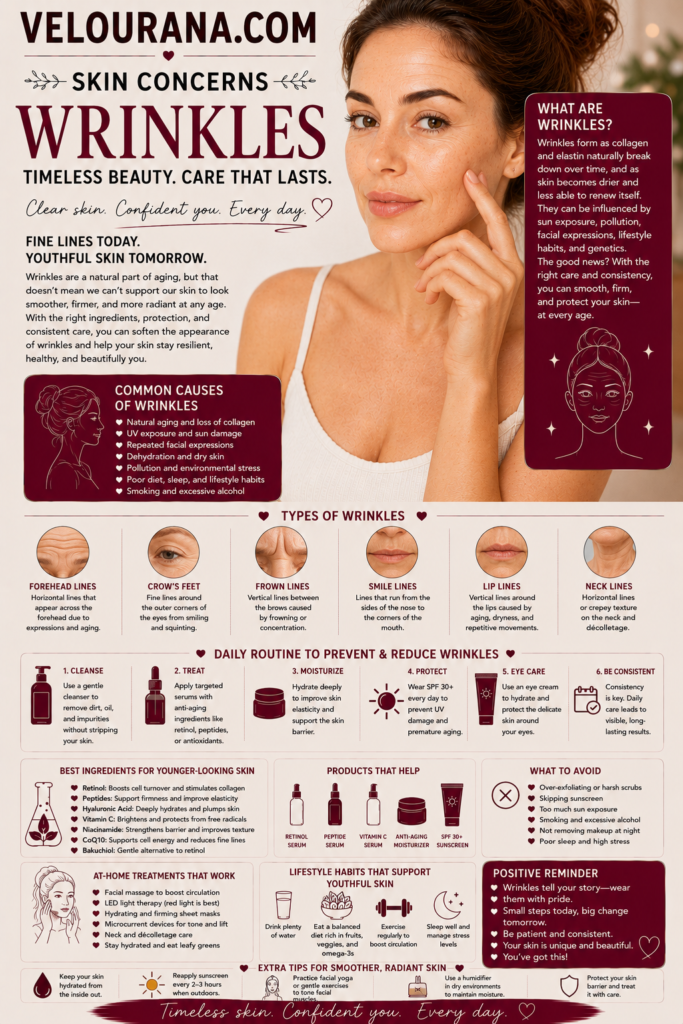
CATEGORY: Wrinkles
Wrinkles rarely appear all at once.
What seems to be a sudden change in the mirror is usually the visible result of a process that has been developing gradually. A faint line that once appeared only when smiling begins to remain for a few seconds after the expression relaxes. A crease that was noticeable only under harsh lighting starts becoming visible in ordinary daylight. The skin beneath the eyes seems more finely textured. Makeup begins collecting in places where it once sat smoothly.
These changes can feel abrupt because the eye notices thresholds, not biology.
Skin aging is continuous.
The transition from fine lines to deeper wrinkles reflects changes occurring across multiple levels of the skin and face: hydration declines, the barrier becomes more vulnerable, collagen and elastin undergo gradual alteration, repeated movement leaves more permanent mechanical traces, ultraviolet exposure accumulates, and deeper facial structures begin to shift.
A wrinkle therefore does not move through a perfectly defined sequence in every person. There is no universal stage one, stage two and stage three. Yet there is a recognizable progression in how many lines evolve—from temporary surface creasing to persistent lines and eventually to deeper folds or etched wrinkles.
Understanding that progression is useful because the most appropriate intervention changes with the stage.
A dehydration line may respond dramatically to moisturization.
An early static wrinkle may improve over time with retinoids, sun protection and consistent barrier care.
A deeply established expression line may remain visible despite excellent topical treatment because its structure is no longer confined to the surface.
The earlier the distinction is understood, the more realistic wrinkle care becomes.
The First Stage Is Often Not a Wrinkle at All
Many people first become concerned about wrinkles when they notice fine creasing in the skin.
But not every fine line represents significant structural aging.
Surface dehydration can make healthy skin look dramatically more lined.
When the outer layer of the skin loses water, it becomes less supple and more irregular. Tiny creases that were previously almost invisible begin casting small shadows. The effect is especially noticeable beneath the eyes, around the mouth and across the forehead.
This is why the same face can look different in winter, after air travel, after a poor night's sleep, or after using an overly drying cleanser.
The biology underneath may not have changed significantly.
The surface condition has.
A useful way to distinguish dehydration-related lines from more established wrinkles is to observe how strongly they respond to hydration.
If a line softens substantially after moisturizer, humid conditions or barrier repair, part of its visibility is likely related to surface water content.
This does not mean the underlying skin is biologically young.
It means the visible problem has a reversible component.
That is important because it prevents unnecessary escalation.
Someone who sees fine dehydration lines and immediately begins strong exfoliation may worsen the appearance by increasing dryness.
Sometimes the earliest "anti-wrinkle" intervention should be the simplest one: restore the barrier, reduce irritation and maintain hydration.
Dynamic Lines Are the Earliest Structural Signals
Dynamic lines appear during facial movement.
They are among the most normal features of expressive skin.
Raise the eyebrows and horizontal lines appear across the forehead.
Smile and fine folds develop around the eyes.
Frown and the skin between the brows compresses.
In younger skin, these folds usually disappear completely when the underlying muscle relaxes.
This happens because the skin has strong structural support and good elastic recoil.
Over time, the situation changes.
Repeated movement continues, but the tissue being folded becomes less resilient.
Dynamic lines then become important not because they are pathological, but because they represent the mechanical pathways along which future static wrinkles may develop.
The process is similar to repeatedly folding a piece of fabric.
A new, resilient fabric recovers easily.
As the material becomes thinner, drier or structurally weaker, the fold begins leaving a visible crease.
Skin is more complex than fabric, but the mechanical principle is comparable.
This explains why wrinkle patterns are so individual.
People do not all move their faces in the same way.
A highly expressive forehead may develop prominent horizontal lines while the mouth remains relatively smooth.
Someone who squints frequently may develop more visible crow's-feet.
Another person may develop strong lines between the eyebrows because of habitual concentration.
The pathway of movement becomes the pathway of wrinkling.
The Transition From Dynamic to Static Wrinkling
The most noticeable stage of wrinkle formation occurs when a line remains visible after facial movement stops.
This is the transition from primarily dynamic to increasingly static wrinkling.
At first, the line may remain only briefly.
Then it stays longer.
Eventually it can be seen while the face is fully relaxed.
Several processes contribute to this change.
Collagen support declines.
Elastic recoil becomes less efficient.
The skin becomes thinner and drier.
Repeated ultraviolet exposure may have damaged structural proteins.
The same facial movement that once left no trace now produces a persistent crease.
This is the point when many people begin seeking anti-aging treatment.
It is also the stage at which expectations need to become more precise.
Topical skin care can still make a meaningful difference.
Improved hydration can soften the line.
Retinoids may gradually improve fine wrinkling and photodamaged texture.
Sun protection can reduce continued ultraviolet injury.
But the line has begun acquiring a mechanical history.
It is no longer simply a temporary fold.
That means complete disappearance becomes less predictable.
Why Early Static Wrinkles Can Still Respond Well to Skin Care
Early static wrinkles occupy an interesting middle ground.
They are more established than dehydration lines but not necessarily deeply etched.
This is where long-term topical care can be particularly worthwhile.
Retinoids are among the best-known options because they influence epidermal turnover and processes associated with collagen production and remodeling. Over time, appropriately used retinoids can improve fine lines and other signs of photoaging.
The effect is gradual.
Weeks may pass before early textural changes are noticed.
Months may be required before fine wrinkles begin looking meaningfully softer.
This slow progression is biologically appropriate.
Collagen does not reorganize overnight.
The epidermis does not permanently remodel because a serum was used for three evenings.
Patience becomes part of the treatment.
Sun protection is equally important because improvement is difficult to maintain if significant ultraviolet damage continues.
Moisturization supports the surface and can reduce the exaggerated appearance created by dryness.
Together, these measures can improve the overall quality of the skin even when they do not completely erase the wrinkle.
That distinction is essential.
A softer line, smoother texture and more resilient surface can represent a very successful result.
The Role of Collagen Loss in Deepening Lines
Collagen forms a major part of the dermal framework.
It gives skin tensile strength and contributes to firmness.
With age, collagen production declines and the existing collagen network undergoes changes in quantity, quality and organization.
Environmental factors, especially ultraviolet exposure, can accelerate this deterioration.
As dermal support becomes weaker, the skin becomes less able to resist repetitive folding.
The same movement creates a deeper mechanical impression.
This helps explain why a forehead line can progress from faint to etched even when facial expressions remain unchanged.
The movement did not necessarily become more intense.
The tissue supporting the movement changed.
Collagen loss also influences how the skin responds to gravity and underlying structural changes.
As support decreases, folds can become more prominent and contours less defined.
This is where the difference between a superficial wrinkle and a deeper structural crease becomes increasingly important.
A topical product can influence accessible skin biology.
It cannot simply replace lost three-dimensional support on demand.
This is one reason wrinkle creams often produce the greatest improvement in fine lines rather than in deeply established folds.
Elastin Determines How Well the Skin Recovers
If collagen provides strength, elastin contributes flexibility.
Elastic fibers allow the skin to stretch and return toward its previous position.
This ability is crucial in facial skin because the face moves constantly.
With age and cumulative environmental damage, elastic properties deteriorate.
The skin becomes less capable of recovering completely after repeated folding.
This is one reason deeper wrinkles tend to remain visible even when the face is relaxed.
The skin has lost part of its recoil.
Sun exposure can accelerate this process substantially.
Photoaged skin often shows not only wrinkles but also textural roughness, uneven pigmentation and reduced elasticity.
The effect is cumulative.
A single episode of sun exposure does not produce a deep wrinkle overnight.
But years of repeated exposure gradually alter the structural environment in which wrinkles form.
This helps explain why prevention matters even after wrinkles have already appeared.
It may be too late to prevent every existing line, but it is not too late to reduce further damage.
Deep Wrinkles Become Three-Dimensional Features
A fine line is primarily visible because of surface irregularity.
A deep wrinkle becomes a three-dimensional structure.
It has depth.
It casts shadows.
Its appearance changes depending on lighting direction.
The skin may be visibly folded even at rest.
At this stage, deeper anatomy increasingly influences what the eye sees.
Facial volume changes, fat redistribution, ligament support and bone remodeling can all contribute.
This is why deep wrinkles cannot always be understood as "older fine lines."
Some are fundamentally different features.
A pronounced fold beside the mouth, for example, may be influenced heavily by the position of surrounding soft tissue.
A deep line between the brows may be strongly driven by years of muscular contraction.
A neck crease may reflect repeated folding combined with laxity and sun exposure.
Treating all of these with the same topical product makes little biological sense.
The deeper the wrinkle, the more important it becomes to understand anatomy.
Why Wrinkles Around the Mouth Become More Complex With Age
The mouth is one of the most mobile regions of the face.
Speaking, eating, smiling, pursing the lips and countless subtle expressions repeatedly move the surrounding skin.
With age, the area also experiences changes in volume, support and elasticity.
Fine vertical lines may develop around the lips.
Folds extending from the nose toward the mouth can deepen.
The corners of the mouth may appear different as surrounding tissues shift.
These features are often grouped together under the general label of "mouth wrinkles," but they do not share one mechanism.
Fine vertical lip lines may be influenced strongly by repeated movement and skin quality.
Nasolabial folds involve deeper facial structure.
Dryness can exaggerate both.
Sun exposure can contribute to deterioration of the surrounding skin.
This complexity explains why topical products may improve surface texture without dramatically changing deeper folds.
The skin can look better while the anatomy remains the same.
That is still a meaningful result.
Forehead Wrinkles Demonstrate Mechanical Aging Clearly
Forehead lines provide one of the clearest examples of wrinkle progression.
At first, they appear only when the eyebrows are raised.
Later, faint horizontal lines remain at rest.
Over time, those lines can become deeper and more permanently etched.
The process reflects repeated muscular movement acting on gradually changing skin.
Someone who raises the eyebrows frequently may develop stronger forehead lines earlier.
Genetics, sun exposure and skin thickness modify the outcome.
This is why two people with similar ages can have completely different forehead patterns.
Topical treatment can improve surface texture and fine static lines.
But it cannot stop the underlying forehead muscle from contracting.
This is why certain professional treatments aimed at muscular movement can produce effects that skin care alone cannot.
The difference is anatomical, not a question of product quality.
A moisturizer is not failing because it cannot alter muscle activity.
It is simply working at a different level.
Crow's-Feet Often Progress From Expression to Etching
Crow's-feet usually begin as smile lines.
During a genuine smile, the muscles surrounding the eyes contract and the skin folds outward from the corners.
In younger skin, these lines often disappear immediately afterward.
With age, they become visible at rest.
Eventually, they may remain even when the face is completely relaxed.
The eye area is especially susceptible because the skin is delicate and repeatedly exposed to ultraviolet radiation.
Squinting contributes additional movement.
Dryness exaggerates fine creasing.
The result is a region where several wrinkle mechanisms overlap.
This makes the eye area particularly responsive to good hydration, but also particularly vulnerable to irritation.
Aggressive treatment around the eyes can produce dryness and inflammation that make fine lines look worse.
The most effective approach is often gradual.
Sun protection, appropriate moisturization and carefully selected active ingredients can support the area without overwhelming it.
Why Makeup Starts Settling Differently
Many people first notice wrinkle progression through makeup.
Foundation that once blended smoothly begins collecting in lines.
Concealer creases beneath the eyes.
Powder emphasizes texture.
This does not necessarily mean makeup has become unsuitable.
The surface beneath it has changed.
Drier skin has less flexibility.
Fine static wrinkles create channels where product can accumulate.
Powder can absorb surface oils and exaggerate texture.
Heavy layers can make creases more visible because there is simply more material available to settle.
Wrinkle-aware makeup often benefits from the same principles as wrinkle-aware skin care: hydration, restraint and realistic expectations.
Trying to completely cover a wrinkle with more product frequently makes it more noticeable.
A smoother, lighter application may create a more flattering result.
The goal is not to create a perfectly flat surface.
It is to work with the texture that exists.
Deep Wrinkles Reflect Cumulative History
By the time a wrinkle becomes deeply etched, it often reflects decades of overlapping influences.
Facial movement has repeated thousands of times.
Collagen support has gradually declined.
Elastic recovery has weakened.
Ultraviolet exposure may have accumulated.
The skin may have become drier.
Deeper facial tissues may have shifted.
This is why deep wrinkles should not be interpreted as evidence that skin care has "failed."
Some degree of wrinkling is inevitable.
Even excellent sun protection and evidence-based treatment cannot completely prevent biological aging.
What good skin care can do is modify the trajectory.
It can reduce preventable photodamage.
It can improve hydration.
It can support smoother texture.
It can improve fine wrinkling.
It can help maintain healthier-looking skin around the deeper lines.
This is a much more realistic goal than complete elimination.
When Exfoliation Helps and When It Makes Things Worse
Exfoliation can improve surface texture.
Alpha hydroxy acids and other exfoliating ingredients remove or loosen dead surface cells, which can make rough skin appear smoother and brighter.
But exfoliation has limits.
It does not rebuild deep structural support.
It does not stop facial muscle movement.
It does not reposition volume.
And excessive exfoliation can create irritation that makes wrinkles more noticeable.
This is especially important in mature skin, where the barrier may already be more vulnerable.
A routine that combines strong acids, retinoids, scrubs and harsh cleansing can produce chronic dryness.
The surface then looks rougher and more creased.
More treatment has created less attractive skin.
Exfoliation therefore works best when used strategically rather than compulsively.
The objective is to improve texture without destabilizing the barrier.
Retinoids Are Most Useful Before Expectations Become Unrealistic
Retinoids can improve fine lines and photoaged texture, but they are not equivalent to procedures.
This distinction becomes more important as wrinkles deepen.
Someone with early fine lines may see meaningful improvement from consistent retinoid use.
Someone with a deeply etched forehead crease may still improve the surrounding skin, but the line itself may remain.
This is not because retinoids stop working at a particular depth.
It is because the visible feature increasingly reflects anatomy and mechanical history that topical treatment cannot fully reverse.
The earlier retinoids are introduced appropriately, the more they can function as part of long-term maintenance rather than emergency correction.
This does not mean everyone should begin strong retinoids at a young age.
Individual skin type, tolerance, medical considerations and pregnancy status matter.
It means that skin care works best when used consistently over time rather than deployed only after deep structural changes have already developed.
Sun Protection Matters at Every Stage
People sometimes assume sunscreen is useful only before wrinkles appear.
That is incorrect.
Sun protection remains relevant at every stage of aging.
Existing wrinkles do not make further ultraviolet damage harmless.
Photodamage continues affecting collagen, elastin, pigmentation and texture.
A person with deep wrinkles still benefits from preventing unnecessary additional damage.
This is important psychologically as well.
Wrinkle care is not an all-or-nothing project.
There is no point at which someone becomes "too old" for prevention.
Protection is always about what happens next.
The skin cannot change its past.
It can still influence its future.
Why Barrier Care Becomes More Important as Wrinkles Deepen
Mature skin often becomes drier and more sensitive.
This means barrier support becomes increasingly important, not less.
Unfortunately, deeper wrinkles often trigger the opposite behavior.
The user becomes frustrated and intensifies treatment.
Stronger retinoids are added.
Exfoliation increases.
Multiple serums are layered.
The skin begins peeling.
The person concludes that the products are "working hard."
But inflammation and barrier damage do not represent successful anti-aging.
A compromised barrier increases water loss, roughness and sensitivity.
Fine lines become more visible.
Deeper wrinkles cast stronger shadows against a dehydrated surface.
Restoring hydration can make the entire complexion look softer even though the structural wrinkle remains.
This is why mature-skin routines often benefit from a stable moisturizer just as much as from sophisticated active ingredients.
The Point Where Procedures Become More Relevant
Deep wrinkles often involve mechanisms beyond the reach of topical cosmetics.
At that stage, professional treatments may become more relevant for people who want significant correction.
The appropriate procedure depends on the wrinkle.
Dynamic expression lines may respond to treatments that reduce selected muscle activity.
Volume-related folds may respond to approaches that alter support or contour.
Surface texture and photodamage can be addressed through resurfacing techniques.
Skin laxity may require yet another strategy.
No single procedure solves every form of aging.
Professional evaluation therefore matters.
A dermatologist or appropriately qualified clinician can determine which structures are contributing to the visible feature.
This avoids treating a volume problem as a surface problem or a muscle problem as a pigmentation problem.
Anatomical diagnosis creates better expectations.
Wrinkle Depth Is Only One Measure of Skin Age
Deep wrinkles attract attention because they are visually obvious.
But they are not the only characteristic that influences perceived age.
Uneven pigmentation can make skin look older.
Dryness can reduce luminosity.
Rough texture can create shadow.
Loss of firmness changes facial contours.
Redness and sun damage affect overall tone.
This means someone can improve their appearance substantially without eliminating a single deep wrinkle.
Better hydration can restore softness.
More even tone can create brightness.
Improved texture can reflect light more evenly.
Sun protection can prevent further damage.
The face can look healthier while retaining its history.
This broader perspective is often more rewarding than focusing obsessively on one crease.
Why Wrinkles Can Seem to Worsen Suddenly
People occasionally report that their wrinkles became dramatically worse within months.
Sometimes there has been genuine accelerated change.
Hormonal transitions, significant weight loss, illness, environmental exposure or changes in skin condition can alter appearance relatively quickly.
But often the perceived change reflects a combination of slower structural aging and a faster surface change.
Dry weather may reduce hydration.
A new active ingredient may cause peeling.
Stress may affect sleep and general appearance.
Lighting may change.
Someone may simply begin paying closer attention.
Once a wrinkle becomes consciously noticed, it can seem to dominate the face.
This is why photographs taken under consistent conditions can be more useful than daily mirror inspection when evaluating treatment.
Memory is unreliable.
Lighting is even more unreliable.
Prevention Works Best Before the Line Becomes Structural
The earlier stages of wrinkle formation are generally easier to influence than deeply established changes.
This is not because skin care can completely stop aging.
It is because fine surface changes are more responsive to hydration, barrier support and topical treatment than deep anatomical alterations.
Prevention therefore means protecting structural quality before significant deterioration accumulates.
Daily sun protection is central.
Avoiding smoking matters.
Using active ingredients appropriately can support skin quality.
Maintaining hydration reduces unnecessary surface creasing.
Gentle cleansing helps preserve the barrier.
These measures are not dramatic.
Their value lies in repetition.
A small benefit repeated daily for years becomes biologically meaningful.
Aging Skin Requires a Change in Strategy, Not Panic
The transition from fine lines to deeper wrinkles can feel unsettling because it makes aging visible.
But the correct response is not necessarily to intensify everything.
Skin needs change.
A routine that worked at thirty may become too drying at fifty.
An exfoliation schedule that once caused no irritation may become excessive.
A lightweight moisturizer may no longer provide enough support.
The skin may need more recovery time between active treatments.
Adapting the routine is not surrender.
It is intelligent maintenance.
The objective should remain stable even as the products change: protect, hydrate, support, treat selectively and avoid chronic irritation.
Deep Wrinkles Do Not Cancel the Value of Skin Care
One of the most damaging ideas in anti-aging is that once wrinkles become deep, skin care becomes pointless.
That is not true.
Deep wrinkles may be less responsive to topical correction, but the surrounding skin still benefits enormously from appropriate care.
Hydrated skin looks better.
Protected skin accumulates less additional photodamage.
Well-managed pigmentation improves overall appearance.
A stable barrier increases comfort.
Retinoids can still improve aspects of photodamaged texture.
Skin cancer prevention remains important.
Healthy skin matters independently of wrinkle depth.
Topical care should therefore not be judged solely by whether one deep crease disappears.
The Mature Face Is a Layered Record
Fine lines and deep wrinkles belong to the same aging landscape, but they are not interchangeable.
A fine line may be superficial and strongly influenced by hydration.
An early static wrinkle may reflect beginning structural change.
A deeper crease may combine dermal remodeling with repeated muscle movement.
A facial fold may depend heavily on the tissues beneath the skin.
Each stage tells a different biological story.
This is why intelligent wrinkle care begins with classification rather than fear.
The skin should be observed carefully.
Does the line appear only with movement?
Does hydration soften it substantially?
Is the surrounding skin photodamaged?
Is the feature actually a fold created by facial structure?
Has it become permanently etched?
The answer determines what can realistically change.
The Best Time to Care for a Wrinkle Is Before It Becomes the Only Thing You See
Wrinkles progress gradually.
So should their care.
There is no need to wait until lines become deep before protecting collagen from ultraviolet exposure.
There is no need to wait until dehydration becomes severe before supporting the barrier.
There is no need to attack early fine lines with an unnecessarily complicated routine.
And there is no reason to abandon skin care simply because deeper wrinkles have already developed.
Every stage offers something worth preserving.
Early skin benefits from prevention.
Changing skin benefits from adaptation.
Mature skin benefits from protection, hydration and realistic treatment.
Deeply wrinkled skin still benefits from health, comfort and resilience.
The progression from fine line to deep wrinkle is not a failure.
It is the visible result of tissue that has moved and aged over time.
Understanding that progression removes much of the confusion surrounding anti-aging care.
A faint line may still respond beautifully to hydration and evidence-based topical treatment.
A deeper wrinkle may require professional intervention for substantial correction.
Some lines will remain regardless of what is applied.
The important thing is knowing the difference.
Skin care is most effective when it works with biology instead of promising to defeat it.
And as wrinkles deepen, that distinction becomes more valuable than ever.
The End Velourana
 Discover More From Our Family of Websites
 ZodiacBearing (Astrology, Tarot, Numerology, Angel Numbers & Spiritual Guidance)
 Velourana (Beauty, Makeup, Hair Care, Skincare & Beauty Tips)
 HavenBearing (Home, Living, Organization, Décor & Everyday Inspiration)
 PawBearing (Pet Care, Dog Breeds, Animal Health, Training & Pet Products)
 PsyCatherine (Notes From the Journal of a Psychologist on Real Life)

