
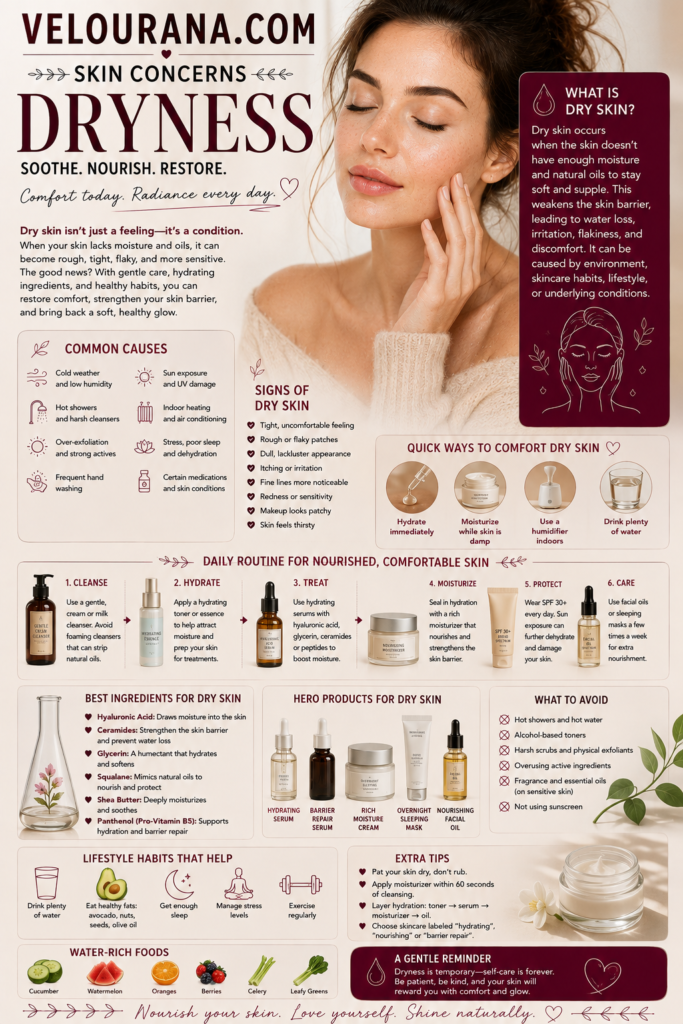
CATEGORY: Dryness
Dry skin and sensitive skin are often discussed as though they were separate categories. One describes a lack of moisture, the other a tendency to react. In practice, the two frequently overlap so closely that it can be difficult to tell where one ends and the other begins.
A face that once tolerated almost any cleanser may begin stinging after washing. A moisturizer that has been used for months suddenly feels uncomfortable. Sunscreen creates a burning sensation around the cheeks. Wind feels sharper. Makeup begins clinging to rough patches, while areas around the mouth or nose become red after even mild rubbing.
These changes can be alarming because they make the skin seem unpredictable.
Yet there is a logical reason dryness often increases sensitivity. The skin barrier is not only responsible for limiting water loss. It also helps regulate what enters from the outside. When that protective structure becomes compromised, the skin may lose water more quickly while also becoming more vulnerable to ingredients, friction, temperature changes, and environmental irritants.
This does not mean every person with dry skin has sensitive skin, nor does it mean every sensitive reaction is caused by dryness. Allergic contact dermatitis, eczema, rosacea, medication effects, and other conditions can create genuine reactivity that requires a different approach.
But when dryness and sensitivity appear together, the barrier is often the most useful place to begin understanding what is happening.
The key is not simply to find a “sensitive skin” label on a product.
It is to reduce unnecessary stress while giving the outer layer enough support to recover.
The Barrier Protects Against Both Water Loss and Irritation
The outermost layer of the epidermis, the stratum corneum, is often described as a physical wall, but that description understates its sophistication.
It consists of flattened corneocytes surrounded by an organized lipid matrix containing ceramides, cholesterol, and fatty acids. Within the cells are substances that help bind water, while the skin surface contains additional lipids and maintains a mildly acidic environment.
Together, these features create a selective protective boundary.
Water is retained more efficiently.
Microorganisms, irritants, and environmental substances have greater difficulty penetrating.
When the barrier becomes disrupted, both functions are weakened.
Water escapes more readily, producing dryness and tightness. At the same time, substances that would normally remain largely on the surface may interact more strongly with living cells beneath.
The result can be increased stinging, burning, itching, or redness.
This explains why a product can suddenly feel irritating even though its formula has not changed.
The skin receiving it has changed.
Why Previously Comfortable Products Can Suddenly Sting
One of the most confusing experiences in skincare is applying a familiar moisturizer and feeling an immediate burning sensation.
The first assumption is often that the product has “gone bad” or that an allergy has suddenly developed.
Both are possible, but neither is the only explanation.
Barrier impairment can dramatically change sensory response. Ingredients that are normally well tolerated may reach or stimulate nerve endings more easily when the outer layer is compromised.
This is especially common after over-exfoliation, retinoid irritation, sunburn, cold-weather exposure, repeated cleansing, or the use of several active products together.
Even substances not generally considered harsh can sting.
Humectants, certain preservatives, sunscreens, acids at low concentrations, or fragranced ingredients may become uncomfortable when the skin is already inflamed.
Water itself can sometimes produce a transient sting on severely irritated skin.
This does not mean that the person has become “allergic to skincare.”
It may mean that the barrier needs recovery before the usual routine becomes tolerable again.
Sensitivity Is a Symptom, Not a Single Diagnosis
The phrase “sensitive skin” is useful descriptively, but it can hide several different biological situations.
Some people have naturally reactive skin that flushes, burns, or stings easily despite having no obvious barrier damage.
Others become temporarily sensitive after using strong treatments.
Some have eczema-prone skin. Others may have rosacea, allergic contact dermatitis, irritant dermatitis, or another dermatological condition.
Still others simply experience dryness severe enough to increase reactivity.
These distinctions matter because treatment differs.
A temporary barrier problem may improve with a simplified routine and time.
Allergic contact dermatitis may require identifying and avoiding a specific allergen.
Rosacea may need medical management.
Eczema may require targeted therapy beyond ordinary cosmetic moisturization.
This is why persistent or severe sensitivity should not be managed indefinitely through trial and error alone.
Skincare can support the barrier.
It cannot diagnose every reason the barrier is failing.
Over-Cleansing Is One of the Most Common Ways Dryness Becomes Reactive
Cleansing is often the first place where sensitive dry skin becomes uncomfortable.
A cleanser that removes sunscreen and makeup effectively may also remove too much of the surface material that contributes to barrier function, particularly when used frequently or combined with hot water and long washing times.
The immediate result can be a feeling of tightness.
With repeated exposure, stinging and redness may follow.
The problem becomes self-reinforcing when the reaction is interpreted as impurity.
The face feels rough, so cleansing becomes more thorough. Small flakes appear, so cleansing cloths or brushes are introduced. Oil appears later in the day, so stronger cleansers are chosen.
The barrier becomes progressively less stable.
For dry, reactive skin, cleansing should be judged not by how dramatically it removes every trace of surface oil but by whether it leaves the skin comfortable.
A cleanser does not need to create tightness in order to work.
The absence of that stripped sensation is often a sign of better compatibility.
Exfoliation Can Turn Mild Dryness Into Persistent Irritation
Exfoliation is particularly risky when dryness is misread.
A few visible flakes can create the impression that dead skin is accumulating and must be removed. An acid toner or scrub may make the surface look smoother almost immediately.
If the flaking was caused primarily by barrier disruption, however, removing more surface cells can deepen the problem.
This is where dry skin can enter a cycle of exfoliation and reactivity.
Flakes appear.
Exfoliation removes them.
The barrier becomes weaker.
More flakes appear.
Stronger or more frequent exfoliation follows.
Eventually, products begin stinging and the skin may develop a shiny, tight appearance despite feeling dry.
At that stage, exfoliation is no longer correcting texture.
It is helping maintain the instability.
A temporary reduction or pause in exfoliating products can therefore be one of the most important steps when dryness and sensitivity coexist.
Retinoids Can Expose the Difference Between Product Strength and Skin Tolerance
Retinoids are among the most effective topical ingredients used for acne, pigmentation, and visible aging.
They are also common causes of temporary dryness and irritation.
This does not make them unsuitable for dry skin, but it does mean that introduction and frequency matter.
A person may tolerate a retinoid perfectly at first, then increase usage quickly because no immediate irritation appears. Several days later, tightness, flaking, and burning develop.
This delayed response can make the cause less obvious.
When the barrier is stressed, continuing the same frequency while simply adding heavier moisturizer may not be enough.
Reducing frequency, adjusting application, or temporarily pausing use may be appropriate depending on the product and individual circumstances.
Prescription retinoids should be managed according to medical guidance rather than altered casually.
The broader lesson extends beyond retinoids.
Skincare efficacy and skin tolerance must coexist.
A powerful ingredient cannot provide its intended benefits if the routine surrounding it repeatedly destabilizes the barrier.
Fragrance Can Become More Noticeable When the Barrier Is Compromised
Fragrance is one of the most debated subjects in skincare because the conversation often becomes unnecessarily absolute.
Many people tolerate fragranced products without difficulty.
Others develop irritation or allergic contact dermatitis.
Dry, reactive skin may become more likely to notice fragranced formulations simply because the barrier is compromised.
This does not mean every fragrance compound will irritate every dry complexion.
It means the threshold for discomfort may be lower during periods of barrier instability.
Essential oils deserve the same balanced consideration. Their natural origin does not make them incapable of causing irritation or sensitization.
For someone whose skin is currently burning, itchy, or inflamed, temporarily choosing simpler fragrance-free products can reduce unnecessary variables.
Once the skin is stable, tolerance may be reassessed.
The goal is not ingredient fear.
It is reducing avoidable stimulation during recovery.
A Minimal Routine Can Function as a Diagnostic Tool
When reactive dryness develops, adding more products usually makes the situation harder to interpret.
A barrier serum is added.
Then a soothing essence.
Then a recovery mask.
Then a facial oil.
Each may contain useful ingredients, but the growing number of formulations increases the number of possible irritants and interactions.
Simplification has diagnostic value.
A routine consisting of a gentle cleanser, a well-tolerated moisturizer, sunscreen, and necessary medical treatment creates a clearer baseline.
If the skin improves, the conclusion is not necessarily that every removed product was harmful.
It simply shows that the total routine had become too demanding.
Products can later be reintroduced one at a time.
This allows the skin's response to become interpretable again.
Moisturizer Choice Becomes More Important When the Skin Stings Easily
Dry sensitive skin often benefits from moisturizers designed around barrier support rather than sensory excitement.
Humectants such as glycerin help bind water.
Ceramides, cholesterol, and fatty acids can complement the skin's natural lipid structure.
Emollients soften rough surface texture.
Occlusive ingredients reduce water loss.
Petrolatum is especially effective at reducing evaporation and is often well tolerated, although some users dislike its texture.
The ideal moisturizer does not need to contain every fashionable ingredient.
It needs to be comfortable enough to use consistently.
This is particularly important when the skin is reactive. A highly sophisticated formula that causes burning every time it is applied is not useful simply because its ingredient list looks impressive.
Sometimes the best recovery product is the least interesting one on the shelf.
Occlusion Can Help, but It Needs to Be Used Intelligently
Applying an occlusive layer over moisturizer can reduce water loss and protect severely dry areas.
This can be valuable around the cheeks, lips, or other regions prone to cracking or flaking.
But heavy occlusion is not automatically appropriate over every active treatment.
Occlusion can increase the penetration of certain ingredients. If strong acids, retinoids, or irritating treatments are trapped beneath a heavy layer, discomfort may increase.
For reactive skin, occlusion is generally most useful when placed over a simple moisturizing routine rather than an aggressive active regimen.
This distinction matters because a technique designed to support the barrier can become counterproductive when used without considering what is underneath it.
Temperature Extremes Can Feel More Intense on Reactive Dry Skin
When the barrier is compromised, environmental temperature becomes more noticeable.
Cold wind may produce immediate burning.
Very hot water can trigger redness or discomfort.
Rapid transitions between heated interiors and cold outdoor air can make the skin feel tight.
This is not simply psychological sensitivity.
Damaged skin can have altered nerve responses and increased exposure to irritants, making ordinary environmental conditions feel more intense.
Avoiding extremes during recovery can therefore help.
Lukewarm water, shorter showers, and protective moisturizer before outdoor exposure reduce unnecessary stress.
The objective is not to create a perfectly controlled environment.
It is to stop adding avoidable pressure while the barrier is trying to recover.
Makeup Can Reveal Barrier Damage Before It Becomes Obvious Bare-Faced
Dry sensitive skin often shows itself through makeup.
Foundation begins catching on areas that looked smooth without pigment.
Concealer emphasizes texture.
Powder creates a rough or papery finish.
Products that normally blend easily suddenly drag across the skin.
This happens because pigment settles into microscopic irregularities and highlights uneven hydration.
The solution is not always a new foundation.
Improving the underlying barrier can have a greater effect on makeup appearance than repeatedly changing cosmetic formulas.
During periods of irritation, reducing heavy powder and highly matte products may also make the complexion look more comfortable.
However, makeup should never be used to conceal significant inflammation that would benefit from medical evaluation.
Cosmetics can camouflage appearance.
They do not repair the cause.
The Eye Area Requires Special Caution
The skin around the eyes is thinner than much of the rest of the face and often becomes reactive before other areas.
Dryness can appear as fine scaling beneath the eyes, redness on the eyelids, or burning when ordinary skincare is applied nearby.
This region is also exposed to many potential irritants: eye makeup, makeup remover, sunscreen, shampoo residue, hair products, fragrance, nail products transferred by touch, and airborne allergens.
Persistent eyelid irritation should not automatically be treated as simple dryness.
Allergic contact dermatitis is relatively common in this area, and the responsible ingredient may not even be applied directly to the eyelid.
Repeated unexplained irritation deserves professional assessment.
A very simple moisturizer may provide temporary comfort, but endless experimentation around the eyes can make identification of the cause more difficult.
Lips Can Become Both Dry and Irritated for Similar Reasons
Lip dryness is common, but repeated irritation can transform simple chapping into a more persistent problem.
Licking is one of the most common contributors. Saliva briefly wets the surface but evaporates quickly and can irritate delicate lip skin.
Flavored lip products, fragrances, toothpaste ingredients, cosmetics, and weather may also contribute in susceptible individuals.
The natural response is often to apply increasingly complicated lip treatments.
A bland occlusive product may actually be more helpful because it reduces water loss without introducing unnecessary sensory ingredients.
Cracking at the corners of the mouth, persistent scaling, swelling, or recurrent inflammation should not be assumed to be ordinary chapping.
As elsewhere, location and persistence provide useful clues.
Hands Demonstrate Barrier Damage in Its Most Practical Form
The hands are repeatedly exposed to water, soap, detergents, sanitizers, cleaning products, cold air, and friction.
Dryness can therefore progress rapidly into irritation.
At first, the skin feels rough.
Then the knuckles crack.
Soon, sanitizer stings.
The progression illustrates the relationship between barrier loss and sensitivity perfectly.
Once cracks develop, products penetrate more easily and nerve endings become more exposed.
Frequent moisturizer use becomes more important because disruption is frequent.
Protective gloves during household cleaning can reduce chemical and water exposure.
Rich creams or ointments at night provide several uninterrupted hours of recovery.
If painful fissures, bleeding, inflammation, or persistent rash develop, medical assessment is appropriate.
Hand dryness is not always merely cosmetic.
“Natural” Does Not Mean Non-Irritating
Sensitive dry skin often drives people toward products marketed as natural, botanical, clean, or chemical-free.
These terms can create a sense of safety, but biological compatibility does not follow marketing categories.
Plants contain active compounds.
Essential oils contain volatile aromatic molecules.
Botanical extracts can irritate some individuals.
Conversely, laboratory-produced ingredients such as petrolatum, silicones, glycerin, or synthetic ceramides may be extremely well tolerated.
The relevant distinction is not natural versus synthetic.
It is tolerated versus irritating.
This becomes especially important when the barrier is unstable because reactive skin benefits from reducing unnecessary variables rather than choosing products based on philosophical labels.
Sunscreen Can Be Difficult but Remains Important
Reactive dryness can make sunscreen one of the hardest products to tolerate.
Some formulas sting immediately.
Others emphasize flakes.
Certain finishes feel too matte.
Very water-resistant products may be difficult to remove without additional cleansing.
Yet sun protection remains important, particularly when the skin is already dealing with inflammation, pigmentation, or visible aging concerns.
The practical solution is not to abandon sunscreen but to find a formula that the skin can tolerate consistently.
Some people prefer moisturizing chemical sunscreens.
Others tolerate mineral formulas better.
Still others find particular combinations uncomfortable.
There is no universal answer.
Comfort and adequate application matter more than loyalty to a specific sunscreen category.
Barrier Recovery Takes Time Even When the Routine Improves Immediately
One reason people become frustrated with dry sensitive skin is that they simplify the routine for two days and expect full recovery.
Barrier repair is biological.
It requires time.
Removing irritation can produce rapid improvements in stinging and tightness, but complete recovery may take longer depending on the severity of disruption.
This is why constantly changing products during the recovery period can be counterproductive.
A routine needs enough time to reveal whether it is helping.
If symptoms are worsening despite simplification, however, persistence is not a virtue.
That is the point at which professional evaluation becomes increasingly important.
How to Reintroduce Active Products Without Starting the Cycle Again
Once the skin becomes comfortable, the temptation is to restart every treatment immediately.
That can recreate the original problem.
A better approach is gradual reintroduction.
One active product can return at a reduced frequency.
The skin can then be observed for several days or weeks depending on the treatment.
If comfort remains stable, frequency may be increased cautiously or another product added.
This process is slower but provides information.
It also establishes the maximum intensity the skin actually tolerates rather than the maximum intensity suggested by marketing or another person's routine.
The most effective schedule is not necessarily daily use.
It is the schedule that delivers benefit without repeatedly destabilizing the barrier.
Persistent Sensitivity Deserves More Than Cosmetic Guesswork
There is a point at which reactive dryness should no longer be treated as an ordinary skincare inconvenience.
Significant redness, swelling, severe itching, painful cracking, oozing, crusting, recurrent eyelid inflammation, persistent localized patches, or symptoms that continue despite a gentle routine deserve medical attention.
Conditions such as eczema, rosacea, psoriasis, fungal infections, and allergic contact dermatitis may resemble or coexist with dryness.
A dermatologist can evaluate patterns that skincare experimentation cannot reliably distinguish.
This is particularly important when reactions are becoming more frequent or spreading.
The purpose of professional evaluation is not to make skincare complicated.
It is to avoid spending months treating the wrong problem.
Sensitive Dry Skin Needs Fewer Battles, Not More Weapons
The most useful way to think about reactive dryness is not as weak skin that needs to be forced into resilience.
It is skin whose protective system has become overwhelmed.
That changes the objective of care.
Instead of asking which stronger product can solve the problem, ask what can be removed.
Instead of exfoliating flakes immediately, ask why the flakes are appearing.
Instead of assuming every sting means allergy, consider whether the barrier is temporarily compromised.
Instead of introducing several soothing products simultaneously, create a stable baseline.
This approach is less exciting than chasing new treatments, but it is often more effective.
Stability Is the Real Goal
Dry sensitive skin becomes easier to manage once stability replaces intensity as the priority.
The barrier does not need constant stimulation.
It needs enough water, lipids, and protection to perform its ordinary functions.
Cleansing should remove what is necessary without stripping.
Moisturizer should provide lasting comfort.
Sunscreen should protect without creating significant irritation.
Active ingredients should be used only at frequencies the skin can actually tolerate.
Environmental exposure should be managed where practical.
That foundation may appear simple, but simplicity is not the same as inadequacy.
A stable barrier allows sophisticated skincare to become possible later.
An unstable barrier turns even basic skincare into a struggle.
When dryness and sensitivity occur together, that distinction becomes especially important.
The goal is not to make the skin tolerate everything.
It is to create conditions in which the skin no longer reacts to almost everything.
Once comfort returns, products stop feeling unpredictable. Cleansing stops becoming an ordeal. Moisturizer no longer burns. Weather becomes easier to tolerate. Makeup sits more smoothly.
The skin begins functioning quietly again.
And that quiet stability is often the clearest sign that the barrier has finally been given what it needed.
The End Velourana.
 Discover More From Our Family of Websites
 ZodiacBearing (Astrology, Tarot, Numerology, Angel Numbers & Spiritual Guidance)
 Velourana (Beauty, Makeup, Hair Care, Skincare & Beauty Tips)
 HavenBearing (Home, Living, Organization, Décor & Everyday Inspiration)
 PawBearing (Pet Care, Dog Breeds, Animal Health, Training & Pet Products)
 PsyCatherine (Notes From the Journal of a Psychologist on Real Life)

