
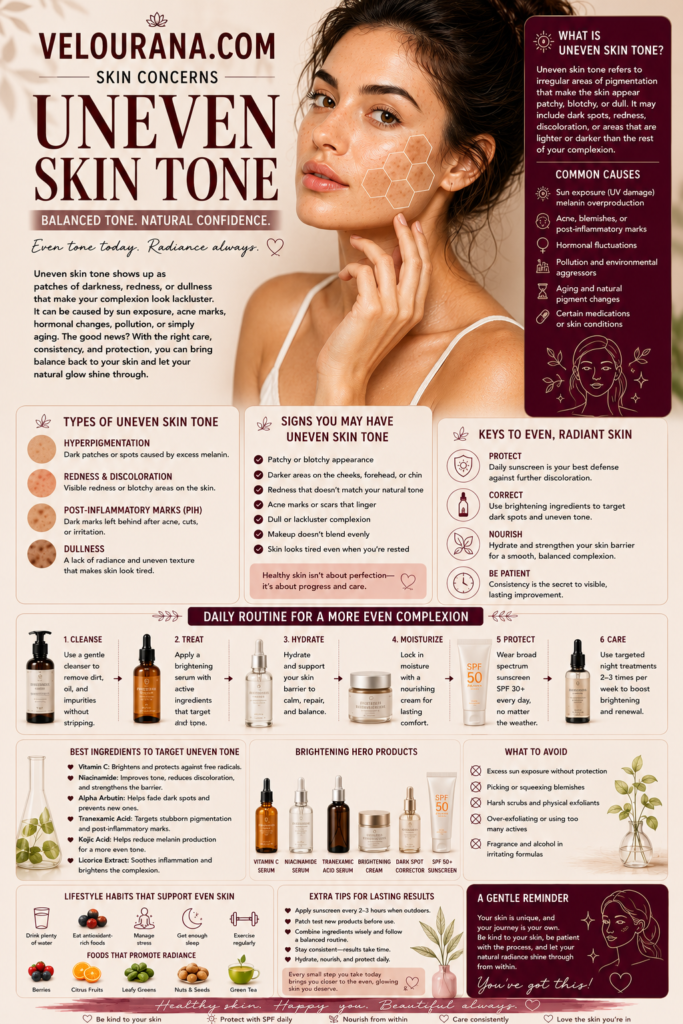
CATEGORY: Uneven Skin Tone
Uneven skin tone is often treated as if the entire problem could be summarised by one word: pigmentation. In reality, the complexion can look uneven for several very different reasons, and those reasons frequently overlap.
A brown mark may sit beside a pink area left by inflammation. Dry skin can make another region look grey or dull. A cluster of enlarged pores can alter the way light reflects from the cheek. A recently healed blemish may leave both colour and texture behind. The overall effect is irregularity, but not every irregularity is produced by the same biological process.
This matters because skincare decisions are often made by visual impression alone.
Someone sees unevenness and reaches for a brightening acid. But what if much of the problem is redness? Someone sees darkness around the mouth and assumes excess melanin, when dehydration and shadowing may be contributing heavily. Another person treats every post-acne mark as identical even though some are predominantly brown and others predominantly red.
The visible complexion is therefore something that must be interpreted rather than merely observed.
A more accurate understanding begins with separation. What appears darker? What appears redder? What looks dull rather than truly pigmented? Where is texture exaggerating the contrast? Which areas change with temperature or irritation, and which remain stable?
Once these patterns are distinguished, the idea of uneven tone becomes less vague.
It becomes a map.
Uneven Tone Is a Visual Result, Not a Diagnosis
The phrase “uneven skin tone” is useful because it describes what a person sees.
It is limited because it does not explain why they see it.
In dermatology and cosmetic skincare, visible colour can result from several processes. Increased melanin may create brown or greyish pigmentation. Dilated blood vessels can create red or purple areas. Reduced circulation, dryness or surface roughness may create dullness. Inflammation can produce temporary or persistent colour changes. Scarring and textural variation can create shadows that the eye interprets as darker tone.
This means that two faces can both appear uneven while having almost nothing biologically in common.
One may mainly show post-inflammatory hyperpigmentation after acne. Another may have persistent facial redness. A third may have sun-induced pigment variation combined with dehydration. A fourth may have melasma.
Applying the same routine to all four would make little sense.
This distinction also explains why some skincare products seem unexpectedly ineffective. The product may not be poor. It may simply be aimed at the wrong process.
A melanin-targeting ingredient cannot directly eliminate visible blood vessels. A soothing moisturiser may calm redness but will not necessarily correct established sun spots. Exfoliating dull surface cells can improve brightness while leaving deeper pigmentation relatively unchanged.
The first step in tone correction is therefore not correction.
It is identification.
Brown Unevenness Often Points Toward Melanin
When uneven tone appears tan, brown or grey-brown, excess or irregular melanin is often involved.
Common triggers include ultraviolet exposure, hormonal influences and inflammation.
Post-inflammatory hyperpigmentation is one of the clearest examples. A blemish, scratch or irritation resolves, yet the skin remains darker in that location. The inflammatory event has passed, but pigment activity has left a visible trace.
Sun-related pigmentation can behave differently. It may appear as individual spots or broader areas of irregular colour, often in regions receiving repeated ultraviolet exposure.
Melasma can create yet another pattern, commonly involving larger, often symmetrical areas of pigmentation.
Although all of these concerns contain melanin, they should not automatically be treated as interchangeable.
The cause matters. The depth of pigment matters. The skin's tendency toward inflammation matters.
This is where careful observation becomes useful.
If marks consistently appear after breakouts, inflammation is probably central to the pattern. If pigmentation becomes more visible after summer, ultraviolet exposure is likely contributing. If larger patches recur predictably and symmetrically, professional assessment may be useful to determine whether melasma or another pigmentary condition is present.
Correcting brown unevenness often requires both reducing existing visible pigment and controlling the signal that continues creating it.
Without the second part, treatment becomes repetitive.
Old marks fade. New marks replace them.
Red Unevenness Tells a Different Story
Redness can create an uneven complexion just as strongly as pigmentation.
Yet it is frequently treated with products aimed almost exclusively at melanin.
Red areas may arise from inflammation, sensitivity, acne, vascular visibility or conditions such as rosacea. The exact cause determines what is appropriate.
Post-inflammatory erythema, for example, can remain after acne lesions heal. Instead of leaving brown pigment, the area remains pink, red or purplish because of vascular changes.
This can be especially noticeable in lighter skin tones, although redness can occur across all complexions.
The difficulty is that red and brown marks can coexist. A person may have some lesions that leave pigment and others that leave vascular redness. One mark may even contain elements of both.
This is one reason a single “dark spot serum” may produce inconsistent results.
It may gradually improve brown marks while leaving red ones largely unchanged.
Redness also behaves differently in response to environment. Heat, exercise, alcohol, spicy food, emotional stress and skincare irritation can all increase facial flushing in some people.
If an area changes dramatically throughout the day, that behaviour offers useful information.
Pigment tends to be more stable over short periods. Vascular redness can fluctuate.
Recognising this difference prevents unnecessary exfoliation or aggressive brightening treatments being applied to skin that primarily needs calming and protection.
Dullness Can Masquerade as Pigmentation
Dullness is one of the most deceptive contributors to uneven tone.
It does not necessarily involve more pigment.
Instead, the skin may simply reflect less light.
A smooth, well-hydrated surface reflects light more evenly and appears brighter. A dry or rough surface scatters light irregularly. Small shadows form across fine flakes, pores and textural irregularities.
The result can look darker or greyer even when melanin has not significantly changed.
This is why moisturisation can sometimes produce an immediate improvement in apparent tone.
No pigment has disappeared within minutes. The optics have changed.
Hydration swells the outermost skin cells slightly, while emollients smooth the surface. The complexion reflects light more coherently and therefore appears more luminous.
This effect is especially relevant around areas that tend to become dry, including the mouth, nose and cheeks.
Someone may repeatedly exfoliate a dull area believing dead cells are the entire problem. If the underlying issue is dehydration, aggressive exfoliation can worsen the appearance by creating further barrier disruption.
Dullness therefore deserves its own category within uneven tone.
It may overlap with pigmentation, but it should not automatically be interpreted as pigmentation.
Texture Can Produce Colour Without Producing Pigment
Texture changes the architecture of reflected light.
This sounds abstract, but it explains a great deal about how the complexion looks.
A raised blemish creates a shadow. A depressed scar catches light differently. Enlarged pores create thousands of microscopic transitions between light and dark. Fine lines break the continuity of the surface. Flaking produces irregular edges.
The eye combines all of these signals into an overall impression of unevenness.
This can become particularly obvious under directional lighting.
A complexion may look reasonably uniform in soft daylight but dramatically more uneven under strong overhead light. The pigment has not changed. The shadows have.
This is why photography can distort people's perception of their skin.
Bathroom lighting, magnifying mirrors and high-contrast phone cameras can exaggerate texture that would barely register during normal social interaction.
Understanding this does not mean texture is imaginary.
It means its effect on apparent tone should be separated from true pigment variation.
A routine that improves hydration and surface smoothness may therefore improve perceived evenness even without strongly targeting melanin.
Post-Acne Skin Often Contains Several Colours at Once
Acne is one of the clearest examples of how complicated uneven tone can become.
An active blemish may begin red and swollen. As it heals, the redness may fade but leave a brown mark. Another lesion may remain pink. A deeper lesion may leave an indented scar that casts a shadow.
By the time active acne decreases, the complexion can contain a mixture of brown, red and textural marks.
This is why people often report that their acne “looks worse” even after breakouts have improved.
The inflammatory phase has ended, but its aftermath remains.
Treating this aftermath effectively requires prioritisation.
Continuing to control new breakouts is essential because every new inflammatory lesion creates another opportunity for lingering marks.
At the same time, existing pigmentation can be addressed gradually with appropriate ingredients and consistent sun protection.
Red marks may require time and, in more persistent cases, professional evaluation.
Textural scars may not respond significantly to ordinary topical brightening products at all.
The complexity is frustrating, but it is also useful.
Once each component is recognised, expectations become more realistic.
The Mouth and Chin Often Create Confusion
Uneven colour around the mouth is a common concern because several factors can converge in that region.
Natural pigmentation can vary around the lips. Friction may contribute. Repeated irritation from skincare, shaving or hair removal can influence colour. Previous breakouts around the chin can leave marks. Dryness may create dullness.
In some cases, hormonal patterns can also influence pigmentation.
This means that the area should not automatically be treated with the strongest brightening ingredients available.
If the skin is chronically irritated, aggressive treatment may intensify the problem.
A calmer approach often begins with reducing unnecessary friction, protecting the barrier and using targeted ingredients cautiously.
Sun protection is equally relevant because pigmentation around the mouth can become more pronounced with ultraviolet exposure.
Persistent or unusual pigmentation in this region may warrant professional assessment, particularly when its cause is unclear.
The Eye Area Has Its Own Rules
Darkness around the eyes is frequently described as uneven skin tone, but its causes can differ substantially from ordinary facial pigmentation.
Genetic anatomy, thin skin, visible blood vessels, shadows created by tear troughs, pigmentation and rubbing can all contribute.
This is why eye-area darkness often responds unpredictably to conventional brightening products.
If shadowing is the dominant cause, topical skincare can only do so much.
If pigmentation contributes, certain gentle brightening ingredients may help over time.
If rubbing from allergies or irritation is involved, addressing that behaviour may be more important than introducing another active.
The skin around the eyes is also thinner and more sensitive than much of the face, making aggressive exfoliation particularly risky.
This region illustrates a broader principle: visible darkness is not always equivalent to excess pigment.
Skin Tone Can Change Throughout the Day
A complexion is not visually static.
Morning skin may look pale and calm. After exercise it may become flushed. Heat can increase redness. Dehydration may make the skin appear duller by evening. Oil production can change reflectivity. Makeup wear can exaggerate texture.
These daily fluctuations can complicate self-assessment.
Someone may conclude that a product has dramatically improved the complexion based on one morning, then believe the improvement has disappeared by evening.
This is why long-term evaluation is more useful than moment-to-moment judgement.
Pigmentation should be assessed under reasonably consistent conditions.
Similar lighting, similar time of day and periodic photographs can help reduce visual noise.
Without consistency, the normal variability of living skin can be mistaken for treatment failure.
Why Aggressive Brightening Can Make Unevenness Worse
The most intuitive response to uneven tone is often escalation.
If one exfoliating treatment helps, more should help more.
If one active works gradually, combining three may appear more efficient.
But skin is not a passive surface.
Aggressive routines can create irritation, barrier disruption and inflammation. These changes may increase redness immediately and, in pigmentation-prone individuals, contribute to darker marks later.
This creates a vicious cycle.
The skin looks uneven, so stronger products are used. Stronger products irritate the skin. Irritation makes the complexion look more uneven. The user responds by increasing treatment intensity again.
Breaking this cycle often requires doing less.
A routine that is tolerated well enough to be repeated for months can outperform a theoretically stronger routine that repeatedly damages the barrier.
Brightening Should Be Matched to the Dominant Pattern
Once the major contributor has been identified, ingredient selection becomes more rational.
For brown pigmentation, ingredients such as vitamin C, niacinamide, azelaic acid, alpha arbutin, tranexamic acid, retinoids and exfoliating acids may be considered depending on skin type, tolerance and formulation.
For redness, calming and barrier-supportive strategies may become more important.
For dullness, hydration and gentle resurfacing may produce visible improvement.
For mixed concerns, a balanced routine is usually preferable to aggressive multitargeting.
The key is not to use every ingredient associated with tone correction.
It is to use the fewest ingredients necessary to address the actual problem without creating new irritation.
Sun Protection Connects Almost Every Form of Unevenness
Although different forms of uneven tone require different strategies, sun protection is one of the few interventions relevant across many of them.
Ultraviolet radiation can deepen pigmentation. It can prolong the visibility of post-inflammatory marks. It contributes to cumulative photodamage and textural change.
Some redness-prone skin may also become more reactive with sun exposure.
Broad-spectrum sunscreen therefore functions as a protective foundation rather than an optional finishing step.
For people actively treating pigmentation, inconsistency here can quietly undermine the rest of the routine.
This does not mean sunscreen alone will eliminate established unevenness.
It means that correction becomes much harder when new damage continues accumulating.
A Better Way to Evaluate Progress
Progress in uneven tone should be evaluated by categories rather than one vague impression.
Are fewer new dark marks appearing?
Are older marks becoming less visible?
Is redness calmer?
Does the skin look more luminous because texture and hydration have improved?
Are there fewer inflammatory episodes?
These questions produce much more useful information than simply asking whether the face is “even yet.”
A complexion can improve significantly before reaching perfect uniformity.
In fact, perfect uniformity is not a realistic biological goal.
Natural skin contains variation.
The real objective is to reduce unwanted contrast while maintaining comfort and health.
When Professional Assessment Becomes Important
Certain patterns deserve medical attention rather than cosmetic experimentation.
A new or changing pigmented lesion, unusual mole, persistent patch, rapidly developing pigmentation or area that bleeds or fails to heal should be assessed by a qualified healthcare professional.
Persistent redness may also warrant evaluation if conditions such as rosacea are suspected.
Professional assessment can clarify whether a concern is pigmentary, vascular, inflammatory or structural.
This is especially valuable when months of careful skincare produce little change.
The issue may not be that the routine is too weak.
The issue may be that the diagnosis is wrong.
The Complexion Becomes Easier to Treat Once It Becomes Easier to Read
Uneven skin tone is frustrating largely because several visible processes are compressed into one phrase.
Brown marks, redness, dullness, dryness and texture all contribute to how even the face appears.
Once these are separated, skincare becomes more precise.
Brown pigmentation suggests one set of mechanisms. Redness suggests another. Dullness raises questions about hydration and surface quality. Texture introduces an optical component that cannot be corrected simply by targeting melanin.
This does not make the complexion more complicated.
It makes it more understandable.
The skin is constantly communicating through colour, texture and response. Learning to distinguish those signals prevents unnecessary treatment and makes improvement more realistic.
The best routine is not the one that attacks every visible irregularity at once.
It is the one that correctly identifies the dominant problem, protects the skin from further disruption and allows gradual correction to occur without creating new damage.
Even tone begins with accurate observation.
Once the skin is read properly, it becomes much easier to decide what deserves treatment and what simply belongs to the natural variation of a living face.
The End
Velourana.
 Discover More From Our Family of Websites
 ZodiacBearing (Astrology, Tarot, Numerology, Angel Numbers & Spiritual Guidance)
 Velourana (Beauty, Makeup, Hair Care, Skincare & Beauty Tips)
 HavenBearing (Home, Living, Organization, Décor & Everyday Inspiration)
 PawBearing (Pet Care, Dog Breeds, Animal Health, Training & Pet Products)
 PsyCatherine (Notes From the Journal of a Psychologist on Real Life)

