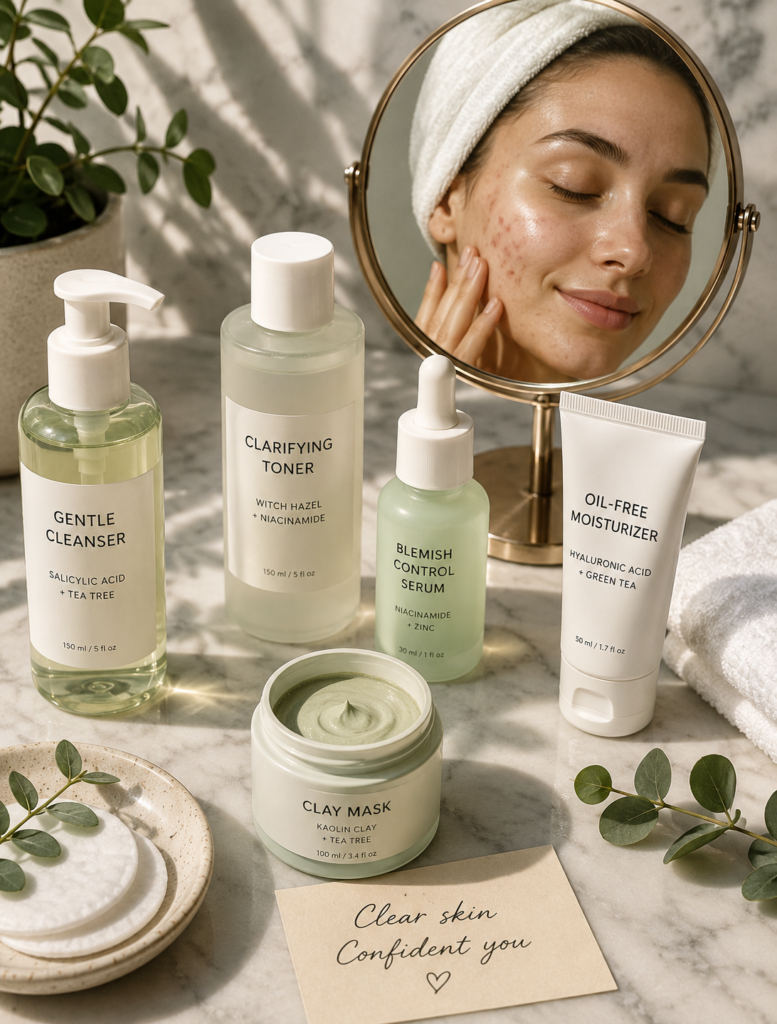
CATEGORY: Acne-Prone Skin
Acne-prone skin is often described as though it has one obvious problem: too much oil. The reality is considerably more complicated. Oil plays an important role, but acne develops through an interaction between sebum, dead skin cells, clogged hair follicles, bacteria, inflammation, hormones, genetics, and sometimes external factors such as certain cosmetics, medications, or repeated friction against the skin.
Understanding these mechanisms changes the way acne-prone skin is treated.
If acne were simply caused by dirt, stronger cleansing would solve it. If it were only caused by oil, removing as much oil as possible would prevent breakouts. If every breakout were caused by the same process, one product would work equally well for everyone.
None of these ideas accurately describes acne.
Acne develops within pilosebaceous units—the structures containing a hair follicle and its associated sebaceous gland. Sebaceous glands produce sebum, an oily substance that contributes to the skin’s protective environment. Problems develop when follicles become clogged and inflammatory processes begin around them.
This means acne is not evidence that someone has failed to keep their skin clean. It is a biological condition, and understanding that distinction is the beginning of more rational skincare.
The Role of Sebum
Sebum is frequently treated as the villain of acne-prone skin, but healthy skin needs it.
Produced by sebaceous glands, sebum contributes to lubrication and helps support the skin’s surface environment. The problem is not that sebum exists. Acne becomes more likely when excess sebum interacts with abnormal accumulation of dead skin cells inside follicles and other acne-related processes.
This helps explain why people with oily skin often experience acne, but also why not everyone with oily skin develops it.
Oiliness and acne-proneness overlap, but they are not identical.
A person can have a shiny complexion and relatively clear skin. Another can experience breakouts while simultaneously dealing with dryness and sensitivity, particularly when acne treatments are already being used.
This distinction matters when choosing skincare.
Attempting to remove every trace of oil can make the skin uncomfortable without addressing the full mechanism behind breakouts.
How a Pore Becomes Clogged
To understand acne, it helps to imagine what is happening before a blemish becomes visible.
Skin cells are constantly being shed. Within an acne-prone follicle, dead cells and sebum can accumulate rather than moving normally out of the follicular opening.
A microscopic blockage begins to form.
As the material builds, different visible lesions can develop.
If the clogged follicle remains closed at the surface, it can appear as a whitehead.
If the opening remains exposed, the material inside can oxidize and darken, creating a blackhead.
The dark appearance of a blackhead is not dirt trapped inside the skin. This misconception sometimes encourages people to scrub aggressively or repeatedly squeeze blackheads, neither of which addresses the underlying tendency of the follicle to clog.
The important process is occurring inside the pore.
Bacteria and Inflammation
Acne is also associated with the bacterium Cutibacterium acnes, commonly abbreviated as C. acnes.
These bacteria normally live on human skin, so their presence alone does not mean something is wrong. Problems arise when conditions within clogged follicles contribute to inflammatory responses.
This is one reason acne can progress from relatively non-inflammatory clogged pores into red, tender lesions.
Inflammation changes the experience of acne dramatically.
A small blackhead may be mainly a cosmetic concern. An inflamed papule can become red and uncomfortable. Deeper nodules or cystic lesions can be painful and carry a greater risk of scarring.
The visible surface of a blemish therefore represents only part of what is happening.
This is also why repeatedly touching or squeezing inflamed acne can be particularly counterproductive. Mechanical pressure can add additional trauma to tissue that is already inflamed.
Hormones and Sebum Production
Hormones are a major reason acne commonly becomes prominent around puberty.
Androgens can stimulate sebaceous glands and increase sebum production. As hormonal activity changes, the skin environment can become more favorable to acne formation.
Hormonal influences do not disappear after adolescence.
Adults can experience acne as well, and hormonal fluctuations may contribute to breakouts in some people. This is particularly noticeable when blemishes seem to follow recurring patterns.
Someone may observe that acne worsens at predictable points rather than remaining constant throughout the month.
Recognizing a pattern can be useful because it prevents every breakout from being blamed on the newest skincare product or yesterday’s meal.
Skin changes can reflect internal processes that no cleanser can completely control.
Why Acne Can Run in Families
Genetics also influence acne susceptibility.
If close family members experienced significant acne, the likelihood of developing acne can be higher.
This does not mean acne is predetermined in every detail. Genetics interact with hormones, skincare practices, environment, and other individual factors.
But genetic influence helps explain why two teenagers with similar hygiene and diets can have completely different skin.
One may experience occasional blemishes.
The other may develop persistent inflammatory acne.
The difference is not necessarily that one person is taking better care of themselves.
This matters emotionally as well as scientifically because acne is frequently treated as though it reflects personal discipline.
It does not.
Does Dirty Skin Cause Acne?
No—and this misconception can create damaging habits.
Because blackheads look dark and oily skin can feel unclean, people sometimes assume that acne results from inadequate washing.
They begin cleansing repeatedly.
Some use strong soaps.
Others scrub with brushes, rough cloths, exfoliating grains, or cleansing devices.
The result can be irritated skin without meaningful improvement in the underlying acne.
Cleansing remains important because sweat, sunscreen, makeup, excess surface oil, and environmental residue should be removed appropriately.
But cleansing should be gentle.
The objective is not to sterilize the face.
Healthy skin contains microorganisms naturally, and acne cannot be scrubbed out of a follicle simply by applying more force to the surface.
Can Skincare Products Cause Breakouts?
Some skincare and cosmetic products can contribute to clogged pores in acne-prone individuals.
This is why terms such as “non-comedogenic,” “oil-free,” or “won’t clog pores” can be useful when choosing products.
However, these labels should not be interpreted as absolute guarantees.
Skin responses vary.
A moisturizer that works beautifully for thousands of people may still feel unsuitable for one individual. Likewise, blaming a product for every new blemish immediately after it is introduced can be misleading because acne lesions do not necessarily form overnight.
A better approach is to introduce new products methodically.
If several products are changed simultaneously and the skin worsens, determining the cause becomes difficult.
One thoughtful change at a time creates more useful information.
Hair Products and Breakouts
Sometimes the product contributing to breakouts is not technically a facial skincare product at all.
Hair oils, styling creams, pomades, conditioners, and other products can come into contact with the forehead, temples, hairline, neck, or back.
For acne-prone individuals, this contact may contribute to clogged pores in characteristic areas.
The location of breakouts can therefore provide clues.
If blemishes cluster mainly around the hairline, consider what repeatedly touches that area.
This does not prove a hair product is responsible, but it provides a reasonable factor to investigate.
Small practical changes can help: keeping oily styling products away from facial skin, washing pillowcases regularly, and cleansing areas where product residue tends to accumulate.
Friction, Pressure, and Acne Mechanica
Acne can sometimes be aggravated by repeated pressure, heat, sweating, and friction.
Helmets, tight straps, sports equipment, masks, or clothing that repeatedly rubs the same area can create conditions where breakouts become more likely.
This pattern is sometimes called acne mechanica.
The important lesson is that skincare products are not always the entire solution.
If a particular area repeatedly breaks out exactly where equipment touches the skin, applying increasingly strong acne treatments without addressing the friction may produce disappointing results.
Look at the environment surrounding the skin.
What repeatedly touches it?
What traps sweat?
Where does pressure occur?
Sometimes the most useful skincare adjustment happens outside the skincare cabinet.
Stress and Acne
Stress is another factor frequently discussed in relation to breakouts.
It is overly simplistic to say that stress directly “causes” all acne. However, stress can worsen existing acne in some people, and stressful periods may coincide with changes in sleep, eating patterns, skincare habits, touching the face, or hormonal activity.
The relationship can also become circular.
Stress contributes to worsening skin.
Worsening skin creates more stress.
The person begins checking the mirror repeatedly, adding products, picking blemishes, or worrying about social situations.
This can make acne occupy far more psychological space than the physical condition alone would suggest.
Recognizing stress as one possible influence does not mean telling someone to “just relax.”
It means understanding that skin exists within a larger biological system.
Diet and Acne: Avoiding Simple Answers
Few acne topics generate more conflicting advice than diet.
People are often told that chocolate, greasy food, dairy, sugar, or individual foods directly caused their breakouts.
Research suggests that dietary patterns may influence acne in some people, but the relationship is more complicated than blaming one food eaten the previous evening.
For example, evidence has explored associations between high-glycemic diets and acne, while dairy has also been investigated. Results do not justify assuming that every person with acne must follow an extremely restrictive diet.
Individual observation can still be useful.
If a person repeatedly notices the same pattern associated with a particular dietary habit, discussing it with an appropriate healthcare professional may be reasonable.
But drastic elimination diets based solely on internet claims can create unnecessary restrictions without guaranteeing clearer skin.
Acne usually deserves a broader explanation.
Medications and Medical Factors
Certain medications can contribute to acne-like eruptions or worsen acne in some individuals.
Hormonal conditions can also influence acne.
This becomes especially relevant when breakouts appear suddenly, become severe, or occur alongside other unexplained physical changes.
Skincare enthusiasts sometimes attempt to solve every problem cosmetically because skincare products are immediately accessible.
But the skin can reflect processes occurring elsewhere in the body.
When the pattern seems unusual or persistent, professional assessment can provide information that another serum cannot.
Why Some Breakouts Become Deep and Painful
Not all acne remains close to the surface.
Inflammation can develop deeper within the skin, producing nodules or cystic lesions.
These blemishes may feel firm or painful and can persist much longer than superficial spots.
They also carry a greater risk of permanent scarring.
This is an important dividing line between everyday cosmetic management and professional treatment.
A person experiencing repeated deep, painful acne should not assume they simply need a stronger cleanser.
The problem is occurring too deeply for surface cleansing to resolve it.
Early dermatologic treatment can be particularly important when scarring is developing because preventing scars is generally easier than treating established scars later.
Why Acne Often Leaves Marks
Even after a blemish has flattened, the skin may not immediately return to its previous appearance.
Inflammation can leave discoloration behind.
Depending on skin tone and individual response, these post-acne marks may appear red, pink, brown, grayish, or darker than the surrounding skin.
These marks are not necessarily permanent scars.
True acne scars involve changes in skin texture, such as depressions or raised areas, whereas post-inflammatory discoloration can gradually fade.
The distinction matters because treatment approaches differ.
It also explains why someone may feel they have “constant acne” even when many of the visible marks are actually evidence of older breakouts rather than active lesions.
Acne Is Usually a Chain of Events
Thinking about acne as a chain is more useful than searching for one villain.
Sebum production changes.
Dead skin cells accumulate abnormally within follicles.
Pores become clogged.
Bacteria interact with the follicular environment.
Inflammation develops.
External factors may worsen the situation.
Hormones and genetics influence susceptibility.
Different acne treatments target different points within this chain.
That is why combination approaches can be effective and why a cleanser alone may not be enough.
It is also why skincare needs patience.
Changing one stage of the acne process does not instantly erase lesions that have already been developing beneath the surface.
What Understanding the Cause Changes
Once acne is understood as a biological process rather than a cleanliness problem, the skincare strategy becomes more rational.
There is less reason to scrub.
Less reason to wash six times a day.
Less reason to panic over every trace of oil.
Less reason to attack the skin with several powerful ingredients simultaneously.
Instead, attention can move toward maintaining a gentle routine, choosing treatments that address acne mechanisms, protecting the skin barrier, observing patterns, and seeking professional treatment when the severity requires it.
This approach may feel less dramatic than declaring war on every blemish.
But acne-prone skin usually benefits more from consistency than aggression.
Learning to Read Your Own Skin
General information provides a framework, but individual patterns still matter.
Observe where breakouts occur.
Notice whether they are primarily blackheads, whiteheads, inflamed pimples, or deeper lesions.
Pay attention to recurring timing.
Consider products that regularly touch the affected areas.
Notice whether aggressive treatment seems to create increasing redness and sensitivity.
Keep changes controlled enough that cause and effect can actually be evaluated.
Over time, this creates a more useful understanding of your skin than constantly responding to isolated blemishes.
Acne-prone skin is not simply skin that needs to be cleaned more thoroughly.
It is skin in which several biological and environmental processes can combine to make clogged and inflamed follicles more likely.
Once those processes are understood, skincare becomes less about fighting the face and more about managing the conditions that allow breakouts to develop.
That change in perspective is one of the most important steps toward building a routine that is both effective and sustainable.
 Discover More From Our Family of Websites
 ZodiacBearing (Astrology, Tarot, Numerology, Angel Numbers & Spiritual Guidance)
 Velourana (Beauty, Makeup, Hair Care, Skincare & Beauty Tips)
 HavenBearing (Home, Living, Organization, Décor & Everyday Inspiration)
 PawBearing (Pet Care, Dog Breeds, Animal Health, Training & Pet Products)
 PsyCatherine (Notes From the Journal of a Psychologist on Real Life)