
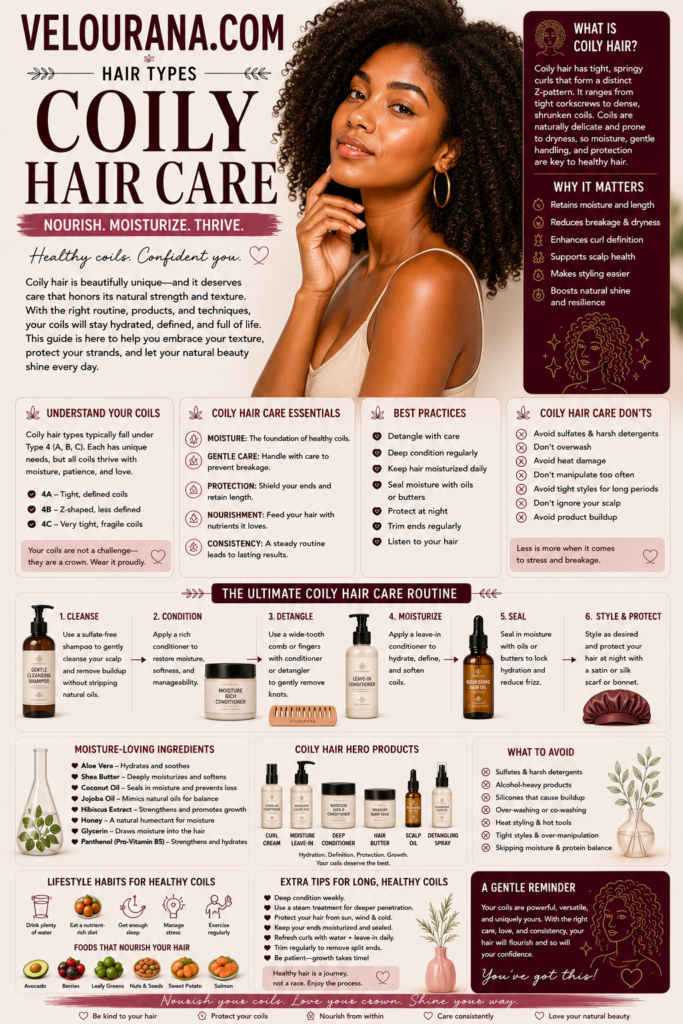
CATEGORY: Coily Hair Care
Wash day has acquired almost legendary status in conversations about coily hair. It can be described as a ritual, a project, an act of self-care, or an exhausting obligation that occupies half a weekend. Entire routines have grown around pre-shampoo treatments, sectioning, cleansing, conditioning, deep conditioning, detangling, moisturizing, sealing, stretching, styling, and drying.
The complexity is understandable. Dense, tightly coiled hair can require more deliberate handling than hair that separates and aligns easily. A hurried approach can create tangles that take longer to resolve than they took to produce. Products must reach through density. Shed hairs can remain trapped within coils. Drying may take considerable time.
But complexity is not the objective.
A successful wash day is not measured by the number of steps completed. It is measured by whether the scalp becomes appropriately clean, accumulated material is removed, the hair is conditioned sufficiently for manageable detangling, unnecessary breakage is minimized, and the finished hair can move comfortably into the next part of the routine.
Once wash day is understood as a sequence of functions rather than rituals, it becomes easier to simplify.
The hair needs to be cleaned.
It needs to be conditioned.
Accumulated shed strands need to be released.
Tangling needs to be managed.
The hair then needs to be prepared for whatever style follows.
Everything else should earn its place.
Wash Day Begins Before Water Touches the Hair
The condition in which coily hair enters the shower influences everything that follows.
Hair that has been loose for a week may contain substantial tangling and trapped shed strands. Hair removed from long-term braids may contain weeks of accumulated shedding. A heavily styled wash-and-go may carry significant gel residue. Hair worn in simple twists may be relatively organized already.
Treating all of these situations identically makes little sense.
Before washing, it can be useful to assess what the hair actually requires.
If sections have become severely tangled, some gentle separation before shampooing may prevent water and manipulation from tightening those tangles further. If the hair is already organized into manageable sections, elaborate preparation may be unnecessary.
Pre-shampoo treatments, often called pre-poos, can provide lubrication before cleansing and may make detangling easier for some people. Oils, conditioners, or purpose-designed treatments are commonly used.
But a pre-poo is not compulsory simply because the hair is coily.
If shampooing and conditioning already leave the hair manageable, adding another step may increase time without producing a meaningful benefit.
The useful question for every preliminary treatment is simple: what problem does this solve?
If there is no clear answer, the routine may not need it.
Sectioning Creates Control
For dense or long coily hair, sectioning can transform wash day.
Loose hair moves freely. As water, hands, and shampoo interact with it, strands can cross between areas and create new tangles.
Sections limit that movement.
Four sections may be sufficient for one person. Another may prefer six, eight, or more. Extremely dense hair may be easier to manage in relatively small portions.
The correct number is the number that allows water and product to reach the hair without turning the process into unnecessary administration.
Sections should not be secured so tightly that they become difficult to open and close during washing.
The purpose is organization.
Once divided, each area can be saturated, cleansed, conditioned, detangled, and temporarily secured before moving to the next.
This makes it easier to know which hair has already been handled and which still needs attention.
More importantly, it reduces uncontrolled interaction between strands.
Saturation Is More Important Than It Looks
Dense coily hair can appear wet on the surface while remaining surprisingly dry underneath.
Before cleansing, water should reach the scalp and penetrate through the sections.
This may take time.
Instead of immediately adding more shampoo when a product seems difficult to distribute, it can be useful to ensure the hair is genuinely saturated first.
Water helps shampoo move across the scalp and through the hair. Proper saturation can also begin loosening some water-soluble residues before cleanser is introduced.
Working section by section makes this easier.
The objective is not to rush water over the exterior.
It is to allow the entire head to participate in the wash.
The Scalp Is the Primary Cleansing Environment
Hair washing is frequently discussed as though shampoo exists mainly to clean the strands.
In routine care, the scalp is often the central target.
Sebum originates there. Sweat accumulates there. Skin cells shed there. Many styling products are applied near it.
Using the fingertips to work cleanser across the scalp can remove accumulated material without requiring aggressive scratching.
Fingernails are not necessary for effective cleansing and may irritate the skin when used forcefully.
The amount of lather is also an imperfect measure of cleanliness.
Some formulas produce abundant foam; others produce less. Heavy oil or product buildup can suppress lather during an initial cleanse, which is one reason some people prefer shampooing twice when the hair is particularly coated.
A second cleanse should respond to need rather than become an unquestioned rule.
If the scalp and hair are adequately clean after one application, another may provide little benefit.
Clean Hair Does Not Need to Feel Stripped
There is a persistent idea that truly clean hair should squeak.
That sensation is not necessary.
The objective of cleansing is to remove enough sebum, debris, and product residue to restore a comfortable scalp and workable hair surface.
If cleansing consistently leaves the hair extremely rough and difficult to separate, the shampoo may be too aggressive for the frequency or routine, or the subsequent conditioning may be insufficient.
At the opposite extreme, avoiding effective cleansing because any shampoo is assumed to be drying can allow buildup to accumulate.
The balance lies between these positions.
Coily hair benefits from cleansing that is strong enough for the products and lifestyle involved but not unnecessarily harsh.
A person using heavy butters, oils, gels, and edge-control products may need a different cleansing strategy from someone using only lightweight styling products.
Exercise frequency, scalp oiliness, environmental exposure, and wash interval also matter.
Cleansing should match reality.
Clarifying Has a Place
Even a well-designed regular shampoo may eventually struggle with certain types of buildup.
Styling polymers, heavy oils, butters, mineral deposits from hard water, and repeated product layering can alter the way hair feels.
It may become dull, coated, unusually heavy, resistant to wetting, or difficult to style.
Clarifying shampoos provide more thorough cleansing and can be useful periodically.
The word periodically is important.
Clarifying does not need to become a weekly act of punishment unless the routine genuinely creates buildup at that pace.
After thorough cleansing, hair may feel different simply because layers that had been coating it are gone.
Conditioning afterward helps restore lubrication and manageability.
For people living in hard-water areas, mineral accumulation may also affect the hair. Chelating formulations are designed specifically to interact with certain mineral deposits and are not exactly the same thing as ordinary clarifying shampoos.
Again, the product should correspond to the problem rather than the category becoming another compulsory step.
Conditioner Changes the Mechanical Environment
The transition from shampoo to conditioner is one of the most important moments of wash day.
Cleansed coily hair can contain thousands of strands sitting close together with considerable opportunity for friction.
Conditioner changes the way those strands interact.
A formula with good slip allows fibers to slide against one another more readily. This makes separation easier and reduces the amount of force required during detangling.
For this reason, conditioner should generally be distributed sufficiently through the lengths rather than placed superficially over the outside of a dense section.
Adding water while working conditioner through the hair can help some formulas distribute more effectively.
The hair can then be gently compressed, smoothed, or worked through with the hands.
This is not about forcing the cuticle closed through a particular hand movement.
It is about achieving useful coverage.
Detangling Should Be Deliberate
Detangling is often the most time-consuming part of coily hair wash day.
It is also one of the stages most capable of influencing breakage.
The ideal environment combines lubrication, manageable section sizes, and controlled force.
Many people prefer detangling while conditioner is present because the hair has greater slip.
Fingers can locate larger tangles before a tool encounters them.
A wide-tooth comb or suitable detangling brush can then help organize strands more efficiently.
Starting near the ends and moving gradually upward remains a practical approach because resistance is removed progressively.
What matters most, however, is responsiveness.
When a tool stops, the hand should stop.
Pulling harder does not make the tangle disappear. It merely transfers force to the hair.
The section can be separated further. More water or conditioner can be added. Fingers can investigate the obstruction.
Sometimes a shed strand has wrapped around several attached hairs and can be gently released.
Sometimes an individual knot has formed.
Occasionally a knot is too tight or damaged to justify prolonged manipulation, and careful trimming is the cleaner solution.
Detangling is not a contest between the tool and the hair.
It is controlled separation.
Shed Hair Can Make Wash Day Look More Dramatic Than It Is
Coily hair holds onto shed strands remarkably well.
A straight shed hair may fall onto clothing or the floor during the day. A tightly coiled shed hair can remain entangled among neighboring fibers until the next detangling session.
The longer the interval between thorough detangling, the more accumulated hair may appear during wash day.
This is especially noticeable after protective styles.
Seeing a large collection of strands can therefore be unsettling without necessarily indicating abnormal loss.
Context matters.
How long has it been since the hair was fully detangled? Was it contained in braids or twists? Are the strands predominantly full-length shed hairs or numerous short broken pieces?
Sudden or substantial changes in shedding, patchy loss, scalp symptoms, or other unusual patterns deserve professional attention.
But accumulated routine shedding should not automatically trigger panic.
Deep Conditioning Should Have a Purpose
Deep conditioning is perhaps the most ritualized part of textured-hair wash day.
Masks are left on for extended periods, often under plastic caps, heated dryers, steamers, or thermal caps.
These products can provide excellent conditioning.
But the term deep does not automatically mean a treatment is necessary every time hair is washed.
A high-quality rinse-out conditioner may already provide sufficient performance for healthy, minimally processed hair.
Hair that is chemically processed, frequently heat styled, highly weathered, or simply responds particularly well to richer treatments may benefit from more intensive conditioning.
The decision should be based on results.
If a mask consistently leaves the hair easier to detangle and more manageable without creating buildup, it has earned its place.
If it produces little noticeable difference from the regular conditioner, the additional thirty minutes may be optional.
Wash day becomes more sustainable when steps survive because they work rather than because they are traditional.
Heat Can Improve Convenience Without Becoming Mandatory
Warmth is often incorporated into conditioning because it can alter the way products interact with hair and can make the process feel more effective.
But extremely high temperatures are unnecessary.
A warm cap or hooded dryer may make a conditioning session more pleasant and useful for some people.
Others achieve excellent results without additional heat.
Steam has also become popular in coily hair routines.
Again, it can be enjoyable and may influence the feel of the hair, but it should not become another requirement imposed on everyone with textured hair.
The routine should remain proportionate.
If achieving healthy, manageable hair requires an expanding collection of specialized devices, it is worth testing whether the same result can be produced more simply.
Rinsing Is Part of Conditioning
How conditioner is rinsed can influence the final feel of the hair.
Leaving large amounts of a rinse-out product behind is not necessarily equivalent to using a leave-in conditioner.
Products are formulated for particular uses.
Some rinse-out conditioners may leave hair feeling pleasant when a small residual amount remains, while others can produce buildup or scalp irritation when not removed as intended.
Following product directions is generally a sensible starting point.
Temperature myths should also be kept in perspective.
Cold water is often said to "seal" the hair completely and create dramatic shine. Hair does not operate through such a simple opening-and-closing mechanism.
Comfortable water temperature and gentle handling matter more than finishing every wash under an unpleasantly cold shower.
The Transition From Washing to Styling Is Critical
Freshly washed and detangled coily hair is in a relatively organized state.
What happens next determines whether that organization survives.
Leaving the entire head loose while moving around, dressing, preparing products, or waiting for styling can allow sections to contract and intertwine again.
Keeping completed areas sectioned can preserve control.
Styling products can then be applied methodically.
A leave-in conditioner may be useful when additional conditioning and manageability are desired. Creams can provide richness and lubrication. Gels can create hold and definition. Mousses may provide lighter styling control.
Not every product category is necessary.
The styling combination should correspond to the desired result.
A wash-and-go needs different support from twists intended to remain installed for a week.
Hair being prepared for a stretched style may require another approach entirely.
Applying More Product Is Not the Same as Better Styling
Freshly washed coily hair can absorb or hold a surprising amount of product, particularly when dense.
This can encourage generous application.
But there is a point beyond which additional product stops improving the result.
Excess cream may increase drying time dramatically. Too much gel can create flaking or an unnecessarily heavy cast. Multiple oils and butters may reduce movement and accelerate buildup.
Product application should therefore begin conservatively enough that performance can be observed.
Water is often an important part of distribution.
Many stylers perform best on wet or very damp hair because water helps products move through sections and supports coil grouping.
If a style repeatedly requires enormous amounts of product to work, technique or product choice may deserve reconsideration.
Drying Is Not an Empty Interval
Coily hair can take a long time to dry.
Density, product quantity, section size, climate, and hairstyle all influence the process.
Allowing hair to remain wet for extremely prolonged periods can be inconvenient and may compromise the intended style.
Air-drying is one option.
Hooded dryers and diffusers can accelerate drying and may help set certain styles.
Blow-dryers can stretch hair when that is the desired result.
Heat should be controlled, but drying tools do not need to be treated as forbidden objects.
The appropriate method is the one that achieves the required result while respecting the condition of the hair.
For wash-and-go styling in particular, minimizing unnecessary touching while the hair dries can help preserve coil grouping and reduce frizz.
Once fully dry, a firm gel cast can often be gently softened if desired.
Wash Frequency Should Follow the Scalp and Lifestyle
There is no universal rule requiring coily hair to be washed every seven days, every fourteen days, or according to any other fixed interval.
Frequency should reflect what is happening to the scalp and hair.
Someone exercising intensely several times per week may prefer more frequent cleansing.
Someone using substantial styling products may notice buildup relatively quickly.
Another person may wear low-product styles and remain comfortable for longer.
The scalp provides useful information.
Persistent buildup, oiliness, itching, odor, or discomfort suggests that extending wash intervals solely to protect the hairstyle may be counterproductive.
At the same time, washing more frequently than necessary can increase manipulation and workload.
The best schedule is one that maintains cleanliness and comfort without making hair care unnecessarily disruptive.
A Wash Day That Takes All Day May Need Examination
Some people genuinely enjoy long wash-day rituals.
There is nothing wrong with that.
But when six or eight hours of hair care becomes an unwanted obligation, simplification deserves consideration.
Which steps are actually consuming the time?
Is pre-detangling necessary if the hair will be detangled with conditioner?
Are both a rinse-out conditioner and a long deep-conditioning treatment producing noticeable benefits?
Are five styling products accomplishing something that two cannot?
Would slightly more frequent washing prevent the severe tangling that makes each session so long?
Would a different hairstyle reduce detangling difficulty?
The goal is not to race.
Rushing coily hair can create damage.
But efficiency and gentleness are not opposites.
A well-designed routine can become faster because fewer problems are being created between wash days.
Wash Day Is Part of a Cycle
The condition of hair on wash day is partly determined by everything that happened since the previous wash.
If the hair was protected at night, detangling may be easier.
If it was manipulated aggressively every morning, more breakage may appear.
If excessive product was layered daily, cleansing may take longer.
If a stable low-manipulation style was maintained, sections may remain relatively organized.
Wash day therefore cannot be perfected in isolation.
It is the reset point in a continuous cycle.
The better the routine between washes, the easier the next wash often becomes.
And the better the wash, the easier the next several days can become.
The Scalp Sets an Important Boundary
Beauty routines should never require ignoring persistent physical symptoms.
A scalp that repeatedly becomes painful, intensely itchy, inflamed, unusually flaky, or otherwise uncomfortable is communicating something more important than hairstyle longevity.
Changing shampoos, reducing product buildup, avoiding irritating ingredients, or modifying styling practices may help in ordinary cases.
But persistent or significant symptoms deserve appropriate professional assessment.
The same applies to unusual hair loss.
Cosmetic hair care is powerful within its proper domain.
It should not be used to disguise conditions that require medical evaluation.
The Best Routine Is Repeatable
A theoretically perfect wash routine that is so complicated that it is constantly postponed may be less useful than a simpler routine performed consistently.
Sustainability matters.
Coily hair does not need ceremonial perfection.
It needs regular opportunities to be cleansed, conditioned, detangled, and reorganized without excessive damage.
A routine that can realistically coexist with work, family, exercise, travel, sleep, and ordinary life is more valuable than one designed for an imaginary schedule with unlimited time.
As technique improves, wash day often becomes less intimidating.
The hands learn how much conditioner is enough.
Sections become intuitive.
The point at which a tangle needs more attention becomes recognizable.
Product quantities become predictable.
Drying methods become familiar.
What once felt like a complicated project becomes maintenance.
From Ritual to Understanding
Wash day is one of the clearest demonstrations that effective coily hair care is not about forcing the texture into obedience.
Water makes coils contract.
Cleansing releases accumulated material.
Conditioning changes the relationship between neighboring strands.
Detangling removes shed fibers and restores organization.
Styling determines how that organization will be maintained.
Drying allows the chosen structure to settle.
Each stage works with the physical reality of coily hair.
When the routine becomes difficult, the answer is not always another product or another step.
Sometimes the hair needs smaller sections.
Sometimes it needs more thorough cleansing.
Sometimes it needs better conditioning.
Sometimes it needs to be washed sooner.
Sometimes the style between wash days is creating the problem.
And sometimes the routine has simply accumulated traditions that are no longer serving a purpose.
The most refined wash day is therefore not necessarily the longest or most luxurious.
It is the one in which every important function is accomplished with the least unnecessary conflict between hands, products, scalp, and fiber.
Cleanse what needs cleansing.
Condition what needs conditioning.
Separate what has tangled.
Protect what has survived.
Then allow the coils to return to life on their own terms.
That is enough to turn wash day from an exhausting battle into what it was always supposed to be: the foundation of everything that follows.
The End
Velourana.
 Discover More From Our Family of Websites
 ZodiacBearing (Astrology, Tarot, Numerology, Angel Numbers & Spiritual Guidance)
 Velourana (Beauty, Makeup, Hair Care, Skincare & Beauty Tips)
 HavenBearing (Home, Living, Organization, Décor & Everyday Inspiration)
 PawBearing (Pet Care, Dog Breeds, Animal Health, Training & Pet Products)
 PsyCatherine (Notes From the Journal of a Psychologist on Real Life)

