
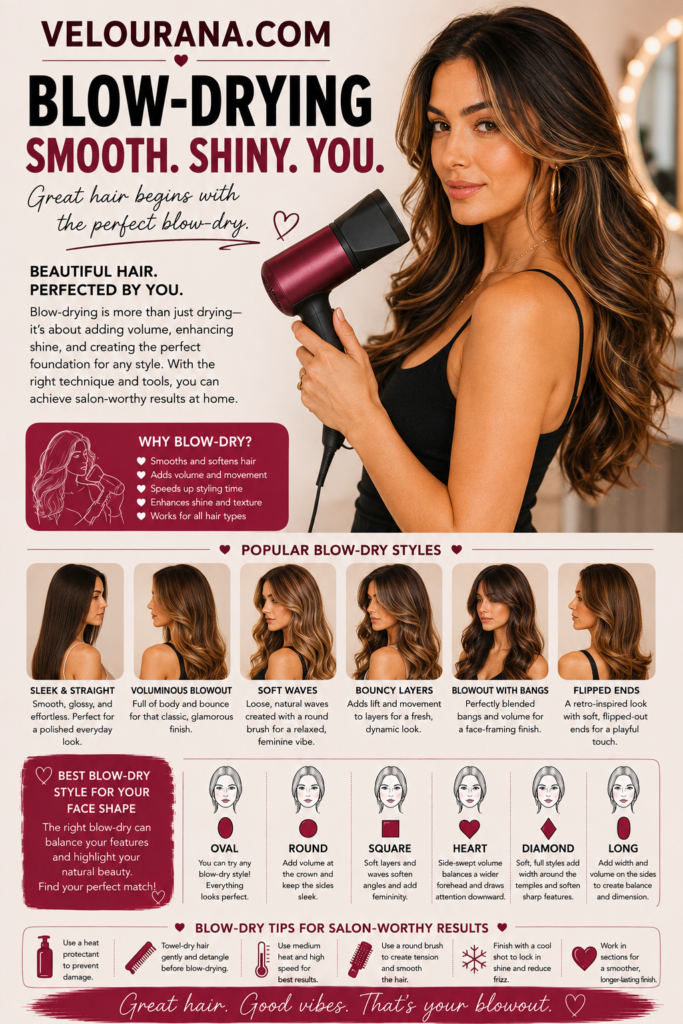
CATEGORY: Blow-Drying
Volume is one of the most sought-after effects in blow-drying, but it is also one of the easiest to misunderstand. More volume does not simply mean making the hair as large as possible. A strong blowout usually has volume in specific places: lift at the roots, fullness through the crown, enough movement through the lengths to prevent collapse, and ends that support the overall shape rather than hanging separately from it.
When volume is placed well, the hairstyle looks alive.
The crown has presence.
The front opens naturally.
Layers move instead of sitting flat against one another.
The hair still feels controlled.
When volume is added without direction, the result can become too wide, too fluffy or visually disconnected. This is why root positioning, sectioning and brush direction matter so much. The dryer does not merely dry the hair. It helps determine where that fullness will sit once the moisture has gone.
The most effective voluminous blow-dry therefore begins with strategy rather than heat. The question is not simply how to make the hair bigger. It is where the hair should lift, where it should remain smoother, and how those areas should connect.
Root Lift Is the Foundation of a Voluminous Blowout
Volume that appears only through the ends can make the hairstyle look wide without creating true lift.
The roots determine the silhouette.
If the hair dries flat against the scalp, the upper shape remains compressed. Creating volume later becomes more difficult because the roots have already settled into their resting position.
Blow-drying provides an opportunity to influence that position while the hair is still responsive.
At the crown, sections can be lifted away from the scalp during drying. The hair can be directed upward or slightly beyond the direction in which it will eventually fall. When released, the roots return with more space beneath them.
This technique is often more effective than trying to create volume by using stronger heat or more styling product.
The lift comes from direction.
The hair has been encouraged to dry with height built into its base.
Overdirection Creates Volume Without Needing Excessive Teasing
Overdirection means moving the hair temporarily away from its natural resting place.
A crown section that normally falls backward can be lifted upward.
A front section can be directed slightly away from where it will eventually sit.
Once dry, the hair returns toward its natural position but retains some of that movement.
This creates volume that feels integrated rather than artificially added afterward.
The technique is particularly useful on fine or straight hair, where the roots may otherwise settle very close to the scalp.
It can also help wavy and thicker hair by placing fullness where it contributes most to the shape.
Not Every Area Needs the Same Amount of Lift
One of the most common mistakes in volume styling is elevating every section equally.
This can create width instead of height.
The crown usually benefits most from lift.
The upper sides may need moderate volume.
The lower sides often look better when they remain more controlled.
The hairstyle becomes more flattering when the fullness is distributed strategically.
A round, expanded shape everywhere can make the head appear wider. A lifted crown with smoother sides creates a more deliberate silhouette.
The Front Determines How Open the Hairstyle Feels
The sections around the face deserve their own approach.
If the front is dried flat and inward, the hairstyle can feel closed even when the crown has volume.
If those sections are lifted and directed away from the face, the entire blowout feels more open.
Long face-framing layers can be shaped outward.
Curtain bangs can be encouraged to split naturally and sweep back.
Shorter layers can gain lift near the roots before curving into the rest of the hair.
The goal is not creating an exaggerated flip.
It is allowing the front to participate in the volume rather than remaining disconnected from it.
Curtain Bangs Can Create the Illusion of More Overall Volume
Curtain bangs are particularly useful in voluminous blowouts because their shape creates movement close to the face.
The center opens.
The outer sections sweep back.
The roots can retain some elevation.
This makes the upper portion of the hairstyle feel fuller even when the rest of the hair remains relatively controlled.
The effect is especially strong when the bangs blend into longer layers.
The eye follows the movement outward and upward, which reinforces the impression of volume.
A Large Round Brush Creates Broad Lift Rather Than Tight Curl
Brush size has a major influence on the type of volume created.
A larger round brush produces broad curves.
The section wraps around a wider diameter, so the resulting movement remains softer.
This is ideal for classic blowout volume.
The hair lifts at the root and gains body through the length without becoming tightly curled.
A smaller brush creates stronger bends. This can be useful for shorter layers or fringe, but if used throughout long hair, the result may move away from a voluminous blowout and toward a more curled style.
The brush should therefore match both the haircut and the desired scale of movement.
The Brush Should Lift Before It Rolls
Root volume is often lost when the brush immediately pulls a section downward.
The root needs elevation first.
A crown section can be lifted away from the scalp before the brush begins guiding the lengths.
Once the root is positioned, the brush can travel through the rest of the section and create the desired curve.
This sequence matters.
Lift first.
Shape second.
If the root is flattened before the length is styled, the blowout may have curved ends but little actual volume.
The Dryer Should Follow the Direction of the Brush
Volume depends on coordination between the tools.
The brush positions the section.
The dryer follows.
At the root, the airflow supports the elevated position.
Through the lengths, it follows the curve created by the brush.
If the dryer moves independently, the section can become inconsistent.
If the brush is held stationary under concentrated heat, unnecessary exposure can build in one area.
The two tools should move together as one system.
Section Size Determines Whether the Volume Is Real or Superficial
A very large section may look voluminous on the outside while remaining damp or flat underneath.
Smaller, manageable sections allow the roots to be lifted properly and the airflow to reach through the hair.
Dense hair often needs more divisions.
Fine hair may require fewer.
The goal is not creating as many sections as possible.
It is making each one controllable.
If the brush cannot lift the full section from the root, the section is too large.
The Crown Should Be Built Progressively
Volume at the crown usually comes from several neighboring sections rather than one oversized piece.
Each section contributes a small amount of lift.
Together, they create a fuller profile.
This produces a more natural result than trying to create one dramatic bump in a single area.
The crown should feel integrated with the rest of the hairstyle.
The Hair Should Not Be So Wet That the Brush Is Doing All the Drying
A voluminous blowout becomes inefficient if round-brush work begins while the hair is still saturated.
Much of the process then becomes simple moisture removal.
The roots and lengths are repeatedly exposed to heat before the actual styling stage begins.
Removing some excess moisture first allows the brush work to focus on shape.
The hair remains damp enough to respond, but the dryer is no longer fighting large amounts of water.
Rough-Drying Can Create Early Root Movement
During the initial drying stage, the fingers can lift the roots.
The hair does not need to lie flat while moisture is being removed.
The crown can be encouraged upward.
The front can be directed away from the face.
This gives the later brush work a better starting point.
The early drying stage therefore contributes to volume even before detailed sectioning begins.
Fine Hair Benefits From Early Root Direction
Fine hair often collapses quickly if allowed to dry flat.
Using the hands to keep the roots moving during initial drying can make a noticeable difference.
The crown does not need aggressive styling.
It simply needs to avoid being pressed into one flat position while moisture leaves the hair.
Later, a round brush can refine and strengthen the lift.
Fine Hair Needs Volume Without Weight
Product choice becomes especially important on fine hair.
Heavy application can work against the volume created during drying.
The roots may become coated and begin falling closer to the scalp.
The lengths can separate into heavier sections.
A lighter approach usually preserves movement more effectively.
The styling technique should provide much of the lift itself rather than relying on product alone.
Fine Hair Often Responds to Fewer, Larger Curves
Creating many small curled sections can make fine hair look busy rather than full.
Broad movement often works better.
A large brush can create root lift and gentle body.
The sections then fall together into a smoother, fuller shape.
The hair appears more substantial because it occupies space without becoming fragmented.
Thick Hair Creates Volume Easily but Needs Control
Dense hair already contains significant natural fullness.
The challenge is not necessarily creating more.
It is deciding where that volume should sit.
The crown may need lift.
The lower sides may need restraint.
The ends may need shaping so the hairstyle does not become triangular or excessively wide.
A voluminous blowout on thick hair is therefore often about redistributing fullness rather than generating it from nothing.
Thick Hair Needs Smaller Sections for Reliable Root Lift
A large dense section is difficult to lift evenly.
The brush may elevate the outer hair while the interior remains flat.
Smaller sections allow the entire root area to respond.
They also help the hair dry more completely.
This creates volume that begins at the scalp rather than simply appearing through the outer surface.
Long Hair Can Lose Volume Through Its Own Weight
Length creates weight, and weight pulls downward.
A crown section may leave the brush with excellent lift and then gradually soften as the long lengths settle.
This is normal.
Long hair often benefits from slightly stronger initial root elevation than the final result requires.
The hairstyle can then relax into a more natural level of volume.
Long Layers Can Support Volume Better Than One Solid Length
Layered hair distributes weight differently.
Shorter upper sections are easier to lift.
They create movement around the crown and sides.
Longer layers provide continuity beneath them.
This makes a layered haircut particularly responsive to blowout styling.
The volume appears to cascade through several lengths rather than sitting only at the roots.
One-Length Hair Creates a Different Type of Fullness
Hair cut closer to one length can still become voluminous, but the movement tends to remain more unified.
The ends carry more weight.
The crown may need more deliberate root work.
Large curves through the lower hair can prevent the silhouette from feeling too heavy.
The final result is usually smoother and more continuous than a layered blowout.
Medium Hair Holds Bounce Particularly Well
Medium lengths often create an excellent balance between movement and weight.
There is enough length for visible curves.
There is not so much weight that every section immediately stretches downward.
The crown can stay lifted.
The ends can retain their bend.
This makes medium hair especially suitable for bouncy blow-drying.
Short Hair Creates Volume Mainly Through Direction
Short hair cannot rely on long curved lengths to create fullness.
The roots become the main styling area.
The crown can be lifted.
The sides can be directed according to the desired silhouette.
The fringe can be shaped separately.
A smaller round brush or fingers may provide greater control than a very large barrel.
Bobs Can Become Fuller Without Becoming Round Everywhere
A bob often looks strongest when volume is concentrated strategically.
The crown can lift.
The sides can retain shape.
The ends can curve inward or outward.
If every section is over-rounded, the haircut can become too circular.
The blow-dry should reveal the cut rather than bury it inside uniform volume.
The Ends Should Support the Volume Above Them
A blowout can have beautiful root lift and still feel unfinished if the ends hang rigidly.
The lower movement should continue the shape created above.
Broad inward curves create a more contained silhouette.
Outward bends can make layers feel more open.
Alternating movement can create a natural, flowing result.
The ends do not need dramatic curls.
They simply need direction.
Outward Ends Can Make Layers Look More Expansive
When face-framing and upper layers move outward, the hairstyle becomes more open.
This creates visible dimension around the sides.
The effect can be particularly flattering when the crown also has lift.
The overall shape becomes airy rather than flat.
Inward Ends Create a Fuller but More Controlled Silhouette
Turning the ends under can still create volume, but the movement remains contained.
This works well on medium cuts, bobs and long hair when the objective is body without a highly flipped finish.
The curve supports the shape rather than expanding away from it.
Wavy Hair Can Use Its Existing Texture as Volume
Naturally wavy hair often does not need much help occupying space.
The blow-dry can focus on organizing that volume.
The roots can be lifted.
Stronger irregular bends can be softened into broader curves.
The lengths can retain some of their natural movement.
The result becomes a voluminous blowout that still looks connected to the original texture.
Wavy Hair Does Not Need to Be Completely Straightened First
Trying to remove every wave before rebuilding volume can create unnecessary work.
The existing texture can contribute to the finished shape.
A large brush can stretch the waves into broader movement without erasing them completely.
This often produces a more natural result.
Curly Hair Can Create a Voluminous Stretched Blowout
Curly hair can be stretched during blow-drying while still retaining significant body.
The objective does not need to be pin-straight hair.
Controlled tension can elongate the curl pattern.
A large round brush can create broad movement.
The roots can maintain lift.
The final result can be full, soft and visibly textured.
Curly Hair Can Also Be Diffused for Natural Volume
If maintaining the natural curl pattern is the goal, a diffuser offers a different route to volume.
The roots can be positioned so they do not dry flat.
The curls can retain their natural shape.
Volume emerges from the texture itself rather than from stretching and round-brushing.
The two techniques should not be confused.
One creates a stretched blowout.
The other preserves the curl pattern.
Coily Hair Can Build Volume Through Stretching or Natural Texture
Coily hair can create impressive volume in both stretched and natural finishes.
A controlled blow-dry can elongate the pattern while preserving body.
A diffuser can support the existing texture.
The hairstyle should be planned according to the desired result rather than assuming volume requires straightening.
The natural structure already provides substantial fullness.
Cooling Helps Preserve Lift
Once a root section has been elevated and dried, allowing it to cool briefly can help the shape settle.
The hair can remain around the brush or in its lifted position while cooler air is used.
This is particularly useful at the crown.
The section has already been dried.
Cooling simply completes the styling phase.
The Front Can Be Cooled in Its Final Direction
Face-framing pieces can also benefit from this.
A section swept away from the face can remain in that position briefly.
Curtain bangs can cool while opened outward.
This helps the front retain the intended movement as the rest of the hair is styled.
Volume Should Be Evaluated From the Side
The front view can be misleading.
Hair may look full around the face but completely flat through the crown.
The side profile reveals whether the volume is actually distributed well.
A balanced blowout usually shows a gentle lift through the upper head rather than one isolated elevated section.
The Back Matters Just as Much
A voluminous front with a flat back can make the hairstyle feel incomplete.
The crown and upper back should contribute to the silhouette.
This is where systematic sectioning becomes valuable.
Every area receives attention rather than only the sections visible in the mirror.
The Final Blend Should Remove Section Lines Without Removing Volume
Once the entire head is dry, the hair may still show the divisions used during styling.
The sections can be blended gently.
The fingers can loosen the roots.
A brush can soften the lengths if appropriate.
The goal is not to flatten the blowout.
It is to make the separate pieces read as one hairstyle.
Overbrushing Can Destroy the Volume You Just Created
A strong blowout can lose much of its lift if the hair is brushed repeatedly afterward.
The crown can collapse.
Broad curves can straighten.
The ends can lose their movement.
Finishing should therefore be restrained.
Blend only as much as necessary.
Finishing Products Should Preserve Air and Movement
A voluminous style depends on the hair occupying space.
Products that make the strands heavy can reduce that effect.
The finish should support the shape without turning the hair into rigid or coated sections.
Fine hair generally needs particular restraint.
Dense or coarse hair may tolerate more product, but the same principle applies: use only what supports the desired result.
Volume Does Not Need to Feel Stiff
A successful blowout should move.
The roots can remain lifted while the lengths swing naturally.
The ends can curve without feeling fixed.
The hairstyle should respond when the head turns.
This movement is part of what makes volume look believable.
Humidity Can Change the Shape
Environmental moisture can affect the blowout after styling.
Fine straight hair may lose some lift.
Wavy or curly hair may begin returning toward its natural pattern.
Dense hair may expand.
The exact response varies.
A voluminous hairstyle should therefore be expected to evolve rather than remain perfectly static.
The Next Day May Need Only a Root Refresh
The lengths can remain attractive while the crown loses some lift overnight.
In that case, the entire blowout does not need to be recreated.
A few root sections can be addressed selectively.
The front can be reshaped.
The ends can be left alone if they still look good.
This avoids unnecessary repeated heat.
Bangs and Face Framing Usually Need Refreshing First
Because they are shorter and exposed to more movement, these areas can lose shape more quickly.
Restoring the front can make the whole hairstyle look refreshed even when the back has barely been touched.
Targeted styling is more efficient than restarting from zero.
A Voluminous Blowout Should Reflect the Haircut
The haircut determines where volume naturally makes sense.
Layers invite movement.
A blunt bob requires more controlled shape.
Long hair needs root lift strong enough to resist weight.
Short hair relies heavily on root direction.
Blow-drying works best when it amplifies the existing architecture of the cut.
The Goal Is Lift With Shape, Not Size for Its Own Sake
Volume is most attractive when it supports the hairstyle.
The crown rises.
The front opens.
The lengths move.
The ends complete the silhouette.
There is no need for every section to be maximized.
More is not always better.
Strategic lift can create a stronger result than uncontrolled fullness.
When Volume Comes From Direction Instead of Excess
The most successful voluminous blowouts often look surprisingly natural because the volume has been built into the shape rather than added on top of it.
The roots were lifted while they dried.
The crown was given more elevation than the lower sides.
Face-framing sections were directed outward.
The brush size created broad curves instead of tight curls.
The ends were shaped to support the movement above them.
Fine hair gained space without being overloaded.
Thick hair had its natural fullness redistributed.
Long hair was given stronger initial lift to compensate for weight.
Medium hair retained bounce.
Waves and curls were organized rather than erased.
Every part of the hairstyle had a purpose.
That is the difference between hair that is simply large and hair that looks voluminous.
True blowout volume is directional.
It begins at the roots, continues through the lengths and resolves at the ends.
When those areas work together, the hairstyle appears fuller without becoming shapeless, polished without becoming flat and expressive without looking overworked.
The volume is there because the hair was taught where to sit while it dried.
And that is what gives a blowout its lift long before any finishing product is added.
The End
Velourana.
 Discover More From Our Family of Websites
 ZodiacBearing (Astrology, Tarot, Numerology, Angel Numbers & Spiritual Guidance)
 Velourana (Beauty, Makeup, Hair Care, Skincare & Beauty Tips)
 HavenBearing (Home, Living, Organization, Décor & Everyday Inspiration)
 PawBearing (Pet Care, Dog Breeds, Animal Health, Training & Pet Products)
 PsyCatherine (Notes From the Journal of a Psychologist on Real Life)

