
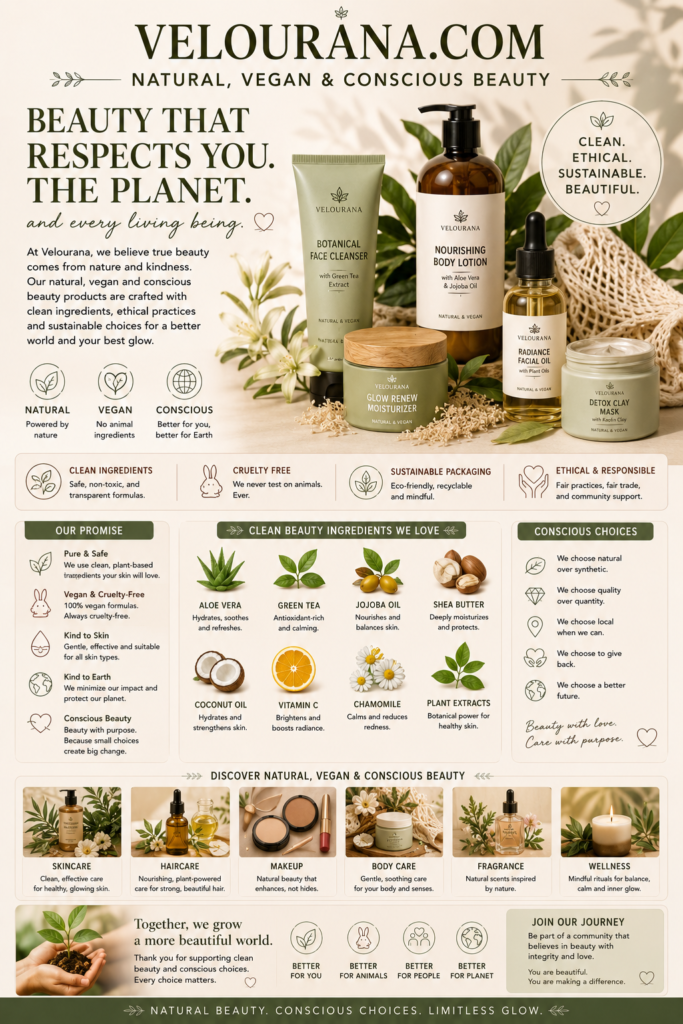
CATEGORY: Vegan Skincare
Vegan skincare has evolved from a relatively specialized corner of the beauty industry into a broad formulation category covering almost every stage of a modern routine. Cleansers, cleansing balms, toners, essences, serums, moisturizers, facial oils, masks, exfoliants, eye products, lip treatments, sunscreens, body care, and intensive treatments can all be formulated without intentionally using animal-derived ingredients.
This expansion has made vegan skincare considerably easier to find, but it has also made the terminology surrounding it more complicated.
Vegan, cruelty-free, natural, organic, plant-based, clean, sustainable, biodegradable, recyclable, and ethically sourced frequently appear together in beauty marketing. Their proximity can make them seem interchangeable even though they describe different characteristics.
At its simplest, vegan skincare concerns ingredient origin. A vegan skincare product is generally formulated without intentionally added animal-derived ingredients according to the standard or claim being used.
That definition does not require the formula to be entirely botanical. It does not exclude synthetic ingredients. It does not guarantee that the packaging is environmentally responsible. It does not establish that the product is suitable for sensitive skin, and it does not automatically answer questions about animal testing.
Modern vegan skincare can use plant-derived ingredients, minerals, synthetic compounds, fermentation technologies, biotechnology, laboratory-produced peptides, advanced polymers, and sophisticated preservation systems.
The result is not a restricted form of skincare. It is a different sourcing framework within contemporary cosmetic science.
What Vegan Skincare Actually Means
The fundamental principle of vegan skincare is the avoidance of animal-derived ingredients.
Some ingredients are easy to recognize as incompatible with a vegan standard. Beeswax, honey, lanolin, and certain milk-derived materials have clear animal origins.
Others are more complicated.
Glycerin, stearic acid, certain fatty acids, amino acids, squalene, and other cosmetic ingredients may historically have been obtained from different sources. Modern versions may be plant-derived, synthetic, biotechnology-produced, or occasionally animal-derived.
The ingredient name alone therefore does not always reveal its source.
A company making a vegan claim should understand the origin of relevant raw materials and maintain suitable supplier information.
Vegan formulation is partly a matter of chemistry and partly a matter of supply-chain verification.
Vegan and Cruelty-Free Are Different
One of the most persistent misunderstandings in ethical beauty is the assumption that vegan automatically means cruelty-free.
The two concepts address different questions.
Vegan concerns animal-derived ingredients.
Cruelty-free concerns animal testing policies and practices.
A formula can theoretically contain no animal-derived ingredients while failing to satisfy a particular cruelty-free standard.
A cruelty-free moisturizer could contain beeswax, honey, lanolin, or another animal-derived ingredient.
Consumers who require both should therefore verify both claims rather than assuming that either one guarantees the other.
Vegan Does Not Mean Natural
A vegan serum can contain highly sophisticated synthetic ingredients.
A natural balm can contain beeswax.
This immediately demonstrates why the two terms cannot be used interchangeably.
Synthetic humectants, emollients, polymers, preservatives, peptides, antioxidants, and texture modifiers can all be compatible with vegan formulation when their sources and manufacturing processes meet the relevant standard.
Rejecting synthetic chemistry is not a requirement of vegan skincare.
In many cases, modern laboratory technologies expand the number of animal-free alternatives available to formulators.
Natural Does Not Automatically Mean Better
Natural ingredients can provide valuable skincare functions, but their origin does not guarantee superior performance or tolerance.
Essential oils can irritate some skin.
Botanical extracts can trigger allergic reactions.
Plant oils vary greatly in composition and sensory properties.
Synthetic ingredients can sometimes offer greater consistency, purity, or formulation flexibility.
The useful question is not whether an ingredient sounds natural.
It is whether the complete formula is appropriate for its intended purpose, stable, well preserved, compatible with the user's skin, and consistent with the desired vegan standard.
Vegan and Organic Are Separate Concepts
Organic skincare relates to agricultural production and certification standards for qualifying ingredients.
Vegan skincare relates to animal-derived ingredients.
A vegan moisturizer can contain no certified-organic ingredients.
An organic balm can contain beeswax and therefore fail a vegan standard.
Products can satisfy both criteria, but one does not establish the other.
Consumers interested in several ethical characteristics should verify each separately.
Vegan Does Not Automatically Mean Sustainable
Animal-free formulation is only one aspect of environmental impact.
A vegan product still requires raw materials, processing, manufacturing energy, packaging, transportation, and eventual disposal.
Plant ingredients require agricultural resources.
Minerals require extraction.
Synthetic ingredients require industrial production.
Glass containers require substantial energy to manufacture and transport.
Plastic has its own environmental consequences.
Vegan status therefore provides meaningful information about ingredient origin but cannot summarize the complete environmental profile of a skincare product.
Beeswax in Traditional Skincare
Beeswax has historically been used in balms, creams, salves, lip products, cleansing products, and protective formulas.
It provides structure and influences texture, occlusivity, and stability.
Because beeswax is produced by bees, it is generally excluded from vegan skincare.
Modern formulators can replace its functional role using plant-derived waxes and synthetic alternatives.
Candelilla, carnauba, sunflower-derived waxes, rice bran wax, and other materials can contribute structure.
Successful replacement often requires blends because different waxes have different hardness, melting behavior, gloss, and sensory characteristics.
Honey and Propolis
Honey and propolis are commonly associated with soothing or traditional skincare.
Both are produced through bee activity and are therefore generally excluded from vegan formulations.
Plant extracts, humectants, antioxidants, polysaccharides, and biotechnology-derived ingredients can provide alternative approaches to hydration and skin comfort.
A vegan product does not need to imitate honey chemically.
The formulator can instead identify the desired skincare function and achieve it through an entirely different ingredient system.
Lanolin
Lanolin is associated with wool-bearing animals and is widely valued for its rich emollient properties.
It may appear in lip treatments, barrier creams, hand products, and intensive moisturizers.
It is not considered vegan.
Plant oils, butters, synthetic emollients, esters, waxes, and occlusive materials can replace its cosmetic role.
Modern vegan formulas can therefore provide extremely rich textures without relying on lanolin.
Glycerin and Source Verification
Glycerin is one of the most widely used humectants in skincare.
It helps attract and retain water within a formulation and supports skin hydration.
Historically, glycerin could be derived from animal fats, vegetable oils, or synthetic processes.
Vegetable-derived glycerin is extremely common today, but an ingredient list normally states only glycerin.
This means consumers cannot always establish its source from the label alone.
A credible vegan declaration should account for this type of sourcing ambiguity.
Squalene and Squalane
Squalene has an important history in discussions of vegan skincare because some traditional sources included shark liver oil.
Modern skincare increasingly uses plant-derived or biotechnology-produced alternatives.
Squalane is the hydrogenated, more oxidation-resistant form commonly found in contemporary cosmetic formulas.
Plant-derived squalane may come from sources such as olives or sugarcane-based processes.
Consumers seeking vegan skincare should rely on verified sourcing rather than assuming that every ingredient with the same name has identical origins.
Collagen in Vegan Skincare
Traditional collagen is animal-derived.
A product containing conventional animal collagen would therefore not meet vegan standards.
The beauty industry increasingly uses terms such as vegan collagen or collagen alternative.
These phrases can refer to plant-based ingredient combinations, biotechnology-derived materials, amino acids, peptides, or formulas designed to support the appearance associated with collagen-focused skincare.
Consumers should read these claims carefully.
A botanical extract does not literally become human collagen simply because it is marketed as a collagen alternative.
Elastin and Other Animal Proteins
Elastin, keratin, silk proteins, milk proteins, and other animal-derived proteins have appeared in cosmetic formulations.
Vegan products avoid animal-derived versions.
Plant proteins, amino acids, synthetic peptides, fermentation-derived ingredients, and other technologies can provide alternative cosmetic functions.
Again, the goal is not necessarily to duplicate the original ingredient molecule for molecule.
Formulation begins with the desired result and identifies suitable vegan-compatible technologies.
Hyaluronic Acid
Hyaluronic acid is a well-known humectant used in hydrating skincare.
Historical production methods could involve animal-derived sources.
Modern cosmetic hyaluronic acid is commonly produced through microbial fermentation.
Fermentation technology has therefore made this ingredient highly compatible with vegan formulation when the production system meets the relevant standard.
The example demonstrates how biotechnology can transform ingredient sourcing without sacrificing skincare performance.
Ceramides
Ceramides are lipid molecules naturally present in the skin barrier.
Cosmetic ceramides can be produced through synthetic or biotechnology-based methods and can be compatible with vegan formulations.
They are particularly useful in products designed to support barrier function.
A vegan moisturizer can therefore use sophisticated barrier-focused ingredients without relying exclusively on plant oils and butters.
This is an important distinction because skin-identical or skin-inspired ingredients do not necessarily need to be harvested from animals.
Peptides
Peptides have become common in modern anti-aging and treatment-oriented skincare.
They consist of amino-acid sequences and may be produced through synthetic chemistry or biotechnology.
Many can be compatible with vegan formulation.
However, individual raw materials should still be verified.
The word peptide alone does not establish origin.
A trustworthy vegan manufacturer should account for the source and processing of these ingredients when making a product-level claim.
Vegan Cleansers
Facial cleansers can be formulated vegan across virtually every texture.
Gel cleansers can use synthetic or plant-derived surfactants.
Cream cleansers can combine vegan emollients with mild cleansing systems.
Foaming cleansers can be designed for different skin types.
Powder cleansers can provide concentrated formats.
The vegan claim does not determine cleansing strength.
A vegan cleanser can be extremely gentle or excessively stripping depending on formulation.
Skin compatibility remains essential.
Vegan Cleansing Balms
Cleansing balms traditionally rely on oils, waxes, emulsifiers, and structuring ingredients.
Because beeswax or lanolin may appear in some balm-style products, vegan formulations require alternatives.
Plant oils, esters, synthetic emollients, and plant or synthetic waxes can create rich textures.
An emulsifier allows the balm to disperse more easily when water is added.
A well-designed vegan cleansing balm can therefore remove sunscreen and makeup effectively without depending on animal-derived materials.
Vegan Cleansing Oils
Cleansing oils are naturally adaptable to vegan formulation.
They may use plant oils, synthetic esters, lightweight emollients, and emulsifiers.
A cleansing oil does not need to consist entirely of recognizable botanical oils.
Synthetic esters can improve rinsing, texture, and stability.
The most important considerations are cleansing effectiveness, skin comfort, and appropriate emulsification.
Vegan Micellar Water
Micellar waters use surfactant systems dispersed in water to lift makeup, oil, and debris from the skin.
They can readily be formulated without animal-derived ingredients.
Humectants and soothing ingredients may be added depending on the product.
Some micellar waters are designed to remain on the skin, while others may be more comfortable when rinsed.
Consumers should follow product instructions and respond to their own skin tolerance.
Vegan Toners
Toners can serve many different functions.
Some primarily hydrate.
Others provide exfoliating acids.
Some contain soothing ingredients.
Others are designed for oilier skin.
Vegan status does not indicate which function the toner performs.
Consumers should choose according to formulation and skin needs rather than assuming that every vegan toner is gentle or botanical.
Vegan Essences
Essences generally provide lightweight hydration or targeted ingredients in a fluid texture.
They can easily be formulated vegan using humectants, fermented ingredients, plant extracts, peptides, niacinamide, and other cosmetic materials.
The distinction between essence, toner, and serum is often influenced by brand positioning and regional beauty traditions rather than rigid scientific definitions.
What matters is what the formula contributes to the routine.
Vegan Serums
Serums demonstrate the technical sophistication possible within vegan skincare.
Niacinamide, vitamin C derivatives, hyaluronic acid, peptides, alpha hydroxy acids, beta hydroxy acids, azelaic-acid-related formulations, antioxidants, retinoids, and many other technologies can appear in vegan products depending on sourcing.
A serum does not become effective merely because it is vegan.
Concentration, stability, delivery system, packaging, compatibility, and routine design remain important.
Niacinamide
Niacinamide is a form of vitamin B3 widely used for barrier support, uneven appearance, oil-related concerns, and general skin conditioning.
It can be produced synthetically and is compatible with vegan skincare.
It illustrates how a highly useful skincare ingredient can have little connection to plant-versus-animal marketing.
Its value comes from its cosmetic properties and formulation quality.
Vitamin C
Vitamin C products can also fit comfortably within vegan routines.
Pure ascorbic acid and numerous vitamin C derivatives are available.
Their stability and performance vary according to formula design.
Packaging can be particularly important because some vitamin C forms are sensitive to light, air, or water.
A vegan claim does not guarantee stability.
A technically poor vitamin C serum remains technically poor regardless of its ethical positioning.
Retinoids
Retinoid skincare can be vegan when the active and supporting ingredients meet the relevant sourcing standard.
Retinol and cosmetic retinoid derivatives used in skincare can be produced through synthetic processes.
Consumers should evaluate retinoids according to strength, tolerance, frequency of use, and appropriate sun protection.
Vegan status does not remove the possibility of dryness or irritation.
Bakuchiol and Plant-Based Alternatives
Bakuchiol is a plant-derived cosmetic ingredient frequently marketed alongside retinol discussions.
It can be suitable for vegan formulation.
However, it should not automatically be described as chemically identical to retinol.
Different ingredients have different structures and evidence bases.
A vegan routine can use conventional synthetic retinoids, plant-derived ingredients, or neither.
Veganism does not require replacing every synthetic active with a botanical one.
Alpha Hydroxy Acids
Alpha hydroxy acids such as glycolic and lactic acid are used for exfoliation and skin-surface renewal.
Lactic acid may sound dairy-related because of its name, but commercial cosmetic lactic acid can be produced through fermentation or synthetic processes.
Its source should still be verified for strict vegan claims.
Ingredient names can therefore be misleading when interpreted through everyday associations rather than actual manufacturing methods.
Salicylic Acid
Salicylic acid is widely used in products targeting clogged pores and oily or blemish-prone skin.
Modern cosmetic salicylic acid can be produced synthetically and can fit vegan formulations.
The fact that salicylic compounds exist naturally in plants does not mean commercial skincare must be extracted directly from plants.
Synthetic production can provide consistency and purity.
Vegan Moisturizers
Moisturizers combine several functional ingredient categories.
Humectants help attract water.
Emollients smooth and soften.
Occlusive materials reduce water loss.
Emulsifiers stabilize mixtures of oil and water.
Texture modifiers influence sensory feel.
Preservatives protect water-containing formulas.
Every one of these functions can be achieved within vegan formulation.
A vegan moisturizer can therefore range from an ultralight gel to a dense barrier cream.
Vegan Moisturizers for Dry Skin
Dry skin often benefits from formulas combining humectants, emollients, and occlusive ingredients.
Plant oils and butters can contribute richness, but they are not mandatory.
Synthetic emollients may create elegant textures.
Vegan ceramides and other barrier-supporting lipids can improve formulation sophistication.
The best product is one that provides sufficient comfort without creating an undesirable sensory experience.
Vegan Moisturizers for Oily Skin
Oily skin does not necessarily need to avoid moisturizer.
Lightweight vegan gels, lotions, and emulsions can provide hydration without an excessively heavy finish.
Humectants such as glycerin and hyaluronic acid can contribute water-binding properties.
Silicones and lightweight synthetic emollients may improve texture.
Vegan skincare does not need to be oil-heavy simply because plant oils are compatible with vegan standards.
Vegan Skincare for Sensitive Skin
Vegan does not mean hypoallergenic.
A vegan moisturizer can contain fragrance.
A botanical serum can contain essential oils.
A plant extract can trigger sensitivity.
Consumers with reactive skin should focus on ingredient tolerance and formula simplicity where appropriate.
The ethical origin of an ingredient does not determine whether an individual's immune system or skin barrier will tolerate it.
Vegan Skincare for Acne-Prone Skin
Vegan products can address acne-prone skin using established cosmetic and over-the-counter technologies where permitted.
Salicylic acid, niacinamide, gentle cleansing systems, lightweight moisturizers, and other ingredients can all fit animal-free formulations.
Plant-based does not automatically mean non-comedogenic.
Rich oils and butters can be unsuitable for some individuals.
Formula selection should remain based on skin response.
Vegan Facial Oils
Facial oils are among the most straightforward vegan skincare categories when plant-derived oils are used.
Jojoba, squalane from verified plant or biotechnology sources, rosehip, sunflower, argan, and numerous other oils can be included.
However, more oils do not necessarily create a better product.
Oxidative stability, skin feel, packaging, and individual tolerance matter.
A carefully designed blend may be preferable to a long ingredient list created mainly for marketing.
Vegan Face Masks
Masks can be clay-based, gel-based, cream-based, sheet-based, exfoliating, hydrating, or treatment-oriented.
All can be vegan.
Clay masks can use mineral ingredients.
Hydrating masks can use humectants and polymers.
Cream masks can use plant or synthetic emollients.
Sheet masks introduce an additional question about the sheet material and packaging.
Consumers seeking broader sustainability may evaluate those separately.
Sheet Masks and Sustainability
A vegan sheet mask can still generate significant single-use packaging.
The sheet, sachet, protective layers, and shipping materials all contribute to waste.
This does not negate vegan status.
It simply illustrates why vegan and sustainable remain different criteria.
Consumers interested in reducing waste may choose reusable or jar-based treatment formats while maintaining vegan formulation standards.
Vegan Eye Cream
Eye creams can use many of the same ingredient technologies found in facial moisturizers and serums.
Humectants, peptides, caffeine, emollients, antioxidants, and barrier-supporting ingredients can all be compatible with vegan formulation.
The eye area can be sensitive.
Products should be used as directed and kept out of the eyes themselves.
Expensive packaging or vegan positioning does not guarantee dramatic results.
Vegan Lip Care
Lip products are particularly important in vegan skincare because traditional formulas frequently contain beeswax or lanolin.
Vegan lip balms use plant waxes, butters, oils, synthetic emollients, and other structuring ingredients.
They can provide substantial protection and comfort.
A successful formula needs the right balance between hardness, glide, adhesion, and occlusivity.
Plant-based does not automatically mean technically superior; formulation balance matters.
Vegan Sunscreen
Sunscreen can be formulated vegan, but the claim should apply to the complete product rather than simply the ultraviolet filters.
UV filters themselves are only one part of the formula.
Emollients, film formers, emulsifiers, stabilizers, and other ingredients also require appropriate sourcing.
Sunscreen performance should be judged according to validated protection, correct use, skin compatibility, and regulatory requirements.
Vegan status is an additional criterion, not a replacement for effective sun protection.
Mineral and Organic UV Filters
The terms mineral and organic can create confusion in sunscreen discussions.
Mineral filters generally refer to zinc oxide and titanium dioxide.
Organic filters refers to a chemical classification and does not mean organically farmed.
Both types can potentially appear in vegan formulations depending on the complete product.
Consumers should choose sunscreen primarily according to effective protection, tolerability, and willingness to apply an adequate amount consistently.
Vegan Body Care
Vegan skincare extends well beyond the face.
Body lotions, creams, oils, scrubs, washes, hand creams, foot products, and deodorants can all avoid animal-derived ingredients.
Traditional rich body products may contain lanolin, beeswax, milk derivatives, or honey.
Modern alternatives can create equally rich textures.
The same principles of ingredient verification and performance apply.
Vegan Hand Cream
Hand creams often require substantial emollience because frequent washing can leave skin feeling dry.
Vegan formulas can combine glycerin, plant oils, synthetic emollients, butters, silicones, and occlusive ingredients.
A product does not need beeswax or lanolin to provide a protective feel.
Texture should suit how often the consumer is willing to apply it.
A formula that feels unpleasant is unlikely to be used consistently.
Vegan Foot Care
Foot creams and balms frequently use rich occlusive systems.
Plant waxes, butters, oils, urea, humectants, and synthetic emollients can create effective vegan options.
Urea used in modern cosmetics is generally manufactured synthetically rather than obtained from biological waste.
Its name can create unnecessary confusion.
As with all ambiguous ingredients, product-level vegan verification remains the simplest approach.
Fermentation and the Future of Vegan Ingredients
Fermentation has become increasingly important in cosmetic ingredient production.
Microorganisms can produce hyaluronic acid, amino acids, enzymes, and other useful materials.
This reduces dependence on certain animal-derived sources and can provide controlled manufacturing conditions.
Fermentation-derived does not automatically mean environmentally perfect, but it expands the technical possibilities for vegan skincare considerably.
Biotechnology
Biotechnology may allow increasingly sophisticated cosmetic ingredients to be produced without harvesting them directly from animals.
Proteins, peptides, lipids, and other molecules can potentially be created through engineered biological systems.
This development could blur traditional distinctions between natural and synthetic.
For vegan skincare, the more relevant question will remain whether animal-derived inputs or materials are involved according to the applicable standard.
Preservation Is Essential
Water-containing skincare needs protection from microbial contamination.
Vegan formulas can use effective cosmetic preservation systems.
The desire for natural or minimalist products should not lead consumers to treat preservatives as inherently undesirable.
An inadequately preserved moisturizer can become unsafe.
Preservation is a technical necessity, not an ethical failure.
Vegan skincare should maintain the same safety expectations as every other cosmetic category.
Packaging
A vegan formula may come in plastic, glass, aluminum, refillable packaging, or mixed-material components.
None of these automatically determines environmental superiority.
Glass can be recyclable but heavy.
Plastic can be lightweight but difficult to recover depending on local infrastructure.
Airless pumps may use multiple materials but protect sensitive formulas and reduce waste from oxidation.
Packaging should be judged by its complete function and lifecycle rather than appearance alone.
Refillable Vegan Skincare
Refill systems can complement vegan formulation by reducing repeated packaging.
Cleansers, moisturizers, hand washes, body products, and some serums can be suitable for refill models.
The environmental benefit depends on consumers actually reusing the durable container.
A refillable package purchased once and never refilled provides little advantage.
Successful systems must therefore be convenient enough to become habitual.
Waterless Vegan Skincare
Solid cleansers, cleansing powders, balm concentrates, facial oils, and certain treatment formats can reduce or eliminate added water.
These products can be vegan.
Waterless formulation may allow smaller packaging or reduce shipping weight in some cases.
However, it does not automatically guarantee sustainability.
Ingredient sourcing, packaging, manufacturing, and product longevity remain relevant.
Vegan Skincare and Overconsumption
Ethical labels can make unnecessary purchasing feel justified.
A consumer may accumulate multiple vegan serums, masks, oils, and moisturizers because each product appears aligned with personal values.
Unused vegan skincare still consumes resources.
Products may expire before they are finished.
A smaller routine used consistently can align more closely with both vegan and sustainability goals.
Ethical beauty is not measured by the number of ethical products owned.
Transitioning an Existing Routine
Moving toward vegan skincare does not necessarily require discarding products already in use.
A gradual transition can reduce waste.
A cleanser can be replaced with a vegan alternative when finished.
The same can happen with moisturizer, serum, sunscreen, and body care.
This approach also allows new products to be introduced individually, making it easier to identify whether the skin tolerates them.
Formula Changes
Skincare formulas change over time.
A product that was vegan in the past may be reformulated.
A previously non-vegan product may become vegan.
Suppliers may also change.
Consumers who require strict compliance should therefore rely on current manufacturer information rather than old reviews, photographs, or archived ingredient lists.
Brands should communicate meaningful formulation changes clearly.
Building a Practical Vegan Routine
A vegan skincare routine does not need to be complicated.
A suitable cleanser, moisturizer, and sunscreen can provide the foundation.
Additional products can address specific concerns.
Serums, exfoliants, retinoids, masks, and oils should have identifiable purposes rather than being added simply because they are vegan.
Routine simplicity can improve consistency and reduce the likelihood of irritation caused by excessive layering.
Performance Still Matters
A vegan moisturizer that feels unpleasant may remain unused.
A vegan cleanser that leaves the skin uncomfortable may be replaced quickly.
A serum that is unstable may be wasted.
A sunscreen that a consumer dislikes wearing may not provide meaningful real-world protection because it is not applied consistently.
Performance therefore belongs within ethical beauty.
Products that people genuinely finish can reduce unnecessary replacement and waste.
Transparency as a Standard
Strong vegan skincare brands should communicate clearly.
They should identify whether the entire brand is vegan or only selected products.
They should distinguish vegan from cruelty-free.
They should maintain current ingredient information.
They should understand ambiguous raw-material origins.
They should explain certification accurately.
They should avoid suggesting that vegan automatically means natural, hypoallergenic, sustainable, or safer.
Precise communication allows consumers to make decisions based on evidence rather than imagery.
The Future of Vegan Skincare
The future of vegan skincare is likely to depend increasingly on biotechnology, fermentation, synthetic chemistry, traceable plant sourcing, advanced packaging, and improved supply-chain documentation.
Ingredients once associated with animal sources can increasingly be produced through alternative technologies.
Textures can become more sophisticated.
Barrier-focused products can use vegan ceramides and lipids.
Hydrating formulas can use fermentation-derived humectants.
Peptides can be produced through controlled technologies.
Vegan skincare therefore has little reason to remain associated with simplistic formulations.
The Long-Term Perspective
Vegan skincare demonstrates that animal-derived ingredients are not essential to sophisticated skin care.
Modern cosmetic science can provide cleansing, hydration, barrier support, exfoliation, antioxidant care, texture refinement, sun protection, and advanced treatment formats through animal-free ingredient systems.
The challenge is no longer merely finding vegan products.
It is choosing good ones.
A strong vegan skincare product should have credible sourcing, appropriate preservation, stable formulation, useful packaging, realistic claims, and a texture that encourages consistent use.
When those qualities are combined with thoughtful purchasing and a routine designed around actual skin needs, vegan skincare becomes less about restriction and more about intelligent formulation choices.
THE END VELOURANA
 Discover More From Our Family of Websites
 ZodiacBearing (Astrology, Tarot, Numerology, Angel Numbers & Spiritual Guidance)
 Velourana (Beauty, Makeup, Hair Care, Skincare & Beauty Tips)
 HavenBearing (Home, Living, Organization, Décor & Everyday Inspiration)
 PawBearing (Pet Care, Dog Breeds, Animal Health, Training & Pet Products)
 PsyCatherine (Notes From the Journal of a Psychologist on Real Life)

