
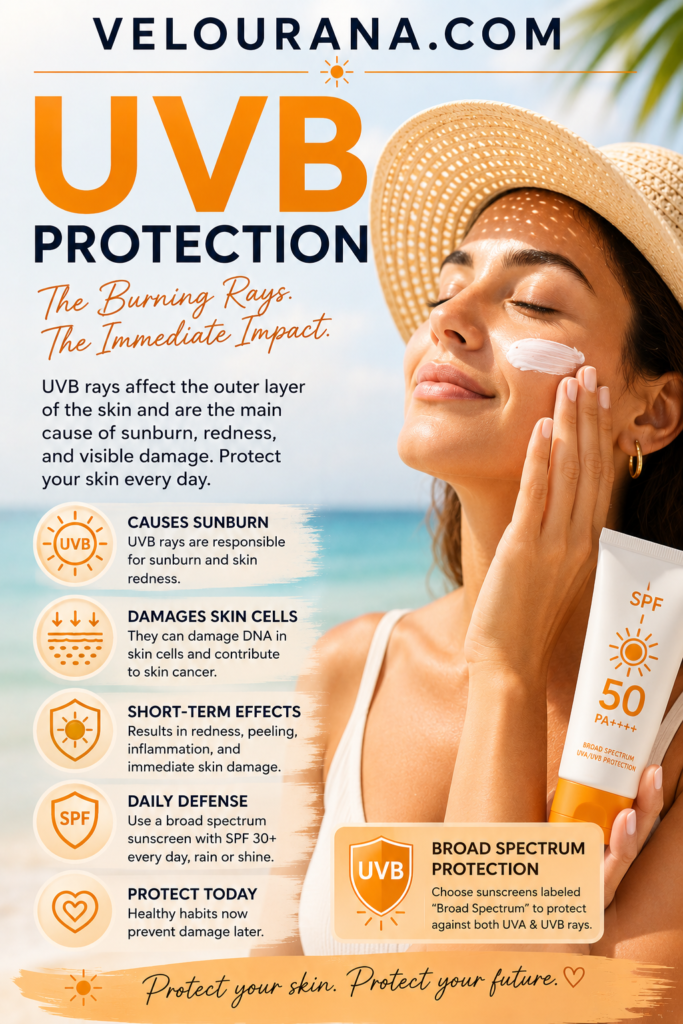
CATEGORY: UVB Protection
Some days place very little demand on sunscreen. You apply it in the morning, travel to work, spend most of the day indoors and have only limited outdoor exposure. Other days are completely different. You swim, perspire, walk for hours, dry yourself with a towel, carry a backpack, change clothes, sit on sand or spend an entire afternoon beneath an open sky.
These are the days when UVB protection becomes more challenging.
The sunscreen itself may be excellent, but outdoor life constantly interferes with the protective layer that has been placed on the skin. Water can affect it. Perspiration can affect it. Towels and clothing create friction. Hands touch the face. Sand sticks to the body. Hours pass while ultraviolet conditions change.
At the same time, outdoor activities often expose much more skin than an ordinary working day. Swimwear leaves the shoulders, back, chest, arms and legs uncovered. Running clothing can expose the neck, arms and legs for hours. Sightseeing may involve an entire day of walking beneath direct sunlight. Hiking introduces altitude, changing terrain and sometimes very little shade.
Reliable UVB protection in these circumstances is therefore not simply a matter of choosing a high SPF. It requires a sunscreen appropriate for the activity, adequate application before exposure, sensible maintenance during the day and additional protection from clothing, hats, sunglasses and shade.
The objective is not to make outdoor life complicated. It is to make sun protection strong enough to survive outdoor life as it actually happens.
Why Water Changes the Sunscreen Routine
Swimming is one of the most demanding situations for sunscreen because it combines prolonged exposure with repeated physical disruption.
This is where water-resistant sunscreen becomes particularly important.
The term “water resistant” has a specific meaning. It indicates that a sunscreen has demonstrated the ability to maintain a stated level of protection for a defined period under standardized water-exposure testing. The exact claim and labeling depend on the regulatory system under which the product is sold.
What water resistance does not mean is that sunscreen becomes waterproof indefinitely.
That distinction matters.
Someone may apply a water-resistant SPF 50 sunscreen before entering the sea and assume that the application will remain completely intact through several hours of swimming, diving, drying, lying on a towel and returning to the water.
Real conditions are much harsher than that assumption allows.
After swimming, the skin is usually dried. Toweling creates friction that can physically remove sunscreen. Sand may stick to the remaining product and then be brushed away. Swimwear moves against the skin. Hands repeatedly touch the face and body.
Protection therefore needs to be restored according to the sunscreen's directions rather than relying indefinitely on the original application.
Applying sunscreen before the outdoor activity also matters. Follow the individual product's instructions regarding when it should be applied relative to sun exposure and water.
Coverage should be deliberate rather than hurried. Shoulders, the upper back, chest, ears, neck and tops of the feet are common areas for beach sunburn precisely because they are easy to miss.
The edges of swimwear deserve particular attention. Clothing moves, and an area that appeared covered while sunscreen was being applied may become exposed later.
A careful initial application creates a much better foundation for everything that follows.
Beach Protection Works Better When Sunscreen Is Not Working Alone
A beach day is often used as the ultimate test of sunscreen, but it is unnecessary to make sunscreen responsible for every minute of exposure.
Shade can dramatically reduce direct sunlight. A beach umbrella, covered area or nearby building can provide periods of reduced exposure, particularly when UV levels are strong.
Protective clothing can be even more useful.
A rash guard or swimming top covers large areas of the torso continuously. This reduces both the amount of sunscreen required and the number of areas that need repeated attention after swimming.
A broad-brimmed hat provides shade for the scalp and parts of the face, ears and neck. Sunglasses protect the eyes and surrounding area.
These measures do not make sunscreen unnecessary on exposed skin, but they make the overall protection strategy much more robust.
They also solve a practical problem.
Repeated full-body sunscreen application can become inconvenient during a long beach day. Skin may be wet, sandy and difficult to cover evenly. If clothing protects much of the torso and a hat shades the head, fewer exposed areas depend entirely on perfect sunscreen application.
This is especially useful for families and children, where repeatedly covering every part of the body can become difficult.
The smartest beach routine is therefore not the one involving the greatest possible quantity of sunscreen. It is the one that combines sunscreen with other forms of protection so that no single measure has to perform perfectly on its own.
Outdoor Exercise Creates a Different Challenge
Exercise introduces perspiration, movement and friction.
A sunscreen that feels excellent during an ordinary office day may perform very differently during a long run in warm weather.
Heavy perspiration can challenge the sunscreen film. Runners frequently wipe the forehead and eyes. Cyclists may repeatedly touch their face or adjust helmets and glasses. Backpack straps rub against the shoulders during hiking. Sports clothing moves across the skin.
For these activities, water-resistant sunscreen can provide an important practical advantage.
Comfort around the eyes is also worth considering. Some sunscreens may migrate with perspiration and cause stinging. If this repeatedly happens during exercise, choosing another formulation designed for active use can make protection much easier to maintain.
Application should extend beyond the center of the face.
Runners may expose the ears, neck, shoulders, arms and legs. Cyclists can receive prolonged exposure on the backs of the hands, arms, thighs and calves. Hikers may expose different areas as clothing is removed or added throughout the day.
A portable sunscreen becomes increasingly important as the activity becomes longer.
Leaving sunscreen in the car does not help halfway through a six-hour hike.
For prolonged activities, the product needs to be accessible enough that reapplication is realistic. A smaller tube in an outside backpack pocket can be more useful than a large bottle buried beneath equipment.
Clothing can again reduce the workload. Long-sleeved technical garments, hats or caps and other appropriate sports clothing cover areas continuously without requiring repeated sunscreen application.
For serious outdoor activity, sun protection should be considered part of the equipment rather than an optional cosmetic step.
Hiking Shows Why Temperature Can Be Misleading
Mountain environments demonstrate particularly well why ultraviolet radiation should not be judged according to heat.
A hike may begin on a cool morning. As elevation increases, the temperature may remain comfortable or even fall. Wind can make conditions feel colder still.
None of this guarantees weak ultraviolet exposure.
Altitude can increase UV exposure because there is less atmosphere above to absorb ultraviolet radiation. Open mountain terrain may also provide little shade.
A hiker who associates sunscreen exclusively with hot weather can therefore receive substantial exposure without ever feeling overheated.
The same issue becomes even more obvious during winter sports.
Skiers and snowboarders may be surrounded by snow and freezing air while the face receives significant ultraviolet radiation. Snow can reflect UV, adding to the exposure environment.
Sunscreen remains relevant despite the temperature.
The nose, cheeks, lips, ears and any exposed areas around helmets or goggles deserve protection. SPF lip balm can be useful because lips are exposed to sunlight as well as cold and wind.
Sunglasses or goggles with appropriate UV protection are essential for the eyes.
Mountain conditions can also change rapidly, making preparation more important than attempting to judge exposure once the activity has begun.
Checking the UV Index and weather conditions before leaving provides much better information than looking at the temperature alone.
Sightseeing Can Quietly Become an Eight-Hour Sun Day
Travel creates another form of prolonged exposure that people frequently underestimate.
A city holiday does not look like a beach holiday.
You are wearing ordinary clothes. You walk between museums, restaurants and shops. You may spend portions of the day indoors. Because the activity is varied, it can feel as though exposure is intermittent.
Yet many travellers spend most of the day outside.
A morning walk becomes an outdoor breakfast. Then comes a queue for an attraction, a walk across an open square, lunch on a terrace, another hour exploring a neighborhood and an evening walk back to the hotel.
By the end of the day, the face, neck and hands may have been exposed repeatedly for many hours.
Summer clothing can increase the exposed area considerably.
The solution does not require turning a holiday into a sunscreen schedule.
Apply broad-spectrum sunscreen properly before leaving accommodation. Carry a suitable product so protection can be refreshed when needed. Wear sunglasses. Consider a hat when long periods outside are expected.
Use shade naturally. Choose a covered table for lunch. Take indoor breaks. Walk on the shaded side of a street when convenient.
These small choices reduce exposure without interfering with the experience of travelling.
Travellers should also remember that UV conditions at the destination may be very different from those at home. Latitude, altitude, season and weather all influence exposure.
A person arriving from a northern winter into a sunny southern destination may suddenly experience conditions their recent routine was not designed to handle.
The destination determines the protection required, not the weather you left behind.
Cruises, Sailing and Open Water Need Additional Attention
Open-water environments can create long periods of exposure with limited shade.
Sailing, boating, fishing and cruises often involve several hours outdoors while wind keeps the body feeling comfortable. This cooling effect can make it easy to underestimate both heat stress and ultraviolet exposure.
Water also contributes to the light environment through reflection.
A water-resistant sunscreen is useful, particularly when swimming or becoming wet. Clothing, however, can provide enormous practical benefit.
Lightweight long sleeves, hats and appropriate sunglasses can reduce the amount of exposed skin. On boats where shade is available, using it during periods of stronger UV can reduce unnecessary exposure.
The lips should not be forgotten. An appropriate SPF lip product can be useful during long periods outdoors, especially where wind and salt water contribute to dryness.
The same general rule applies here as at the beach: sunscreen should be part of a broader protection system rather than the only defense.
Reapplication Should Respond to What Has Happened to the Skin
Reapplication advice is sometimes reduced to watching the clock.
Time matters during prolonged exposure, but physical activity matters too.
Imagine two people who applied the same sunscreen at the same time.
One spends the next period reading quietly beneath shade.
The other swims, dries with a towel, plays beach volleyball and wipes perspiration from the face repeatedly.
Their sunscreen layers have not experienced the same conditions.
This is why product directions concerning reapplication after swimming, perspiration or towel drying are important.
The purpose is to restore a reliable protective film after it has potentially been compromised.
The same reasoning applies during sport. If a runner repeatedly wipes sweat from the forehead, that area deserves attention. If backpack straps have rubbed the shoulders for hours, exposed skin around the straps may need sunscreen restored.
Rather than thinking about sunscreen as something that simply “expires,” think about the physical layer on the skin.
Has it been washed?
Rubbed?
Wiped?
Sweated through?
Has the skin remained exposed for a prolonged period?
If so, maintaining protection becomes important.
Clothing Can Solve Problems Sunscreen Cannot
One of the easiest ways to improve UVB protection during outdoor activity is to cover the skin.
This sounds almost too simple, yet it solves several practical limitations of sunscreen simultaneously.
Clothing does not wash away every time you swim unless it is removed. It does not disappear because you perspire. It does not need to be spread evenly across the skin. It does not leave white cast.
The degree of protection provided by clothing varies according to fabric, weave, color, condition and other characteristics. Garments specifically rated for ultraviolet protection provide more standardized information about their performance.
For prolonged outdoor activities, these can be particularly useful.
A hiking shirt can cover the arms and torso.
A rash guard can protect much of the upper body in the water.
A wide-brimmed hat can cover the scalp and provide shade.
Longer sports clothing can reduce exposed skin during cycling or running.
This does not mean everyone should cover themselves completely whenever they go outside. It simply demonstrates why sunscreen is only one tool.
When exposure becomes demanding, combining tools creates stronger and more convenient protection.
Planning Prevents Most Outdoor Sunscreen Problems
Many failures in UVB protection begin before the person ever goes outside.
The sunscreen bottle is nearly empty.
The only product available is a small facial tube intended for a full family beach day.
The sunscreen is left at home.
The hat is forgotten.
No one checks whether the sunscreen is water resistant before swimming.
The product is buried at the bottom of a backpack and never used again after the morning application.
A minute of preparation solves many of these problems.
For a beach day, bring enough sunscreen for everyone who will use it and for repeated application.
For a hike, place sunscreen somewhere accessible.
For outdoor sport, choose a formulation suited to perspiration.
For sightseeing, carry a portable product.
For skiing, remember the lips and exposed facial areas.
For children, use clothing and shade to reduce the amount of skin depending entirely on sunscreen.
This is not complicated planning. It is the same type of preparation used for water, appropriate shoes, weather protection or other basic outdoor needs.
Enjoying Outdoor Life Without Treating Sunscreen as Armor
There are two unhelpful extremes in discussions about ultraviolet protection.
One is ignoring UV exposure entirely unless the skin begins to burn.
The other is becoming so concerned about sunlight that outdoor activity starts to feel dangerous.
Neither is necessary.
Sunscreen exists to make outdoor life safer, not to eliminate it.
Swimming, hiking, travelling, running, cycling, skiing and spending time outdoors can all remain part of a healthy and enjoyable life.
Protection simply becomes part of preparation.
The same principle applies to high-SPF sunscreen. It should not be treated as armor that permits unlimited time in intense sunlight.
Even excellent sunscreen does not block every ultraviolet ray. Real-world application is imperfect, and outdoor activities continuously challenge the sunscreen film.
Using shade when available, wearing appropriate clothing and avoiding unnecessary prolonged exposure during particularly intense UV conditions remain sensible even after sunscreen has been applied.
Making UVB Protection Work in the Real World
Laboratory sunscreen testing takes place under controlled conditions.
Outdoor life does not.
Real skin gets wet.
Real people perspire.
Children roll in sand.
Swimmers dry themselves with towels.
Runners wipe their faces.
Hikers remove clothing as temperatures change.
Travellers forget how long they have been walking.
Sunscreen is asked to function in the middle of all this activity.
Good UVB protection acknowledges that reality.
Start with an appropriate broad-spectrum sunscreen and adequate SPF. Apply it properly and cover exposed areas carefully. Choose water resistance when swimming or perspiring. Bring enough product for the duration of the activity. Restore protection according to product directions and the conditions the sunscreen has experienced.
Then reduce the pressure on sunscreen.
Wear clothing.
Use a hat.
Protect the eyes with suitable sunglasses.
Seek shade when practical.
Consider the UV Index.
Adapt protection to altitude, season and destination.
These measures work together.
A successful outdoor sun-protection routine is not the one that keeps someone constantly thinking about sunscreen. It is the one that becomes sufficiently natural that protection happens while attention remains on the activity itself.
You swim without spending the afternoon worrying about UVB because you prepared properly.
You hike with sunscreen in the backpack and appropriate clothing already on your body.
You explore a new city wearing sunglasses and a hat, refreshing sunscreen when needed.
You enjoy the beach while using shade between periods in the water.
That is what practical UVB protection should accomplish.
It does not remove outdoor life.
It protects your ability to enjoy it with fewer unnecessary risks from ultraviolet exposure.
The End
Velourana.
 Discover More From Our Family of Websites
 ZodiacBearing (Astrology, Tarot, Numerology, Angel Numbers & Spiritual Guidance)
 Velourana (Beauty, Makeup, Hair Care, Skincare & Beauty Tips)
 HavenBearing (Home, Living, Organization, Décor & Everyday Inspiration)
 PawBearing (Pet Care, Dog Breeds, Animal Health, Training & Pet Products)
 PsyCatherine (Notes From the Journal of a Psychologist on Real Life)

