
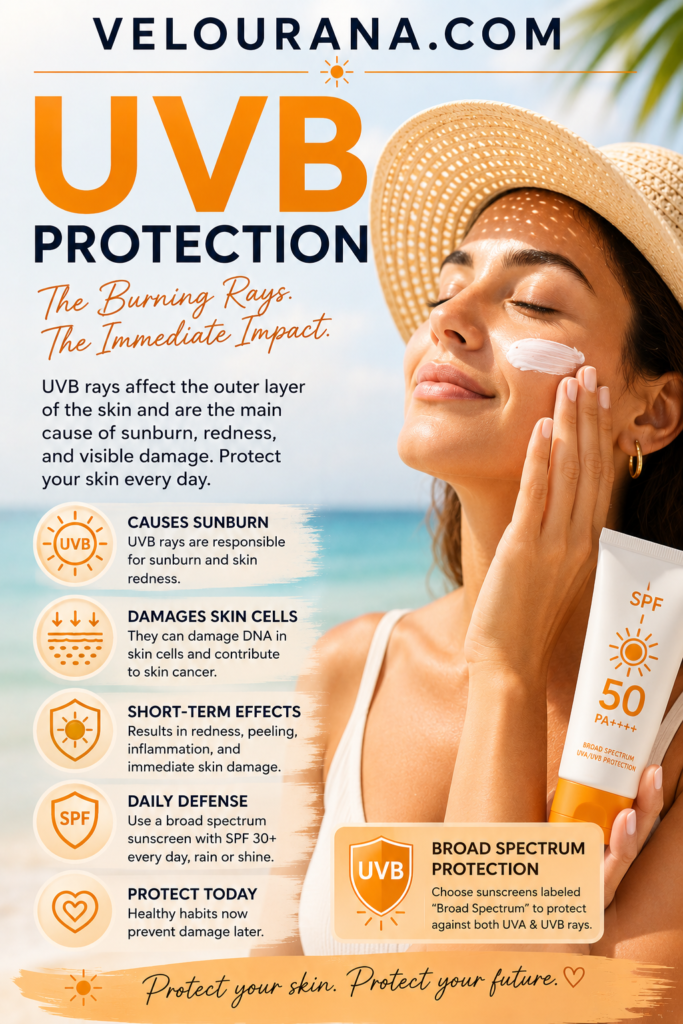
CATEGORY: UVB Protection
Children are naturally drawn outdoors. Beaches, playgrounds, gardens, swimming pools, parks, school sports and family holidays create some of the most enjoyable parts of childhood, but they can also involve long periods of ultraviolet exposure. Because children are usually thinking about playing rather than the position of the sun, responsibility for UVB protection initially falls largely on the adults around them.
That does not mean childhood should become dominated by warnings about sunlight. Outdoor activity is valuable, and sun protection works best when it supports that activity rather than making children frightened of it. The objective is much simpler: reduce unnecessary ultraviolet exposure, prevent sunburn and gradually make sensible protection part of normal family life.
UVB radiation is particularly relevant because it is a major cause of sunburn and contributes to skin cancer risk. Children can become deeply absorbed in what they are doing and may remain outdoors for hours without noticing how much exposure they are receiving. Heat is not a reliable warning either. A breezy beach, cool playground or cloudy afternoon can feel comfortable while ultraviolet radiation remains significant.
For families, the most successful approach is rarely one that depends entirely on sunscreen. Clothing, hats, shade, timing, sunglasses and appropriately selected sunscreen can work together. When these habits become routine, children can spend less time being interrupted for sun protection and more time enjoying the outdoors.
Why Childhood Sun Protection Deserves Particular Attention
Skin remembers exposure in ways that are not immediately visible. A child may recover from a sunburn within several days, but the ultraviolet damage responsible for that burn is more than a temporary cosmetic problem. Repeated UV exposure and episodes of sunburn contribute to cumulative skin damage and future skin cancer risk.
This is why preventing sunburn during childhood is important even though the consequences of ultraviolet damage may not become apparent for many years.
Children can also be particularly difficult to protect simply because of how they behave. An adult may sit beneath an umbrella for an hour, while a child moves continuously between the shade, water and open beach. Sunscreen that was applied carefully in the morning may be challenged by swimming, toweling, sand, perspiration and repeated changes of clothing.
The answer is not necessarily applying sunscreen every few minutes. It is designing the day so that sunscreen is only one part of the protection.
Protective swimwear can cover a large proportion of the body. A hat can protect the scalp and shade parts of the face and neck. A beach umbrella or covered area can provide somewhere to play and rest away from direct sunlight. Sunglasses can protect the eyes when children are old enough to wear them safely and comfortably.
These measures reduce the amount of exposed skin that depends entirely on sunscreen and make the routine much easier for everyone.
Choosing and Applying Sunscreen for Children
Sunscreen for children should be selected according to age-appropriate guidance and the manufacturer's instructions. Babies require particular care, and parents should follow pediatric and public-health recommendations regarding sun exposure, shade, clothing and sunscreen use for very young infants.
For older children, broad-spectrum sunscreen with appropriate SPF protection can be applied to exposed skin as part of the outdoor routine.
The formulation matters because a product that is difficult to use can quickly become a source of conflict. Some children dislike sticky creams. Others become impatient while sunscreen is being rubbed into large areas. A product that spreads easily and feels comfortable can make adequate application considerably more realistic.
Water resistance becomes particularly important when swimming or when children are perspiring heavily during sport and play.
Whatever formulation is chosen, coverage needs to be complete. The face is obvious, but many childhood sunburns occur in places adults simply missed. Ears, shoulders, the back of the neck, upper back, arms, legs, ankles and tops of the feet deserve attention according to what clothing leaves exposed.
The edges of swimwear are another common problem. A swimsuit may move while a child plays, exposing skin that was originally covered. Applying sunscreen slightly beyond the visible edges can help avoid narrow strips of unprotected skin.
Sunscreen should also be applied in an adequate quantity. Attempting to stretch a small amount across the entire body may leave protection uneven. For a family beach day, bringing enough sunscreen for repeated use is therefore part of basic preparation.
Swimming Changes Everything
A child can move between the water and beach dozens of times during a long summer day.
Water-resistant sunscreen is designed for this type of environment, but water resistance should never be interpreted as permanent waterproofing. Sunscreen needs to be maintained according to the product directions, particularly after swimming, towel drying and prolonged activity.
Toweling deserves special attention because it physically rubs the skin. Even if a sunscreen has performed well in the water, vigorous drying can remove some of the protective layer.
Sand creates another challenge. It sticks to sunscreen, and children often rub or brush it away repeatedly. This friction can disturb coverage further.
Protective swimwear becomes extremely valuable under these conditions. A rash guard or similar garment can cover the shoulders, back and torso continuously. Those areas no longer depend on repeated sunscreen application every time the child leaves the water.
This can transform the practical experience of family sun protection.
Instead of trying to re-cover almost the entire body repeatedly, adults can concentrate on exposed areas while clothing provides reliable coverage elsewhere.
Shade between periods of swimming adds another layer. Children do not necessarily need to remain in direct sunlight while building sandcastles, eating, reading or resting. Moving these activities beneath an umbrella or covered area reduces unnecessary exposure without limiting the enjoyment of the beach.
Playgrounds, Parks and Ordinary Family Days
Family UVB protection is not only a holiday issue.
A playground visit can unexpectedly become several hours outside. A picnic extends through the afternoon. A short walk turns into a full day at a park. Children begin playing in a garden while adults talk and nobody notices how long they have remained in the sun.
These ordinary situations can be easier to overlook than the beach because they do not trigger the same automatic preparation.
A simple habit can make a large difference: before an extended outdoor activity, think about how long the family is likely to remain outside and what skin will be exposed.
If the outing will be brief under relatively low UV conditions, elaborate preparation may not be necessary. If several hours outdoors are planned while UV levels are significant, sunscreen, hats, suitable clothing and access to shade become much more relevant.
The UV Index can be useful for parents because it provides information that temperature cannot.
A cool spring afternoon may still involve significant ultraviolet exposure. A cloudy day does not automatically mean UVB is absent. Children may also remain outside longer precisely because the weather feels comfortable.
Rather than using heat as the signal for protection, families can gradually become accustomed to considering UV conditions and duration of exposure.
School and Outdoor Sports Require a Practical Routine
School creates a different challenge because parents are not always present when exposure occurs.
Children may spend breaks outside, participate in physical education, attend sports training or take part in school excursions. During warmer months, these activities can create substantial outdoor exposure.
A morning sunscreen application can provide a foundation, while clothing and hats can add protection where school policies and activities allow them. Depending on the child's age and school rules, older children may be able to carry sunscreen and learn when and how to reapply it appropriately.
Outdoor sport creates additional demands because perspiration can disturb sunscreen. Football, athletics, tennis, swimming and other activities may involve long periods outside combined with heavy physical activity.
Water-resistant sunscreen is particularly useful in these circumstances.
Sports uniforms also determine which areas need attention. A football shirt may cover the shoulders while leaving the arms, legs, neck and face exposed. A swimsuit exposes much more skin. Tennis clothing can leave the shoulders and legs exposed for hours.
Protection should therefore follow the actual clothing rather than becoming a fixed ritual that covers the same areas regardless of activity.
Parents can also help children develop independence gradually. A younger child may need sunscreen applied completely by an adult. An older child can learn to cover the arms and legs while an adult checks difficult areas such as the back and shoulders.
Eventually, sun protection becomes a personal skill rather than something performed only by parents.
Teaching Children Without Making Them Afraid of the Sun
The language adults use around sun protection matters.
If children repeatedly hear that the sun is dangerous, they may develop an unnecessarily fearful relationship with outdoor activity. If they are told that sunscreen makes them completely safe regardless of exposure, they may develop the opposite misunderstanding.
A more useful message is that sunlight is part of being outdoors and that we protect ourselves appropriately when exposure is significant.
We wear coats when it is cold.
We drink water when it is hot.
We wear helmets when cycling.
We use sunscreen, hats, clothing and shade when ultraviolet exposure requires protection.
Presented this way, sun protection becomes ordinary preparation rather than a warning that something terrible is about to happen.
Children can also understand surprisingly simple explanations of sunburn. The skin can be damaged by too much ultraviolet exposure before it begins to hurt, which is why protection happens before redness appears.
This teaches an important principle without requiring complicated science.
Older children and teenagers can gradually learn more about SPF, broad-spectrum protection and the reasons for reapplication. Giving them some control over product selection may also improve compliance. A teenager who dislikes a greasy facial sunscreen may be far more willing to use a lightweight formulation they have helped choose.
The objective is to create habits that can survive after parental supervision disappears.
Teenagers Bring Different Sun-Protection Challenges
Adolescence often changes the relationship with sunscreen.
Appearance becomes more important. Acne may develop. Makeup may become part of the morning routine. Some teenagers dislike sunscreen because they believe it feels oily, worsens breakouts or leaves a visible white cast.
Others may actively want a tan.
Simply repeating instructions to “wear sunscreen” may not address any of these concerns.
Product selection becomes particularly important. Lightweight, non-greasy sunscreens can work better for oily or acne-prone skin. Transparent or tinted formulations may be preferable when white cast is a concern. Sunscreens that layer well beneath makeup can make daily protection easier.
For teenagers interested in tanning, explaining the relationship between UV exposure, sunburn, skin damage and future skin cancer risk is more useful than pretending the desire for a tan does not exist.
Cosmetic self-tanning products can provide color without requiring intentional ultraviolet tanning, although they generally do not replace sunscreen unless specifically formulated and tested to provide sun protection.
Teenagers also begin spending more time outdoors independently. Festivals, sports, beaches, travel and social activities may take place without parents nearby.
At this stage, the sunscreen habit developed during childhood begins to show its real value.
A teenager who has always regarded sunscreen as normal outdoor preparation is more likely to use it independently than one who experienced it only as something a parent forced onto them during holidays.
Family Holidays Need Enough Sunscreen, Not Just Good Sunscreen
One of the simplest family mistakes is bringing too little product.
A small bottle may look sufficient when packing, but full-body application across several people consumes sunscreen quickly. Add repeated applications over several days and the quantity required becomes substantial.
When supplies begin running low, people ration sunscreen.
A smaller amount is spread across a larger area. Reapplication is delayed. Adults decide they will skip themselves and save the remaining product for the children.
Planning enough sunscreen avoids this entirely.
For longer holidays, it may be practical to bring several products. A comfortable facial sunscreen can be used for the face, while a larger and more economical water-resistant product covers the body. Different family members may also prefer different textures.
The most expensive sunscreen is not automatically the most protective. Appropriate formulation, correct use and reliable application matter far more than luxury positioning.
Availability matters too.
Keep sunscreen where it will actually be used. A bottle in the hotel room is useless during an unexpected afternoon excursion. A portable product in a day bag provides flexibility when plans change.
For road trips, beach days and sightseeing, having sunscreen accessible prevents the routine from depending on perfect planning.
Clothing and Shade Can Make Family Protection Much Easier
Families often focus so heavily on sunscreen that they overlook the easiest forms of protection.
Clothing can cover large areas for hours.
A lightweight shirt protects the shoulders and much of the torso. Longer shorts or trousers cover additional skin. Protective swimwear can reduce the amount of exposed body dramatically.
Hats are particularly valuable for children because the scalp, ears, forehead and neck can otherwise receive substantial exposure.
Shade creates a useful place for lower-exposure activities. Meals, reading, resting, playing with toys and breaks between swimming sessions do not need to happen in direct sunlight.
Planning shade is especially important in places where it may be limited. A park with mature trees is different from an open sports field. A beach with permanent covered areas is different from an exposed shoreline.
Bringing an umbrella or portable shade where appropriate can make a long outdoor day considerably easier.
These measures also reduce the anxiety around perfect sunscreen application.
If a child's torso is covered by appropriate clothing and they spend regular periods beneath shade, missing one tiny area during sunscreen application becomes less consequential than when sunscreen is the only protection being used.
When Sunburn Still Happens
Even careful families sometimes experience sunburn.
Plans change, an area is missed, sunscreen is rubbed away or exposure lasts much longer than expected.
Once a burn occurs, the priority is preventing additional exposure while the skin recovers.
Keep the affected skin out of further strong sunlight, use gentle cooling measures and moisturization for comfort, and avoid unnecessary irritation. Peeling skin should not be scrubbed or pulled away.
More significant sunburn requires greater caution. Extensive blistering, severe pain, fever, chills, dehydration, unusual tiredness or other concerning symptoms should prompt appropriate medical advice, particularly in children.
After recovery, it can be useful to identify what happened without turning the experience into blame.
Perhaps the shoulders were missed.
Perhaps the sunscreen was not reapplied after swimming.
Perhaps the family stayed outdoors much longer than planned.
Perhaps cloud cover created false confidence.
Understanding the reason helps improve the next outing.
The objective is progress, not perfection.
Turning Protection Into a Family Habit
The easiest family routines are the ones children can predict.
Before a beach day, sunscreen goes on.
The hats come with us.
Sunscreen stays in the beach bag.
After swimming and drying, protection is checked and restored as appropriate.
Meals and breaks happen in shade when possible.
Before outdoor sport, exposed skin is protected.
For a long family walk, the UV conditions and weather are considered alongside water, clothing and footwear.
When these actions happen repeatedly, they stop feeling like interruptions.
Children begin reminding adults.
Older siblings help younger ones.
Teenagers develop their own preferred sunscreen products.
Eventually the behavior becomes independent.
This is the real long-term value of family sun protection. Parents are not simply preventing one afternoon's sunburn. They are helping establish an understanding of ultraviolet exposure that children can carry into adulthood.
Protecting Childhood Without Restricting It
A good UVB-protection routine should leave plenty of room for messy, energetic outdoor childhood.
Children should be able to swim until they are tired, build sandcastles, play football, explore parks, travel, hike and spend summer afternoons with friends.
The objective is not to remove the sun from those experiences.
It is to remove as much unnecessary ultraviolet damage as reasonably possible.
Broad-spectrum sunscreen provides an important layer of defense. Water resistance makes it more suitable for swimming and active play. Correct application improves the protection actually achieved. Reapplication maintains coverage when water, towels and activity have disturbed it.
Clothing provides another layer.
Hats protect exposed areas of the head.
Sunglasses protect the eyes.
Shade reduces direct exposure.
Planning ensures enough sunscreen is available when it is needed.
Education gradually turns parental protection into a child's own habit.
None of these measures needs to dominate the day.
In fact, the better the routine becomes, the less attention it eventually requires.
The sunscreen is already in the bag. The hat is already on. The protective swimwear is already being worn. The shaded area is already part of the family's beach setup.
Protection becomes background behavior while childhood remains in the foreground.
That is ultimately what sensible UVB protection for children should achieve: not less time outdoors, but better-protected time outdoors, supported by habits that can continue long after childhood itself has passed.
The End
Velourana.
 Discover More From Our Family of Websites
 ZodiacBearing (Astrology, Tarot, Numerology, Angel Numbers & Spiritual Guidance)
 Velourana (Beauty, Makeup, Hair Care, Skincare & Beauty Tips)
 HavenBearing (Home, Living, Organization, Décor & Everyday Inspiration)
 PawBearing (Pet Care, Dog Breeds, Animal Health, Training & Pet Products)
 PsyCatherine (Notes From the Journal of a Psychologist on Real Life)

