
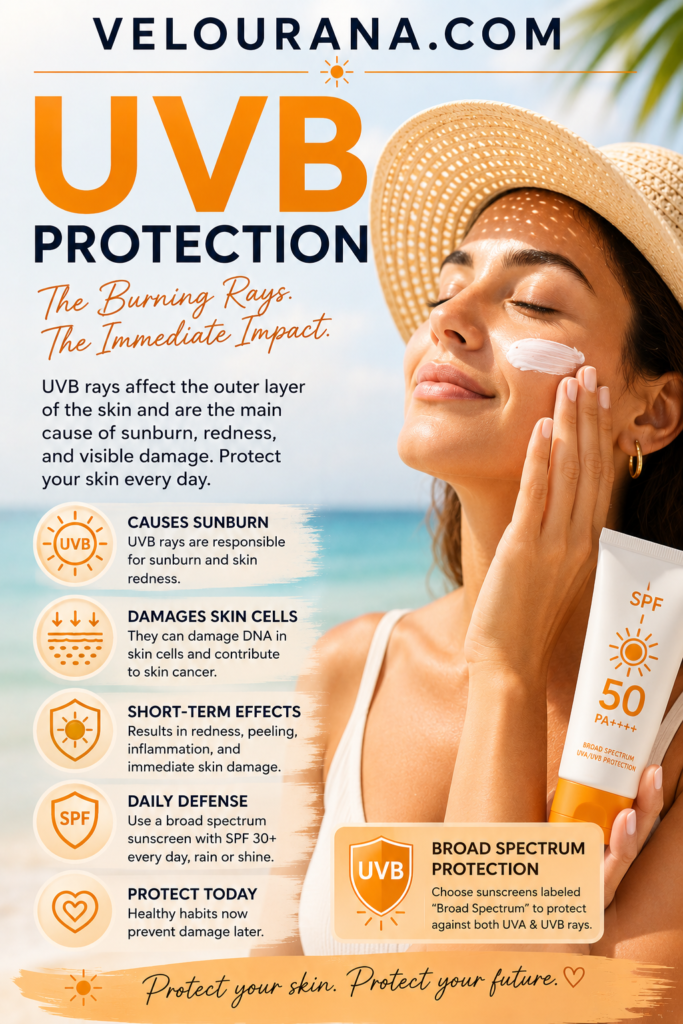
CATEGORY: UVB Protection
The beach is where most people expect to need sunscreen. There is open sky, strong sunlight, exposed skin, reflective water and usually several hours outdoors. Sunscreen feels as natural there as swimwear and sunglasses. The same person, however, may spend an entire Saturday walking through a city, gardening, watching an outdoor sporting event or sitting at a café without thinking seriously about ultraviolet protection.
That difference has more to do with perception than with the way ultraviolet radiation works.
UVB radiation does not appear only when we deliberately place ourselves in the sun. It reaches exposed skin during ordinary outdoor life, and while the intensity varies considerably according to time, season, location and weather, repeated everyday exposure contributes to the total amount of ultraviolet radiation our skin receives.
This does not mean every brief walk outside should be treated like a day at the beach. Sun protection works best when it is proportionate to actual exposure. The useful change is learning to recognize the ordinary situations in which UVB exposure can become substantial without feeling like traditional sunbathing.
Once those situations become easier to identify, protecting the skin becomes less about following rigid rules and more about making sensible decisions throughout the day.
Why Everyday UVB Exposure Is Easy to Overlook
Our idea of dangerous sunlight is heavily influenced by heat. When the temperature is high and sunlight feels intense on the skin, protection seems obvious. When the air is cool, the sky is slightly cloudy or a breeze keeps us comfortable, it is easy to assume that the sun is weak.
Temperature, however, is not a reliable measurement of UVB intensity.
Ultraviolet radiation and heat are different parts of the solar spectrum. A cool day can still have meaningful UV levels, particularly when the sun is high in the sky. Likewise, a very hot late afternoon or evening can occur after ultraviolet levels have declined substantially.
This difference explains many unexpected sunburns. Someone spends several hours outdoors because the weather feels comfortable, only to discover later that the shoulders, nose or neck have become red.
Clouds can create the same false confidence. Heavy cloud can reduce ultraviolet radiation considerably, but cloud cover does not automatically eliminate UVB. Conditions can also change quickly, with periods of stronger sunlight appearing between clouds while someone remains outdoors for hours.
Rather than trying to judge exposure through sensation, the UV Index provides a more useful reference. It takes relevant environmental conditions into account and provides an indication of the level of ultraviolet radiation expected at a particular place and time.
For a normal working day spent mostly indoors, checking the UV Index may not require much thought. For a day involving several hours of walking, gardening, sport or sightseeing, it becomes much more useful.
Duration matters as well as intensity.
A relatively short exposure under strong UV conditions and a much longer exposure under more moderate conditions can both become relevant. This is why everyday activities deserve attention when they extend for substantial periods.
Walking, Shopping and Sightseeing Can Become Significant Outdoor Exposure
Walking is a perfect example of an activity that rarely feels like deliberate sun exposure.
A fifteen-minute journey from home to a shop may not require the same preparation as a beach afternoon. But a weekend spent walking through an outdoor shopping district for four hours is a different situation.
Sightseeing intensifies this effect.
Travellers often leave their hotel in the morning and remain outdoors until evening. They walk between attractions, wait in queues, eat outside, cross large open squares and spend hours exploring unfamiliar streets. Because they are not wearing swimwear or lying beside a pool, the day may not psychologically register as a “sun day.”
The face, neck, ears and hands can nevertheless remain exposed for hours.
Summer clothing may also expose the shoulders, upper chest, arms and legs.
This is where a morning sunscreen application, a portable product for later use and simple physical protection become valuable. A hat can shade much of the head and face. Sunglasses protect the eyes. Lightweight clothing can reduce the amount of exposed skin requiring sunscreen.
Shade can also be incorporated naturally. Walking on the shaded side of a street, choosing a covered table for lunch or taking breaks indoors can reduce direct exposure without changing the enjoyment of the day.
None of these measures needs to turn sightseeing into a medical procedure. They simply recognize that several hours outdoors are several hours outdoors, regardless of whether a beach is involved.
Gardening and Home Activities Can Produce Unexpected Exposure
Gardening creates another common blind spot.
People frequently begin with the intention of spending twenty minutes outside. One small task leads to another, and suddenly two or three hours have passed.
Because gardening happens at home, preparation can feel unnecessary. There is no beach bag to pack and no journey that triggers the thought of sunscreen.
The body position also changes constantly. Bending, reaching and kneeling can expose areas that clothing normally covers. The back of the neck, shoulders, lower back, arms and hands may receive prolonged sunlight.
A simple routine can prevent this from becoming complicated.
If gardening will take more than a short period, apply broad-spectrum sunscreen to exposed areas before beginning. Wear a hat and suitable clothing. Keep water nearby and use shaded breaks, particularly during hot weather.
Long sleeves can be especially useful because they provide continuous coverage without requiring sunscreen across the entire arms. Gardening gloves protect the hands from dirt and physical injury while also covering much of the skin.
Timing can make a difference as well. When practical, arranging prolonged outdoor work outside periods of the strongest UV exposure can reduce the overall burden.
This is not about avoiding the garden when the sun is shining. It is about recognizing that home activities can create exactly the kind of sustained exposure for which sun protection is intended.
Outdoor Exercise Changes the Demands on Sunscreen
Running, cycling, hiking and outdoor training combine ultraviolet exposure with another challenge: perspiration.
A sunscreen that performs beautifully during an ordinary working day may not be the best choice for a long run in summer heat. Sweat, repeated wiping and friction from clothing or equipment can disturb the protective layer.
Water-resistant formulations are therefore useful for activities involving heavy perspiration.
Application should happen before the activity according to the product instructions, with particular attention to exposed areas. For runners, the face, ears, neck, shoulders, arms and legs may require protection depending on clothing. Cyclists may expose the back of the neck, arms, hands and legs for long periods.
Hiking can create even more varied conditions. A route may begin in forest shade and later move into completely open terrain. Elevation can increase, temperatures can fall, and the cool air can make the strength of ultraviolet radiation less obvious.
Long activities also create a practical question about reapplication.
If a hike or cycling session will last for several hours, sunscreen needs to be carried rather than left in the car. A small accessible tube is more useful than a large bottle that remains at home.
Protective clothing can substantially simplify the problem. Sportswear designed for outdoor activity can cover large areas while remaining comfortable. Hats, caps and sunglasses provide additional protection appropriate to the activity.
The objective is to make protection compatible with exercise rather than allowing sunscreen to become a reason to avoid it.
Outdoor Work Requires a Different Level of Protection
Someone who works outside faces a fundamentally different exposure pattern from someone who occasionally spends a weekend afternoon outdoors.
Construction workers, gardeners, agricultural workers, delivery personnel, lifeguards and many other occupations can involve repeated exposure over many hours and many years.
For these individuals, sun protection cannot realistically depend on remembering sunscreen only when the weather feels particularly hot.
Clothing becomes especially important because it provides protection without requiring constant reapplication across every covered area. Appropriate long sleeves, trousers, hats and other occupational clothing can reduce exposed skin substantially.
Sunscreen is then used on areas that cannot easily be covered.
The face, ears, neck and hands often require particular attention. Reapplication becomes important because perspiration, physical work and repeated wiping can remove product.
Access also matters. If sunscreen is kept somewhere inconvenient, workers may be less likely to use it. Keeping appropriate sunscreen where it can easily be reached during breaks makes regular use more realistic.
Workplaces can also support sun protection through shade, scheduling and access to protective equipment where appropriate.
This illustrates an important principle: when UVB exposure is repeated and predictable, protection should be built into the environment rather than relying entirely on individual memory.
Driving, Commuting and the Difference Between UVA and UVB
Cars create an interesting situation because glass changes ultraviolet exposure.
Standard vehicle glass generally blocks much UVB, although the exact protection varies according to the glass. UVA can penetrate glass to a greater degree, making broad-spectrum protection relevant for people who spend substantial time driving.
For UVB specifically, the greater everyday exposure may occur before and after the journey rather than through the glass itself.
Someone walks to the car, parks several streets away from work, walks outside at lunch and then spends an hour running errands after work. None of these periods is especially long, but together they form the day's outdoor exposure.
Public transport can create similar patterns. Walking to stations, waiting at exposed stops and changing between services can keep someone outdoors for longer than expected.
This is another reason broad-spectrum sunscreen makes more sense than trying to create separate routines for UVA and UVB. A well-designed sunscreen protects against both, while the user adjusts application and reapplication according to the day's circumstances.
Children Often Receive UVB Exposure Through Ordinary Play
Children do not need to be at the beach to spend substantial time outdoors.
School breaks, playgrounds, sports, gardens, parks and family activities can create hours of exposure, particularly during spring and summer.
Because children are usually focused on playing rather than monitoring the sun, adults need to create the protective environment.
Clothing and shade can reduce the amount of exposed skin. Hats can become a normal part of outdoor clothing. Appropriate sunscreen can be applied to exposed areas according to age guidance and product instructions.
Outdoor sport may require additional attention because perspiration can disturb sunscreen, while uniforms may leave arms, legs and the back of the neck exposed.
The objective should not be to discourage children from outdoor activity. Physical play and time outside are valuable.
Sun protection allows those activities to continue with less unnecessary ultraviolet exposure.
Habits developed early can also become normal later in life. A child who grows up associating a hat and sunscreen with long outdoor days may find those behaviors far less inconvenient as an adult.
Everyday Sunburn Often Begins With a Missed Area
Many sunburns are not caused by complete failure to use sunscreen.
They happen because part of the skin was forgotten.
The nose receives sunscreen, but the ears do not.
The face is covered carefully, but the neck is ignored.
Sunscreen is applied to the arms, but the shoulders remain exposed beside the edges of a sleeveless shirt.
The legs are covered, but the tops of the feet are missed.
This is particularly common during ordinary activities because application tends to be quicker than it would be before a beach day.
A systematic approach solves much of the problem.
Look at what the day's clothing leaves exposed and protect those areas rather than automatically applying sunscreen only to the face.
If sandals are being worn during several hours outdoors, remember the feet. If the neckline is open, include the upper chest. If the hair is short or tied up, check the ears and back of the neck.
Men with thinning hair may also have exposed areas of scalp that need protection. A hat is often the simplest solution.
The sunscreen routine should follow the exposed skin rather than an arbitrary cosmetic boundary.
The Problem With Using Sunburn as Your Warning System
Many people adjust their behavior only after the skin begins to feel uncomfortable.
Unfortunately, sunburn does not necessarily appear immediately.
The inflammatory response develops after excessive exposure has already occurred. Waiting for visible redness before moving into shade or applying sunscreen is therefore too late.
The same applies to the sensation of heat.
Skin can feel cool because of wind, water or air temperature while ultraviolet radiation remains significant. This is particularly deceptive during boating, mountain activities and windy beach days.
Good UVB protection is preventive.
You protect the skin because the exposure is expected, not because the skin has begun reporting damage.
This becomes much easier when sun protection is connected to activities rather than symptoms.
A long outdoor day means preparation.
Swimming means water-resistant sunscreen and later reapplication.
Outdoor sport means a product that can tolerate perspiration.
Several hours of gardening means protection before starting.
The decision is made before the damage rather than after it.
Sunscreen Should Not Become Permission to Stay in Strong Sun Indefinitely
One of the more subtle problems with sunscreen is behavioral.
A person applies SPF 50 and feels protected enough to remain in intense sunlight for much longer than they otherwise would.
This misunderstands the purpose of sunscreen.
No sunscreen blocks every ultraviolet ray, and real-world application is imperfect. Areas are missed, product is rubbed away and reapplication does not always happen exactly when it should.
Sunscreen should therefore reduce exposure, not encourage additional exposure.
If shade is available during a period of strong UV, using it is sensible even when sunscreen has been applied. If a hat can be worn comfortably, it adds another layer of protection. If there is no reason to spend several hours in direct midday sun, moving an activity to another time can reduce exposure.
This does not require reorganizing life around the sun.
It simply avoids treating sunscreen as an invisible suit of armor.
Creating a Routine That Works Outside the Beach
The best everyday UVB routine is usually much simpler than people expect.
Start by understanding the day ahead.
If most of it will be spent indoors with only brief outdoor periods, protection can be straightforward. Apply broad-spectrum sunscreen appropriately to exposed areas according to your circumstances and normal sun-protection guidance.
If the day will involve hours outdoors, increase the preparation.
Use enough sunscreen.
Bring it with you.
Wear appropriate clothing.
Take a hat and sunglasses.
Look for shade when practical.
Reapply according to the product directions and the activity, particularly after swimming, heavy perspiration or significant rubbing.
If plans change, adapt.
A short lunch that becomes an entire afternoon outdoors may create a reason to refresh sunscreen. An unexpected walk can be handled with the portable sunscreen in your bag. A cloudy morning that becomes bright later does not need to become a problem if protection is accessible.
These are ordinary adjustments, not a complicated lifestyle.
Why Everyday Protection Matters Over the Long Term
One afternoon without sunscreen does not define the future of your skin.
What matters more is the pattern that develops over years.
Someone who regularly spends time outdoors without protection accumulates a different exposure history from someone who routinely uses sunscreen, clothing and shade appropriately.
UVB protection is therefore most useful when it becomes habitual rather than occasional.
This does not mean perfection.
People forget sunscreen. Plans change. A shoulder gets missed. A bottle runs out. Sometimes a person stays outside longer than expected.
A sustainable routine accepts these imperfections while improving the overall pattern.
That is also why comfort matters so much when choosing sunscreen. If a product feels pleasant, works with your skin and fits beneath makeup or alongside facial hair, using it becomes easier. If a body sunscreen is affordable enough to apply generously, you are less likely to ration it. If a portable product fits conveniently into a bag, it is more likely to be available when plans change.
The practical details determine whether theoretical protection becomes real protection.
Bringing UVB Protection Into Normal Life
The greatest improvement in sun protection often happens when we stop categorizing exposure according to whether we are “sunbathing.”
The skin does not know whether you are lying beside a swimming pool or walking through a city.
It responds to ultraviolet radiation.
A long afternoon gardening can create substantial exposure. So can a football match, a hike, a sightseeing tour, an outdoor market or several hours at a café.
Recognizing these situations does not mean becoming afraid of being outside.
It means treating sun protection as ordinary preparation.
We already adjust clothing for rain, temperature and wind. UV conditions can become another environmental factor considered when necessary.
On a low-exposure day, little additional effort may be required.
On a high-exposure day, sunscreen, clothing, shade, a hat and sunglasses can work together.
This flexible approach is much more useful than keeping sunscreen hidden until the next beach holiday.
UVB protection is ultimately about reducing avoidable ultraviolet damage before the skin produces the unmistakable warning of sunburn.
Once protection becomes connected to real exposure rather than beaches, heat or summer holidays, it becomes easier to understand when the skin genuinely needs it.
And that is when sunscreen stops being a seasonal product and becomes something far more useful: one part of a sensible, everyday approach to protecting the skin while continuing to enjoy life outdoors.
The End
Velourana.
 Discover More From Our Family of Websites
 ZodiacBearing (Astrology, Tarot, Numerology, Angel Numbers & Spiritual Guidance)
 Velourana (Beauty, Makeup, Hair Care, Skincare & Beauty Tips)
 HavenBearing (Home, Living, Organization, Décor & Everyday Inspiration)
 PawBearing (Pet Care, Dog Breeds, Animal Health, Training & Pet Products)
 PsyCatherine (Notes From the Journal of a Psychologist on Real Life)

