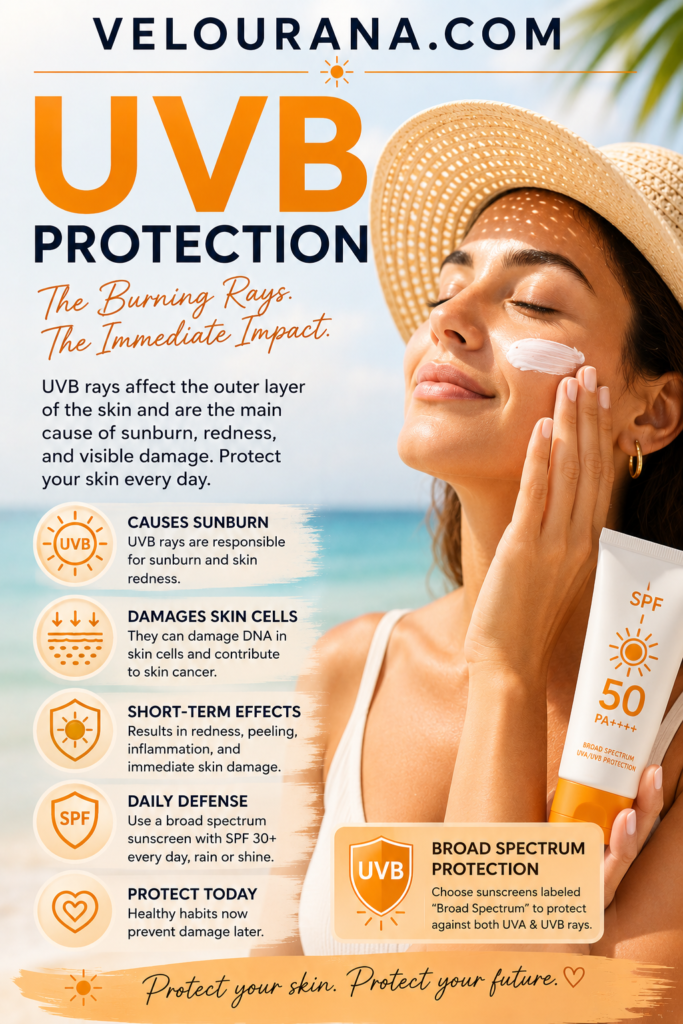
CATEGORY: UVB Protection
Few numbers in skincare are as familiar as SPF. It appears on sunscreen bottles, moisturizers, foundations, lip products and increasingly on products designed for almost every part of the face and body. SPF 15, SPF 30, SPF 50 and SPF 50+ have become so recognizable that most people understand the basic message: a higher number means greater protection from the sun.
What is less widely understood is exactly what SPF measures, how that protection is established, and why the number on the bottle cannot tell you how well protected your skin will actually be during an ordinary day.
SPF, or Sun Protection Factor, is primarily a measure of protection against the effects of UVB radiation that cause sunburn under standardized testing conditions. It is extremely useful information, but it is often interpreted as though it were a complete description of everything a sunscreen can do.
That misunderstanding can lead to some surprisingly poor sun-protection habits. Someone may choose SPF 50 and apply only a very thin layer because the number feels reassuring. Another person may believe SPF 50 allows twice as much unprotected behavior as SPF 25. Someone else may assume that applying SPF 30 sunscreen beneath SPF 20 makeup creates SPF 50 protection.
None of these interpretations reflects how sunscreen works.
Understanding SPF properly makes sunscreen much easier to use intelligently. Instead of treating the number as a promise of invulnerability, it becomes what it was designed to be: standardized information about a product's UVB protection when that product is applied correctly.
What SPF Is Actually Measuring
SPF testing compares the amount of ultraviolet exposure required to produce a defined degree of redness on sunscreen-protected skin with the amount required to produce the same response on unprotected skin. The sunscreen is applied at a standardized quantity during testing, allowing different products to be assessed under controlled conditions.
This is why SPF is strongly associated with UVB protection. UVB is a major contributor to sunburn, although ultraviolet exposure and skin damage are more complex than sunburn alone.
The important point is that SPF describes relative protection under particular testing conditions. It does not translate directly into a fixed number of minutes that everyone can safely spend outside.
The popular idea that SPF 30 simply means thirty times longer in the sun is an oversimplification because real-world ultraviolet exposure is not constant. The amount of UVB reaching the skin changes according to time of day, geographic location, season, altitude and environmental conditions.
A person outdoors early in the morning may experience very different UV intensity from the same person outside around the middle of the day. Someone in northern Europe in winter has different conditions from someone near the equator. A mountain environment differs from sea level. Cloud cover can alter exposure, while reflective surfaces such as snow can change the overall ultraviolet environment.
Individual skin response also varies.
The SPF number therefore should not be converted into a personal countdown clock.
If you normally begin to burn after a certain period without sunscreen, multiplying that period mechanically by the SPF number does not provide a reliable schedule for how long you can remain outside. Sunscreen can be applied inadequately, rubbed away, washed away or disturbed by perspiration long before such a theoretical calculation becomes relevant.
SPF is valuable because it allows comparison of tested UVB protection. It becomes misleading only when we ask the number to predict things it was never designed to predict.
Why SPF 50 Is Not Twice SPF 25 in the Way People Imagine
SPF numbers can create an intuitive but inaccurate impression of how protection increases.
If one product says SPF 25 and another says SPF 50, it is natural to assume that the second simply blocks twice as much UVB. The relationship is not that straightforward.
As SPF increases, the additional percentage of UVB filtered becomes progressively smaller. High-SPF products still provide meaningful additional protection, particularly because no sunscreen blocks 100 percent of ultraviolet radiation, but the numbers should not be interpreted as simple percentages.
This has an important practical consequence.
Choosing a higher SPF does not compensate reliably for poor application.
A generous, even application of an appropriate sunscreen is essential regardless of whether the label says SPF 30 or SPF 50. If half the face receives adequate sunscreen while the ears, hairline and neck receive almost none, the higher number on the bottle cannot correct those gaps.
Similarly, a very thin layer of SPF 50 should not be assumed to provide the protection indicated by the label.
The tested SPF relates to the tested application conditions. Real-world protection depends on what actually reaches and remains on the skin.
This is one reason public-health recommendations frequently combine advice about SPF with instructions concerning quantity, reapplication and other forms of sun protection.
The number matters, but behavior determines how useful that number becomes.
Why Applying Enough Sunscreen Matters So Much
One of the largest differences between sunscreen testing and everyday sunscreen use is quantity.
People frequently apply less sunscreen than is used during standardized SPF testing. There are understandable reasons for this. Some products feel heavy. Others become shiny when applied generously. Mineral formulations can leave a visible cast. Makeup may behave differently over a substantial sunscreen layer, and expensive facial products can make generous application feel wasteful.
The result is often a compromise: a tiny amount is spread as far as possible.
Unfortunately, sunscreen does not behave like concentrated perfume, where using less simply produces a weaker version of the same experience. An inadequate amount can create uneven coverage and reduce the protection achieved.
This makes sunscreen texture much more important than it might initially appear.
A person with oily skin may find a lightweight fluid much easier to apply adequately than a rich cream. Someone with dry skin may have the opposite experience. A person with facial hair may prefer a formula that disappears easily around the beard and hairline. Someone with deeper skin may need a product that does not create a visible white cast.
There is no universal texture that works best for everyone.
What matters is finding a broad-spectrum sunscreen with suitable SPF protection that you can comfortably apply in the necessary amount.
For the body, affordability becomes part of the same equation. A small luxury facial sunscreen may be perfectly reasonable for the face, but using it across the shoulders, arms, chest and legs can become expensive very quickly. A larger body sunscreen may make generous application far more practical.
Using different products for different areas is not a compromise in protection as long as each product is appropriate for its intended use. It can actually improve protection by removing the temptation to ration sunscreen.
SPF Does Not Add Up Between Products
Modern beauty routines often contain SPF in several places.
A moisturizer may provide SPF 30. The dedicated sunscreen may be SPF 50. Foundation may contain SPF 20, and finishing powder may advertise additional sun protection.
It is tempting to add these numbers together and imagine an enormous final SPF.
That is not how it works.
SPF 30 plus SPF 20 does not automatically become SPF 50. SPF 50 sunscreen underneath SPF 30 foundation does not become SPF 80.
Layering products may provide additional coverage in some circumstances, but the protection cannot be calculated by simply adding the printed numbers.
For reliable UVB protection, the dedicated sunscreen should therefore be applied adequately rather than relying on small amounts of SPF distributed among several cosmetic products.
Makeup containing SPF can still be useful. It may provide supplementary protection, and it certainly does not need to be avoided. The problem arises only when a light layer of foundation is expected to replace an adequate sunscreen application.
Most people apply foundation according to the amount required for the appearance they want. Applying enough foundation to reproduce the conditions of sunscreen testing could produce far more coverage than they would normally choose.
A dedicated sunscreen allows protection to be established first. Makeup can then be applied for cosmetic purposes rather than being forced to perform two jobs at once.
High SPF Does Not Eliminate the Need for Reapplication
Another common misunderstanding is that high SPF lasts longer.
Someone may assume that SPF 50 needs less frequent reapplication than SPF 30 because the protection number is higher. In reality, the sunscreen layer can be physically disturbed regardless of the SPF printed on the bottle.
Swimming is an obvious example.
Water-resistant sunscreen is designed to maintain protection for a specified period under standardized water-exposure conditions, but water resistance does not mean permanent waterproof protection. Swimming, toweling and returning to the water repeatedly can challenge even an excellent formulation.
Perspiration creates similar problems during exercise or physical work. Wiping sweat from the forehead can remove sunscreen mechanically. Backpack straps, clothing, helmets, towels and hands can all disturb coverage.
The reason for reapplication is therefore not simply that SPF has somehow expired at a particular moment. It is that protection needs to be maintained while meaningful exposure continues.
During prolonged outdoor activity, follow the sunscreen's reapplication directions and established sun-protection guidance. After swimming or heavy perspiration, pay particular attention to restoring coverage appropriately.
During an ordinary indoor working day, the context may be different. Someone who applied sunscreen properly in the morning and then spent several hours inside away from meaningful sunlight has not experienced the same conditions as someone who spent those hours swimming.
If significant outdoor exposure begins later, refreshing sunscreen before going outside can be a practical approach.
SPF should support sensible decision-making, not replace it.
Broad-Spectrum Protection Matters Alongside SPF
An article about SPF and UVB would be incomplete without mentioning UVA.
SPF primarily tells us about protection related to UVB-induced sunburn. Comprehensive sun protection should also address UVA radiation.
UVA contributes to photoaging and skin cancer risk and can penetrate more deeply into the skin. It also behaves differently from UVB in relation to factors such as window glass.
This is why broad-spectrum sunscreen matters.
Depending on the regulatory system in which a sunscreen is sold, UVA protection may be communicated through broad-spectrum terminology, UVA symbols, protection factors or other standardized labeling.
When choosing sunscreen, look beyond the largest number on the front of the package.
A suitable product should provide appropriate UVB protection through its SPF while also offering meaningful UVA protection.
This becomes especially relevant for people whose skincare concerns include pigmentation or photoaging. Preventing sunburn is important, but a skincare routine focused on long-term environmental protection should not address UVB while ignoring UVA.
Fortunately, consumers do not need separate bottles for each type of radiation. A well-formulated broad-spectrum sunscreen is designed to address both.
SPF and the Reality of a Beach Day
A beach provides an excellent demonstration of the difference between theoretical SPF and real-world protection.
Imagine applying SPF 50 carefully before leaving home. Under controlled conditions, the sunscreen offers high UVB protection.
Then reality begins.
You sit in the car and clothing rubs against the skin. You arrive at the beach and carry bags over your shoulders. You lie on a towel. Sand sticks to the sunscreen. You swim. You dry yourself. You perspire. You touch your face. Several hours pass.
The SPF number on the bottle has not changed, but the sunscreen layer on your body certainly may have.
This is why a beach routine cannot consist simply of applying a high-SPF product once and forgetting about it.
Water resistance becomes useful. Reapplication becomes necessary. Shade reduces direct exposure. Protective swimwear covers areas that would otherwise depend entirely on sunscreen. A hat protects the scalp and shades parts of the face. Sunglasses protect the eyes.
The best protection comes from combining these measures.
This also explains why deliberately remaining in intense sunlight for longer because you have applied SPF 50 is a poor use of sunscreen. The product is intended to reduce ultraviolet exposure, not to create permission for unlimited exposure.
SPF for Outdoor Exercise and Sport
Sport introduces different practical requirements.
A sunscreen used for a short commute may not be ideal for a long run, tennis match, cycling session or hike.
Perspiration can be heavy, and wiping the skin can repeatedly disturb coverage. Sunscreen may migrate toward the eyes, creating discomfort. Clothing and equipment can rub specific areas continuously.
A water-resistant sunscreen designed for active conditions can therefore be useful.
The product should be applied before activity according to its instructions, with adequate attention to exposed areas. During long events, carrying sunscreen allows protection to be restored rather than depending entirely on the original application.
Athletes can also use clothing strategically.
Longer sleeves, appropriate sports fabrics, hats or caps, sunglasses and other protective equipment reduce exposed skin. For cycling and hiking, this can make protection far easier over many hours.
Again, SPF is part of the solution rather than the entire solution.
SPF for Everyday Beauty and Skincare
For everyday skincare, the challenge is often not extreme exposure but consistency.
A sunscreen needs to fit comfortably between the rest of the morning routine and whatever follows.
If foundation pills over it, the user may apply less. If it creates excessive shine, sunscreen may be skipped on important workdays. If it leaves a strong white cast, adequate application may feel cosmetically unacceptable.
The solution is not to conclude that sunscreen cannot work with beauty routines.
It is to find a compatible formulation.
Some sunscreens have lightweight finishes that behave almost like primers. Others are moisturizing enough to replace a separate daytime cream. Tinted products can provide light complexion coverage. Mattifying formulations may work better for oily skin.
Allowing skincare layers to settle can also help. Applying several products rapidly on top of one another can encourage pilling, particularly when formulas are not compatible.
A simpler morning routine may sometimes work better than an elaborate one.
For example, someone might use a gentle cleanse, one treatment serum if needed, sunscreen and makeup. Another person with dry skin may need moisturizer between the treatment and sunscreen.
There is no requirement to use every possible skincare step.
The sunscreen should have enough space in the routine to be applied properly.
When SPF Can Create False Confidence
Perhaps the greatest weakness of SPF is not scientific at all.
It is psychological.
A high number feels powerful.
SPF 50 can create the impression that ultraviolet exposure has effectively been solved. This can encourage people to stay outside longer, skip hats, avoid shade or ignore reapplication.
The sunscreen then changes behavior in a way that partially defeats its purpose.
Good sun protection does the opposite.
The sunscreen reduces exposure reaching uncovered skin. Clothing reduces exposure further. Shade reduces direct exposure. Avoiding unnecessarily long periods under intense UV reduces it again.
Each layer contributes.
This approach is particularly valuable for people who burn easily, have a history of skin cancer, use medications that increase photosensitivity or have been given specific sun-protection advice by a healthcare professional.
Individual medical circumstances should always take priority over general cosmetic guidance.
Choosing SPF Without Becoming Obsessed With Numbers
Sunscreen shopping can become unnecessarily complicated when every decision is reduced to comparing numbers.
SPF matters, and appropriate high protection is valuable. But once you have chosen a suitable broad-spectrum sunscreen, practical qualities deserve attention too.
Will you use enough?
Does it cover the skin evenly?
Does it work with your complexion?
Does it remain comfortable after several hours?
Can you afford to use it generously?
Is it water resistant when you need water resistance?
Can you carry it easily when reapplication will be necessary?
Does it work with makeup?
These questions determine whether the product will become part of your actual life.
There is little value in owning a technically impressive sunscreen that you dislike enough to avoid.
The ideal sunscreen is not necessarily the one with the most dramatic marketing claim. It is an appropriately protective product that you can use correctly and consistently.
SPF Makes Sense When the Whole Routine Makes Sense
SPF is one of the great successes of modern sun protection because it gives consumers a standardized way to understand a sunscreen's tested UVB performance.
But the number becomes genuinely useful only when it is placed in context.
SPF does not measure how carefully you applied the sunscreen.
It does not know whether you forgot your ears.
It does not know that you went swimming.
It cannot detect that your towel removed product from your shoulders.
It does not know whether you spent the afternoon in an office or hiking beneath intense sunlight.
It cannot tell whether the sunscreen also provides the UVA protection you want unless you read the rest of the label.
And it cannot decide when shade or protective clothing would be a better choice than relying on sunscreen alone.
Those decisions belong to the person using the product.
Once SPF is understood this way, the number becomes more useful rather than less important.
Choose appropriate broad-spectrum protection. Apply enough. Cover exposed skin carefully. Maintain the sunscreen during prolonged exposure. Use water-resistant products when swimming or perspiring heavily. Combine sunscreen with clothing, shade, hats and sunglasses.
Then allow SPF to do what it was designed to do: provide a tested level of UVB protection as one part of a complete sun-protection strategy.
The number on the bottle matters.
How you use what is inside the bottle matters just as much.
The End
Velourana.
 Discover More From Our Family of Websites
 ZodiacBearing (Astrology, Tarot, Numerology, Angel Numbers & Spiritual Guidance)
 Velourana (Beauty, Makeup, Hair Care, Skincare & Beauty Tips)
 HavenBearing (Home, Living, Organization, Décor & Everyday Inspiration)
 PawBearing (Pet Care, Dog Breeds, Animal Health, Training & Pet Products)
 PsyCatherine (Notes From the Journal of a Psychologist on Real Life)