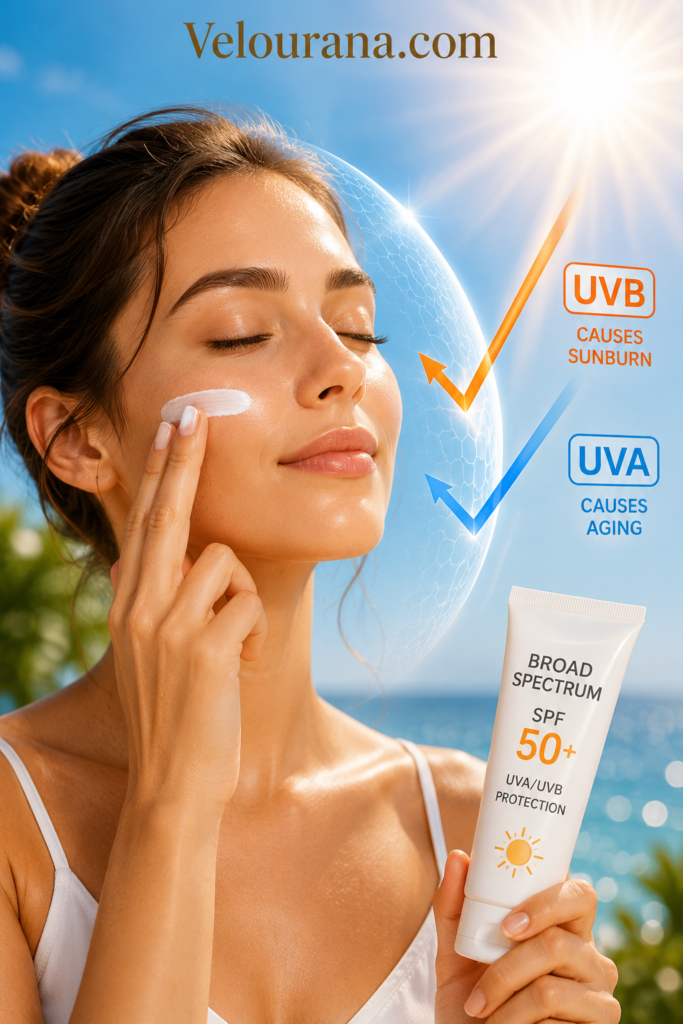
CATEGORY: Broad-Spectrum Protection
When people think about sun protection, they often think first about sunburn. A red nose after a summer afternoon, painful shoulders after a beach holiday, or skin that feels hot after spending too long outdoors provides an immediate and visible reminder that ultraviolet exposure matters.
But sunburn tells only part of the story.
The ultraviolet radiation reaching the skin is primarily divided into two categories that matter for everyday sun protection: UVA and UVB. Both can affect the skin, but they do not behave in exactly the same way.
Understanding the difference between UVA and UVB helps explain why choosing a sunscreen based only on the SPF number does not provide the complete picture.
SPF is extremely important, but broad-spectrum protection goes further.
It addresses the need to protect against both UVA and UVB.
What Does UV Mean?
UV is the abbreviation for ultraviolet.
Ultraviolet radiation is part of the electromagnetic radiation produced by the sun.
It cannot be seen with the human eye.
The fact that UV radiation is invisible is important because people cannot reliably judge exposure simply by looking outside or deciding how hot the weather feels.
A cool day can still involve ultraviolet exposure.
A cloudy day can still involve ultraviolet exposure.
A windy beach can feel comfortable while the skin continues receiving UV radiation.
The Main Types of UV Radiation
Ultraviolet radiation is commonly divided into UVA, UVB, and UVC.
UVC is largely absorbed by the atmosphere and is not the main concern in ordinary sunlight reaching the Earth's surface.
For everyday sunscreen education, the primary focus is therefore UVA and UVB.
These are the forms that make broad-spectrum protection necessary.
What Is UVA Radiation?
UVA has longer wavelengths than UVB.
It penetrates more deeply into the skin and is strongly associated with photoaging.
UVA is also involved in skin damage associated with long-term ultraviolet exposure.
Unlike the immediate redness people often associate with excessive UVB exposure, UVA exposure can occur without an obvious warning signal.
This makes it particularly easy to underestimate.
What Is UVB Radiation?
UVB has shorter wavelengths than UVA.
It is strongly associated with sunburn.
When someone spends too much time outdoors and develops visible redness, UVB has played an important role.
UVB also contributes to skin damage and skin-cancer risk.
Preventing sunburn is therefore important, but it is not the only objective of sunscreen.
An Easy Way to Remember the Difference
People sometimes use a simple memory aid:
UVA is associated strongly with aging.
UVB is associated strongly with burning.
This can be useful for remembering the distinction, but it is an oversimplification.
UVA does more than contribute to aging, and UVB does more than cause burns.
Both contribute to ultraviolet-related skin damage.
The memory aid should therefore be treated as an introduction rather than a complete scientific description.
UVA Reaches Deeper Into the Skin
UVA penetrates into deeper layers of the skin than UVB.
This helps explain its strong association with photoaging.
Repeated exposure can contribute to changes in collagen, elasticity, pigmentation, and overall skin appearance.
These effects accumulate gradually.
A person does not need to experience obvious sunburn every day for ultraviolet exposure to influence the appearance of the skin over time.
UVB Has Strong Effects Nearer the Surface
UVB is strongly associated with the visible inflammatory response recognized as sunburn.
This makes UVB easier to notice.
If your shoulders become red and painful after a day at the beach, the body provides a very clear warning that exposure was excessive.
The problem is that waiting for this warning means waiting until damage has already occurred.
Sun protection should therefore be preventive.
UVA Can Be Present Throughout Daylight Hours
UVA exposure can occur throughout daylight hours and can remain relatively significant across different seasons and weather conditions.
This is one reason people concerned about cumulative photoaging often incorporate broad-spectrum sunscreen into daily skincare rather than using it only during summer holidays.
The actual need for protection depends on circumstances and expected exposure, but UVA should not be thought of as exclusively a midday beach issue.
UVB Varies More Strongly
UVB intensity varies substantially with factors such as time of day, season, latitude, altitude, and atmospheric conditions.
It is generally more intense when the sun is high.
This contributes to the greater risk of sunburn during periods of strong sunlight.
However, relying exclusively on the clock is not an adequate protection strategy.
Local UV conditions matter.
Temperature Does Not Measure UV Exposure
One of the most important concepts in sun education is that heat and ultraviolet radiation are different.
Infrared radiation contributes strongly to the sensation of heat.
Ultraviolet radiation cannot be reliably judged by temperature.
A cool spring day may therefore involve substantial UV exposure.
A hot evening may involve less UV than an apparently cooler midday period.
Do not use temperature as your sunscreen guide.
Wind Can Hide the Warning Sensation
A strong breeze can make an intensely sunny day feel comfortable.
This is particularly common at beaches, on boats, and in the mountains.
Because the skin feels cooler, people may remain outside longer.
The cooling sensation does not remove ultraviolet radiation.
Water Can Also Create a False Sense of Safety
Swimming cools the body.
This can make it easy to forget how much time has been spent outdoors.
Water does not switch off UV exposure.
People swimming outdoors should use appropriate water-resistant sunscreen and follow the product's reapplication instructions.
UVA and Window Glass
Ordinary window glass blocks much of UVB but allows a greater proportion of UVA to pass through.
This means UVA exposure can be relevant while sitting near windows or spending extended periods in a vehicle.
The amount varies according to the type of glass and circumstances.
The broader lesson is that being behind glass does not necessarily mean ultraviolet exposure has disappeared completely.
Driving and UVA Exposure
People who drive for long periods may receive repeated UVA exposure through vehicle windows.
The hands, forearms, and sides of the face can be particularly relevant depending on vehicle design and driving position.
Broad-spectrum protection can therefore have value beyond traditional outdoor activities.
UVA and Photoaging
Photoaging describes visible skin changes associated with repeated ultraviolet exposure.
These can include uneven pigmentation, visible lines, changes in texture, and loss of elasticity.
Chronological aging occurs naturally.
Photoaging is influenced by environmental exposure.
This is why sunscreen is often described as one of the foundations of an anti-aging skincare routine.
Expensive Anti-Aging Products Cannot Replace UV Protection
Someone can use sophisticated serums, retinoids, peptides, moisturizers, and professional treatments while still receiving substantial unprotected ultraviolet exposure.
These approaches serve different purposes.
Cosmetic treatments may address aspects of skin appearance.
Sunscreen reduces ultraviolet exposure.
The most elaborate nighttime routine cannot perform the same function as daytime sun protection.
UVA and Pigmentation
UVA can contribute to pigmentation changes.
For people trying to maintain an even complexion or manage pigmentation concerns, broad-spectrum protection is therefore particularly relevant.
UVB protection alone does not address the entire ultraviolet spectrum affecting pigmentation.
UVB and Sunburn
UVB's strong association with sunburn makes it the form of UV radiation most people recognize.
A mild burn may produce redness and tenderness.
More severe sunburn can produce significant pain, swelling, or blistering.
Avoiding sunburn is an important health objective.
A Tan Is Not Evidence of Safe Exposure
Tanning is a response to ultraviolet exposure.
A person does not need to burn for the skin to have been affected by UV radiation.
This is why the absence of redness should not be interpreted as proof that exposure was harmless.
Sunscreen Should Not Be Used to Extend Tanning Time
Applying high-SPF sunscreen does not make deliberate prolonged UV tanning risk-free.
Sunscreen reduces exposure when used correctly.
It does not eliminate all ultraviolet radiation.
Its purpose should be protection rather than enabling longer exposure.
Why SPF Focuses Mainly on UVB
SPF stands for Sun Protection Factor.
The SPF testing system primarily reflects protection against UVB-associated sunburn.
This makes SPF extremely valuable, but it does not independently tell you everything about UVA protection.
This is where broad-spectrum labeling becomes important.
SPF 30 Does Not Mean 30 Minutes
A common misunderstanding is that SPF can be converted directly into a safe number of minutes in sunlight.
Real-world exposure is much more complicated.
UV intensity changes.
People apply different amounts.
Sunscreen can be removed by water, sweat, towels, clothing, and touching.
SPF should therefore not be used as a countdown timer.
SPF 50 Does Not Mean Unlimited Protection
A higher SPF provides greater tested UVB protection, but no sunscreen should be treated as an impenetrable shield.
SPF 50 does not mean someone can remain in intense sunlight indefinitely.
Application and reapplication remain essential.
Why Broad-Spectrum Protection Matters
If SPF primarily communicates UVB protection, consumers need additional information about UVA.
Broad-spectrum sunscreen addresses this requirement by providing tested protection across both UVA and UVB according to applicable standards.
This creates a more complete approach to ultraviolet protection.
Look Beyond the Largest Number on the Bottle
Sunscreen packaging often displays the SPF number very prominently.
It may be the first thing you notice.
Do not stop there.
Look for the relevant UVA or broad-spectrum information as well.
The exact labeling system depends on where the sunscreen is sold.
European UVA Labeling
In Europe, consumers may see the letters UVA inside a circle on sunscreen packaging.
This symbol communicates that the product meets the relevant requirements concerning UVA protection relative to its SPF.
It provides useful information alongside the SPF number.
PA Ratings
Many Asian sunscreens display PA ratings.
The PA system communicates information about UVA protection.
Consumers may encounter PA+, PA++, PA+++, or PA++++.
This rating is separate from the SPF value because it communicates a different aspect of ultraviolet protection.
Different Countries Use Different Systems
A sunscreen purchased in Europe may not look identical to one purchased in Korea, Japan, Australia, or the United States.
Regulations and labeling conventions differ.
Do not assume a product is inadequate simply because it does not display the exact symbol you recognize from another market.
Understand the system applicable to the product.
Broad-Spectrum Protection for Everyday Life
Broad-spectrum sunscreen is not only for beaches.
Think about ordinary exposure.
Walking to work.
Driving.
Sitting at an outdoor café.
Gardening.
Shopping.
Exercising outside.
Walking the dog.
Watching outdoor sports.
These activities can collectively contribute to cumulative exposure.
Broad-Spectrum Protection at the Beach
Beach conditions deserve particular attention.
Direct sunlight combines with reflection from water and sand.
Swimming can remove sunscreen.
Towel drying can disturb the protective layer.
A comprehensive strategy includes sunscreen, shade, clothing, hats, sunglasses, and appropriate reapplication.
Broad-Spectrum Protection at the Pool
Pool environments create similar challenges.
Water cools the body, potentially reducing awareness of exposure.
Swimming affects sunscreen.
Towels can remove it.
Use an appropriate water-resistant broad-spectrum sunscreen and reapply according to directions.
Broad-Spectrum Protection on Boats
Boating combines extended outdoor exposure with reflection from water and often significant wind.
The breeze can make conditions feel deceptively comfortable.
Protect exposed skin carefully.
Broad-Spectrum Protection in the Mountains
Mountain environments can involve substantial UV exposure.
Altitude matters.
Snow can reflect ultraviolet radiation.
Cold temperatures do not mean sunscreen is unnecessary.
This is an excellent example of why heat and UV should never be confused.
Broad-Spectrum Protection During Winter
Winter does not eliminate ultraviolet exposure.
People may still receive UVA and UVB depending on location, weather, altitude, and activity.
Snow sports can create particularly significant exposure.
Sun protection is therefore not exclusively a summer concept.
Broad-Spectrum Protection on Cloudy Days
Clouds can reduce some ultraviolet radiation, but they do not necessarily eliminate it.
A grey sky should not automatically be interpreted as zero UV exposure.
Consider actual conditions rather than relying solely on visible sunshine.
The UV Index Can Help
The UV Index provides information about the expected level of ultraviolet radiation.
It can help guide sun-protection decisions.
Checking the UV Index is often more informative than judging risk based on temperature.
UVA and Skin Tone
Melanin provides some natural protection against ultraviolet radiation, which means different skin tones may burn at different rates.
However, no natural skin tone makes a person immune to UV-related damage.
People of all skin tones can benefit from appropriate sun protection.
Darker Skin Can Still Experience Hyperpigmentation
For darker complexions, pigmentation concerns may be particularly relevant.
Ultraviolet exposure can influence uneven pigmentation.
Broad-spectrum protection can therefore be important even when visible sunburn occurs less readily.
Lighter Skin May Burn More Quickly
People with lighter skin often experience sunburn more easily.
This makes UVB exposure particularly obvious.
However, UVA protection remains equally relevant.
A sunscreen selected only to prevent burning would still provide an incomplete strategy if UVA coverage were ignored.
Broad-Spectrum Sunscreen for Oily Skin
Protection should be comfortable enough to use properly.
Oily skin may prefer lightweight fluids, gels, or oil-control formulations.
The important point is not to compensate for an unwanted texture by applying too little.
Find a sunscreen you can use in an adequate quantity.
Broad-Spectrum Sunscreen for Dry Skin
Dry skin may prefer creamier sunscreen formulations.
Some sunscreens provide enough moisturization to replace a separate daytime moisturizer.
Others layer well over cream.
The best arrangement is the one that provides comfort without interfering with adequate sunscreen application.
Broad-Spectrum Sunscreen for Combination Skin
Combination skin often benefits from lightweight lotions or fluids.
A moisturizer can be applied selectively underneath on dry areas.
Then sunscreen can provide an even protective layer across the exposed face.
Broad-Spectrum Sunscreen for Sensitive Skin
Sensitive skin may react differently to particular formulations.
Fragrance, alcohol, individual UV filters, preservatives, or other ingredients may influence tolerance.
If finding a comfortable sunscreen is difficult, professional dermatological advice can be useful.
The objective is to find a formulation that can be used consistently.
Mineral UV Filters
Mineral sunscreens commonly use zinc oxide and titanium dioxide.
Depending on formulation, they can provide broad-spectrum protection.
Some formulas may leave a visible cast, particularly on deeper skin tones.
Tinted and newer formulations can improve cosmetic appearance.
Organic UV Filters
Organic UV filters absorb ultraviolet radiation.
Different filters cover different portions of the UV spectrum.
Sunscreen formulators combine filters to create appropriate protection.
Available filters differ among regulatory markets.
One Filter Is Not the Whole Sunscreen
Consumers sometimes focus heavily on individual UV-filter names.
The performance of sunscreen depends on the complete formulation.
Filter combinations, concentrations, stability, film formation, and testing all matter.
Judge the finished sunscreen by its tested protection and suitability rather than a single ingredient.
Application Quantity Matters
Even an excellent broad-spectrum sunscreen cannot provide its labeled protection if applied inadequately.
A very thin, uneven layer leaves areas less protected.
Follow the product instructions and cover exposed skin thoroughly.
Commonly Missed Facial Areas
People frequently miss the hairline, ears, sides of the face, around the eyes, and the area near the jaw.
Apply carefully.
A uniform layer is important.
Do Not Stop at the Face
The neck, upper chest, hands, shoulders, and arms may receive substantial exposure.
Protect all exposed areas rather than concentrating exclusively on facial skincare.
Sunscreen for the Ears
The ears are easy to forget.
If they are not covered by hair or a hat, include them in sunscreen application.
Sunscreen for the Hands
Hands experience regular sunlight and frequent washing.
Reapplication may be necessary when ongoing outdoor exposure is expected.
Sunscreen for the Scalp
An exposed scalp can receive significant sunlight.
Hats provide a practical protective option.
Suitable sunscreen can also be used on exposed scalp areas according to product directions.
Sunscreen for the Lips
Use a lip product offering appropriate sun protection during outdoor exposure.
Reapply as necessary, particularly after eating, drinking, or swimming.
Water Resistance Does Not Mean Waterproof
A water-resistant sunscreen is tested to maintain specified protection under defined water-exposure conditions for a limited period.
It is not permanently waterproof.
Follow the reapplication instructions.
Reapply After Swimming
Swimming affects the sunscreen layer.
Reapply as directed after water exposure.
This remains important even when the product is water resistant.
Reapply After Toweling
Towel drying can physically remove sunscreen.
Restore the protective layer afterward when continued exposure is expected.
Perspiration Can Affect Coverage
Heavy perspiration can also influence sunscreen performance.
People exercising outdoors should select suitable formulations and reapply according to instructions.
Touching the Face Matters
Hands, phones, towels, clothing, and ordinary movement can disturb sunscreen.
This is another reason protection cannot be assumed to remain perfectly unchanged for an entire day.
Makeup Can Disturb Sunscreen
Apply sunscreen before makeup unless product instructions indicate otherwise.
Allow it to settle.
Apply makeup without excessive rubbing.
Reapplication over makeup may require some planning, particularly during prolonged outdoor exposure.
Makeup SPF Is Useful but Has Limitations
A foundation may display an SPF value.
However, most people apply foundation much more thinly than sunscreen is applied during standardized testing.
Makeup with SPF can therefore be considered supplementary rather than automatically replacing dedicated sunscreen.
Sunscreen Sprays Require Careful Application
Sprays can be convenient for the body.
However, it is easy to miss areas or apply insufficient product.
Follow the instructions carefully.
Make sure coverage is even.
Sunscreen Sticks Require Multiple Passes
Sticks are useful for targeted reapplication.
A single quick swipe may not provide enough product.
Apply according to the manufacturer's directions and ensure complete coverage.
Sunscreen Powders Can Be Supplementary
Powder sunscreen formats can provide convenient touch-ups.
However, achieving a sufficiently uniform and substantial layer may be difficult.
They should not automatically replace a well-applied base sunscreen.
Do Not Mix Sunscreen With Foundation
Mixing sunscreen directly with foundation, moisturizer, or facial oil creates an untested combination.
It can interfere with the film the sunscreen is designed to form.
Apply products separately.
Do Not Dilute High-SPF Sunscreen
Mixing SPF 50 sunscreen with moisturizer does not reliably produce SPF 25.
The resulting protection is unpredictable.
Use sunscreen exactly as formulated.
DIY Sunscreen Is Not a Reliable Alternative
Sunscreen requires careful formulation and standardized testing.
Homemade recipes cannot provide reliable information about SPF, UVA protection, stability, or uniformity.
Use properly tested products from legitimate sources.
Product Authenticity Matters
Counterfeit sunscreen is particularly concerning because appearance cannot confirm performance.
A fake product may resemble legitimate packaging while failing to provide the labeled protection.
Purchase from reputable retailers and suppliers.
Expiration Matters
Check sunscreen expiration information.
Follow guidance concerning the period after opening.
Replace products when appropriate.
Do not assume an old sunscreen remains reliable indefinitely.
Storage Matters
Follow manufacturer storage directions.
Avoid unnecessarily exposing sunscreen to extreme heat for prolonged periods.
A car parked in summer sunlight can become extremely hot.
UVA Protection Is Part of Anti-Aging Skincare
People often spend substantial amounts on products intended to maintain youthful-looking skin.
Broad-spectrum sunscreen deserves equal attention.
Reducing cumulative ultraviolet exposure addresses one of the major environmental contributors to premature visible skin aging.
UVB Protection Is Essential for Preventing Burns
Avoiding sunburn remains extremely important.
A burn is evidence of excessive ultraviolet exposure.
Use sunscreen and other protective measures before redness begins rather than responding only afterward.
Both Types Matter at the Same Time
The distinction between UVA and UVB should not become a competition over which is worse.
Both matter.
Both contribute to skin damage.
A comprehensive sunscreen strategy addresses both.
That is precisely what broad-spectrum protection is designed to achieve.
Sunscreen Is Only One Layer of Protection
Even excellent broad-spectrum sunscreen should be combined with other strategies during substantial exposure.
Seek shade.
Wear protective clothing.
Use a broad-brimmed hat.
Wear appropriate sunglasses.
Avoid unnecessarily prolonged exposure when UV levels are intense.
Shade Reduces Direct Exposure
Shade is one of the simplest protective measures.
Umbrellas, trees, buildings, canopies, and covered areas can reduce direct sunlight.
However, reflected UV may still reach the skin.
Sunscreen remains useful on exposed areas.
Clothing Can Provide Reliable Coverage
A shirt does not wash off in the swimming pool or need to be reapplied every two hours.
Protective clothing can therefore be extremely useful during prolonged outdoor activities.
Some garments are specifically rated for ultraviolet protection.
Hats Protect Areas Sunscreen Often Misses
A broad-brimmed hat provides useful shade for the scalp, face, ears, and neck.
It complements sunscreen rather than replacing it.
Sunglasses Protect the Eyes
Choose sunglasses designed to provide appropriate UV protection.
The eyes also deserve protection from ultraviolet exposure.
Avoid Using Sunscreen as a Permission Slip
High SPF can create a false sense of security.
Someone may apply sunscreen and then deliberately remain in intense sunlight much longer than they otherwise would.
This can undermine the purpose of protection.
Sunscreen should reduce exposure, not encourage unnecessary exposure.
When Sunburn Occurs
If the skin becomes burned, avoid further sun exposure.
Mild discomfort may be supported with gentle cooling and moisturizing skincare.
Severe pain, extensive burns, significant swelling, blistering, or other concerning symptoms may require medical attention.
Cosmetics cannot treat serious burns.
The Absence of Sunburn Does Not Mean Zero Damage
This is one of the most important lessons in UVA education.
You can receive ultraviolet exposure without turning visibly red.
Therefore, "I never burn" is not a sufficient reason to ignore sun protection.
Daily Habits Create Cumulative Exposure
Not every meaningful exposure occurs during a holiday.
Short walks.
Driving.
Outdoor lunches.
Gardening.
Commuting.
Weekend activities.
Over years, these repeated exposures accumulate.
Broad-spectrum protection can become part of an everyday preventive strategy.
Build a Sunscreen Habit
Keep sunscreen somewhere visible during the morning routine.
Choose a texture you enjoy.
Use a separate body sunscreen if that makes application easier.
Carry a practical reapplication format during long outdoor days.
Making sunscreen convenient increases the likelihood of consistent use.
Understand Rather Than Fear the Sun
Sun education should not turn ordinary outdoor life into anxiety.
The objective is informed protection.
Understand that UVA and UVB behave differently.
Know that both matter.
Use appropriate sunscreen and physical protection.
Enjoy outdoor activities with sensible precautions.
The Core Difference Between UVA and UVB
UVA has longer wavelengths, penetrates more deeply into the skin, and is strongly associated with photoaging and cumulative skin damage.
UVB has shorter wavelengths and is strongly associated with sunburn while also contributing significantly to skin damage.
Both are relevant to skin-cancer risk.
Both deserve protection.
Why Broad-Spectrum Is the Logical Choice
A sunscreen that addresses only one part of ultraviolet exposure would provide an incomplete strategy.
Broad-spectrum sunscreen is designed to cover both UVA and UVB according to applicable testing standards.
This is why the words "broad spectrum," or the equivalent UVA protection labeling used in the product's market, deserve attention alongside SPF.
Read SPF and UVA Information Together
Do not ask only:
"What SPF is this?"
Also ask:
"Does it provide appropriate UVA protection?"
These two questions provide a more complete picture of sunscreen performance.
Protection Is More Important Than Perfection
Consumers can become overwhelmed comparing filters, ratings, textures, brands, and formulation technologies.
These details can be useful, but they should not make sunscreen so complicated that it is avoided.
Choose a legitimate, appropriately tested broad-spectrum sunscreen that suits your skin and intended activity.
Apply it adequately.
Reapply appropriately.
Combine it with other protective measures.
That foundation matters more than endlessly searching for a theoretically perfect sunscreen.
The Final Lesson
UVA and UVB are different, but your skin encounters both.
UVB provides the more obvious warning because excessive exposure can produce visible sunburn.
UVA can be quieter, contributing to cumulative damage and photoaging without necessarily producing the same immediate signal.
This is why broad-spectrum protection matters.
SPF remains essential, but it should be interpreted as one part of the sunscreen label rather than the entire story.
Choose protection that addresses both UVA and UVB. Apply it correctly. Reapply when circumstances require it. Use clothing, shade, hats, and sunglasses as additional protection.
Once the difference between UVA and UVB is understood, broad-spectrum sunscreen stops being another marketing phrase on the bottle.
It becomes what it should be: a fundamental requirement of a complete sun-protection strategy.
The End
Velourana.
 Discover More From Our Family of Websites
 ZodiacBearing (Astrology, Tarot, Numerology, Angel Numbers & Spiritual Guidance)
 Velourana (Beauty, Makeup, Hair Care, Skincare & Beauty Tips)
 HavenBearing (Home, Living, Organization, Décor & Everyday Inspiration)
 PawBearing (Pet Care, Dog Breeds, Animal Health, Training & Pet Products)
 PsyCatherine (Notes From the Journal of a Psychologist on Real Life)