
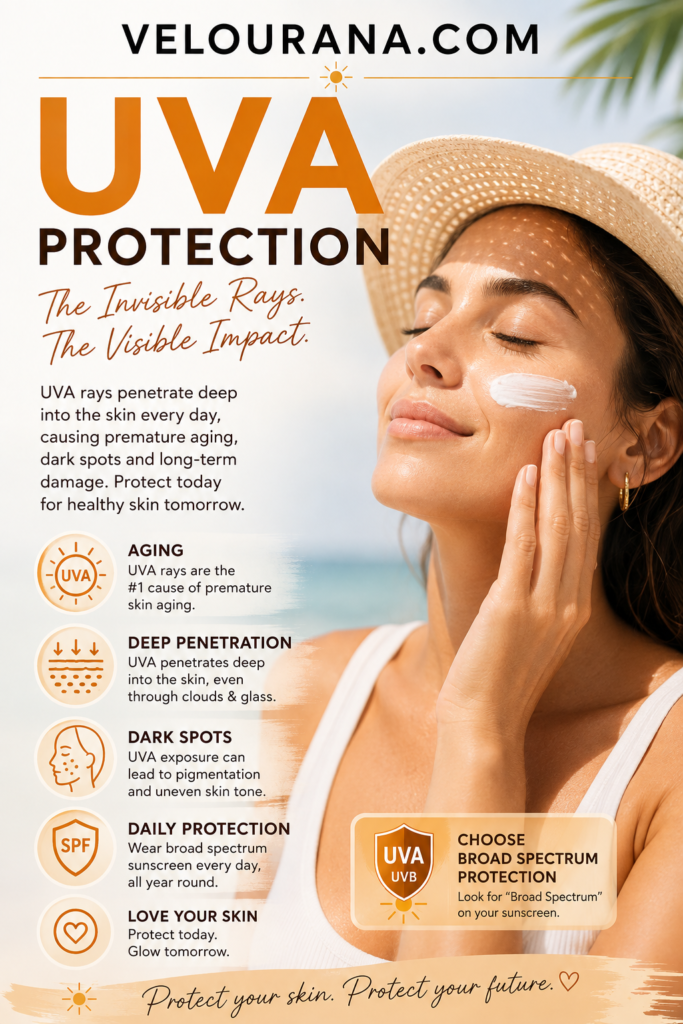
CATEGORY: UVA Protection
For many people, sun protection begins and ends with obvious sunshine. Sunscreen comes out for the beach, a summer holiday, a long afternoon beside the pool, or perhaps a particularly hot day. On ordinary mornings, especially when the sky is cloudy or most of the day will be spent at work, ultraviolet protection can feel much less relevant.
UVA radiation makes that distinction less simple.
Unlike the dramatic sunburn commonly associated with excessive UVB exposure, UVA can be part of ordinary daily life without creating an immediate warning. You do not necessarily feel it on your skin. The temperature does not tell you how much is present. The sky does not have to be perfectly blue, and you do not have to be lying in direct summer sunshine for UVA exposure to occur.
Over time, repeated ultraviolet exposure contributes to changes in the skin that may become visible as uneven pigmentation, fine lines, changes in texture, reduced elasticity, and other features associated with photoaging. UVA also contributes to skin cancer risk, which is why broad-spectrum sun protection is about considerably more than maintaining a youthful complexion.
The practical challenge is finding a sensible balance. Daily UVA protection should not make ordinary daylight feel threatening, nor does it require treating every indoor day as though it were a tropical beach holiday. What matters is understanding where exposure occurs, how it changes throughout the day, and how a few consistent habits can reduce unnecessary cumulative exposure.
The Difference Between a Sunburn Day and an Everyday Exposure Day
A beach day is easy to understand. You know you will be outside, perhaps for hours. Much of the body may be exposed. Water and sand reflect light, sunscreen can be disturbed by swimming and towels, and there may be relatively little shade. Most people immediately recognize that this is a situation requiring deliberate sun protection.
Everyday exposure is less obvious precisely because it rarely feels dramatic.
Imagine a typical weekday. You leave home and walk ten minutes to public transport. Later you cross several streets to buy coffee. At lunchtime you sit outside for half an hour. In the afternoon you walk to a meeting. After work you spend forty minutes shopping in an open-air commercial area before driving home.
None of these moments resembles sunbathing. Individually, they may feel insignificant. Together, however, they form part of your cumulative exposure.
This is one reason daily sunscreen is frequently discussed in dermatology and skincare. The objective is not merely to prevent the spectacular overexposure that produces a painful burn. It is also to reduce the smaller, repeated exposures that accumulate across months and years.
The same principle explains why someone interested in preventing visible photoaging may benefit more from a consistent, comfortable routine than from using an extremely sophisticated sunscreen only on holidays.
Consistency changes the mathematics of exposure.
Why UVA Can Be Easy to Underestimate
Human beings are naturally influenced by what they can immediately perceive. We notice heat. We notice bright sunlight. We notice redness. We notice discomfort.
UVA does not necessarily provide those signals.
A cool breeze can make a sunny day feel mild. Cloud cover can make outdoor conditions appear harmless. Air conditioning can make a sunny car journey feel completely removed from the outdoor environment. None of these sensations is a reliable measurement of ultraviolet radiation.
This is why temperature should not be used as a substitute for UV information.
A cool spring day can involve meaningful UV exposure. A hot evening can occur when UV levels have already fallen substantially. Similarly, winter conditions do not automatically eliminate the need for protection, particularly in high-altitude or snowy environments.
The UV Index provides much more useful context because it is specifically designed to communicate the level of ultraviolet radiation expected at the Earth's surface. Checking it can help turn sunscreen decisions from guesswork into something more informed.
That does not mean monitoring the index obsessively. It simply provides useful information when planning a day outdoors, especially during travel, sport, gardening, hiking, sightseeing, or other prolonged activities.
What Happens When You Are Indoors?
The question of UVA through windows has created considerable confusion because it is often discussed without enough context.
Ordinary window glass generally blocks much of UVB, while UVA can penetrate glass to varying degrees. The exact amount depends on the type of glass, coatings, films, and other characteristics.
This does not mean that everyone inside a building receives the same UVA exposure.
Consider two offices.
In the first, someone works in an interior room with no nearby windows. In the second, someone spends eight hours directly beside a large window receiving strong daylight.
These are not equivalent environments.
Distance matters. Window characteristics matter. The direction of the sunlight matters. The amount of time spent near the window matters.
The practical conclusion is therefore more nuanced than either “you never need sunscreen indoors” or “you must continuously reapply sunscreen whenever you are inside a building.”
If you spend prolonged periods immediately beside windows receiving substantial daylight, broad-spectrum protection may be useful. Curtains, blinds, window treatments, or changing the position of a desk can also reduce exposure without requiring additional skincare products.
If you spend the day deep inside a building away from significant daylight, your circumstances are very different.
Good sun protection should respond to reality rather than slogans.
Driving and UVA Exposure
Driving deserves particular attention because it combines prolonged sitting with exposure through glass.
Vehicle glazing varies. Windshields and side windows can provide different levels of ultraviolet protection, and specifications differ between vehicles. For someone who drives occasionally for a few minutes, this may represent a relatively small part of total exposure. For someone who spends hours driving every day, it can become much more relevant.
The areas exposed while driving are also predictable. The face, hands, and forearms may receive repeated light from the same direction.
A broad-spectrum sunscreen can therefore be useful for frequent drivers, particularly when journeys are long and occur during periods of meaningful UV exposure.
Clothing can simplify protection considerably. Long sleeves cover the arms without requiring repeated sunscreen application. Sunglasses provide important protection for the eyes, while appropriate vehicle window protection can further reduce exposure.
Again, the goal is not to turn every car journey into a complicated skincare procedure. It is to recognize that routine exposure can occur in places that do not feel like traditional “sun exposure.”
UVA During Cloudy Weather
Clouds are another source of false confidence.
A cloudy sky can dramatically change how a day feels. The light becomes softer, temperatures may fall, and direct sunshine may disappear. It is natural to assume that ultraviolet exposure has disappeared with it.
That assumption is unreliable.
Clouds can reduce UV radiation, but they do not necessarily eliminate it. The effect varies considerably according to cloud type and atmospheric conditions.
This is why a person spending hours outdoors on a cloudy day may still need sun protection.
The important distinction is duration and exposure. Walking briefly from one building to another on a grey day is not the same as spending six hours hiking beneath cloud cover.
Rather than using visible sunshine as the only criterion, consider what you will actually be doing.
If the day involves prolonged outdoor activity, check the UV Index and prepare accordingly.
Everyday UVA and the Appearance of the Skin
UVA protection is particularly relevant in beauty because many common skincare concerns are influenced by ultraviolet exposure.
Pigmentation is one example.
People may spend considerable time and money trying to improve the appearance of dark marks or uneven skin tone. Brightening serums, exfoliating acids, retinoids, professional treatments, and other approaches may all be part of the routine.
Without consistent sun protection, however, ongoing exposure can work against those efforts.
The same is true for photoaging.
Collagen and elastin help give skin its structure and resilience. Chronic ultraviolet exposure contributes to changes in these supporting structures over time. The visible result can include lines, wrinkles, uneven texture, laxity, and pigmentation.
This is not the same as saying that sunlight is responsible for every visible sign of aging. Intrinsic aging is a natural biological process influenced by genetics, hormones, lifestyle, and many other factors.
Photoaging is the portion associated with repeated environmental exposure, particularly ultraviolet radiation.
Sun protection cannot stop biological aging, nor should skincare be framed as a battle against getting older. What it can do is reduce an important source of preventable environmental damage.
That distinction makes UVA protection both more realistic and more meaningful.
Making Broad-Spectrum Sunscreen Part of the Morning Routine
The easiest daily sunscreen routine is usually one that does not require a separate decision every morning.
Instead of waking up and asking whether the weather looks sunny enough, sunscreen can become part of normal daytime skincare whenever meaningful exposure is expected.
For many people, the sequence is simple: cleanse as necessary, apply treatment products, moisturize if needed, then apply sunscreen before makeup.
There is no benefit in making the routine excessively complicated.
In fact, too many layers can sometimes make sunscreen harder to use. Products may pill, the skin may feel overloaded, or makeup may sit poorly. When this happens, simplifying the routine can be more useful than adding another product.
Some people find that a moisturizing sunscreen eliminates the need for a separate morning moisturizer. Others prefer a lightweight moisturizer beneath sunscreen. The right combination depends on skin type and product formulation.
The sunscreen itself should provide appropriate broad-spectrum protection and should be comfortable enough to use in an adequate quantity.
That last point deserves emphasis.
A theoretically exceptional sunscreen is not particularly useful if you dislike it so much that you apply only a tiny amount.
The Importance of Applying Enough
Sunscreen performance depends partly on quantity.
The protection stated on the packaging is established through standardized testing. Habitually applying much less than the tested amount can result in lower real-world protection.
This is one reason texture matters so much.
If your sunscreen feels unbearably heavy at an adequate amount, look for another formulation rather than automatically reducing the quantity.
Modern sunscreens are available as creams, lotions, gels, fluids, sticks, and other formats. Some are designed for dry skin, some for oily skin, some for sport, and some specifically to work well beneath makeup.
There is no prize for forcing yourself to use a sunscreen you hate.
Finding a formulation that fits naturally into your routine can improve consistency more than repeatedly purchasing products based only on impressive specifications.
Coverage is equally important. Sunscreen applied generously to the cheeks does not protect the ears. Product carefully blended over the forehead does nothing for an exposed neck.
Think about the entire area receiving exposure.
The hairline, temples, ears, jawline, neck, upper chest, hands, and other exposed areas deserve attention according to clothing and circumstances.
Reapplication Should Fit the Day You Are Actually Having
Morning sunscreen is important, but maintaining protection becomes relevant when exposure continues.
This is another area where daily life requires more nuance than a single universal instruction.
If you spend several hours outdoors, regular reapplication is important. Swimming, towel drying, heavy perspiration, and repeated wiping can disturb sunscreen and create reasons to restore coverage sooner.
An office day is different.
Suppose you apply sunscreen at 8 a.m., travel to work, and then remain in an interior environment until late afternoon. Automatically reapplying at 10 a.m., noon, and 2 p.m. regardless of exposure may add little practical value.
If you then leave the office at 4 p.m. while UV levels remain significant and plan to walk outdoors for an hour, refreshing sunscreen before leaving is a much more meaningful habit.
This event-based approach makes reapplication easier to maintain.
Before outdoor lunch.
Before an afternoon walk.
Before leaving work for a long commute.
Before gardening.
Before outdoor exercise.
Before sightseeing.
Reapplication becomes connected to exposure rather than merely to the movement of a clock.
When Everyday Life Becomes an Outdoor Day
Some ordinary days unexpectedly turn into prolonged exposure days.
A quick shopping trip becomes three hours walking around town. Lunch extends into an afternoon at an outdoor café. A short gardening task becomes an entire afternoon outside. A travel day involves hours of sightseeing rather than the expected indoor activities.
A portable sunscreen provides flexibility for these situations.
It does not need to be a large bottle. A small facial sunscreen, stick, or other convenient format can remain in a handbag or work bag.
If the body is substantially exposed, however, a tiny facial product will not be enough. Large areas require enough sunscreen to achieve proper coverage.
For outdoor days, physical protection becomes increasingly valuable. A hat, sunglasses, appropriate clothing, and shade can reduce the amount of skin depending entirely on sunscreen.
This is especially helpful when exposure continues for many hours.
UVA Protection and Makeup
For people who wear makeup, sunscreen needs to work cosmetically as well as functionally.
A sunscreen that causes severe pilling beneath foundation is unlikely to become a favorite. A product that leaves an unacceptable white cast may encourage underapplication. An extremely greasy finish may lead someone to skip sunscreen on days when makeup matters.
This is why cosmetic elegance has become an important part of modern sunscreen formulation.
A suitable sunscreen can function almost like a primer, creating a comfortable surface for makeup while providing broad-spectrum protection.
After sunscreen has settled, foundation can be applied gently. Excessive rubbing may disturb the underlying film, so controlled application can be useful.
Makeup containing SPF can provide supplementary protection, but it should not automatically replace dedicated sunscreen. Foundation is generally applied for appearance, and the quantity used may be far smaller than would be necessary to rely on its SPF as the primary protection.
Reapplication over makeup can be managed with compatible fluids, sticks, cushions, sprays, or powders depending on the situation. During substantial outdoor exposure, however, protection should take priority over preserving makeup perfectly.
Cosmetics can be touched up afterward.
UVA Protection for Different Skin Tones
Ultraviolet protection is relevant across skin tones.
Melanin provides some natural protection, and susceptibility to visible sunburn differs considerably between individuals, but deeper skin tones are not immune to ultraviolet damage.
Pigmentation concerns can be particularly significant. Post-inflammatory hyperpigmentation and uneven tone may persist or become more noticeable when environmental exposure is not managed consistently.
At the same time, sunscreen itself can create cosmetic challenges on deeper skin.
Some mineral-heavy formulations may leave a visible white or grey cast, especially when applied in the amount required for reliable protection. This can encourage people to apply less than necessary.
Transparent and tinted sunscreens can provide better cosmetic options.
The important principle is not that one filter system is universally best for every skin tone. It is that the sunscreen needs to provide appropriate protection while remaining wearable at the amount required.
A product that disappears beautifully into the skin can make consistent application much easier.
UVA Protection During Travel
Travel changes exposure patterns dramatically.
Someone who normally spends weekdays inside may suddenly spend ten hours walking through a city. A winter holiday may involve skiing at altitude. A cruise or island holiday can combine strong sunlight, water reflection, and long periods outdoors.
This is why sunscreen routines should adapt to circumstances.
For sightseeing, apply sunscreen before leaving accommodation and carry enough for later application. Wear sunglasses and consider a hat, particularly when shade is limited.
For beach travel, choose water-resistant sunscreen and use protective clothing where practical. Reapply after swimming and towel drying according to product directions.
For mountain travel, do not allow cold temperatures to create false confidence. Altitude can increase UV exposure, while snow can reflect radiation toward the face.
Travel also makes the neck, ears, hands, and lips particularly easy to neglect. These areas should be included in the protection routine rather than treating sunscreen as facial skincare alone.
Building Protection Without Building Anxiety
There is a point at which health advice can become so complicated that people either become anxious about following it or abandon it entirely.
UVA protection does not need to reach that point.
You do not need to fear daylight.
You do not need to spend your life calculating the exact number of minutes since sunscreen application.
You do not need an enormous collection of products.
What helps is understanding a few principles and applying them consistently.
Ultraviolet exposure can occur even when the skin does not burn.
Broad-spectrum protection matters because SPF alone does not describe the entire protection profile.
Sunscreen needs to be applied adequately.
Reapplication becomes particularly important during prolonged outdoor exposure and when the protective film has been disturbed.
Clothing, hats, sunglasses, and shade reduce reliance on sunscreen alone.
The UV Index provides better guidance than temperature or visible sunshine.
Once those principles are understood, the routine can become remarkably ordinary.
A Long-Term View of UVA Protection
Many skincare products are designed around visible change. They promise brighter skin, smoother texture, increased hydration, or a more even complexion. Because those results are visible, it is easy to appreciate what the product is doing.
Sun protection is different.
Much of its value lies in what does not happen.
The sunburn avoided.
The unnecessary exposure reduced.
The cumulative damage limited.
The additional pigmentation that may never develop.
The photoaging that may progress more slowly because years of repeated exposure have been reduced.
Prevention is difficult to photograph because there is no alternate version of your skin available for comparison.
That does not make it less valuable.
Daily UVA protection is therefore best understood as a quiet background habit. It does not need to dominate the skincare routine, but it deserves to remain consistently present within it.
Choose a broad-spectrum sunscreen you genuinely like using. Apply it properly when meaningful exposure is expected. Maintain it when you spend prolonged periods outdoors. Protect the areas beyond the face. Use clothing and shade intelligently. Pay attention to changing circumstances rather than following rules mechanically.
Over months and years, these ordinary decisions form something much more significant than a single application of sunscreen.
They create a pattern of reduced cumulative ultraviolet exposure.
And for anyone interested in protecting both the health and appearance of their skin, that pattern is one of the most valuable long-term skincare habits available.
The End
Velourana.
 Discover More From Our Family of Websites
 ZodiacBearing (Astrology, Tarot, Numerology, Angel Numbers & Spiritual Guidance)
 Velourana (Beauty, Makeup, Hair Care, Skincare & Beauty Tips)
 HavenBearing (Home, Living, Organization, Décor & Everyday Inspiration)
 PawBearing (Pet Care, Dog Breeds, Animal Health, Training & Pet Products)
 PsyCatherine (Notes From the Journal of a Psychologist on Real Life)

