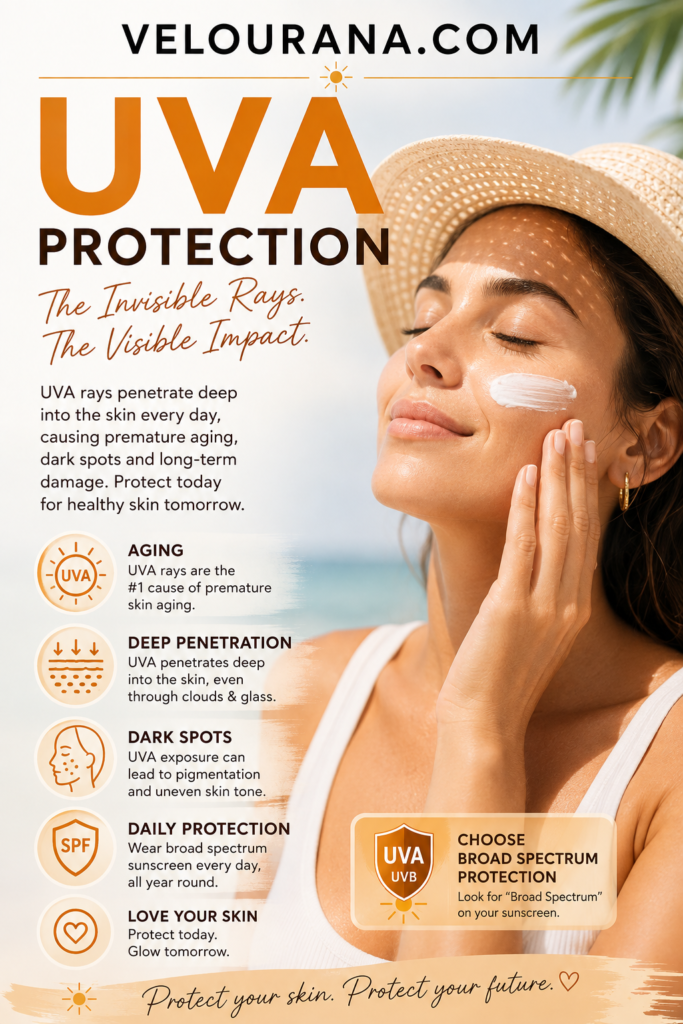
CATEGORY: UVA Protection
Skin aging is often discussed as though it begins suddenly. A person notices a fine line that was not obvious before, pigmentation that seems more persistent than it once did, or a gradual change in firmness and texture. It can feel as though these changes appeared overnight, but the visible appearance of aging skin is usually the result of processes that have been developing quietly for years.
Some of those processes are intrinsic. Skin naturally changes with age as cell turnover, collagen production, hormonal influences, and many other biological functions evolve. No skincare routine can or should attempt to stop normal biological aging.
Another part of what we see, however, is influenced by the environment.
Ultraviolet radiation is one of the most significant environmental contributors to premature visible skin aging, a process commonly known as photoaging. Both UVA and UVB matter, but UVA deserves particular attention because of the way it interacts with deeper structures in the skin and because exposure can occur during many ordinary activities without producing an obvious sunburn.
For anyone investing in skincare with the goal of maintaining smoother, more even-looking and resilient skin, UVA protection is therefore not simply another optional product category. It is one of the foundations upon which the rest of an anti-aging routine can be built.
What Photoaging Actually Means
Chronological aging and photoaging overlap, but they are not identical.
Chronological aging describes the natural biological changes that occur as the years pass. Genetics, hormones, metabolism, lifestyle, and many other factors influence how these changes appear from one person to another.
Photoaging refers to changes associated with repeated exposure to ultraviolet radiation.
Over time, this exposure can contribute to wrinkles, uneven pigmentation, changes in skin texture, loss of elasticity, and other visible alterations. The degree of photoaging varies enormously because people have different skin characteristics, lifestyles, occupations, geographic locations, and histories of sun exposure.
Someone who has spent decades working outdoors may have a very different exposure history from someone who has spent most working hours indoors. A person living in a region with intense year-round UV has different environmental circumstances from someone living much farther north. Recreational habits also matter: beach holidays, gardening, sailing, hiking, outdoor sport, and intentional tanning can all contribute to cumulative exposure.
The important word is cumulative.
Skin does not need to burn every day for ultraviolet exposure to matter.
That is one reason UVA can be underestimated. Sunburn is memorable. Gradual photoaging is not. You can see the consequences of a severe burn that evening, while the effects of repeated everyday exposure may become apparent only much later.
This delayed visibility makes prevention less emotionally compelling than treatment. A serum that improves hydration can make the skin look better almost immediately. Sunscreen usually does not provide that same dramatic feedback. Much of its value lies in helping prevent additional damage from accumulating.
In long-term skincare, however, prevention can be extraordinarily important.
How UVA Influences the Skin's Supporting Structure
The youthful appearance of skin depends partly on the structure of the dermis beneath the surface. Collagen provides strength and support, while elastin contributes to elasticity. These structures exist within a complex biological environment that continually changes throughout life.
UVA radiation can penetrate more deeply into the skin than UVB and contributes to oxidative stress and biological processes that affect collagen and other components of the extracellular matrix.
Over repeated exposure, these effects contribute to the characteristic appearance associated with photoaged skin.
This is one reason wrinkles caused or accelerated by environmental exposure cannot be understood simply as a surface problem. Applying a richer moisturizer may temporarily make fine dehydration lines appear softer, but moisturizer cannot remove the history of ultraviolet exposure that contributed to structural changes deeper within the skin.
This does not make moisturizer unimportant. Hydration supports skin comfort and barrier function and can improve the appearance of dryness and fine lines.
It simply has a different job.
The same distinction applies to many anti-aging ingredients. Retinoids, antioxidants, peptides, exfoliating ingredients, and professional treatments may address particular aspects of skin appearance. Sunscreen addresses another fundamental issue: reducing continuing ultraviolet exposure.
A thoughtful skincare routine allows each component to perform its own role rather than expecting one product to do everything.
Why Anti-Aging Skincare Without Sun Protection Is Incomplete
It is easy to build an impressive evening skincare routine.
Cleanser.
Exfoliant.
Retinoid.
Serum.
Moisturizer.
Perhaps an eye treatment or facial oil.
The products may be excellent, but if the skin receives substantial unprotected ultraviolet exposure the following day, part of the routine is effectively working against an ongoing environmental influence.
This is particularly relevant for people using ingredients intended to improve visible photoaging.
Consider pigmentation. A brightening routine may gradually improve the appearance of certain dark marks, but repeated UV exposure can encourage pigmentation to persist or become more noticeable.
Consider collagen-focused skincare. Treatments may be chosen specifically to support smoother and firmer-looking skin, while continued UV exposure contributes to processes associated with collagen degradation.
The answer is not necessarily to purchase more treatment products.
It is often to make protection more consistent.
This is one of the reasons dermatological skincare tends to place such emphasis on sunscreen. It is difficult to construct a rational strategy for managing photoaging while ignoring one of its major environmental causes.
For many routines, a reliable sunscreen may ultimately contribute more to the long-term objective than adding another fashionable serum.
The Role of Broad-Spectrum Protection
SPF is important, but UVA protection requires looking beyond the SPF number alone.
SPF primarily describes protection against UVB-related erythema, or sunburn, under standardized testing conditions. A sunscreen intended to provide comprehensive protection should also offer appropriate UVA protection.
Depending on where you live, this may be communicated through broad-spectrum labeling, UVA symbols, protection grades, or other regulatory systems.
Consumers do not need to become sunscreen chemists to choose a suitable product. They do, however, benefit from understanding that a large SPF number is not the only information worth reading on the packaging.
For someone particularly concerned about photoaging, broad-spectrum protection should be a priority.
The product also needs to be applied correctly. A sunscreen with excellent laboratory performance cannot provide its intended protection if only a tiny amount is spread across the face.
This is where formulation becomes surprisingly important.
A sunscreen that looks beautiful on the skin and feels comfortable at an adequate amount is likely to be used more consistently. A sunscreen that feels unpleasant, leaves an unacceptable cast, stings the eyes, or interacts badly with makeup may encourage underapplication.
Choosing sunscreen is therefore partly about science and partly about behavior.
The best protection on paper has limited practical value if the product remains unused in the bathroom cabinet.
The Everyday Exposure That Does Not Feel Like Sun Exposure
When discussing photoaging, people often think about their most obvious episodes of sun exposure: childhood holidays, beach trips, sunbathing, or a memorable sunburn.
Those events certainly matter, but everyday exposure can also form part of the cumulative picture.
Walking to work is exposure.
Eating outside is exposure.
Gardening is exposure.
Driving can involve UVA exposure through glass to varying degrees.
Sitting for prolonged periods beside certain windows can contribute exposure.
Weekend sports, outdoor shopping, sightseeing, and walking the dog all add to the pattern.
None of these activities should be avoided simply because sunlight exists. Outdoor activity has many benefits, and sensible sun protection is intended to support normal life rather than discourage it.
The useful change is recognizing exposure when it occurs.
If you know you will spend much of the day outside, protection can become more comprehensive. If you know you will spend the entire working day indoors away from meaningful sunlight, the routine can be simpler.
This is much more practical than dividing life into “beach days that require sunscreen” and “everything else that does not.”
UVA Protection Through Different Decades of Life
People sometimes become interested in sun protection only after they begin noticing visible signs of aging. This can lead to the discouraging belief that starting later is pointless.
It is not.
Past exposure cannot be undone by sunscreen, but future exposure can still be reduced.
Someone beginning consistent protection in their forties, fifties, or later can still make a meaningful change to the environmental exposure their skin receives from that point forward.
There is no requirement that you must have followed a perfect sunscreen routine since adolescence for protection to be worthwhile today.
At the same time, developing good habits earlier has obvious advantages because it reduces cumulative exposure across a longer period.
The objective should not be regret about what happened previously. It should be making the future routine sensible and sustainable.
This perspective is particularly useful in anti-aging skincare because marketing frequently encourages people to think in terms of reversing time. Skin biology does not work that way.
A more realistic objective is to care for the skin you have now, address concerns appropriately, and reduce avoidable environmental damage going forward.
UVA Protection and Pigmentation
Photoaging is not limited to wrinkles.
Uneven pigmentation can become one of its most visible characteristics.
Repeated ultraviolet exposure can contribute to the development or persistence of areas of hyperpigmentation. Individual susceptibility varies, and pigmentation can arise from many causes, including inflammation, hormones, injury, medical conditions, and other factors.
This means sunscreen should not be presented as a universal treatment for every dark mark.
Nevertheless, photoprotection is frequently an important component of pigmentation management.
This becomes particularly relevant for people using brightening ingredients or undergoing professional treatments. Protecting the skin from ongoing exposure helps support the broader objective of achieving a more even-looking complexion.
Some people with pigmentation concerns may also benefit from tinted sunscreens containing iron oxides because visible light can play a role in certain pigmentation disorders. A dermatologist can provide individualized guidance, particularly for conditions such as melasma.
The cosmetic quality of the sunscreen matters here as well. If a product leaves an obvious white cast, people with deeper skin tones may understandably find it difficult to apply generously.
Modern transparent and tinted formulations provide increasingly useful alternatives.
Sunscreen and Retinoid Routines
Retinoids are among the most established ingredients used in routines addressing photoaging, acne, texture, and pigmentation. They can be highly effective, but they are not a replacement for sunscreen.
A person may use a retinoid at night while using broad-spectrum sunscreen during the day, creating a routine in which treatment and prevention complement one another.
This is a more coherent strategy than expecting the nighttime treatment to compensate for repeated unprotected exposure.
Some retinoid users also experience irritation, dryness, or increased sensitivity during the adjustment period. A gentle skincare routine and appropriate sun protection become particularly important when the skin barrier is irritated.
Prescription retinoids should be used according to medical guidance, and significant irritation should be discussed with the prescribing professional.
The broader lesson extends beyond retinoids.
Skincare treatments work best when the environment surrounding them supports their purpose.
Vitamin C, Antioxidants and UVA Protection
Antioxidants are another popular component of morning skincare.
Vitamin C is frequently used because of its antioxidant properties and its role in supporting a brighter, more even-looking complexion. Other antioxidant ingredients appear in many modern formulations.
These products can complement a sun-protection routine, but they should not be confused with sunscreen.
An antioxidant serum does not provide a substitute for tested broad-spectrum UV filters.
A simple morning routine might therefore involve an antioxidant product, moisturizer if necessary, and sunscreen. For someone who dislikes multiple layers, the routine can be simplified according to skin needs.
More products do not automatically create better protection.
Consistency and correct use matter more than the number of bottles on the shelf.
Protecting the Neck, Chest and Hands From Photoaging
Anti-aging skincare is often strangely limited to the face.
Expensive serums are carefully applied around the cheeks and forehead while the neck, upper chest, and hands receive little attention.
Yet these areas can accumulate substantial sun exposure.
The neck is particularly easy to neglect because facial sunscreen application often stops at the jawline. The upper chest may be exposed by open collars and summer clothing. The backs of the hands receive exposure during walking, driving, gardening, and everyday activities, while frequent washing removes sunscreen repeatedly.
If your objective includes reducing visible photoaging, protection should follow exposed skin rather than cosmetic boundaries.
This does not mean applying your most expensive facial treatment across the entire body.
A practical sunscreen can be used on the neck, chest, hands, arms, and other exposed areas. Clothing can provide even easier protection.
Long sleeves protect the arms continuously. Gloves may be useful in specialized outdoor situations. Higher necklines reduce chest exposure. A hat protects areas of the face and scalp.
Physical protection can be both effective and economical.
Reapplication and Long-Term Protection
A morning sunscreen application is valuable, but sunscreen does not remain physically unchanged on the skin regardless of activity.
Perspiration, water, washing, rubbing, towels, and clothing can disturb the protective layer.
During prolonged outdoor exposure, regular reapplication is therefore important. Follow the directions provided with the sunscreen, particularly when swimming or exercising.
Everyday life requires more context.
If you apply sunscreen in the morning and then spend several hours inside an office away from significant sunlight, your situation differs from someone who has spent those hours walking outdoors.
If you later plan to leave the office while UV levels remain meaningful, refreshing sunscreen before that new exposure can be practical.
This approach makes reapplication sustainable.
The objective is not to use as much sunscreen as physically possible. The objective is to maintain reliable protection when meaningful exposure occurs.
The Importance of Hats, Shade and Clothing
Sunscreen receives enormous attention in skincare discussions, but it should not carry the entire responsibility for sun protection.
A broad-brimmed hat can reduce direct exposure to the face, scalp, ears, and neck.
Appropriate clothing can cover the arms, shoulders, chest, and legs.
Sunglasses protect the eyes and provide additional shade to surrounding skin.
Shade reduces direct exposure and can make outdoor activities considerably more comfortable.
These measures become particularly valuable during prolonged exposure because they do not depend on repeatedly applying a cosmetic product to every covered area.
For example, someone spending an entire day sightseeing may find that lightweight long sleeves and a hat make the routine far easier than repeatedly applying sunscreen across the arms and scalp.
At the beach, protective swimwear can dramatically reduce the surface area requiring sunscreen and reapplication.
Good photoprotection is therefore a system.
Sunscreen is an important part of that system, but it is not the entire system.
Avoiding the Anti-Aging Trap of Chasing More Products
The skincare industry constantly introduces new ingredients, technologies, devices, and treatment concepts. Some are genuinely useful. Others offer smaller benefits than their marketing suggests.
This can create a tendency to believe that improving an anti-aging routine means continuously adding something new.
Another serum.
Another cream.
Another exfoliant.
Another device.
Another treatment.
Sometimes the most meaningful improvement is much simpler.
Use the sunscreen you already own correctly.
Apply enough.
Use it consistently.
Protect the neck.
Wear the hat.
Choose shade.
Avoid unnecessary intentional tanning.
Reapply when prolonged exposure requires it.
These habits are not glamorous, but skincare does not become more effective simply because it becomes more complicated.
A streamlined routine that is followed every day can outperform an elaborate routine that is followed inconsistently.
Sun Protection Without Fear of Aging
There is also an important emotional distinction to make.
Protecting the skin from photoaging does not mean that aging itself is something to fear.
Lines, changes in facial structure, altered texture, and other age-related characteristics are normal parts of human life. Skincare can support the health and appearance of the skin without suggesting that a naturally older face is a failure.
UVA protection has health benefits that extend beyond appearance, including reducing ultraviolet exposure associated with skin cancer risk.
From a cosmetic perspective, it offers people the opportunity to reduce one preventable contributor to premature visible skin changes.
That is a very different goal from trying to remain permanently young.
A sensible skincare philosophy can acknowledge both realities: aging is normal, and protecting the skin from unnecessary environmental damage is still worthwhile.
Making UVA Protection Sustainable for Years
Long-term habits need to be easy enough to survive ordinary life.
If your sunscreen routine requires twenty minutes every morning, six products, and constant monitoring throughout the day, you may eventually abandon it.
A sustainable routine can be much simpler.
Find a broad-spectrum sunscreen you genuinely enjoy wearing.
Keep it where you perform your morning skincare.
Apply it adequately to exposed areas.
Use a separate body sunscreen when larger areas require protection.
Keep a portable product available when you expect significant later exposure.
Use clothing, hats, sunglasses, and shade to reduce the amount of skin requiring sunscreen.
Check the UV Index when planning prolonged outdoor activities.
Adapt the routine to the day rather than expecting an office morning and a beach holiday to require identical behavior.
These habits can continue for decades precisely because they do not demand constant attention.
Thinking About the Future of Your Skin
Skincare naturally encourages us to look closely at what we see today.
A blemish appears and we want it gone.
Dryness develops and we moisturize it.
Pigmentation becomes visible and we search for a brightening treatment.
Fine lines appear and we investigate retinoids.
UVA protection asks us to think differently.
Its greatest value may not be visible tomorrow morning.
It lies in reducing a source of cumulative damage over years.
That makes sunscreen unusual within the beauty routine. It is simultaneously a daily product and a long-term investment in skin health.
You cannot see the ultraviolet exposure you avoided during today's walk.
You cannot compare your face ten years from now with an identical version of yourself who never used sunscreen.
Prevention does not provide that kind of dramatic before-and-after photograph.
But the biological relationship between ultraviolet exposure and photoaging gives consistent protection a clear purpose.
The objective is not perfect skin.
It is not eternal youth.
It is not avoiding every ray of sunlight.
It is reducing unnecessary cumulative exposure while continuing to enjoy ordinary life.
A broad-spectrum sunscreen applied correctly, supported by sensible reapplication and physical protection, can become one of the simplest elements of that strategy.
When UVA protection becomes part of everyday skincare rather than something reserved for summer holidays, anti-aging skincare begins to make much more sense.
Instead of continually trying to repair yesterday's environmental damage, you are also doing something to reduce tomorrow's.
And over the long term, that balance between protection, treatment, and realistic expectations is one of the most intelligent ways to care for your skin.
The End
Velourana.
 Discover More From Our Family of Websites
 ZodiacBearing (Astrology, Tarot, Numerology, Angel Numbers & Spiritual Guidance)
 Velourana (Beauty, Makeup, Hair Care, Skincare & Beauty Tips)
 HavenBearing (Home, Living, Organization, Décor & Everyday Inspiration)
 PawBearing (Pet Care, Dog Breeds, Animal Health, Training & Pet Products)
 PsyCatherine (Notes From the Journal of a Psychologist on Real Life)