
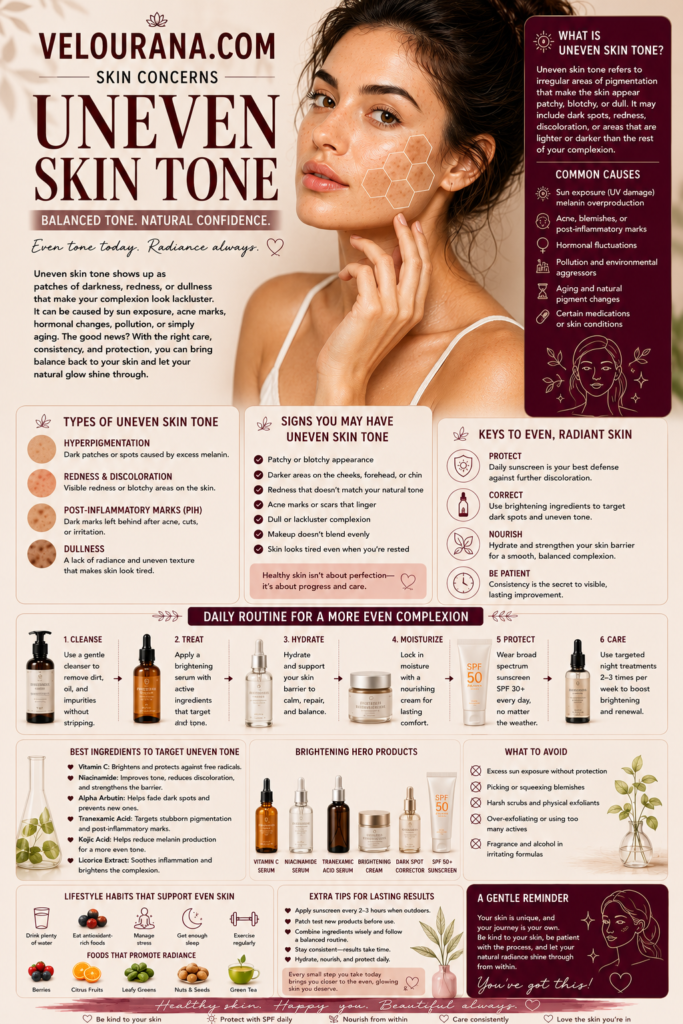
CATEGORY: Uneven Skin Tone
There is a particular frustration attached to uneven skin tone because it rarely presents itself as one clearly defined concern. A single dark mark can be identified. A blemish can be watched as it heals. Dryness can be felt. Unevenness is more elusive. The complexion may simply seem less harmonious than it once did: one area appears darker, another slightly red, the forehead looks more tanned than the cheeks, old blemishes leave faint shadows, and the overall face seems to reflect light irregularly.
This is why the phrase uneven skin tone can be misleading. It sounds like a single condition when it is actually a visual description of many possible processes occurring within the skin. Pigment production, inflammation, sun exposure, vascular redness, dryness, cellular turnover and the aftermath of previous irritation can all influence how uniform the complexion appears.
Understanding that distinction changes the way uneven tone should be approached. The goal is not simply to make the skin “lighter.” Healthy skin naturally contains variation, and perfectly identical pigmentation across every millimetre of the face is neither realistic nor necessary. The more useful objective is to understand why certain areas have become noticeably different from their surroundings and to reduce the processes that continue to exaggerate those differences.
In other words, a more even-looking complexion is usually created not by aggressively correcting colour, but by helping the skin behave more consistently.
The Complexion Is a Landscape, Not a Single Colour
Human skin was never designed to be perfectly uniform. Even when it appears exceptionally even from a conversational distance, closer inspection reveals subtle variations in pigment, blood flow, texture, follicle density and thickness. The eye area differs from the cheeks. The nose may contain more visible vessels. The forehead receives different levels of ultraviolet exposure. The mouth and chin experience their own patterns of movement, friction and hormonal activity.
What we perceive as an even complexion is therefore not absolute sameness. It is visual balance.
This distinction matters because attempts to eliminate every variation can lead to unnecessary treatment and, paradoxically, more unevenness. Strong exfoliation, excessive brightening products or repeated experimentation with active ingredients can irritate the skin. Irritation may create redness, dryness and, in susceptible complexions, additional pigmentation. The pursuit of uniformity can become the very thing that disrupts it.
A more intelligent approach begins with identifying the dominant type of unevenness.
Brown, tan or greyish areas often suggest increased pigmentation. Pink or red irregularities may have a vascular or inflammatory component. Areas that look dull or slightly darker only under certain lighting may actually be textural rather than deeply pigmented. Flaking can create shadows. Enlarged pores can scatter light differently. Old acne marks can produce a mixture of colour and texture.
Several of these patterns can coexist.
This is one reason two people who both describe themselves as having “uneven skin tone” may require completely different skincare strategies. One may primarily need consistent sun protection and pigment management. Another may benefit more from calming persistent inflammation. A third may discover that what appeared to be pigmentation was largely dehydration and surface roughness affecting the way light moved across the face.
The visible result may be similar. The biology underneath it is not.
Melanin and the Geography of Pigmentation
Much of what is commonly called uneven tone involves melanin, the pigment that contributes to the colour of the skin, hair and eyes. Melanin itself is not an imperfection. It is an essential component of the skin's natural defence system, particularly in response to ultraviolet radiation.
Specialised cells called melanocytes produce melanin and distribute it to surrounding skin cells. When these pigment-producing systems are stimulated more strongly in certain areas than others, patches, spots or lingering marks can become visible.
Sunlight is one of the most important influences. Ultraviolet exposure signals the skin to increase pigment production as part of its protective response. This is why tanning occurs, but exposure is rarely distributed perfectly evenly. The forehead, cheekbones, nose and other prominent areas may receive more radiation. Previous areas of pigmentation can also become more noticeable after sun exposure.
Inflammation provides another powerful signal.
A blemish, scratch, rash, cosmetic reaction or other inflammatory event can leave behind excess pigment after the original problem has resolved. This phenomenon, commonly known as post-inflammatory hyperpigmentation, explains why someone may technically have clear skin while continuing to see evidence of acne months after individual spots disappeared.
Hormonal influences can contribute as well. Melasma, for example, is a complex pigmentation disorder often associated with characteristic symmetrical patches and influenced by factors including hormones, ultraviolet radiation and visible light. It cannot simply be treated as an ordinary collection of isolated dark spots.
The important principle is that pigmentation has causes. A darkened area is the visible endpoint of biological signalling that occurred earlier and may still be occurring.
Effective care therefore involves two questions: what can gradually improve existing excess pigment, and what is continuing to tell the skin to produce more of it?
Ignoring the second question is one of the most common reasons brightening routines disappoint.
Sun Exposure Can Quietly Undo Months of Progress
Pigmentation management is frequently discussed in terms of serums, exfoliants and specialised ingredients, yet daily light exposure can be more important than any individual corrective product.
This creates an uncomfortable imbalance in many routines. Considerable attention may be given to what is applied at night while the environmental stimulus responsible for much of the pigmentation receives comparatively little attention during the day.
Ultraviolet radiation does not require a dramatic sunburn to influence pigmentation. Repeated exposure accumulates. Walking outdoors, sitting near strong daylight, driving and spending ordinary time outside all contribute to the skin's lifetime exposure.
For a person trying to improve uneven pigmentation, sunscreen is therefore not merely an anti-ageing addition. It is part of the pigmentation strategy itself.
Broad-spectrum protection helps reduce exposure to both UVA and UVB radiation. SPF indicates protection primarily against UVB, while broad-spectrum labelling indicates that UVA protection is also included. Adequate application matters, as does reapplication when prolonged outdoor exposure, sweating or other circumstances make it necessary.
Physical behaviour remains important too. Shade, hats and avoiding unnecessarily intense midday exposure can complement sunscreen rather than being regarded as alternatives to it.
For pigmentation-prone skin, this consistency can make an enormous difference over time. Brightening ingredients are being asked to reduce visible evidence of previous pigment activity. Unprotected sun exposure can simultaneously encourage new pigment production.
Those two forces working against each other help explain why someone may use an apparently sophisticated routine for months and see little overall change.
There is another subtle point. Uneven pigmentation often becomes more visible during sunnier periods not necessarily because every existing mark suddenly becomes dramatically darker, but because different regions of the complexion respond differently to exposure. Contrast increases. Areas that already contain irregular pigment may behave differently from surrounding skin, making the overall pattern more noticeable.
Prevention and correction are therefore inseparable.
Inflammation Often Writes Its History on the Skin
One of the most useful ways to understand uneven tone is to think of the complexion as retaining a temporary record of previous inflammation.
A blemish lasts a week, but its mark may remain for months. An episode of irritation disappears, yet the affected region continues to look different. Picking at a spot can turn a relatively brief breakout into a much longer pigmentation concern.
This delayed visual consequence can make skincare decisions confusing. People naturally focus on what they see today. Yet today's dark mark may be the consequence of inflammation that occurred many weeks earlier.
This is particularly relevant for acne-prone skin. Treating post-blemish pigmentation without controlling recurring breakouts creates a moving target. Old marks may slowly improve while new ones continuously appear.
The same principle applies to irritation caused by skincare itself.
A routine containing numerous strong acids, retinoids, scrubs and brightening ingredients may appear logically suited to uneven tone because each product promises some form of renewal or correction. But if the combination repeatedly compromises the skin barrier, the resulting inflammation can work against the intended goal.
This is especially important in skin tones that are more prone to post-inflammatory hyperpigmentation. Aggressive treatment is not automatically faster treatment. In some cases, the safest route to visible improvement is deliberately slower because avoiding additional inflammation is part of the correction process.
Even seemingly insignificant habits can matter. Repeated rubbing, squeezing blemishes, scratching irritated areas or continually testing strong products may extend inflammatory activity.
The complexion cannot become consistently calmer while it is being repeatedly provoked.
This shifts the philosophy of pigmentation care away from attacking visible colour and toward reducing unnecessary biological disturbance.
Texture Can Create the Illusion of Uneven Colour
Not every uneven-looking complexion is primarily a pigmentation problem.
Skin is a reflective surface. When its texture is relatively smooth, light travels across it more uniformly. When the surface is rough, flaky, congested or dehydrated, light scatters irregularly. Some areas appear brighter while others fall into tiny shadows.
The result can look remarkably similar to uneven pigmentation.
This explains why well-hydrated skin can sometimes appear more even almost immediately despite the fact that no meaningful quantity of melanin could possibly have disappeared within minutes. The improvement is optical. Water content and emollients have temporarily made the surface smoother, allowing light to reflect more consistently.
This is not merely cosmetic trickery. Surface condition is a genuine part of how skin tone is perceived.
Dryness around the mouth, for instance, can make that area look duller. Fine flaking may create a slightly grey appearance. Congestion across the forehead can produce uneven reflection that makes the region seem less uniform than the cheeks.
For this reason, hydration and barrier support deserve a place in routines designed for uneven tone even though moisturisers are not normally described as pigmentation treatments.
Humectants can help attract and retain water within the upper layers of the skin. Emollients smooth spaces between surface cells, while occlusive components can reduce excessive water loss. Ceramides and other barrier-supportive ingredients may be useful when the skin has become dry or sensitised.
The exact formulation matters less than the broader principle: a complexion cannot be evaluated solely by pigment.
Sometimes improving the canvas changes the appearance of the colour painted across it.
Brightening Ingredients Work Through Different Pathways
The skincare market frequently groups a wide range of ingredients under the convenient term brightening. Their mechanisms, however, are not identical.
Vitamin C is one of the most familiar. Depending on its form and formulation, it can provide antioxidant activity and may help support a brighter, more even appearance. Pure ascorbic acid has substantial research behind it but can be challenging to formulate because of its instability and may irritate some skin.
Niacinamide works differently. This form of vitamin B3 is valued not only in pigmentation-focused skincare but also for its broader relationship with barrier function and skin appearance. Its versatility can make it particularly useful when uneven tone exists alongside oiliness, sensitivity or compromised barrier function.
Azelaic acid occupies another interesting position because it can be relevant where pigmentation and blemish-prone or redness-prone skin overlap. Rather than thinking of it simply as a “dark spot remover,” it is more accurate to see it as an ingredient capable of addressing several processes that may contribute to an uneven complexion.
Alpha arbutin, tranexamic acid and certain other cosmetic brightening ingredients may also appear in formulations designed to target discolouration.
Retinoids approach the problem from yet another direction. By influencing cellular behaviour and turnover, they can gradually improve several features associated with photoaged and uneven-looking skin. Their effectiveness does not mean they should be introduced aggressively. Retinoids can initially produce dryness and irritation, and poorly managed irritation is particularly undesirable when pigmentation is already a concern.
Exfoliating acids such as glycolic acid can improve surface texture and help gradually reduce the appearance of certain forms of superficial discolouration. But exfoliation illustrates perfectly the difference between useful intervention and excessive intervention. More frequent exfoliation does not produce proportionally faster results. Once irritation begins, the equation changes.
The most effective routine is therefore not necessarily the one containing the greatest number of brightening ingredients.
It is the one in which carefully selected ingredients can be used consistently without repeatedly destabilising the skin.
Why Layering Everything at Once Usually Fails
Uneven tone invites impatience.
Unlike a dry patch that may improve rapidly after moisturisation, pigmentation often changes slowly. This encourages escalation. A person begins with a brightening serum, adds an exfoliating toner, introduces a retinoid, buys a stronger acid treatment and perhaps begins using several products morning and evening.
The routine becomes increasingly complicated while the skin becomes increasingly unpredictable.
Complexity itself is not inherently harmful. Experienced skincare users may comfortably combine multiple active ingredients. The problem arises when the number and intensity of interventions exceed the skin's tolerance.
Irritation can initially be subtle. The face may feel slightly tight after cleansing. Moisturiser may sting for a few seconds. Flaking appears around the nose. Makeup sits less smoothly. The skin begins to look shiny yet dehydrated.
These are not signs that the products are necessarily “working harder.” They may indicate that the barrier is struggling.
A compromised barrier can make previously comfortable products sting and can increase susceptibility to further irritation. The complexion may then become redder, rougher and visually more uneven. In pigmentation-prone individuals, inflammation may eventually contribute to additional discolouration.
A restrained routine often performs better precisely because it can be maintained.
A gentle cleanser, appropriate moisturiser and reliable broad-spectrum sunscreen provide the foundation. One or perhaps a carefully selected combination of targeted ingredients can then be introduced according to tolerance and need.
This approach may feel less dramatic, but pigmentation responds to accumulated consistency rather than cosmetic drama.
Skincare is not a competition between the skin and the strongest available formula.
Time Is an Active Ingredient
Pigmentation products are sold in bottles, but one of the most important components of improvement cannot be purchased: time.
The skin continually renews itself, but visible pigmentation does not disappear according to a fixed schedule. The depth and cause of the pigment matter. So do skin tone, sun exposure, inflammation, hormonal influences, treatment consistency and individual biology.
Superficial post-blemish marks may gradually fade. Deeper or more persistent pigmentation can take considerably longer. Certain disorders, including melasma, often require long-term management rather than the expectation of permanent eradication.
This makes weekly judgement unreliable.
People frequently change routines because they cannot see dramatic progress after several days. A new ingredient is introduced, then another. Eventually it becomes impossible to determine which product is helping, which is irritating and whether the original routine might have worked if it had simply been given sufficient time.
Photography can sometimes provide a more objective perspective. Images taken periodically in similar lighting, from a similar angle and without filters can reveal gradual improvement that is difficult to notice when looking in the mirror every morning.
The mirror is excellent at showing today's skin. It is poor at remembering precisely what the skin looked like eight weeks earlier.
Patience should not mean blindly continuing a routine that causes persistent irritation or obvious worsening. Nor should it mean ignoring a suspicious or changing lesion. Rather, patience means recognising that biological processes operate on biological timescales.
Pigmentation accumulated over months or years should not reasonably be expected to disappear over a weekend.
The Difference Between Brightening and Bleaching
Language surrounding pigmentation deserves careful attention.
A desire for more even skin should not become a desire to erase one's natural skin colour. Healthy pigmentation is part of normal human biology. The objective of responsible tone-correcting skincare is generally to reduce areas of excess or irregular pigmentation and improve overall visual uniformity, not to make someone's genetically determined complexion unnaturally lighter.
This distinction also has practical safety implications.
The global demand for skin-lightening products has historically created markets for inappropriate or unsafe substances, including products that may contain undisclosed or poorly controlled ingredients. A product promising extremely rapid and dramatic lightening should therefore inspire caution rather than excitement.
Cosmetic improvement should occur within the context of skin health.
A well-designed pigmentation routine respects the surrounding complexion. It seeks gradual reduction in excessive contrast while protecting the barrier, limiting unnecessary inflammation and reducing environmental triggers.
This is also why the language of “perfect skin” is unhelpful. Real skin contains freckles, pores, vessels, shadows and variations. Some pigmentation is simply part of an individual's appearance.
The aim is not to convert living skin into a digitally uniform surface.
A successful result may instead be skin that appears calmer, clearer and more harmonious while still looking unmistakably human.
When Uneven Tone Is More Than a Cosmetic Concern
Most everyday variations in complexion are benign, but not every change in colour should automatically be treated with cosmetics.
A new pigmented lesion, a mole that changes in size, shape or colour, an area that bleeds or does not heal, rapidly developing pigmentation, or any mark that appears distinctly unusual deserves professional medical assessment rather than experimentation with brightening products.
Similarly, widespread or persistent changes in pigmentation can sometimes have causes that require a dermatologist or other qualified healthcare professional to evaluate.
Professional consultation can also be valuable when the concern is clearly cosmetic but stubborn. Dermatologists have access to prescription treatments and procedures that are not equivalent to ordinary skincare products.
Depending on the diagnosis and individual skin characteristics, professional approaches may include prescription topical therapies, chemical peels, lasers or other energy-based procedures. These are not universally appropriate. Certain interventions can worsen pigmentation when incorrectly selected or performed, particularly in skin that is prone to post-inflammatory colour changes.
The expertise lies not merely in having access to stronger treatment but in determining what the pigmentation actually is.
Melasma should not automatically be managed like isolated sun spots. Post-inflammatory pigmentation requires attention to the inflammation producing it. Vascular redness will not necessarily respond to ingredients designed to reduce melanin.
Diagnosis changes strategy.
This is perhaps the clearest example of why “uneven skin tone” should be considered a description rather than a diagnosis.
Building a Routine Around Stability
Once the complexity of uneven tone is understood, an effective home routine often becomes surprisingly straightforward.
The morning is primarily an opportunity for protection. Gentle cleansing may be appropriate depending on skin type and preference, followed by a well-tolerated brightening or antioxidant treatment if desired, moisturiser where needed, and broad-spectrum sunscreen.
The evening provides an opportunity for targeted correction and recovery. Cleansing removes sunscreen, makeup, excess oil and accumulated material from the day. A targeted ingredient can then be used according to the individual's goals and tolerance, followed by moisturisation.
The sophistication lies not in the number of steps but in selecting them intelligently.
Someone whose unevenness follows frequent breakouts may prioritise acne control alongside treatment of existing marks. Someone experiencing significant dryness may first need to restore comfort and barrier function before introducing stronger actives. A person with substantial sun-related pigmentation may gain little from an elaborate evening routine if daytime protection remains inconsistent.
Products can also be introduced gradually. Adding one major active at a time makes it easier to assess tolerance. Patch testing may be sensible, particularly for reactive skin. When irritation develops, reducing frequency or temporarily simplifying the routine is often more rational than forcing continued use.
Consistency extends beyond products.
Picking blemishes can be reduced. Unnecessary friction can be avoided. Sun protection can become habitual rather than occasional. Products can be given enough time to demonstrate whether they are genuinely useful.
These decisions lack the excitement of constantly discovering a new miracle ingredient, but they create something far more valuable: a stable environment in which the skin has an opportunity to improve.
Why Prevention Eventually Matters More Than Correction
There is an important transition in successful pigmentation care.
At first, attention is naturally directed toward what already exists. The dark marks are visible. The uneven patches are frustrating. The objective is correction.
Over time, however, prevention becomes increasingly important.
Imagine that a person successfully fades ten old post-blemish marks but develops ten new ones during the same period because acne remains uncontrolled. The routine has technically produced results, but the complexion may not look substantially different.
The same is true of sun-induced pigmentation. Existing spots can be targeted indefinitely, but repeated unprotected exposure continually supplies the skin with new reasons to produce pigment.
This is why the best long-term pigmentation strategy eventually becomes less about chasing individual marks and more about reducing their rate of formation.
Fewer inflammatory episodes mean fewer opportunities for post-inflammatory pigmentation. Better sun protection reduces a major stimulus for irregular pigment production. A healthier barrier reduces avoidable irritation. More deliberate use of active ingredients reduces the cycle of over-treatment and recovery.
The complexion gradually becomes easier to manage because fewer new problems are being created.
This may be one of the least glamorous principles in skincare, yet it is one of the most powerful. Preventing tomorrow's pigmentation can be more efficient than repeatedly correcting yesterday's.
A More Realistic Definition of Even Skin
The beauty industry has trained the eye to recognise extraordinary uniformity as normal. Professional lighting, makeup, image processing and carefully controlled photography can remove almost every visible variation in a complexion.
Living skin behaves differently.
It flushes with temperature. It tans. Blemishes appear and heal. Blood vessels become temporarily more visible. Hormones change pigment activity. Dry weather alters texture. A night of poor sleep can change the way the entire face reflects light.
An intelligent approach to uneven tone therefore requires a realistic endpoint.
The goal is not a face without colour variation. It is a complexion in which unnecessary contrast has been reduced, recurring causes are better controlled and the skin remains comfortable while improvement takes place.
That endpoint may involve fading old blemish marks until they no longer dominate the complexion. It may mean reducing the appearance of sun-related discolouration. It may simply mean restoring hydration so that previously dull areas reflect light more evenly.
The definition of success should be connected to the cause.
This perspective also protects against endless correction. Once every freckle, shadow and natural tonal difference becomes something to eliminate, skincare can become an impossible project. There will always be another microscopic variation to find.
Healthy skin does not require perfect visual uniformity.
It requires balance.
The Path Toward a More Even Complexion
Uneven skin tone becomes easier to understand when it is no longer treated as one mysterious problem.
Colour is the visible result of many interacting systems. Melanin responds to sunlight, hormones and inflammation. Blood flow contributes red and pink tones. Texture changes the way light reflects from the surface. Dryness can create dullness. Previous blemishes can leave pigmentation long after active acne disappears. Repeated irritation can produce new unevenness while someone is actively trying to correct the old.
This complexity does not mean that improvement is impossible. It means that improvement should be strategic.
Begin with the pattern rather than the product.
Ask whether the dominant issue appears to be pigmentation, redness, texture, post-inflammatory marks or a combination. Protect the skin consistently from unnecessary ultraviolet exposure. Reduce recurring inflammation where possible. Maintain a comfortable barrier. Introduce targeted ingredients deliberately rather than accumulating them impulsively. Give appropriate treatments sufficient time to work, and seek professional assessment when pigmentation is unusual, changing, persistent or difficult to identify.
Above all, remember that skin tone is dynamic.
The complexion seen today reflects not only today's routine but weeks, months and sometimes years of environmental exposure, inflammation and biological activity. Improving its appearance is therefore rarely a matter of forcing the skin to change quickly. It is a matter of gradually changing the conditions under which the skin operates.
When those conditions become more stable, the visible surface often follows.
The pursuit of even skin is ultimately less about erasing colour than restoring harmony: reducing unnecessary contrast, preventing repeated disruption and allowing the complexion's natural variations to exist without being overwhelmed by accumulated pigmentation, inflammation or damage.
That is a slower objective than the promise of instant correction.
It is also a far more realistic one.
The End
Velourana.
 Discover More From Our Family of Websites
 ZodiacBearing (Astrology, Tarot, Numerology, Angel Numbers & Spiritual Guidance)
 Velourana (Beauty, Makeup, Hair Care, Skincare & Beauty Tips)
 HavenBearing (Home, Living, Organization, Décor & Everyday Inspiration)
 PawBearing (Pet Care, Dog Breeds, Animal Health, Training & Pet Products)
 PsyCatherine (Notes From the Journal of a Psychologist on Real Life)

