
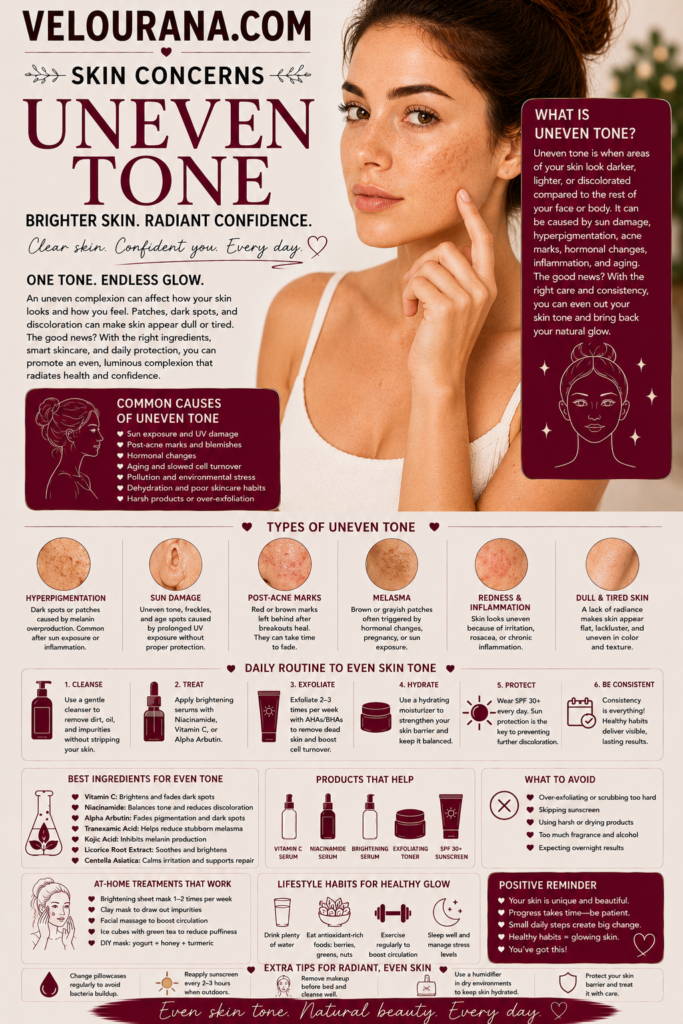
CATEGORY: Uneven Tone
Aging is often described through the language of lines, wrinkles, and firmness, yet one of its most visually influential changes is considerably quieter: the complexion gradually becomes less uniform. Areas that once seemed relatively consistent in color begin to show greater contrast. A faint brown mark remains after summer. An old blemish leaves a shadow that takes longer to disappear. The forehead appears slightly different from the cheeks. Small areas of redness coexist with patches of deeper pigmentation, while years of accumulated sun exposure begin to reveal themselves in places that previously looked clear.
This is what makes uneven tone such an important part of the visible aging process. It is not necessarily a single condition, and it cannot always be reduced to "dark spots." Skin color is created by several interacting biological and optical factors, and changes in any of them can alter how even the complexion appears. Melanin is central, but inflammation, blood vessels, the thickness and organization of the epidermis, environmental exposure, hormonal influences, and the way light reflects from the skin all contribute to the final impression.
Understanding uneven tone therefore requires a different approach from simply searching for the strongest brightening ingredient. The more useful question is why particular areas of the skin have begun to look different from the surrounding complexion. Once that distinction is made, skincare becomes more strategic. The objective is not to erase the natural variations that give skin its character, nor to pursue an artificial idea of perfectly uniform color. It is to reduce unnecessary contrast, limit the processes that continually create new discoloration, and support a complexion that looks calmer, clearer, and more coherent over time.
Aging Changes the Landscape of Pigmentation
Melanin is produced by specialized cells called melanocytes and transferred to surrounding skin cells, where it contributes to natural skin color and helps absorb ultraviolet radiation. The number, activity, and distribution of these pigment-producing systems are influenced by genetics, hormones, inflammation, and environmental exposure.
Uneven tone becomes especially noticeable when melanin is produced or distributed irregularly. Hyperpigmentation occurs when areas contain more pigment than the surrounding skin, producing marks or patches that may appear brown, black, gray, reddish, or otherwise darker depending on the person's natural complexion and the depth of the pigment. Sun exposure, hormonal changes, inflammation, injuries, certain medications, and several medical conditions can contribute to this process.
Aging complicates the picture because the visible complexion represents decades of accumulated biological history. Sun exposure from many years earlier can eventually become apparent as solar lentigines, commonly called sun or age spots. Previous inflammation may leave pigmentation that persists long after the original irritation has disappeared. Repeated low-level environmental stress can create subtle variations that become increasingly obvious as the surrounding skin changes.
The result is rarely a perfectly predictable pattern. One part of the face may show sun-related pigmentation, another may carry post-inflammatory marks, and another may be influenced by hormonal pigmentation. Meanwhile, redness and textural changes may make the overall complexion appear even more irregular.
This is why "uneven tone" should be understood as a visual description rather than a diagnosis. Two people may both describe their complexion as uneven while experiencing entirely different underlying processes. Their optimal skincare strategies may consequently be different as well.
The Sun Is Not Simply Creating Tomorrow's Tan
Among the forces affecting uneven tone, ultraviolet exposure deserves particular attention because it is both cumulative and persistent.
A tan is the most obvious demonstration that sunlight can stimulate pigment production, but the relationship between light and pigmentation extends far beyond temporary tanning. Repeated exposure can contribute to localized areas of excess pigmentation and gradually increase the contrast between different regions of the complexion. Solar lentigines are a familiar example of pigmentation associated with accumulated sun exposure.
The effect is particularly important in an anti-aging context because photoprotection is simultaneously preventative and supportive. A person can use sophisticated products intended to improve existing discoloration, but continuing exposure may stimulate the same pigmentary pathways the routine is attempting to control.
This explains why sunscreen belongs at the foundation of an uneven-tone routine rather than being treated as an optional final step. The American Academy of Dermatology recommends broad-spectrum sunscreen with SPF 30 or higher as part of protection against pigmentation concerns, while DermNet emphasizes consistent high-protection sunscreen for exposed areas affected by hyperpigmentation.
For some pigmentation disorders, visible light matters as well. Melasma is a particularly important example. Dermatologists may recommend tinted sunscreens containing iron oxides because these can add protection against visible light alongside ultraviolet protection.
This changes the philosophy of treating uneven tone. Sunscreen is not merely protecting today's skin from becoming darker during an afternoon outdoors. Consistent photoprotection is an attempt to reduce the repeated biological signal that tells susceptible skin to produce more pigment.
A brightening routine without adequate photoprotection is therefore working against an active opponent.
Inflammation Leaves a Memory
Not every dark mark associated with aging was created by sunlight.
Skin remembers inflammation remarkably well. A blemish, scratch, burn, eczema flare, irritating cosmetic, or other inflammatory event may resolve while leaving a darker area behind. This phenomenon, known as post-inflammatory hyperpigmentation, develops when inflammation stimulates increased melanin production and pigment is deposited within the epidermis and sometimes deeper within the dermis.
The distinction matters because the original problem and the remaining pigmentation are two different stages of the same story.
Imagine repeatedly treating dark marks left by acne while new inflammatory lesions continue to develop. Even an effective pigmentation routine may appear unsuccessful because new marks are continually replacing those that are fading. Similarly, an aggressive exfoliating routine intended to remove discoloration can become counterproductive if it creates persistent irritation.
This is particularly significant in skin that is prone to post-inflammatory pigmentation. The American Academy of Dermatology notes that irritation itself can trigger dark marks, especially in darker skin tones.
There is an important lesson here for mature skincare: more intensity does not necessarily produce more clarity.
A routine filled with strong acids, scrubs, retinoids, brightening products, and frequent procedures may appear ambitious, but if the combined result is inflammation, the skin can enter a cycle in which the treatment becomes one of the causes of the discoloration it is supposed to correct.
Successful tone management often requires restraint. Treat the process that is generating inflammation, protect the barrier, and then address the pigmentation without repeatedly disturbing the skin.
Uneven Tone Is Not Always the Same Kind of Pigmentation
One of the most common mistakes in skincare is treating every brown or gray area as though it were interchangeable.
It is not.
Solar lentigines, melasma, freckles, post-inflammatory hyperpigmentation, medication-related pigmentation, and deeper pigmentary disorders can look superficially similar without sharing the same biological origin or response to treatment. DermNet's differential diagnoses for localized pigmentation include benign pigmented lesions, post-inflammatory pigmentation, melasma, infections, drug reactions, and several other conditions. Importantly, pigmented skin cancers can also enter the differential diagnosis of a dark lesion.
Melasma demonstrates particularly well why diagnosis matters. It is generally characterized by patterned facial hyperpigmentation and can be influenced by sunlight and hormonal factors. Management often requires long-term photoprotection together with carefully selected topical therapy, and recurrence can remain an issue.
Post-inflammatory pigmentation behaves differently because the first priority is often eliminating or controlling the inflammatory trigger.
Sun spots represent another pattern associated with cumulative ultraviolet exposure.
And sometimes what appears to be an "uneven tone problem" is not primarily excess melanin at all. Redness, visible blood vessels, changes in skin thickness, dryness, shadows created by texture, or areas of reduced pigmentation can alter perceived uniformity.
This is why skincare should not become amateur dermatological diagnosis. A routine can reasonably address ordinary cosmetic unevenness, but a new, changing, unusual, symptomatic, bleeding, crusting, or otherwise concerning lesion should not simply be classified as an age spot and covered with brightening serum. Skin cancers can sometimes present as pigmented or changing lesions, making professional assessment important when something does not fit the person's usual pattern.
Knowing when skincare has reached the boundary of what it can responsibly address is part of intelligent skincare.
Brightening Should Mean Regulation, Not Bleaching
The vocabulary surrounding pigmentation can create unrealistic expectations.
"Brightening" is often interpreted as making the entire complexion lighter. That is neither necessary nor a useful objective for uneven tone. The more sophisticated goal is reducing excessive contrast between areas where pigment has accumulated and the person's natural surrounding complexion.
Healthy skin is not monochromatic. Faces naturally contain variations produced by blood flow, underlying structures, freckles, genetically determined pigmentation, and differences in thickness. The objective is not to eliminate every visible variation.
Instead, a well-designed routine attempts to influence several processes: reduce unnecessary pigment stimulation, support orderly skin renewal, address inflammation, protect against additional environmental triggers, and gradually improve the appearance of existing discoloration.
This is also why results tend to be gradual.
Hyperpigmentation is not simply dirt or surface staining that can be polished away. Pigment exists within biological structures and must be influenced through cellular processes. Cleveland Clinic notes that treatment may require months, and some pigmentation can persist considerably longer.
That timeframe can feel frustrating in a beauty culture built around immediate transformations. Yet pigmentation rewards consistency far more reliably than impatience.
A routine that is tolerated comfortably for six months can be more useful than an extremely aggressive program abandoned after three weeks because the skin becomes irritated.
The Ingredients That Matter Work Through Different Pathways
There is no single universal ingredient for uneven tone because different ingredients influence pigmentation through different mechanisms.
Retinoids occupy an important position because they address several features commonly associated with aging simultaneously. Retinol, one member of the retinoid family available in cosmetic products, is commonly used to improve mild pigmentation irregularities as well as texture and fine lines. Prescription retinoids may be used when clinically appropriate.
Their usefulness does not justify immediate aggressive application. Retinoids can cause irritation, particularly when introduced too quickly. The AAD advises gradual introduction and notes that irritation can itself contribute to hyperpigmentation in susceptible skin.
That creates a revealing paradox. An ingredient capable of helping pigmentation can worsen the appearance of pigmentation when used in a way the skin cannot tolerate.
Azelaic acid offers another route. It is used in the management of hyperpigmentation and is particularly interesting when discoloration coexists with acne or inflammatory tendencies. DermNet includes azelaic acid among topical options used for epidermal hyperpigmentation and post-inflammatory pigmentation.
Vitamin C is another familiar brightening ingredient. Its antioxidant role makes it particularly attractive in daytime routines, and topical vitamin C is among the agents used for epidermal pigmentation.
Niacinamide also appears in pigmentation-focused skincare, particularly where barrier support and tolerability are priorities. DermNet lists it among options used for post-inflammatory hyperpigmentation.
Alpha hydroxy acids such as glycolic acid can influence surface renewal and may contribute to a more even-looking complexion, but exfoliation requires discipline. The purpose is controlled renewal, not repeatedly stripping the skin until it feels polished.
Prescription hydroquinone remains an established dermatological treatment for certain forms of hyperpigmentation, including melasma, but it belongs in a different category from casually adding another cosmetic serum. The AAD describes hydroquinone and combinations involving tretinoin and corticosteroids among dermatologist-prescribed approaches for melasma.
The important principle is that these ingredients are not competing versions of the same thing. They interact with different parts of the pigmentation and renewal process. A successful routine therefore does not need every brightening ingredient available. It needs a small number of appropriate interventions that the skin can tolerate consistently.
The Skin Barrier Determines How Ambitious the Routine Can Be
When someone becomes determined to correct uneven tone, it is remarkably easy to construct a routine that looks impressive on paper and performs badly on skin.
A strong cleanser is followed by an exfoliating toner. Then comes vitamin C, another acid, a pigment serum, retinol, and perhaps an overnight resurfacing treatment. Each product may have a rational purpose when considered individually. Together, they may create chronic irritation.
Mature skin can make this particularly problematic because dryness and barrier vulnerability often become more noticeable with age. A damaged or persistently irritated barrier can make the complexion appear rough, red, dull, and visually irregular even before additional pigmentation develops.
Barrier care is therefore not separate from tone correction.
Gentle cleansing, adequate moisturization, avoiding unnecessary friction, and giving active ingredients enough space to work without overwhelming the skin can materially affect the success of a pigmentation routine.
This becomes especially important with retinoids and exfoliating acids. If the skin is repeatedly burning, stinging, peeling heavily, or remaining inflamed, continuing to escalate treatment is unlikely to produce the elegant improvement being sought.
A mature routine should be judged by what the skin can sustain, not by how many powerful ingredients appear on the bathroom shelf.
The complexion often improves most convincingly when treatment becomes quieter.
A Morning and Evening Strategy Creates Order
The most practical way to approach uneven tone is to give different parts of the day different responsibilities.
Morning is primarily defensive.
A gentle cleanse—or simply rinsing when appropriate for dry skin—can be followed by a well-tolerated antioxidant or pigmentation-supportive treatment. Vitamin C or niacinamide may fit here depending on the individual's skin and existing routine. Moisturizer can then support comfort and barrier function.
The final and most important morning treatment is broad-spectrum sunscreen.
For pigmentation-prone skin, this should not be treated as a ceremonial layer applied once before leaving the house and forgotten. Adequate application, reapplication when exposure requires it, shade, hats, and sensible avoidance of intense direct sunlight all strengthen the protective strategy. Melasma-prone individuals may particularly benefit from discussing tinted iron-oxide-containing sunscreens with a dermatologist.
Evening becomes the restorative and corrective period.
After gentle cleansing, an appropriate treatment such as a retinoid, azelaic acid, or another targeted pigmentation product may be used according to tolerance and professional guidance where necessary. Moisturizer completes the routine and can sometimes be used before or after stronger treatments to improve comfort.
What matters is not constructing the longest possible sequence.
It is creating a routine whose components have clear jobs.
Protection in the morning. Controlled correction at night. Barrier support throughout.
Once that framework is established, additional products should have to justify their presence.
Why Exfoliation Cannot Force Pigmentation to Disappear
Uneven tone invites exfoliation because the concept feels intuitive: if darker cells are near the surface, removing more surface cells should reveal clearer skin underneath.
There is some truth in the mechanism. Controlled chemical exfoliation can support epidermal renewal, and agents such as glycolic acid are used in approaches to superficial pigmentation.
The mistake is assuming that increasing the frequency or intensity will accelerate improvement indefinitely.
Pigmentation may exist at different depths. Superficial epidermal pigmentation is generally more accessible to topical treatments than pigment located deeper within the dermis. Aggressive procedures also carry their own risk of inflammation and subsequent pigmentary alteration. DermNet specifically notes that procedures such as chemical peels, laser treatment, intense pulsed light, and dermabrasion can sometimes produce additional pigment changes because of epidermal injury.
This is especially relevant for anyone prone to post-inflammatory hyperpigmentation.
A treatment powerful enough to create significant inflammation may leave the skin temporarily smoother while initiating another pigmentary problem beneath the apparent improvement.
Exfoliation should therefore be viewed as a controlled signal for renewal, not a campaign to remove layers of skin as rapidly as possible.
Skin does not need to be punished into becoming even.
Professional Procedures Require More Precision, Not Less
When topical skincare reaches its practical limit, professional treatments can sometimes address pigmentation more intensively.
Chemical peels, laser technologies, intense pulsed light, and other resurfacing procedures may be considered depending on the type and depth of discoloration. These approaches can produce meaningful improvements in carefully selected cases, but they are not universal solutions.
The crucial phrase is carefully selected.
Different pigments absorb energy differently. Skin tones vary in their susceptibility to post-inflammatory hyperpigmentation and hypopigmentation. Melasma can be particularly challenging because apparently successful treatment does not necessarily remove the biological tendency toward recurrence.
A procedure should therefore follow diagnosis rather than replace it.
Someone with several distinct sun spots may require a different approach from someone with diffuse melasma. Someone whose primary concern is lingering acne pigmentation requires another strategy. And someone with an unusual changing pigmented lesion requires medical evaluation rather than cosmetic resurfacing.
Professional treatment is not simply stronger skincare.
It introduces additional variables, including treatment depth, energy settings, wound healing, inflammation, practitioner experience, and the patient's natural pigment response.
The more powerful the intervention, the more important accurate assessment becomes.
Progress Is Better Measured in Seasons Than Days
Pigmentation is one of those skincare concerns that can distort perception because people tend to examine it too frequently.
A mirror viewed from twenty centimeters away every morning is a poor measurement instrument.
Day-to-day changes in hydration, lighting, inflammation, sleep, temperature, and blood flow can make the complexion look different without representing meaningful pigment change. True improvement is easier to evaluate over longer periods.
Monthly photographs taken under similar lighting can be more informative. Rather than asking whether every mark has disappeared, look for changes in overall contrast. Are the darkest areas becoming less distinct? Are fewer new marks appearing? Does the complexion recover from blemishes more cleanly? Does the skin look calmer and more consistent even though individual spots remain?
This approach also prevents one of the most common mistakes in pigmentation care: abandoning products before they have had sufficient time to work.
Cleveland Clinic notes that hyperpigmentation treatments can require months and sometimes considerably longer, depending on the cause.
Patience is not simply a comforting idea in this context. It is biologically appropriate.
Pigmentation developed through years of accumulated exposure and repeated cellular signaling should not be expected to disappear through a week of enthusiastic serum application.
Prevention Eventually Becomes More Valuable Than Correction
There is a point in every successful uneven-tone routine when the objective changes.
Initially, attention is directed toward existing marks. The darker patch near the cheekbone, the pigmentation left by old blemishes, or the diffuse discoloration across the forehead attracts most of the concern.
Over time, however, preventing new discoloration becomes at least as important as fading what already exists.
This is where daily habits quietly outperform dramatic interventions.
Consistent sunscreen reduces repeated ultraviolet stimulation. Controlling acne or eczema reduces the inflammatory events that can leave pigment behind. Avoiding picking prevents unnecessary injury. A well-supported barrier reduces irritation. Introducing active ingredients gradually decreases the likelihood that the treatment itself will create inflammation.
The AAD's guidance on dark spots emphasizes treating the underlying inflammatory condition and avoiding repeated injury because pigmentation often fades once its continuing trigger has been controlled.
This preventative philosophy is particularly relevant to aging skin.
The goal is not merely to make today's complexion look better. It is to reduce the number of new pigmentary disturbances that will accumulate over the next five or ten years.
Seen from that perspective, sunscreen becomes an anti-aging treatment, gentle skincare becomes a pigmentation strategy, and barrier preservation becomes part of complexion management.
A More Even Complexion Is Ultimately About Balance
Uneven tone is one of the clearest examples of why mature skincare benefits from moving beyond the search for miracle products.
The visible problem may appear simple: one area is darker than another. Beneath that difference, however, may lie years of ultraviolet exposure, inflammatory history, hormonal influence, natural pigment biology, environmental stress, and changes in skin renewal.
That complexity does not mean improvement is impossible. It means improvement works best when the strategy respects the cause.
Protect the complexion from the signals that encourage additional pigmentation. Control inflammation rather than repeatedly provoking it. Introduce corrective ingredients gradually enough that the skin can tolerate them. Support the barrier instead of treating moisturization as an afterthought. Give biological processes enough time to respond. And when pigmentation behaves unusually or does not fit the expected pattern, seek professional assessment rather than escalating cosmetic treatment blindly.
Most importantly, abandon the idea that beautiful mature skin must be perfectly uniform.
Natural complexion contains variation. Freckles, subtle shifts in color, and the individual architecture of a face are not defects that need to be erased. What often makes skin appear older is not variation itself but increasing irregularity—the accumulated contrast created when inflammation, environmental exposure, and pigment production cease to remain balanced.
The most convincing approach to uneven tone therefore does not attempt to bleach the past away. It reduces unnecessary contrast while protecting the skin's future.
When that process is approached patiently, the result is more than fading individual spots. The entire complexion can begin to look calmer, clearer, more harmonious, and better able to reflect light evenly.
That is the more meaningful definition of an even tone: not perfection, but coherence.
The End Velourana
 Discover More From Our Family of Websites
 ZodiacBearing (Astrology, Tarot, Numerology, Angel Numbers & Spiritual Guidance)
 Velourana (Beauty, Makeup, Hair Care, Skincare & Beauty Tips)
 HavenBearing (Home, Living, Organization, Décor & Everyday Inspiration)
 PawBearing (Pet Care, Dog Breeds, Animal Health, Training & Pet Products)
 PsyCatherine (Notes From the Journal of a Psychologist on Real Life)

