
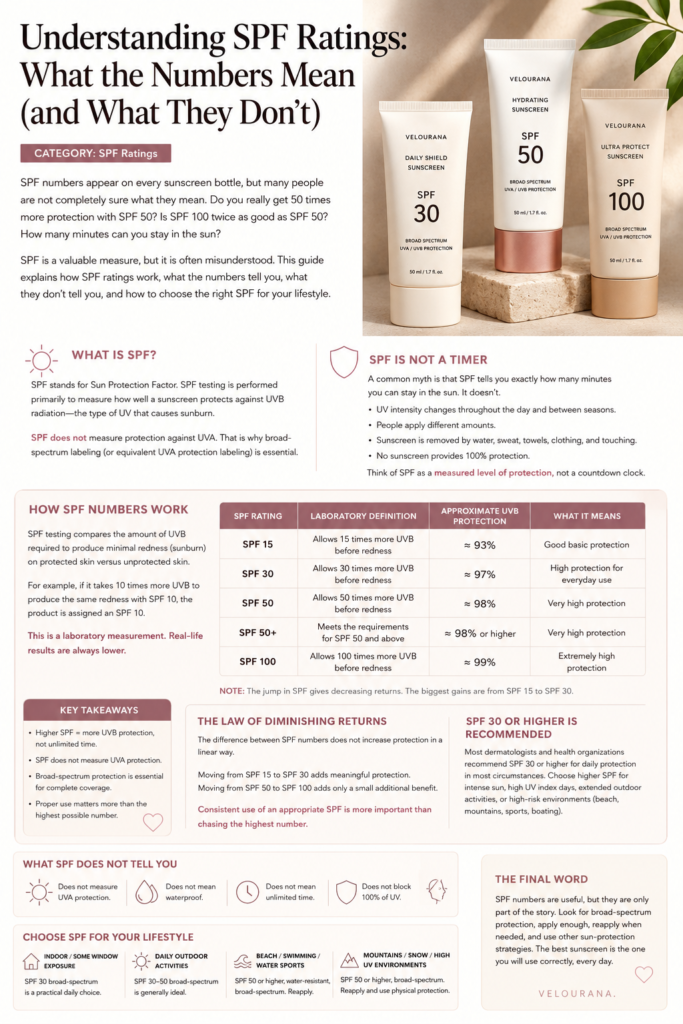
CATEGORY: SPF Ratings
SPF is one of the most recognizable terms in skincare. It appears prominently on sunscreen bottles, moisturizers, foundations, lip products, sprays, sticks, and many other products designed to protect the skin from sunlight.
Yet the meaning of the number beside those three letters is frequently misunderstood.
SPF 15, SPF 30, SPF 50, and SPF 50+ do not represent the number of minutes you can safely remain in the sun. SPF 50 does not simply provide twice the protection of SPF 25. A very high SPF does not mean sunscreen can be applied once in the morning and forgotten for the rest of the day.
Understanding SPF ratings makes sunscreen selection considerably easier.
The number is important, but it needs to be interpreted correctly and considered together with UVA protection, application quantity, reapplication, water resistance, and the circumstances in which the sunscreen will be used.
What Does SPF Stand For?
SPF stands for Sun Protection Factor.
It is a standardized measurement primarily related to protection against UVB radiation and the development of sunburn.
A higher SPF indicates greater tested protection against UVB when the sunscreen is applied under standardized conditions.
The important words are tested and standardized.
The protection printed on the bottle assumes that the product is used appropriately.
Real-world protection can be lower when sunscreen is applied too thinly, distributed unevenly, rubbed away, washed off, or not reapplied when necessary.
SPF Primarily Measures UVB Protection
Sunlight exposes the skin to different forms of ultraviolet radiation.
For everyday sunscreen education, the two major categories are UVA and UVB.
UVB is strongly associated with sunburn and contributes to ultraviolet-related skin damage.
SPF primarily describes protection against UVB-associated sunburn.
This means SPF is extremely useful, but it does not tell the complete story about ultraviolet protection.
What About UVA?
UVA penetrates more deeply into the skin than UVB and contributes significantly to photoaging and cumulative skin damage.
UVA can also be present without producing the obvious redness that people associate with excessive UVB exposure.
For this reason, a sunscreen should not be selected solely by finding the largest SPF number on the shelf.
Broad-spectrum or appropriate UVA protection matters too.
SPF and Broad-Spectrum Protection Are Different Pieces of Information
Think of sunscreen protection as having two important components.
The SPF rating provides information primarily about UVB protection.
Broad-spectrum or UVA labeling provides additional information about protection against UVA.
A well-rounded sunscreen strategy considers both.
A high SPF without appropriate UVA protection would not provide the balanced protection most consumers are looking for.
What Percentage of UVB Does SPF 15 Filter?
When applied correctly under standardized conditions, SPF 15 filters approximately 93 percent of UVB radiation.
That is substantial protection.
However, it also allows more UVB to reach the skin than higher SPF ratings.
This difference becomes particularly relevant during prolonged or intense exposure.
What Percentage of UVB Does SPF 30 Filter?
SPF 30 filters approximately 97 percent of UVB radiation when properly applied under standardized conditions.
This is why SPF 30 is frequently recommended as a practical minimum level for routine sun protection.
The difference between 93 percent and 97 percent may initially appear small.
However, looking only at percentages can be misleading.
What Percentage of UVB Does SPF 50 Filter?
SPF 50 filters approximately 98 percent of UVB radiation under standardized conditions when applied correctly.
Again, this does not mean that SPF 50 provides only a meaningless improvement over SPF 30.
The amount of UVB getting through the sunscreen is another way to understand the difference.
Looking at What Gets Through
If SPF 30 filters approximately 97 percent of UVB, roughly 3 percent reaches the skin under the simplified standardized comparison.
If SPF 50 filters approximately 98 percent, roughly 2 percent reaches the skin.
Viewed this way, the difference becomes easier to appreciate.
The amount getting through with SPF 30 is greater than with SPF 50.
This is why apparently small percentage differences can still matter.
What Does SPF 50+ Mean?
SPF 50+ is used in certain regulatory systems for products that test above the threshold required for SPF 50 labeling.
The exact rules depend on the market.
It communicates very high UVB protection.
However, the plus sign should never be interpreted as complete protection.
No sunscreen blocks all ultraviolet radiation.
Why Isn't There SPF 100 Everywhere?
Sunscreen labeling rules vary around the world.
Some regulatory systems permit higher numerical SPF labels.
Others cap the displayed rating at SPF 50+ even when testing indicates protection above SPF 50.
This means consumers may encounter different labeling conventions depending on where a product is sold.
Is SPF 100 Twice as Protective as SPF 50?
No.
SPF numbers do not translate into a simple linear percentage of UVB blocked.
SPF 50 already provides very high UVB protection when properly applied.
A higher SPF can provide additional protection, but it does not mean that the percentage of UVB filtered suddenly doubles.
Why Higher SPF Can Still Be Valuable
The fact that SPF 30 and SPF 50 both filter a high percentage of UVB does not mean the difference is irrelevant.
Higher SPF can provide an additional margin of UVB protection.
This may be particularly useful for people who burn easily, spend substantial time outdoors, live in high-UV environments, or have specific medical reasons for careful photoprotection.
Professional advice may be appropriate when strict sun protection is medically necessary.
Higher SPF Can Also Help With Imperfect Real-World Application
Sunscreen testing occurs under controlled conditions.
People in everyday life frequently apply less sunscreen than the amount used during testing.
Application may also be uneven.
A higher SPF can provide some additional margin, but it should not be used as an excuse to apply less product.
The correct response to underapplication is to improve application.
SPF 30 Applied Properly Is Better Than SPF 50 Applied Poorly
The number on the bottle cannot compensate completely for inadequate use.
An evenly applied SPF 30 can provide more reliable real-world protection than an SPF 50 that is spread extremely thinly and leaves uncovered areas.
Application matters enormously.
SPF Is Not a Measure of Time
One of the most persistent sunscreen misconceptions is that SPF tells you how long you can stay outside.
For example, someone may reason that if their skin normally burns after ten minutes, SPF 30 means they can remain outside for 300 minutes.
This is not a reliable way to use SPF.
Why the Time Calculation Does Not Work Well in Real Life
Ultraviolet intensity is not constant.
Exposure at one time of day can be very different from exposure several hours later.
Latitude matters.
Altitude matters.
Season matters.
Cloud conditions matter.
Reflection from water, sand, and snow matters.
Sunscreen application quantity matters.
Swimming and perspiration matter.
Trying to convert SPF directly into a fixed number of safe minutes ignores all these variables.
SPF Does Not Give Permission to Stay Outside Longer
Sunscreen should reduce ultraviolet exposure during outdoor activity.
It should not be treated as a tool for extending intentional exposure indefinitely.
Higher SPF means greater tested UVB protection.
It does not mean the sun becomes harmless.
Choosing Between SPF 15 and SPF 30
SPF 15 provides meaningful UVB protection when used correctly.
However, SPF 30 provides substantially stronger protection and is commonly recommended for general sun protection.
For someone choosing a dedicated daily sunscreen, SPF 30 or higher is generally the more practical starting point.
Choosing Between SPF 30 and SPF 50
Both can provide high UVB protection when applied correctly.
SPF 50 provides greater protection and an additional margin.
The choice may depend on expected exposure, skin characteristics, lifestyle, climate, and personal preference.
Cosmetic suitability also matters.
When SPF 50 May Be Particularly Attractive
SPF 50 can be especially useful during prolonged outdoor activities.
Beach days.
Hiking.
Outdoor sport.
Sightseeing.
Gardening.
Boating.
High-altitude activities.
Situations involving strong UV exposure generally justify careful protection.
What About Everyday Office Days?
Someone who spends most of the day indoors may experience very different exposure from someone working outside.
However, commuting, walking, driving, outdoor lunches, and time near windows can still contribute to exposure.
A comfortable broad-spectrum SPF 30 or SPF 50 sunscreen can fit naturally into an everyday skincare routine.
Should Everyone Simply Buy the Highest SPF?
Not necessarily.
Protection matters, but usability matters too.
If an SPF 50 sunscreen feels excellent and you apply it correctly, it can be a very good choice.
If a particular SPF 50 formula feels so unpleasant that you apply too little, while an SPF 30 product feels excellent and is used properly, the practical comparison becomes different.
The sunscreen must work in real life.
Texture Influences Consistency
Modern sunscreens come in many textures.
Fluids.
Gels.
Lotions.
Creams.
Milk-like emulsions.
Sticks.
Sprays.
The SPF rating tells you about tested UVB protection.
It does not tell you whether the product will feel lightweight, rich, matte, dewy, moisturizing, or invisible.
SPF for Oily Skin
Oily skin may prefer lightweight SPF 30 or SPF 50 fluids and gels.
A high SPF does not automatically mean a heavy texture.
Modern sunscreen technology allows very high protection in surprisingly lightweight formulations.
SPF for Dry Skin
Dry skin may prefer creamier sunscreen.
A moisturizing SPF 30 or SPF 50 can sometimes replace a separate daytime moisturizer.
The ideal routine depends on how the skin feels.
SPF for Combination Skin
Combination skin may prefer lightweight lotions or fluids.
Moisturizer can be used selectively beneath sunscreen on dry areas.
The sunscreen itself should still be applied evenly across exposed skin.
SPF for Sensitive Skin
Sensitive skin may need more experimentation.
The SPF number alone does not predict whether a formula will be comfortable.
Fragrance, alcohol, UV filters, preservatives, and other ingredients can influence individual tolerance.
A dermatologist can help when sunscreen repeatedly causes significant irritation.
Does Mineral Sunscreen Have Different SPF Mathematics?
No.
An SPF 30 mineral sunscreen and an SPF 30 sunscreen using organic UV filters have both been tested to meet the applicable SPF requirement.
The UV-filter systems differ, but the SPF rating still communicates standardized UVB protection.
Mineral Sunscreen
Mineral sunscreens generally use zinc oxide, titanium dioxide, or combinations of these filters.
They can provide high SPF and broad-spectrum protection depending on the formulation.
Some may leave a visible white cast.
Tinted options can improve cosmetic appearance for many skin tones.
Organic UV Filters
Organic UV filters absorb ultraviolet radiation.
Different filters cover different portions of the UV spectrum.
Manufacturers combine filters to achieve the desired SPF and UVA protection.
Available filters vary among regulatory regions.
Hybrid Sunscreens
Hybrid sunscreens combine mineral and organic filters.
They can also achieve high SPF ratings.
Again, the final tested formulation matters more than placing the sunscreen into a simplistic "mineral versus chemical" competition.
SPF Does Not Tell You Whether Sunscreen Is Water Resistant
SPF 50 sunscreen is not automatically water resistant.
SPF and water resistance are separate properties.
If you intend to swim or perspire heavily, look specifically for a water-resistance claim appropriate to your activity.
Water Resistant Does Not Mean Waterproof
Water-resistant sunscreen maintains specified protection under defined testing conditions for a limited period.
It does not remain permanently unchanged in water.
Reapplication remains necessary according to product instructions.
SPF After Swimming
Swimming can reduce sunscreen coverage.
Reapply according to the product directions.
This applies even when using a high-SPF water-resistant sunscreen.
SPF After Towel Drying
Towels can physically remove sunscreen.
If continued exposure is expected, restore protection after drying.
SPF 50 that has been rubbed away cannot protect the area simply because the original bottle had a high number.
SPF During Exercise
Perspiration can affect sunscreen coverage.
Wiping the face can remove it further.
For outdoor exercise, choose an appropriate broad-spectrum water-resistant sunscreen and follow reapplication instructions.
How Much Sunscreen Matters
SPF ratings are based on standardized application.
If much less sunscreen is applied, the protection achieved can be significantly lower than the labeled rating.
This is one reason sunscreen education should focus on application rather than numbers alone.
Do Not Try to Make a Bottle Last by Using Tiny Amounts
Sunscreen is intended to be used.
Applying a tiny quantity to preserve an expensive product undermines its protective purpose.
If cost prevents adequate use, choosing a more affordable sunscreen that can be applied properly may be the better strategy.
Apply Sunscreen Evenly
Quantity alone is not enough.
Coverage should also be uniform.
An adequately protected forehead does not compensate for an uncovered nose.
An adequately protected face does not compensate for forgotten ears.
Commonly Missed Areas
The ears are frequently forgotten.
So is the hairline.
The sides of the neck.
The back of the neck.
The upper chest.
The hands.
The lips.
Exposed scalp.
Broad-spectrum protection should cover exposed skin rather than only the central face.
SPF on the Neck
If the neck is exposed, extend sunscreen below the jaw.
The front, sides, and back of the neck can all receive sunlight depending on clothing and hairstyle.
SPF on the Hands
Hands receive substantial cumulative exposure.
They are also washed repeatedly.
If continued outdoor exposure is expected after hand washing, reapplication may be appropriate.
SPF on the Lips
Use a lip product providing appropriate SPF during significant exposure.
Reapply after eating, drinking, swimming, or wiping the lips.
SPF for the Scalp
An exposed scalp can burn.
People with thinning hair, shaved heads, or prominent hair parts should consider protection.
Hats are especially useful.
Suitable sunscreen formats can also be applied according to their directions.
SPF and Makeup
Foundation may contain SPF.
This can provide additional protection.
However, most people do not apply foundation in the quantity used for standardized sunscreen testing.
A dedicated broad-spectrum sunscreen underneath makeup therefore provides a more dependable protective base.
SPF Foundation Does Not Add Mathematically to Sunscreen
If you apply SPF 30 sunscreen and SPF 20 foundation, you should not assume you now have SPF 50.
SPF values are not added together.
The protective performance of layered products cannot be calculated by simply adding their numbers.
SPF 30 Plus SPF 30 Is Not SPF 60
This is another common misconception.
Layering two SPF 30 products does not automatically produce SPF 60.
Use the dedicated sunscreen as the primary protective layer and treat additional SPF cosmetics as supplementary.
Mixing SPF Products Is Different From Layering Them
Applying sunscreen and then makeup is layering.
Mixing sunscreen directly into foundation or moisturizer is different.
Mixing changes the sunscreen formulation and can interfere with the film it was designed to create.
Do not dilute sunscreen.
SPF 50 Mixed With Moisturizer Does Not Become SPF 25
There is no reliable home calculation for diluted sunscreen.
The resulting mixture has not been tested.
Apply moisturizer separately.
Then apply sunscreen as formulated.
SPF and Reapplication
Higher SPF does not eliminate the need to reapply.
An SPF 50 sunscreen can still be removed by swimming, perspiration, towels, rubbing, and ordinary activity.
Follow the product's directions.
SPF 50 Does Not Last Longer Simply Because the Number Is Higher
The SPF number represents protection level, not durability.
Water resistance and wear characteristics are separate considerations.
An SPF 30 water-resistant sport sunscreen may be more appropriate for swimming than a non-water-resistant SPF 50 facial sunscreen.
Choose according to activity.
SPF on Cloudy Days
Clouds can reduce some ultraviolet radiation but do not necessarily eliminate it.
SPF can still be relevant when the sky is overcast.
The UV Index provides more useful information about ultraviolet conditions than simply looking at the clouds.
SPF During Winter
Cold weather does not mean zero UV.
Snow can reflect ultraviolet radiation.
High-altitude winter activities can involve substantial exposure.
Sunscreen is therefore not exclusively a summer product.
SPF in the Mountains
Altitude can increase UV exposure.
Hiking and skiing can therefore require careful sun protection even when temperatures are cool.
Use broad-spectrum sunscreen and physical protection.
SPF at the Beach
Beach environments can combine strong direct sunlight with reflection from water and sand.
Choose appropriate broad-spectrum protection.
Use water-resistant sunscreen when swimming.
Reapply.
Seek shade.
Wear protective clothing where practical.
SPF Around Water
Water cools the skin, which can make exposure feel less intense.
Do not use temperature or skin sensation as your measure of UV.
Continue protection even when swimming feels refreshing.
SPF on Boats
Boating combines prolonged outdoor exposure, reflection from water, and cooling wind.
This can make ultraviolet exposure easy to underestimate.
High broad-spectrum protection, hats, clothing, and reapplication are particularly useful.
SPF in the City
Urban exposure is usually less dramatic than a beach day, but it can accumulate.
Walking.
Commuting.
Outdoor dining.
Shopping.
Driving.
Daily sunscreen can provide a convenient baseline without requiring you to calculate every short period outdoors.
SPF While Driving
Vehicle glass can reduce some UV, but UVA may still penetrate depending on the glass.
People who spend long periods driving can consider broad-spectrum protection for the face, hands, and exposed arms.
SPF Near Windows
Indoor exposure depends heavily on where you spend your time.
Someone sitting far from windows has a different exposure pattern from someone sitting directly beside a bright window for hours.
Broad-spectrum sunscreen may be relevant according to circumstances.
SPF and Skin Tone
People of every skin tone can experience ultraviolet-related skin damage.
Darker skin contains more melanin and may burn less readily, but this does not remove the need for sun protection.
Product choice should focus on protection and cosmetic suitability.
SPF for Deeper Complexions
White cast can make some sunscreens difficult to use on deeper skin tones.
Modern transparent, tinted, and organic-filter sunscreens provide many alternatives.
Do not compensate for white cast by applying too little.
Choose a formulation that looks better at the correct application quantity.
SPF for Fair Complexions
Fair skin may burn relatively quickly.
Higher SPF, careful application, shade, clothing, and reapplication can be particularly important.
Broad-spectrum UVA protection should still accompany the SPF rating.
SPF and Freckles
Freckles can become more noticeable with sun exposure.
People who wish to minimize UV-related pigmentation changes should prioritize broad-spectrum protection rather than concentrating exclusively on the SPF number.
SPF and Hyperpigmentation
Ultraviolet exposure can contribute to pigmentation concerns.
Broad-spectrum sunscreen is therefore an important part of many pigmentation-management routines.
Tinted sunscreens containing appropriate pigments may offer additional benefits for certain visible-light-related pigmentation concerns.
SPF and Photoaging
Repeated ultraviolet exposure contributes to visible skin aging.
Broad-spectrum sunscreen can help reduce this exposure.
This makes sun protection relevant to people concerned about fine lines, uneven pigmentation, elasticity, and texture.
SPF Is Preventive Skincare
Many skincare products respond to existing concerns.
Sunscreen works differently.
Its purpose is to reduce exposure before damage occurs.
This makes consistent application more important than trying to repair the consequences afterward.
After-Sun Products Cannot Replace SPF
Aloe gel can feel cooling.
A moisturizer can reduce dryness.
A hydrating mask can improve comfort.
None replaces sunscreen.
After-sun care occurs after exposure.
SPF is designed to reduce exposure in the first place.
SPF Does Not Make Intentional Tanning Safe
A high-SPF sunscreen should not be used as a tool for extending deliberate tanning sessions.
No sunscreen eliminates all ultraviolet exposure.
If cosmetic color is desired, self-tanning products can create a tanned appearance without requiring deliberate UV tanning.
Self-tanner generally does not replace sunscreen unless the product specifically provides tested sun protection.
Tanning Beds Are Not a Safe Alternative
Artificial tanning devices expose skin to ultraviolet radiation.
They should not be viewed as a safer method of obtaining a tan.
SPF education is ultimately about reducing unnecessary UV exposure regardless of its source.
Sunscreen and the UV Index
The UV Index describes expected ultraviolet radiation intensity.
It can help determine how carefully protection should be planned.
The UV Index and SPF rating answer different questions.
The UV Index describes environmental exposure.
SPF describes the tested UVB protection of the sunscreen.
Temperature and SPF Are Unrelated
A hot day does not automatically require a different SPF solely because it is hot.
A cold day is not automatically safe.
UV exposure and temperature are different environmental measurements.
Choose protection according to UV conditions and activity.
Wind Can Be Misleading
Wind cools the skin.
This can make strong sunlight feel comfortable.
Beachgoers, sailors, hikers, and cyclists should be particularly aware of this effect.
A cooling breeze does not reduce the SPF you need.
Shade Does Not Make SPF Irrelevant
Shade is an excellent protective measure.
However, indirect and reflected UV can still reach the skin.
Use shade together with sunscreen when appropriate.
Clothing Can Reduce Dependence on Sunscreen
Covering skin with suitable clothing reduces the surface area requiring sunscreen.
This can be particularly practical during prolonged outdoor activity.
Purpose-designed UPF clothing provides predictable ultraviolet protection.
Hats Complement SPF
A broad-brimmed hat provides shade to the scalp, face, ears, and neck.
These are areas frequently missed during sunscreen application.
A hat and sunscreen work together.
Sunglasses Complete the Strategy
Sunscreen protects skin.
Appropriate UV-protective sunglasses help protect the eyes.
Complete sun protection should consider both.
SPF for Children
Children require careful sun protection.
Appropriate SPF, product selection, shade, clothing, and hats should follow pediatric and public-health recommendations for the child's age.
Children should not simply be treated as smaller adults when planning sun exposure.
SPF for Babies
Very young babies require specific sun-protection strategies.
Shade, protective clothing, and avoiding direct exposure often play central roles.
Parents and caregivers should follow appropriate pediatric guidance regarding sunscreen use.
SPF and Photosensitive Medication
Some medications can increase sensitivity to sunlight.
People taking these medicines may require particularly careful sun protection.
Follow medication instructions and healthcare advice.
SPF and Dermatological Conditions
Certain skin conditions can make photoprotection especially important.
A dermatologist can recommend suitable SPF levels, UVA protection, textures, and additional measures according to the individual's needs.
Expired SPF Is Not Reliable SPF
Check sunscreen expiration information.
A bottle displaying SPF 50 does not deserve indefinite trust after its usable life has passed.
Follow the expiration date and period-after-opening guidance.
Storage Can Affect Sunscreen
Follow manufacturer storage instructions.
Avoid unnecessarily leaving sunscreen in extreme heat for prolonged periods.
Cars and direct summer sunlight can create particularly high temperatures.
Buy Sunscreen From Reliable Sources
Counterfeit sunscreen can create dangerous false confidence.
A fake product may display SPF 50 without providing anything close to the expected protection.
Purchase from reputable retailers and suppliers.
DIY SPF Is Not Reliable
Homemade sunscreen cannot reliably reproduce professional formulation and standardized testing.
Adding zinc oxide to moisturizer does not allow you to calculate an accurate SPF at home.
Use properly formulated and tested sunscreen.
SPF Is a Property of the Finished Formula
Consumers sometimes try to estimate sunscreen strength by looking at individual UV filters.
This is unreliable.
SPF depends on the complete formulation, filter concentrations, dispersion, stability, film formation, and testing.
Trust legitimate standardized testing rather than home calculations.
The Highest SPF Is Not Automatically the Best Product for You
Suppose one sunscreen is SPF 50 but feels extremely heavy on your skin.
You apply very little because you dislike it.
Another sunscreen is SPF 30, feels excellent, and you apply it properly every morning.
Real-world use matters.
Ideally, find both high protection and a texture you enjoy.
Cosmetic Elegance Has Practical Value
A sunscreen that disappears comfortably into the routine is more likely to be used consistently.
This is why texture, white cast, eye comfort, fragrance, finish, and makeup compatibility matter.
They do not determine SPF.
They determine whether you are willing to use the SPF properly.
SPF 30 or SPF 50?
For many people, this is the central shopping decision.
Both provide high UVB protection when applied correctly.
SPF 50 provides greater protection.
SPF 30 can still provide excellent everyday protection.
The better choice is influenced by exposure, skin characteristics, personal risk factors, and product usability.
For Strong Exposure, More Protection Makes Sense
When planning substantial outdoor exposure, choosing higher broad-spectrum protection is sensible.
Combine it with water resistance when appropriate.
Then add shade, clothing, hats, and sunglasses.
For Everyday Use, Consistency Is Critical
The sunscreen that becomes part of the morning routine has enormous practical value.
Whether SPF 30 or SPF 50 is chosen, apply it properly.
Do not treat the number as the only measure of success.
Do Not Become Obsessed With Tiny Numerical Differences
Sunscreen education should improve protection rather than create anxiety.
You do not need to spend hours calculating theoretical differences among dozens of SPF ratings.
Choose an appropriate broad-spectrum sunscreen.
Use enough.
Reapply when necessary.
Protect exposed areas.
Use physical protection too.
SPF Ratings Become Simple Once You Understand Them
SPF 15 provides meaningful UVB protection.
SPF 30 provides higher protection.
SPF 50 provides still greater protection.
SPF 50+ represents very high protection under the applicable labeling system.
The increases are not linear percentages.
Higher SPF does not mean proportionally longer safe exposure.
None of these ratings provides complete protection from ultraviolet radiation.
The Number Is Only the Beginning
After checking SPF, check UVA protection.
Then consider water resistance.
Then consider the activity.
Then consider the texture.
Then make sure you can apply the sunscreen properly.
This approach produces a much better decision than simply choosing whichever bottle displays the largest number.
The Most Important SPF Rule
The protection on the label depends on correct use.
An SPF rating is not magic.
It cannot protect skin where sunscreen was never applied.
It cannot maintain protection after being rubbed away.
It cannot compensate for deliberately prolonged exposure indefinitely.
It cannot replace shade, clothing, hats, and sunglasses.
Understanding SPF Without Overcomplicating It
SPF ratings are ultimately straightforward.
They communicate the tested level of protection primarily against UVB-associated sunburn.
Higher numbers provide greater UVB protection, but the relationship is not as simple as doubling the number and doubling the protection.
SPF 30 and SPF 50 both provide high levels of protection when used correctly, with SPF 50 offering additional protection.
The number does not tell you how long you can remain in the sun.
It does not tell you everything about UVA protection.
It does not tell you whether the product is water resistant.
And it does not remove the need for correct application and reapplication.
Choose an appropriate broad-spectrum sunscreen, apply it generously and evenly according to its directions, reapply when necessary, and combine it with other forms of sun protection.
Once SPF is understood in this context, the numbers stop being confusing.
They become what they were intended to be: a useful guide to the UVB protection offered by a properly tested sunscreen.
The End
Velourana.
 Discover More From Our Family of Websites
 ZodiacBearing (Astrology, Tarot, Numerology, Angel Numbers & Spiritual Guidance)
 Velourana (Beauty, Makeup, Hair Care, Skincare & Beauty Tips)
 HavenBearing (Home, Living, Organization, Décor & Everyday Inspiration)
 PawBearing (Pet Care, Dog Breeds, Animal Health, Training & Pet Products)
 PsyCatherine (Notes From the Journal of a Psychologist on Real Life)

