CATEGORY: Tight Skin
There is a point at which tight skin stops feeling like a minor inconvenience and begins to feel fundamentally different.
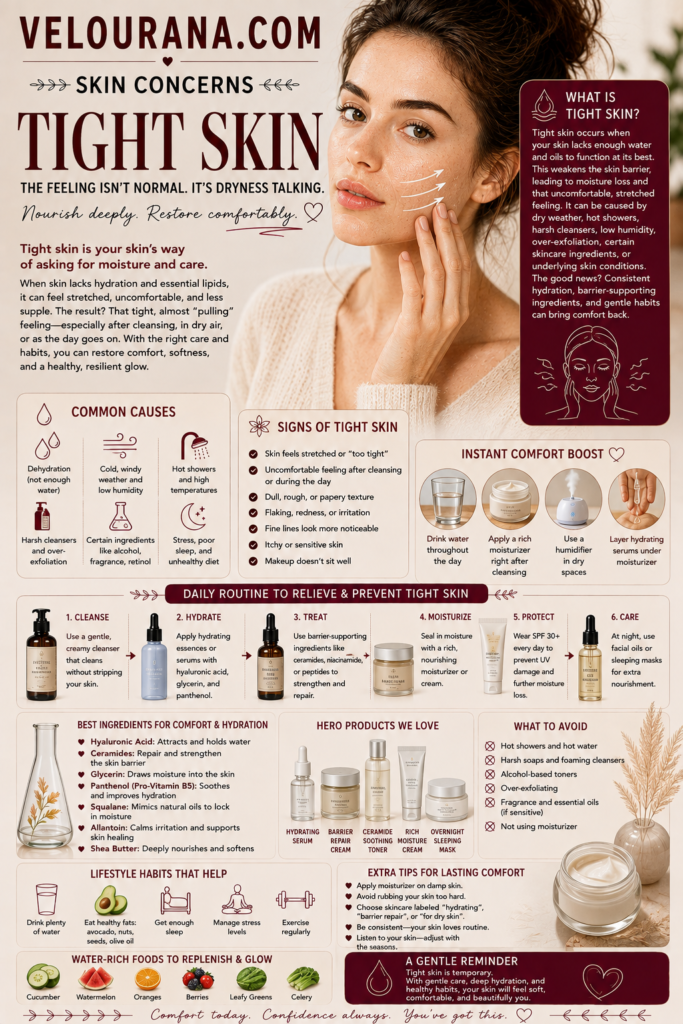
Ordinary dryness may produce a temporary stretched sensation after cleansing or during cold weather. A moisturizer is applied, comfort returns, and the issue remains relatively contained. But when the skin barrier becomes significantly disturbed, tightness often takes on a more persistent quality. The face may feel uncomfortable even before cleansing. Products that were previously well tolerated begin to sting. Small areas become rough or flaky. Makeup settles unevenly. The skin may feel simultaneously dry, sensitive and strangely reactive, as though its tolerance has narrowed.
This is where the language of “barrier damage” becomes useful—but also where it is frequently misunderstood.
The skin barrier is not an invisible shield that suddenly breaks one morning. Nor is every episode of tightness proof that the barrier has been severely damaged. The outer skin is constantly renewing itself, continually responding to cleansing, weather, friction, treatment products and environmental exposure. Its condition exists on a spectrum.
At one end is comfortable, resilient skin that retains water effectively and tolerates ordinary skincare without complaint. At the other is visibly irritated, inflamed or cracked skin that may require professional medical attention. Between those extremes lies a large territory where the skin is still functioning but is struggling.
Persistent tightness often belongs here.
Understanding what is happening at the surface can help distinguish ordinary temporary dryness from a routine that has become too aggressive, and it can prevent one of the most common mistakes in modern skincare: attempting to repair an overworked complexion by adding even more work.
What the Skin Barrier Actually Is
The expression “skin barrier” is used so casually that it can sound almost metaphorical. Biologically, however, it refers primarily to the protective role of the outermost epidermal layer, particularly the stratum corneum.
The stratum corneum is made of flattened cells called corneocytes surrounded by a structured mixture of lipids. Ceramides, cholesterol and fatty acids are important components of this lipid environment. Together, these structures help restrict excessive water loss while protecting deeper tissues from substances and environmental conditions outside the body.
A popular analogy compares the system to a brick wall. Corneocytes are the bricks and the surrounding lipids are the mortar.
The analogy is useful because it shows why both parts matter. A wall made from bricks without adequate mortar would be less effective. In much the same way, healthy barrier function depends not only on the presence of surface cells but also on the organized lipid material surrounding them.
Yet skin is far more sophisticated than masonry.
It is alive beneath the outermost layer. It renews itself continuously. Enzymes regulate processes within the stratum corneum. Water content influences flexibility. Natural moisturizing factors help maintain hydration inside corneocytes. Lipids are produced and reorganized. Damaged structures are gradually replaced.
This dynamic nature is reassuring.
The barrier is capable of recovery.
But recovery becomes more difficult when the same stresses that created the problem continue every day.
Tightness Is Often an Early Functional Signal
One of the reasons tightness deserves attention is that it can appear before the skin looks dramatically compromised.
The complexion may still appear smooth in photographs.
There may be no obvious scaling.
Redness may be absent.
Yet after cleansing, the face feels as though it has been shrink-wrapped. Moisturizer disappears quickly. Smiling creates tension across the cheeks. The skin around the mouth feels unusually rigid.
This does not automatically mean severe barrier damage.
It does suggest that the surface is no longer maintaining comfort as effortlessly as before.
Water content influences the flexibility of the stratum corneum. When the outer layer becomes excessively dry, it is less supple. Facial movement therefore becomes more noticeable.
This is why the sensation can provide information that appearance alone misses.
A person who responds early may be able to restore comfort through relatively simple changes.
A person who ignores the sensation and continues intensifying the routine may eventually develop more visible irritation.
The Barrier Is Usually Disturbed Gradually
Severe irritation can certainly occur after one dramatic exposure.
A strong chemical peel, allergic reaction or accidental contact with an irritating substance can create sudden symptoms.
Most everyday barrier problems, however, develop through accumulation.
A cleanser is slightly too strong.
Exfoliation happens a little too often.
A retinoid is introduced.
The weather becomes colder.
Hot showers become longer.
A matte foundation is worn every day.
None of these events independently causes an obvious crisis.
Together, they can slowly move the skin away from comfort.
This explains why people sometimes insist that nothing has changed in their routine.
Technically, the products may be identical.
But cumulative exposure has continued, or the environment around the routine has changed.
The skin is not responding only to what happened this morning.
It is responding to the pattern.
Over-Cleansing Is One of the Most Common Paths to Tightness
Cleansing creates an unavoidable paradox.
The skin needs to be cleaned.
Yet cleansing necessarily interacts with the materials that help maintain the surface environment.
Surfactants—the cleansing agents responsible for lifting oils and debris—are extremely useful. Without them, removing sunscreen, makeup and accumulated sebum would be difficult.
Problems arise when cleansing is stronger or more frequent than necessary.
A very aggressive cleanser may remove more surface lipids than the complexion tolerates comfortably. Repeated cleansing provides less time for recovery between exposures.
The result can begin as immediate post-wash tightness.
At first, moisturizer fixes it.
Eventually the skin may become uncomfortable for longer.
This is one reason the sensation of being “squeaky clean” should not necessarily be considered desirable facial skincare.
The face should feel clean.
It does not need to feel stripped of every trace of surface flexibility.
Foam Is Not the Enemy, but Sensory Associations Can Mislead
Foaming cleansers have acquired a complicated reputation.
Some people assume all foam is drying. Others believe abundant foam proves that cleansing is thorough.
Neither assumption is universally correct.
Modern surfactant systems vary enormously. A well-formulated foaming cleanser can be gentle, while a poorly matched non-foaming cleanser may still irritate a particular person.
The more useful test is what happens afterward.
Does the face feel comfortable?
Does it remain flexible?
Does moisturizer sting?
Does the skin become tight before the routine is even finished?
Sensory cues can be deceptive.
A dramatic foam may feel satisfying.
A perfectly clean surface may feel matte.
Neither quality proves that the skin has been treated appropriately.
Exfoliation Can Remove the Evidence While Worsening the Cause
One of the strangest aspects of barrier disruption is that some treatments can temporarily make the skin look better.
Dry skin often develops roughness and visible flakes.
Exfoliation removes some of those surface cells.
Immediately afterward, the complexion appears smoother.
This creates strong reinforcement.
The person concludes that exfoliation is necessary because the skin looked rough beforehand.
But if the roughness was caused by excessive dryness, repeatedly removing more surface material may prolong the underlying problem.
This becomes particularly relevant with leave-on acids.
A single glycolic acid toner may be well tolerated.
A salicylic acid cleanser may also be useful.
A retinoid may have another legitimate purpose.
A weekly peeling treatment may appear reasonable.
Placed together, however, the routine may contain several overlapping processes encouraging increased turnover or exfoliation.
The labels differ.
The skin experiences cumulative intensity.
Retinoid Irritation Can Be Mistaken for a Requirement to “Push Through”
Retinoids are among the most evidence-supported categories in dermatological and cosmetic care, but their benefits have created an unfortunate cultural idea: irritation proves effectiveness.
Some degree of dryness or adjustment can occur when a retinoid is introduced.
That does not mean progressively worsening discomfort should be treated as a badge of commitment.
Persistent tightness, burning, excessive flaking and sensitivity can indicate that the frequency, strength or combination of treatments exceeds current tolerance.
The skin does not become more sophisticated because it is suffering.
A product can be scientifically valuable and still require a gentler introduction.
This principle is important because people sometimes respond to irritation by layering increasingly elaborate repair products while continuing the same intensity of retinoid use.
That can become an expensive attempt to neutralize a problem that would be easier to reduce at its source.
When Moisturizer Suddenly Starts to Burn
Few skincare experiences are more revealing than applying a familiar moisturizer and feeling it sting.
The cream has been used for months.
Nothing about the formulation has changed.
Yet suddenly, what once felt soothing creates heat or prickling.
This often indicates that the skin's tolerance has changed.
When the barrier is disrupted, substances that would normally remain relatively comfortable at the surface can produce stronger sensations.
This does not mean every momentary tingle is dangerous.
But persistent burning from normally bland products deserves attention.
It is especially significant when multiple products suddenly begin to sting.
If cleanser, serum, moisturizer and sunscreen all feel unusually intense, the likelihood that every product independently became unsuitable overnight is low.
The common factor is the skin receiving them.
Sensitivity Is Often a Condition, Not a Permanent Identity
People frequently say, “I have sensitive skin,” as though sensitivity were always a fixed biological identity.
Some people do have chronically reactive or sensitive complexions.
Others experience temporary sensitivity when their barrier is disturbed.
This distinction matters.
A person who normally tolerates fragrance, acids and a wide variety of cosmetics may suddenly react to everything after several weeks of over-exfoliation.
The skin may not have permanently changed type.
It may be temporarily less resilient.
This is encouraging because the appropriate response is not necessarily to rebuild the entire skincare identity from zero.
Sometimes the priority is simply allowing the surface to recover.
Barrier Recovery Is Less About Adding Than Subtracting
The beauty industry naturally sells products.
When barrier damage becomes a popular topic, an entire category of barrier serums, recovery creams and repair masks appears.
Many are thoughtfully formulated and genuinely useful.
But there is a fundamental limitation.
No repair cream can fully compensate for continued excessive irritation.
If a person applies a soothing moisturizer after aggressive exfoliation every night, the moisturizer is working against a process that immediately continues.
A more logical strategy begins with subtraction.
Reduce unnecessary exfoliation.
Pause newly introduced irritants.
Use a gentler cleanser.
Shorten cleansing time.
Avoid very hot water.
Reduce friction.
Simplify the routine.
Then allow moisturizer to support the skin in an environment that is no longer constantly undermining it.
This is less exciting than purchasing a complete “barrier repair system.”
It is often more effective.
Ceramides Matter Because Lipids Matter
Ceramides are often highlighted in barrier-focused skincare because they represent a substantial portion of the lipids naturally present in the stratum corneum.
Alongside cholesterol and fatty acids, they contribute to the organized lipid structure surrounding corneocytes.
This has practical significance.
Dry, compromised skin does not merely lack water.
Its ability to regulate water loss also depends on the condition of the lipid-rich outer layer.
Moisturizers containing ceramides can therefore be useful in formulations designed for dry or barrier-compromised skin.
But ingredient marketing can oversimplify this.
The word “ceramide” on a label does not automatically guarantee superior performance.
Concentration, delivery, accompanying ingredients and overall formulation matter.
A well-formulated moisturizer without prominent ceramide branding may perform beautifully.
The goal is not to collect fashionable lipid names.
The goal is to provide an effective moisturizing environment.
Glycerin Is Less Glamorous and Extremely Useful
Glycerin rarely receives the celebrity treatment given to newer skincare ingredients.
Yet it remains one of the most established humectants used in moisturization.
It helps attract and retain water within the upper layers of the skin and can contribute significantly to improved hydration.
This illustrates an important lesson in barrier care.
Effective skincare is not necessarily exotic skincare.
Ingredients with decades of use can be extremely valuable precisely because their functions are well understood.
When tight skin is recovering, reliability often matters more than novelty.
Petrolatum and the Fear of Heavy Products
Petrolatum has one of the strongest occlusive effects among commonly used moisturizing ingredients.
It can significantly reduce water loss from the surface.
Yet many people avoid it because it feels unfashionably heavy or because they fear that anything occlusive must automatically clog pores.
Reality is more nuanced.
Different skin types tolerate different formulations. Someone with severe dryness may benefit considerably from a more occlusive product, especially on localized areas.
Someone prone to acne may prefer a lighter formulation for the entire face.
The point is not that everyone should apply petrolatum everywhere.
It is that occlusion is a legitimate skincare strategy.
Reducing water loss is part of moisturizing.
A product does not become biologically inferior because its texture is not weightless.
Occlusion Works Best When Used Intelligently
The popularity of “slugging”—applying a highly occlusive layer over skincare—introduced many consumers to an old dermatological principle in a new cultural format.
Occlusion can help reduce water evaporation.
For dry skin, that can be useful.
But it should not become automatic.
Applying a heavy occlusive layer over potentially irritating active products may increase their penetration or intensify irritation in some circumstances. Someone using retinoids, exfoliating acids or other strong treatments should therefore think carefully before trapping everything beneath an occlusive layer.
Barrier care should not transform into another aggressive trend.
The goal is comfort, not maximalism.
Humectants Need a Complete Moisturizing Environment
Hydrating serums often rely heavily on humectants such as glycerin or hyaluronic acid.
These ingredients can be excellent.
But persistent tightness may require more than humectancy alone.
Water needs to be attracted and retained, but the surface also needs sufficient emollience and, in many cases, some degree of occlusion to slow evaporation.
This explains why a watery serum can feel wonderful immediately yet leave the skin tight again shortly afterward.
It may be doing exactly what it was designed to do.
It simply requires an appropriate moisturizer over it.
The best routine is not necessarily the one containing the largest number of hydration-focused ingredients.
It is the one that provides the right balance of functions.
Facial Oils Can Support the Barrier but Are Not Complete Moisturizers
Plant oils have long been used to soften dry skin.
Many contain fatty acids and other lipid components that can improve surface feel and reduce roughness.
Yet facial oils are frequently misunderstood as complete substitutes for moisturizer.
Oil does not directly replace water.
Someone with dehydrated, tight skin may apply oil and notice increased softness without complete relief from tension.
This is why facial oil often works better as part of a routine rather than as the entire routine.
A well-formulated moisturizer can provide humectants, emollients and occlusive ingredients together.
Oil may then be optional.
Skincare becomes simpler when each product is understood according to what it actually contributes.
The Problem With Chasing Instant Repair
Barrier disruption often takes time to develop.
Recovery may also take time.
This frustrates people accustomed to immediate cosmetic effects.
Foundation changes appearance instantly.
A mask can make the skin feel softer in fifteen minutes.
Exfoliation can create smoother texture overnight.
Barrier recovery is less theatrical.
The skin renews itself through biological processes that cannot be compressed indefinitely.
A good moisturizer can provide immediate comfort, but rebuilding a more resilient surface may require days or weeks depending on the severity of disruption and whether the triggering factors have been removed.
This is why constant product switching can interfere with recovery.
Every new formula creates another variable.
Patience becomes part of the treatment strategy.
The Recovery Routine Should Be Boring
There is something almost paradoxical about the most useful routine for overworked skin.
It is usually not exciting.
A gentle cleanser.
A supportive moisturizer.
Daily sunscreen.
Perhaps a carefully chosen hydrating or soothing product if needed.
That may be enough temporarily.
No peel.
No scrub.
No rotating acid schedule.
No experimental mask.
No attempt to treat six cosmetic concerns simultaneously.
This simplicity is not unsophisticated.
It is controlled.
It gives the skin fewer variables to manage and gives the person observing it clearer information.
If the complexion improves, the routine can later be expanded gradually.
If it does not improve, the persistence of symptoms becomes more meaningful.
Sunscreen Still Matters During Recovery
When the skin is tight and irritated, people sometimes reduce the routine so aggressively that sunscreen disappears too.
This is rarely ideal.
Ultraviolet exposure remains relevant to skin health regardless of whether the barrier feels comfortable.
The challenge is finding a sunscreen that does not intensify irritation.
Some formulations contain high levels of alcohol or create a very matte finish, which may feel unpleasant on compromised dry skin. Others are formulated in creamier, more moisturizing vehicles.
Personal tolerance matters.
If a sunscreen suddenly stings during a period of barrier disruption, this does not mean sun protection should be abandoned indefinitely.
It may mean the formulation needs temporary reconsideration while the skin recovers.
Makeup During Barrier Recovery
Makeup is not automatically prohibited when the skin barrier is struggling.
But expectations may need adjustment.
Long-wear foundation, heavy powder and repeated removal can add further stress to a tight complexion.
The preparation stage also changes.
Trying to force flaky skin into a perfectly smooth matte finish often requires more exfoliation, more primer, more foundation and more powder—the opposite of what the surface needs.
A lighter cosmetic approach may be more comfortable temporarily.
Using less product can also reduce the intensity of cleansing required at night.
This creates a useful feedback loop.
Less makeup can mean gentler removal.
Gentler removal can help the skin recover.
As comfort returns, the normal routine can be reintroduced.
Fragrance-Free Does Not Mean Ingredient-Free
When sensitivity appears, people often move toward fragrance-free products.
This can be sensible because fragrance contributes no essential moisturizing function and can irritate susceptible skin.
But “fragrance-free” should not be mistaken for “incapable of causing a reaction.”
Every skincare product contains ingredients.
Preservatives, emulsifiers, botanical extracts, active substances and even commonly tolerated moisturizing components can occasionally cause irritation or allergy in particular individuals.
This is why persistent reactions sometimes require professional evaluation rather than endlessly searching for the perfect supposedly hypoallergenic product.
Labels can guide choices.
They cannot diagnose individual sensitivity.
Natural Ingredients Are Still Chemicals
Barrier-focused skincare often attracts consumers toward “natural” alternatives.
The assumption is understandable.
If synthetic-sounding ingredients feel harsh, perhaps plant oils and botanical extracts will be gentler.
But natural substances are chemicals too.
Essential oils contain volatile aromatic compounds.
Botanical extracts contain numerous biologically active molecules.
Some are soothing.
Some can irritate.
Some can trigger allergic contact dermatitis.
The barrier does not evaluate whether an ingredient came from a laboratory or a plant.
It responds to the molecule.
When the skin is already reactive, simpler formulations can make troubleshooting easier regardless of whether the ingredients are marketed as natural or synthetic.
The Neck Can Reveal Barrier Problems Before the Face
Many people extend facial skincare onto the neck.
This sounds logical.
Yet the neck often tolerates certain active products less comfortably than the face.
Retinoids and exfoliating acids can produce redness or tightness there even when facial skin remains relatively calm.
Fragrance from perfume may add another source of exposure.
The result can be a dry, tight, itchy neck that seems disconnected from the facial routine.
It is not.
The same products are being used on a different anatomical area with different tolerance.
Recovery may require treating the neck more gently rather than assuming it should receive every treatment intended for the face.
Eyelids Are Especially Vulnerable
The eyelids have very thin skin and can become irritated easily.
Tightness around the eyes may therefore appear before generalized facial dryness.
Eye makeup removal, retinoids migrating from nearby areas, fragranced products, nail polish transferred through touching the eyes and airborne allergens can all contribute to eyelid irritation in susceptible people.
Persistent eyelid redness, swelling, itching or scaling deserves caution.
This is not an area where aggressive experimentation is appropriate.
A dermatologist may need to determine whether eczema, allergic contact dermatitis or another condition is involved.
The Mouth Area Can Be Deceptive
Dryness around the mouth looks simple.
People instinctively apply richer cream.
Often that helps.
But not every tight, flaky area around the mouth is ordinary dryness.
Perioral dermatitis, irritant reactions and other conditions can occur in this region.
Heavy occlusive products may not always be appropriate.
If redness, small bumps or persistent irritation develop around the mouth, repeatedly escalating moisturizer may obscure rather than solve the problem.
Location and appearance matter.
Barrier Damage and Acne Can Coexist
One of the most frustrating combinations is acne-prone skin with a compromised barrier.
The person sees blemishes and assumes they should intensify treatment.
Yet the skin also feels tight, burns after cleansing and flakes around active lesions.
Applying more benzoyl peroxide, salicylic acid or retinoid may worsen irritation.
Stopping all acne treatment indefinitely may allow breakouts to worsen.
The correct balance can be difficult.
This is where a dermatologist can be particularly helpful, especially for moderate or severe acne.
Treatment should be effective enough to manage acne while remaining tolerable enough to continue.
A routine that destroys comfort is rarely sustainable.
Oily Skin Can Still Have a Compromised Barrier
A shiny face can create the illusion that the barrier must be well lubricated.
Sebum does contribute lipids to the skin surface, but oiliness does not guarantee optimal barrier function.
Over-cleansing oily skin can still create tightness.
Strong acne treatments can still produce irritation.
The face may therefore become simultaneously greasy and uncomfortable.
This combination often leads to a damaging cycle.
Oil appears.
The person cleanses more aggressively.
Tightness increases.
The skin remains oily later in the day.
The person interprets this as failure and cleanses even more.
Breaking the cycle requires separating the concept of oil control from the concept of barrier health.
Barrier Recovery Does Not Mean Avoiding All Water
People sometimes become so concerned about protecting the barrier that they begin treating water as harmful.
That is unnecessary.
Water is essential to cleansing and ordinary hygiene.
The issue is exposure pattern.
Very hot water, prolonged soaking and repeated washing can worsen dryness.
Brief cleansing with comfortably warm water is entirely different.
The goal is moderation.
Barrier care should make ordinary life easier, not create fear around basic routines.
How to Know When the Skin Is Improving
Barrier recovery is rarely announced by a dramatic visual transformation.
Instead, small signals accumulate.
Cleansing becomes less uncomfortable.
Moisturizer no longer stings.
The face stays comfortable for longer between applications.
Flaking decreases.
Makeup sits more evenly.
Cold air feels less aggressive.
Facial expressions stop drawing attention to the cheeks.
These changes matter.
They indicate improved function even if the complexion looks nearly identical in photographs.
Comfort is a legitimate skincare outcome.
Reintroducing Active Products Requires Restraint
Once the skin feels normal again, there is a temptation to restart everything immediately.
That can reproduce the original problem.
A better approach is gradual reintroduction.
One active product returns.
The skin is observed.
Frequency is increased only if tolerance remains good.
Another product is added later if it contributes something genuinely necessary.
This method is slower but informative.
If tightness returns after a particular change, the relationship becomes easier to identify.
Skincare stops being guesswork.
The Barrier Does Not Need to Be Perfect
The language surrounding barrier health can create another unrealistic standard.
People begin analyzing every moment of dryness as evidence that the barrier is damaged.
Normal skin is not static.
It becomes slightly drier in winter.
It reacts to long flights.
It may feel different after swimming.
Temporary fluctuations are part of normal biology.
Barrier care should therefore not become obsessive monitoring.
The relevant question is whether discomfort is persistent, escalating or interfering with ordinary routines.
A brief episode of tightness may require only moisturizer.
A repeated pattern deserves closer attention.
When Tightness Becomes a Medical Issue
There is a boundary beyond which cosmetic self-care should stop.
Persistent redness, intense itching, pain, deep cracks, bleeding, extensive scaling, swelling or open sores may indicate a dermatological condition.
Eczema, psoriasis, allergic contact dermatitis and other disorders can all affect barrier function and produce significant dryness.
If symptoms persist despite gentle care or repeatedly return without an obvious explanation, professional assessment is appropriate.
This is especially important when sleep or daily activity is affected.
Cosmetics can support healthy skin.
They cannot replace diagnosis.
Barrier Repair Is Really Barrier Respect
The phrase “repair the barrier” suggests an active project.
It encourages products.
It implies intervention.
But one of the most useful ways to think about recovery is simpler.
Respect the conditions the skin requires to repair itself.
Do not repeatedly strip it.
Do not exfoliate it simply because flakes appear.
Do not treat burning as a sign of effectiveness.
Do not require every active ingredient to operate at maximum frequency.
Do not expect one moisturizer to neutralize an unnecessarily aggressive routine.
Provide water-binding ingredients.
Provide appropriate lipids and emollience.
Reduce excessive evaporation where needed.
Protect from ultraviolet exposure.
Then allow biological renewal to do part of the work.
The Quiet Return of Normal Skin
The most successful stage of barrier recovery is surprisingly uneventful.
The face stops demanding attention.
There is no dramatic sensation after cleansing.
Moisturizer feels pleasant rather than necessary for immediate rescue.
Makeup no longer exposes every dry patch.
Wind is simply wind.
Facial movement feels normal.
This ordinary state is easy to underestimate because modern skincare culture celebrates visible transformation.
Yet the absence of discomfort is one of the most meaningful signs that the surface is functioning well.
Tight skin taught the lesson precisely because it interrupted that normality.
It made every smile noticeable.
Every cleanser became a test.
Every moisturizer became an assessment.
When the barrier recovers, those moments become ordinary again.
That is the real objective.
Not a theoretically perfect barrier.
Not a shelf filled with repair products.
Not endless monitoring of every sensation.
Simply a resilient surface capable of holding onto enough water, tolerating an appropriate routine and protecting itself without continually asking to be rescued.
The End Velourana
 Discover More From Our Family of Websites
 ZodiacBearing (Astrology, Tarot, Numerology, Angel Numbers & Spiritual Guidance)
 Velourana (Beauty, Makeup, Hair Care, Skincare & Beauty Tips)
 HavenBearing (Home, Living, Organization, Décor & Everyday Inspiration)
 PawBearing (Pet Care, Dog Breeds, Animal Health, Training & Pet Products)
 PsyCatherine (Notes From the Journal of a Psychologist on Real Life)