
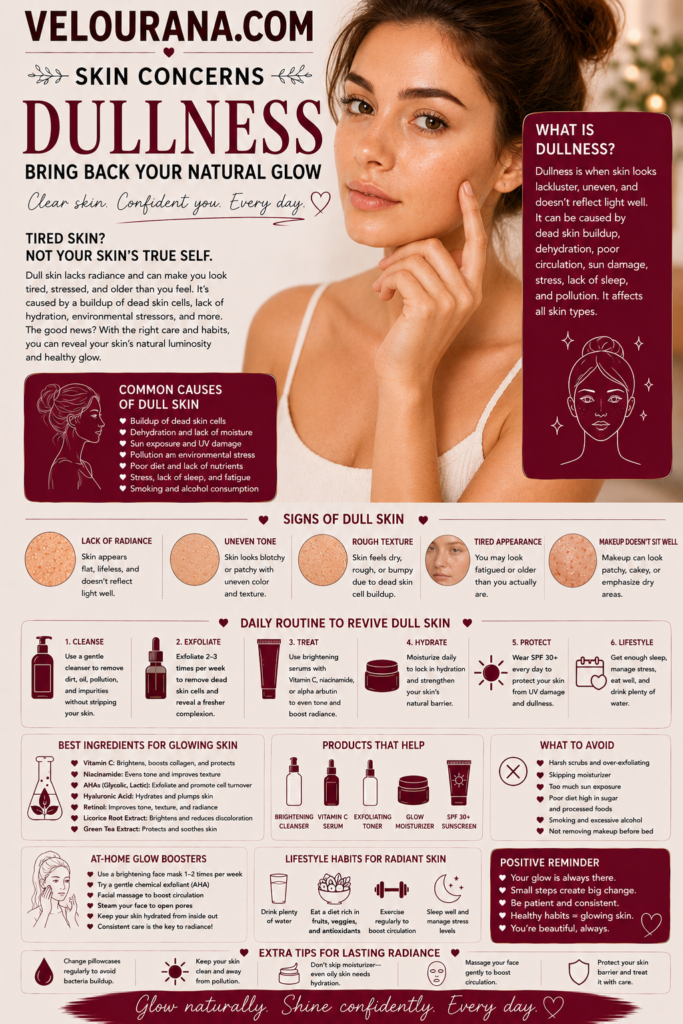
CATEGORY: Dullness
There is a familiar contradiction in ageing skin: you can feel perfectly well, have slept properly, followed your usual routine, and still encounter a face in the mirror that seems to suggest otherwise. The complexion looks tired. The cheeks appear flatter. The area around the mouth lacks freshness. Shadows seem more pronounced. Makeup that once brought immediate vitality now seems to sit on the skin rather than becoming part of it.
It is easy to interpret this as simple fatigue. Sometimes fatigue certainly contributes. But the persistent “tired face” associated with mature skin is often something more structural.
Ageing changes the way the surface holds water, the speed and organisation of epidermal renewal, the distribution of pigment, the architecture beneath the skin and the way light interacts with all of these features. Cumulative ultraviolet exposure adds another layer, creating uneven pigmentation and texture that can make the complexion appear less clear. The result is a face that may visually communicate tiredness even when the person behind it is anything but tired.
This distinction is useful because a complexion that looks exhausted does not necessarily need a more stimulating skincare routine. It may need a more supportive one.
The temptation is to wake the skin up: stronger exfoliation, colder water, vigorous massage, increasingly concentrated brightening products. Yet mature skin often responds better when the objective shifts from stimulation to restoration. Instead of forcing brightness onto the surface, the aim becomes improving the qualities from which luminosity naturally emerges—hydration, smoothness, evenness, resilience and protection.
The tired complexion is therefore not merely an aesthetic problem. It is a useful illustration of how profoundly the visual language of skin changes with age.
Why We Read Certain Complexions as Tired
Human beings are remarkably sensitive to subtle changes in faces.
We do not need to consciously analyse skin texture, shadows, pigmentation and hydration to decide that somebody looks rested or exhausted. The judgement happens almost instantly. A brighter, smoother, more evenly illuminated face tends to appear energetic, while increased shadowing, dryness and unevenness can suggest fatigue.
Ageing alters several of these visual signals at once.
Fine lines create additional micro-shadows. Changes in facial volume can affect the way larger shadows fall beneath the eyes and around the cheeks. Uneven pigmentation interrupts visual clarity. Dryness makes the surface less reflective. Rough texture scatters light rather than returning it uniformly.
None of these changes means the skin is unhealthy simply because it is older. They are normal features of ageing. But together they can create the impression we casually describe as dullness.
This explains why adding shine does not necessarily solve the problem.
A luminous foundation or highlighting product can increase reflected light, but if the underlying surface is dehydrated and irregular, excessive shimmer may emphasize texture instead of creating freshness. Similarly, applying a rich facial oil can create gloss without correcting the dryness underneath it.
Radiance is not the same as shininess.
Shine primarily describes reflected light from the surface. Radiance is a broader visual impression created by smoothness, hydration, relatively even pigmentation and the way light travels across the complexion.
Understanding that difference can completely change the strategy for mature dullness. Instead of asking, “How can I make my skin shine?” the more useful question becomes, “What is preventing my skin from reflecting light evenly?”
The Surface Becomes Less Forgiving With Age
Young skin is not universally perfect, but it tends to recover from certain disturbances more readily.
A late night, a dry environment or an overly enthusiastic cleansing session may produce temporary dullness that quickly disappears. As skin ages, the same disruption can become more visible and may take longer to settle.
One reason is that the epidermal environment itself changes. Skin becomes increasingly prone to dryness, while natural renewal processes slow. The outer surface can therefore develop a combination of dehydration and irregular cell accumulation that makes it feel less smooth.
The change can be extremely subtle to touch yet obvious under directional light.
This is why mature skin sometimes appears perfectly acceptable in soft bathroom lighting but surprisingly textured beside a window or beneath strong overhead illumination. Light reveals differences in surface topography that flattering diffuse lighting conceals.
Trying to eliminate every visible irregularity is unrealistic. Skin has texture at every age. The objective is to prevent avoidable roughness from exaggerating normal texture.
That begins with respecting the outer barrier.
The stratum corneum—the outermost portion of the epidermis—is sometimes spoken about dismissively because much of it consists of cells that have reached the final stage of their life cycle. Yet this layer performs an essential protective role. Its cells and surrounding lipids form a barrier that helps limit excessive water loss while protecting the tissues underneath.
When this organisation is disturbed, the skin can become dry, rough and reactive.
A mature complexion that is already becoming less efficient at retaining moisture may therefore respond poorly to routines designed around repeated stripping and resurfacing.
The irony is obvious: the harder someone tries to remove dullness, the duller the skin can eventually become.
Dehydration Can Transform the Entire Face
Few changes affect the immediate appearance of mature skin as dramatically as insufficient hydration at the surface.
Dehydrated skin does not simply feel dry. Fine lines can become more visible. Foundation may separate or gather around them. The cheeks can look papery. Areas that once appeared naturally luminous begin absorbing visual attention through roughness instead.
Moisture changes the optical characteristics of the outer skin.
When the stratum corneum contains adequate water, its surface becomes more flexible and smooth. A well-formulated moisturiser helps by attracting water, softening the surface and reducing excessive evaporation according to its combination of ingredients.
This is why moisturising can create a visible improvement long before an anti-ageing treatment has had time to influence deeper biological processes.
There is also an important difference between dry skin and dehydrated skin.
Dryness generally refers to insufficient oil or lipid content, while dehydration refers to insufficient water. The two frequently coexist, particularly with ageing, but they are not identical. Even a complexion that produces noticeable oil can become dehydrated.
This matters because people who have always identified themselves as oily may continue avoiding moisturiser decades after their skin's behaviour has changed.
The skincare identity we develop in adolescence can become surprisingly persistent. Someone who struggled with oily skin at twenty may still buy aggressive foaming cleansers at fifty because “my skin is oily,” even though the complexion now feels tight after washing and looks rough beneath makeup.
Skin type is not a contract signed for life.
Hormonal changes, age, climate, medication, environment and the products being used can all alter what the complexion needs. A routine designed for a younger version of the skin may eventually become part of the reason it looks dull.
Cleansing Can Quietly Determine How Bright the Skin Looks
Cleansing receives remarkably little attention in discussions of anti-ageing skincare.
Serums sound sophisticated. Retinoids have decades of research behind them. Vitamin C has antioxidant appeal. Peptides occupy luxurious packaging. Cleansing seems merely functional: remove the day's debris and proceed to the interesting products.
Yet an unsuitable cleanser is used repeatedly, often twice every day.
That makes it enormously influential.
If each cleansing session removes more surface lipids than the skin comfortably tolerates, the cumulative effect can be persistent tightness and dryness. A person may then purchase a richer moisturiser to compensate for a problem being recreated every morning and evening.
Mature skin often benefits from gentler cleansing practices. This does not mean the face should never be properly cleansed. Sunscreen, makeup, excess oil and environmental debris still need appropriate removal. The distinction lies in cleansing effectively without treating the skin as a surface that must feel completely stripped afterward.
That squeaky-clean sensation many people learned to associate with effectiveness can be misleading.
Comfort is a better guide.
The face should not routinely emerge from cleansing feeling as though it has become one size too small.
Water temperature matters too. Very hot water can worsen dryness and irritation. Vigorous rubbing with cleansing brushes, rough washcloths or granular scrubs adds mechanical stress that may be unnecessary.
For a dull mature complexion, the ideal cleansing ritual is almost deliberately uneventful.
It removes what needs to be removed and leaves behind no drama.
That restraint creates better conditions for every treatment that follows.
Exfoliation Should Refine the Surface, Not Punish It
The logic behind exfoliating dull skin is compelling.
If surface renewal has become slower and the complexion looks rough, removing some of the outermost cells can produce smoother texture and greater apparent luminosity. This is why exfoliating acids have become central to so many brightening routines.
The problem begins when exfoliation changes from a targeted intervention into a philosophy of skincare.
The skin is not brighter simply because more of its surface has been removed.
Alpha hydroxy acids such as glycolic and lactic acid work primarily at the surface and can be useful for improving rough texture. Other exfoliating ingredients have different properties and may be chosen according to the person's skin and accompanying concerns.
Strength is only one variable. Frequency matters equally.
A moderate formulation used too often can become more irritating than a stronger treatment used infrequently. Combining an exfoliating cleanser, acid toner, exfoliating serum and weekly peel may create far more total exposure than the individual labels suggest.
Retinoids complicate the picture further because they can also influence skin renewal and may cause dryness or irritation during adaptation.
A routine can therefore become aggressive without containing a single product marketed as “strong.”
The skin experiences the total routine, not the advertising categories.
For mature dullness, successful exfoliation often reveals itself through what does not happen. The skin does not remain persistently red. Moisturiser does not sting. There is no constant peeling around the mouth or nose. The complexion feels smoother without becoming fragile.
This is refinement rather than assault.
And because ageing skincare is a long-term project, refinement is the more useful objective.
Uneven Pigmentation Creates Dullness Without Changing the Skin's Natural Colour
Tone is another major component of luminosity.
A complexion can be perfectly hydrated yet still appear dull because pigmentation has become irregular. Decades of ultraviolet exposure can leave freckles, solar lentigines and areas of uneven tone. Previous inflammation may leave darker marks. Hormonal influences can contribute to other forms of hyperpigmentation.
The important issue is not whether the skin is light or dark.
It is uniformity.
A deep natural complexion can look extraordinarily luminous when its surface is hydrated and relatively even. A pale complexion can look dull when it contains blotchy pigmentation and roughness. Brightness should therefore never be confused with paleness.
This distinction is particularly important because the beauty industry's historical language around “brightening” has sometimes blurred the line between improving uneven pigmentation and promoting lighter skin as an aesthetic ideal.
Healthy skincare has no reason to pursue that ideal.
The objective is to support the person's natural complexion while addressing unwanted areas of unevenness where appropriate.
Ingredients used for this purpose can include vitamin C, niacinamide, retinoids, azelaic acid and other targeted compounds depending on the nature of the pigmentation and the individual's tolerance.
But pigment correction is rarely fast.
Melanin biology does not operate according to marketing calendars. Visible changes generally require consistency, and the process becomes far more difficult when ultraviolet exposure continues stimulating pigmentation.
This brings the conversation inevitably back to sunscreen.
Sunscreen Is Part of a Brightening Routine, Not an Optional Addition to It
A person can spend a considerable amount of money treating dullness while unknowingly undermining those efforts every day.
Ultraviolet radiation contributes significantly to visible skin ageing. It influences pigmentation, collagen degradation and textural changes. Over years, these effects accumulate into what we recognize as photoaging.
Sun protection therefore has a role far beyond preventing sunburn.
For a person treating uneven tone and dullness, sunscreen helps reduce the environmental stimulus responsible for part of the problem. Without it, a routine may continually attempt to correct yesterday's damage while allowing additional damage today.
Broad-spectrum protection is important because UVA and UVB radiation affect the skin differently, and both deserve consideration.
Application also matters.
A theoretically excellent sunscreen used inconsistently provides inconsistent protection. The same is true when too little is applied or large areas are missed. Outdoor exposure may require reapplication, particularly with sweating, swimming or prolonged time outside.
Shade, clothing, hats and sunglasses provide additional layers of protection.
This does not require developing an anxious relationship with daylight.
Sun protection is simply one component of intelligent skin maintenance, much like wearing appropriate clothing for the weather.
For ageing dullness, its effects are best understood over long periods. Sunscreen may not produce the immediate tactile satisfaction of an exfoliating treatment or the instant plumping of a rich moisturiser. Its value accumulates through what it helps prevent.
In mature skincare, prevention is not passive.
It is one of the most active long-term decisions available.
Retinoids Address More Than a Single Sign of Ageing
Many skincare ingredients are associated primarily with one concern.
Retinoids are unusual because their relevance extends across several features that contribute to the appearance of ageing skin. Depending on the formulation and strength, they can influence epidermal renewal, pigmentation, fine lines and aspects of collagen biology.
This makes them particularly interesting for dullness accompanied by uneven texture and visible photoaging.
But retinoids demand patience.
The early phase can involve dryness, peeling and irritation. Mature skin that is already dehydrated may find aggressive introduction particularly uncomfortable.
The sensible approach is adaptation.
Beginning with an appropriate formulation, using it conservatively and supporting the skin with moisturiser can make long-term use more achievable. Increasing frequency should follow tolerance rather than ambition.
This principle sounds simple, but it runs against a powerful psychological tendency in skincare.
People want visible action.
A product that tingles feels active. Peeling appears to prove renewal. Redness can be interpreted as evidence that something powerful is happening.
Yet irritation is not a measurement of anti-ageing efficacy.
A retinoid does not need to make the face visibly peel in order to be useful. Indeed, a routine that creates constant inflammation may become impossible to maintain, eliminating the very consistency required for long-term results.
The objective is not to survive the treatment.
It is to live comfortably with it.
The Eye Area Can Make the Whole Complexion Appear Duller
Sometimes the perception of dullness does not originate across the entire face.
The eye area can disproportionately influence how rested or luminous somebody appears.
With age, changes in skin thickness, volume distribution and underlying structures can make shadows around the eyes more visible. Pigmentation may contribute. Puffiness can create additional shadowing. Fine lines alter the way light reflects from the area.
This is why someone can improve the hydration and texture of the cheeks yet continue feeling that the entire face looks tired.
No eye cream can completely eliminate structural shadows created by anatomy.
That is an important limitation to acknowledge because cosmetic marketing frequently treats every dark circle as though it were a superficial pigment problem.
Some are predominantly pigmentary. Some are vascular. Some are caused largely by shadow. Many involve a combination.
Skincare can improve hydration and perhaps address certain pigmentation or texture concerns, but it cannot fundamentally rearrange facial anatomy.
Makeup can often achieve what skincare cannot by manipulating colour and reflected light. A carefully chosen concealer can reduce visible contrast beneath the eyes immediately. This is not a failure of skincare; it is simply a different tool solving a different optical problem.
Recognizing those limits prevents endless purchasing.
Sometimes the best answer to a cosmetic concern is cosmetic.
Makeup Changes as the Surface Changes
A mature complexion can also appear dull because makeup techniques that worked beautifully years earlier no longer interact with the skin in the same way.
Heavy matte foundation may absorb too much visual luminosity. Excessive powder can collect around texture. Shimmer placed over dry areas may exaggerate irregularities. A foundation shade that once matched perfectly may no longer harmonize with changes in pigmentation or undertone.
The solution is not automatically to abandon coverage.
It is to reconsider texture.
Hydrated skin generally provides a better canvas. Allowing skincare to settle before makeup can help prevent products from mixing unpredictably. Thin layers tend to behave more naturally than attempting to create a flawless surface with one heavy application.
Strategic radiance can also be more convincing than universal shine.
Light naturally catches particular areas of the face. Recreating that effect selectively can make the complexion appear dimensional without emphasizing every pore and line.
Cream and liquid formulas may suit some mature complexions particularly well, although there is no universal rule that older skin cannot wear powder. The formulation, quantity and individual skin matter more than age labels.
The broader principle is adaptation.
Just as skincare should evolve with the complexion, makeup should evolve too.
Trying to reproduce the exact finish of twenty-year-old skin is usually less flattering than working intelligently with the characteristics of the face today.
Stress, Sleep and the Difference Between Temporary and Persistent Dullness
Not every dull day represents skin ageing.
Sleep deprivation can make the face appear tired. Stress can alter behaviour and routine. Travel, alcohol, illness, climate changes and disrupted skincare can temporarily affect the complexion.
The useful distinction is duration.
If the face looks unusually tired after a difficult week, radical intervention is unnecessary. Returning to normal sleep, hydration, gentle skincare and regular habits may be sufficient.
Persistent dullness is different.
When the complexion has gradually become rougher, drier and more uneven over months or years, lifestyle correction alone is unlikely to reverse the entire pattern. Ageing and cumulative environmental exposure have become part of the picture.
This is where realistic expectations matter.
Eight hours of sleep are valuable for health, but they cannot erase solar lentigines.
Drinking adequate water supports normal physiology, but excessive water consumption does not function as an internal facial moisturiser capable of reversing photoaging.
A healthy diet contributes nutrients the body needs, but no particular smoothie can replace a well-designed skincare routine and sun protection.
The beauty industry often takes behaviours that are genuinely healthy and inflates them into dermatological treatments.
The opposite mistake is equally unhelpful: pretending lifestyle has no relationship with appearance.
The mature position lies between those extremes. Sleep properly because sleep matters. Eat well because nutrition matters. Avoid smoking because smoking damages health and accelerates visible ageing. Exercise because the body benefits from movement.
Then allow skincare to do the jobs skincare can actually do.
Professional Treatments Can Go Beyond the Limits of a Home Routine
There is a point at which topical skincare reaches its natural limits.
A moisturiser can improve hydration. Retinoids and other ingredients can improve certain aspects of texture and pigmentation over time. Sunscreen can reduce additional photodamage.
But significant pigmentation, extensive photodamage, pronounced texture changes and structural features may require professional treatment if the person wants a greater degree of correction.
Dermatological options can include chemical peels, certain laser technologies, intense pulsed light, resurfacing procedures and other treatments chosen according to the problem being addressed.
The important phrase is “chosen according to the problem.”
A procedure should not be selected merely because it is described as rejuvenating.
Pigmentation, vascular redness, texture and volume loss are different concerns. Technologies that work well for one may not be appropriate for another. Skin tone and susceptibility to post-inflammatory pigmentation also affect treatment decisions.
This is where professional diagnosis becomes particularly valuable.
A dermatologist can distinguish ordinary cosmetic dullness from specific pigmentary disorders, inflammatory conditions, photodamage and lesions that require medical attention.
Professional treatment should therefore be viewed not as an escalation from weak skincare to powerful skincare, but as a different category of intervention.
There are problems a bottle can address.
There are problems a bottle cannot.
A Better Way to Measure Progress
Dullness creates an unusual difficulty because it is subjective.
Wrinkle depth can theoretically be measured. Pigmented spots can be photographed. But “my skin looks brighter” is partly a perception influenced by lighting, makeup, sleep and even mood.
This makes progress photographs useful.
Photographing the complexion periodically under approximately the same lighting, angle and conditions can reveal gradual changes that are difficult to perceive from daily mirror inspection.
Daily observation is surprisingly unreliable because biological improvements tend to happen slowly.
When we see our own face every morning, yesterday's appearance becomes today's reference point. Small changes disappear into familiarity.
The same phenomenon can encourage unnecessary product switching. Someone uses a routine for three weeks, forgets what the complexion looked like before starting, decides nothing is happening and replaces everything.
Consistency never gets the chance to demonstrate its value.
A better assessment looks at several dimensions simultaneously.
Does the skin feel less tight after cleansing? Is makeup sitting more smoothly? Are flaky areas less frequent? Does pigmentation look slightly more even? Is the complexion tolerating the routine without persistent irritation? Has the urge to constantly exfoliate decreased because the surface already feels comfortable?
These changes may be more meaningful than chasing an undefined idea of glow.
The healthiest-looking complexion is not necessarily the glossiest one.
It is often the most stable.
The Mature Complexion Does Not Need to Be Awakened—It Needs to Be Supported
Language influences behaviour.
When dull skin is described as tired, sluggish, lazy or asleep, the natural response is to stimulate it. Scrub it. Peel it. Shock it with cold. Layer acids over it. Force it to renew itself.
But mature skin is not lazy.
It is changing.
Its barrier may be more vulnerable to dryness. Renewal is different. Decades of sunlight have left biological traces. Pigment has become less evenly distributed. Facial structure has evolved. The relationship between the surface and light is no longer identical to what it was twenty or thirty years earlier.
None of this requires punishment.
A more effective strategy begins by removing unnecessary sources of irritation. Cleanse without stripping. Restore moisture consistently. Introduce renewal carefully. Address uneven pigmentation with patience. Protect the skin from ultraviolet radiation every day. Use makeup as an optical tool when makeup can solve the problem better than skincare. Seek dermatological guidance when the concern moves beyond what cosmetics can reasonably achieve.
This approach may sound less exciting than the promise of an instant transformation.
It is also far more sustainable.
The ageing complexion does not need to become perfectly smooth to become luminous. Fine lines do not extinguish radiance. Neither do pores, natural pigmentation, freckles or the visible history of a face.
What most often steals luminosity is not age itself, but the collection of conditions that can accompany it: dehydration, roughness, irritation, accumulated sun damage and uneven tone.
Address those intelligently and something interesting happens.
The face does not suddenly become younger.
It becomes clearer.
The surface feels more comfortable. Light moves across it more naturally. Makeup behaves better. Texture appears softer. The complexion begins to look less depleted, even though its age remains visible.
That is a far more achievable—and ultimately more sophisticated—definition of glow.
A mature face does not have to disguise time in order to look awake.
It only needs skin healthy enough to reflect the light already falling upon it.
The End Velourana.
 Discover More From Our Family of Websites
 ZodiacBearing (Astrology, Tarot, Numerology, Angel Numbers & Spiritual Guidance)
 Velourana (Beauty, Makeup, Hair Care, Skincare & Beauty Tips)
 HavenBearing (Home, Living, Organization, Décor & Everyday Inspiration)
 PawBearing (Pet Care, Dog Breeds, Animal Health, Training & Pet Products)
 PsyCatherine (Notes From the Journal of a Psychologist on Real Life)

