
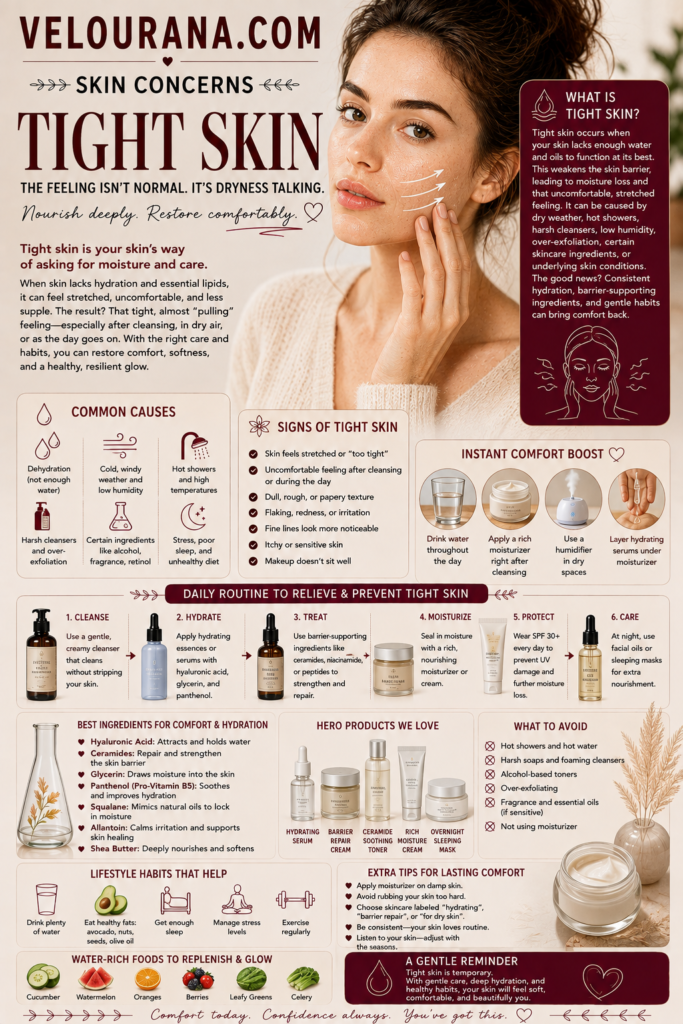
CATEGORY: Tight Skin
Tight skin is often treated as a temporary inconvenience.
The face feels uncomfortable after cleansing, moisturizer is applied, and the problem seems to disappear. Yet for many people, the sensation returns the following morning. Or later that afternoon. Or every winter. Or every time an exfoliating treatment is introduced. The cycle becomes so familiar that it begins to feel like an unavoidable characteristic of the complexion.
But recurring tightness is not always simply “how the skin is.”
Often, it is a pattern.
Something repeatedly pushes the skin toward dryness. Moisturizer temporarily restores comfort. The underlying trigger remains. The same discomfort then returns, leading to more product, more intervention and sometimes even more irritation.
This creates a distinctive cycle in which skincare becomes increasingly focused on rescue rather than prevention.
Understanding that cycle changes the entire approach to tight skin.
Instead of asking which cream can make the face feel better for the next few hours, the more useful question becomes: what keeps putting the skin back into this state?
The answer is rarely dramatic.
For many people, recurring tightness develops through a collection of ordinary decisions: cleansing a little too aggressively, washing too frequently, preferring water that is too hot, using several active products at the same time, choosing moisturizer according to texture rather than need, or refusing to adjust the routine when the climate changes.
None of these habits may appear severe enough to cause a problem alone.
Together, however, they can keep the skin permanently close to the edge of discomfort.
Breaking the tight-skin cycle therefore requires more than hydration.
It requires changing the conditions that make hydration difficult to maintain.
The Difference Between Relieving Tightness and Preventing It
Immediate relief is relatively easy to understand.
Dry skin feels uncomfortable. Moisturizer is applied. The surface becomes softer and more flexible.
Prevention is more complex.
Preventing repeated tightness means creating a routine in which the skin does not become excessively dry between applications in the first place.
This distinction is important because many skincare routines are excellent at relief but poor at prevention.
A person may own a rich moisturizer capable of making the complexion feel wonderful at night. Yet every morning, the face is cleansed with a strong foaming wash until it feels completely oil-free.
The moisturizer then spends the next twelve hours repairing what the cleansing stage repeatedly disrupts.
Another person may apply several hydrating serums while continuing to exfoliate frequently.
The skin receives plenty of water-binding ingredients, but the routine continues to challenge the surface faster than the hydration strategy can compensate.
This is why the question “What should I apply to tight skin?” sometimes starts too late in the process.
The better investigation begins earlier.
What happened before the skin became tight?
Recurring Tightness Usually Has a Trigger
When tightness happens once, the cause may be obvious.
A long flight.
A day in cold wind.
Swimming in a chlorinated pool.
A new exfoliating product.
An unusually hot shower.
When tightness happens repeatedly, the trigger can be harder to identify because it has become part of everyday life.
Daily habits disappear from awareness.
A cleanser used every morning no longer feels like an active choice.
The shower temperature feels normal because it has always been that hot.
Powder is reapplied automatically.
Exfoliation happens every Tuesday and Friday because that is the routine.
The skin experiences these events repeatedly even when the person no longer notices them.
This is where observation becomes more valuable than experimentation.
Instead of immediately changing products, notice when the sensation begins.
Does the skin feel comfortable before washing but tight afterward?
Does tightness develop only in the evening after wearing makeup?
Does it happen after active-treatment nights?
Does it appear primarily when indoor heating is running?
Does the skin improve while travelling somewhere humid?
Patterns reveal causes.
Causes make prevention possible.
Post-Cleansing Tightness Is One of the Clearest Clues
There is a simple test that can reveal a great deal about a skincare routine.
Notice how the face feels a few minutes after cleansing, before moisturizer is applied.
A slight awareness of the skin is not necessarily concerning.
But if the face immediately feels rigid, stretched, squeaky, itchy or desperate for cream, the cleansing step deserves scrutiny.
Effective cleansing should remove sunscreen, makeup, environmental residue and excess oil.
It does not need to remove every trace of surface comfort.
The idea that the face should feel completely stripped after washing is partly a sensory misunderstanding.
People associate that sensation with cleanliness because it is dramatic.
But dramatic sensations are not necessarily signs of better skincare.
For dry and tight complexions, a cleanser that leaves some feeling of softness and flexibility may be more appropriate than one that creates a perfectly matte finish.
The goal is cleanliness without unnecessary disruption.
The Cycle of Strong Cleansing and Heavy Moisturizing
One of the most common tight-skin patterns is surprisingly contradictory.
The person uses a strong cleanser because they dislike feeling oily or coated.
The cleanser leaves the skin tight.
A rich moisturizer is then required to restore comfort.
By morning, the moisturizer may leave some residue or shine.
The person dislikes that feeling and cleanses aggressively again.
The cycle repeats.
This creates the illusion that the skin simultaneously needs stronger cleansing and heavier moisturization.
In reality, the two choices may be feeding each other.
A gentler cleansing strategy could reduce the amount of compensation required afterward.
The moisturizer might then be able to become lighter.
This is an important lesson because skincare products do not operate independently.
Changing one stage can change what is required from the next.
Hot Water Makes the Cycle More Difficult to See
Water temperature rarely appears on ingredient lists, which is why it is easy to overlook.
Yet it can influence how a cleanser behaves in practice.
A cleanser that feels tolerable with lukewarm water may become significantly more drying when used during a long, hot shower.
This can create confusion.
The person changes moisturizers repeatedly while continuing exactly the same shower routine.
Nothing improves for long.
The missing variable is temperature.
Very hot water can increase the removal of surface oils and worsen dryness.
This is particularly relevant during winter, when people naturally prefer hotter showers at exactly the same time that cold weather and indoor heating are already increasing the skin's tendency toward dryness.
Several moderate stresses can become one significant problem.
Why the Skin Can Feel Tight but Still Become Oily
Perhaps the most confusing version of recurring tightness occurs in oily skin.
The face feels stretched after cleansing.
A few hours later, the forehead and nose become shiny.
The person concludes that the skin cannot truly be dry because oil is clearly present.
This leads to stronger cleansing.
The tightness becomes worse.
The important distinction is that surface oil and water content are not the same thing.
Sebaceous glands produce sebum.
The stratum corneum still needs sufficient water to remain flexible and comfortable.
A complexion can therefore produce significant oil while simultaneously experiencing dehydration or irritation.
Once this is understood, the routine can become more rational.
The objective is not to force the skin into complete mattness.
It is to control excess oil where necessary without repeatedly stripping the surface into discomfort.
The False Logic of “Drying Out” Blemishes
Acne can make tight-skin management particularly difficult.
Blemishes look inflamed and oily, so drying them seems logical.
Strong cleansers, acne treatments, exfoliants and spot products accumulate.
The blemishes may improve.
But the surrounding skin becomes uncomfortable.
At this point, some people assume the dryness proves the treatments are working.
That is not a useful standard.
Effective blemish management does not require the entire complexion to feel painfully tight.
In fact, excessive irritation can make consistent treatment more difficult because the person eventually needs to stop everything until the skin recovers.
A moderate routine that can be maintained is often more useful than an aggressive routine that repeatedly creates crisis and recovery.
This principle extends beyond acne.
Skincare is not more effective simply because it produces stronger sensations.
The Exfoliation Paradox
Dry skin can feel rough.
Roughness encourages exfoliation.
Exfoliation removes rough surface cells.
The complexion looks smoother.
The person concludes that the exfoliation was necessary.
A few days later, tightness returns.
More exfoliation follows.
This is the exfoliation paradox.
A treatment can temporarily remove the visible consequence of dryness while leaving the underlying cause unresolved.
If exfoliation is too frequent, it may even contribute to the recurrence.
This does not make exfoliating ingredients inherently inappropriate for dry skin.
They can be useful for many concerns.
But frequency should be determined by tolerance, not by the desire to maintain a permanently polished surface.
Healthy skin has texture.
It does not need to feel like glass.
When Several Mild Products Become One Aggressive Routine
Skincare intensity is often evaluated product by product.
A toner is considered mild.
A serum contains only a modest concentration of acid.
The retinoid is low strength.
The cleanser includes an exfoliating ingredient.
Each product appears reasonable.
The combined routine may not be.
The skin experiences total exposure, not marketing categories.
This is one of the most common reasons recurring tightness becomes difficult to diagnose.
No single product looks guilty.
But several products are performing overlapping functions.
The solution is often not to identify one villain.
It is to reduce cumulative intensity.
The Problem With Treating Every Concern at Once
A modern routine may attempt to address acne, pigmentation, fine lines, enlarged pores, dullness, rough texture and dehydration simultaneously.
Each concern has its own ingredient category.
The result can become a laboratory.
Vitamin C in the morning.
Exfoliating toner several times per week.
Retinoid at night.
Niacinamide serum.
Clarifying mask.
Spot treatment.
Hydrating serum.
Barrier cream.
Facial oil.
The routine looks comprehensive.
The skin may experience it as relentless.
When tightness becomes persistent, one of the most productive decisions is deciding which concerns actually need active treatment now.
Not every imperfection requires simultaneous correction.
Skin often performs better when priorities are established.
Why Moisturizer Sometimes Becomes a Rescue Product
In a stable routine, moisturizer is maintenance.
It supports hydration and comfort.
In an overactive routine, moisturizer becomes emergency medicine.
It is applied because the exfoliant made the face sting.
It is layered heavily because the cleanser created tightness.
Another layer is added because the retinoid increased flaking.
A sleeping mask goes over everything because the skin still feels uncomfortable.
When moisturizer is constantly rescuing the skin from the rest of the routine, the issue may not be insufficient moisturizer.
The issue may be excessive stress.
This is one of the clearest signals that subtraction deserves consideration.
Richer Is Not Always Better
Once tightness becomes chronic, people often move toward increasingly heavy creams.
This can help when the problem is genuinely insufficient occlusion or emollience.
But richness alone is not the solution to every kind of tightness.
If irritation is the primary problem, an extremely heavy product may improve the sensation without addressing the cause.
It may also feel uncomfortable under sunscreen or makeup, leading the person to cleanse more aggressively later.
The ideal moisturizer should be substantial enough to maintain comfort yet practical enough to fit the entire routine.
Balance matters more than maximum richness.
Lightweight Is Not Automatically Better Either
The opposite bias is equally common.
Some people refuse anything richer than a gel because they dislike feeling product on the skin.
This sensory preference can work beautifully in warm, humid conditions.
During winter or periods of significant dryness, it may become insufficient.
A moisturizer should not be selected only according to how quickly it disappears.
The skin's comfort several hours later matters more than the first thirty seconds after application.
If a gel moisturizer feels elegant but tightness consistently returns before lunchtime, the formulation may not be providing enough support under current conditions.
The right texture is contextual.
Seasonal Routines Are Often More Logical Than Permanent Ones
Skin changes with the environment.
A routine that works all year in one climate may need substantial adjustment in another.
Winter commonly brings colder outdoor air and drier heated interiors.
Summer may bring heat, humidity, sweat and air conditioning.
Spring can increase environmental allergens.
Travel introduces entirely different climates.
Expecting one fixed routine to perform identically across every condition is unrealistic.
Seasonal adjustment does not require changing everything.
Often, one or two variables are enough.
A cream replaces a lotion.
Cleansing becomes gentler.
Exfoliation frequency decreases.
A heavier moisturizer is used only at night.
The routine remains recognizable while adapting to the environment.
The Morning Routine Can Be Part of the Problem
Many people cleanse morning and night because that is the traditional skincare structure.
For some complexions, this works perfectly.
For very dry or tight skin, morning cleansing may need reconsideration.
The face after waking is not necessarily carrying the same mixture of sunscreen, makeup and environmental residue present at the end of the day.
Some people therefore find that a lighter morning cleanse or simple water rinse is sufficient.
This is individual.
The important point is not that morning cleanser is universally unnecessary.
It is that routines should be based on need rather than ceremony.
If morning cleansing consistently produces tightness, examining whether it is necessary is reasonable.
The Evening Routine Should Remove the Day Without Removing the Skin
Nighttime cleansing has a clearer purpose.
Sunscreen, makeup and accumulated environmental residue generally need to be removed.
The challenge is accomplishing this efficiently.
Long-wearing cosmetics may require an oil-based or balm cleanser first.
That can be useful.
But the second cleanser should not automatically become a harsh finishing step designed to create extreme cleanliness.
Double cleansing should remove the day.
It should not create a new problem to be repaired overnight.
Tight Skin Under Foundation Is Often a Skincare Message
Foundation can reveal dryness with remarkable precision.
A bare complexion may appear reasonably smooth.
Once foundation is applied, tiny flakes become visible.
Texture appears around the mouth.
Concealer settles under the eyes.
Powder seems to catch on invisible roughness.
This is often blamed entirely on the makeup.
A different foundation may certainly perform better.
But repeated problems across multiple formulas suggest that the condition of the skin underneath deserves attention.
When the surface is comfortable and adequately moisturized, makeup has a more flexible base.
When the skin is tight, makeup may simply make that tightness visible.
Powder Can Extend the Drying Sensation
Powder is useful.
It controls shine.
It helps set makeup.
It can improve longevity.
But applying it heavily across already dry areas can exaggerate both texture and discomfort.
This is particularly relevant for combination skin.
The forehead may genuinely benefit from powder.
The cheeks may not.
Uniform application is not always necessary.
Treating different areas according to their needs can preserve makeup performance without turning the entire face matte.
The Role of Facial Mists
Facial mists are appealing because they provide immediate sensory relief.
A tight face feels refreshed after spraying.
But water on the surface is temporary.
Without appropriate moisturizing support, much of it will evaporate.
A mist can be useful as part of a routine.
It is rarely a complete answer to recurring tightness.
This reflects an important distinction between temporary comfort and lasting moisture retention.
Both matter.
Only one breaks the cycle.
Why Facial Oils Can Feel Better Than They Actually Hydrate
Oil creates softness quickly.
It reduces friction.
It gives dry skin a flexible, conditioned feel.
But oils do not replace water.
Someone can therefore apply facial oil to dehydrated skin and experience an unusual contradiction: the surface feels smoother while the deeper sensation of tightness remains.
This does not mean facial oils are useless.
They can be excellent emollients and may complement moisturizer.
The mistake is expecting them to perform every moisturizing function alone.
Lipids Matter as Much as Water
The language of hydration often focuses almost entirely on water.
But comfortable skin depends on the structures that help keep that water from escaping too quickly.
Lipids in the stratum corneum are essential to this function.
Ceramides, cholesterol and fatty acids contribute to the organized environment surrounding surface cells.
This is why barrier-supportive moisturizers often include lipid components alongside humectants.
Dryness is not merely an empty reservoir waiting to be filled.
It is also a retention problem.
Humectants Need Somewhere to Work
Humectants such as glycerin and hyaluronic acid are valuable because they help attract and hold water.
They are common in hydrating serums and moisturizers for good reason.
But a routine containing multiple humectant serums can still fail if the skin lacks sufficient emollient or occlusive support.
This explains why layering increasingly watery products does not always solve tightness.
A complete moisturizing strategy considers attraction, softness and retention together.
The Environment Can Defeat an Otherwise Good Routine
Sometimes skincare is not the problem.
The environment is simply demanding more than usual.
A sudden cold spell.
Several days of strong wind.
Extended time in air conditioning.
A heated office with very low humidity.
A long flight.
The moisturizer that normally works may temporarily become inadequate.
This does not necessarily justify redesigning the entire routine.
A temporary increase in richness or frequency may be enough.
Understanding context prevents unnecessary product turnover.
Swimming Can Restart the Cycle
Swimming is easy to overlook because it is healthy recreation rather than skincare.
Chlorinated pools can leave some skin feeling noticeably dry.
Seawater, sun and wind can create their own combination of stress.
A person who swims several times per week may therefore experience recurring tightness even with an otherwise excellent routine.
Rinsing after swimming and applying moisturizer promptly can help.
The important principle is accounting for repeated exposure.
The skin remembers frequency even when the mind categorizes each swim as an isolated event.
Repeated Hand-to-Face Contact Adds Friction
Rubbing the eyes.
Resting the cheek on the hand.
Wiping the mouth.
Scratching the nose.
Drying sweat with a towel.
These movements seem insignificant.
Repeated hundreds of times, they add mechanical stress.
For healthy, resilient skin, this may not matter.
For already tight or irritated skin, friction can maintain discomfort.
This is particularly relevant around the eyes and mouth, where skin can be more delicate.
The solution is not obsessive avoidance of touching the face.
It is awareness of habitual rubbing when irritation is already present.
The Neck Often Shows the Consequences of Excessive Ambition
People are frequently told to extend facial skincare down the neck.
Moisturizer and sunscreen usually make sense there.
Active treatments require more caution.
The neck can be less tolerant of retinoids, exfoliating acids and fragranced products.
A routine that feels mild on the face may produce significant tightness or irritation on the neck.
This reminds us that skin is not uniform across the body.
Different areas deserve different treatment intensity.
Tight Eyelids Should Not Be Treated Aggressively
The eyelid area deserves particular restraint.
The skin is thin.
Makeup removal creates repeated friction.
Products applied nearby may migrate.
Fragrance or preservatives can trigger reactions in susceptible people.
If eyelids become persistently tight, itchy, swollen or flaky, aggressive exfoliation or experimentation is inappropriate.
Persistent eyelid symptoms are better assessed professionally than treated through endless cosmetic trial and error.
Tightness Around the Mouth Can Become Complicated
The mouth area experiences constant movement and repeated exposure.
Toothpaste touches it.
Food contacts it.
Lips may be licked.
Tissues and napkins create friction.
Cold weather dries it.
Skincare products migrate into it.
Simple dryness is common.
But persistent irritation, redness or bumps around the mouth may have causes beyond ordinary dry skin.
This is another area where repeatedly applying heavier products without understanding the problem may not help.
Patterns and accompanying symptoms matter.
The Desire to Fix Tightness Quickly Can Prolong It
When skin becomes uncomfortable, urgency rises.
People want immediate restoration.
This encourages rapid product switching.
A moisturizer is tested for two nights.
Then another.
A serum is introduced.
A barrier balm follows.
A facial oil is added.
Eventually the skin is receiving five unfamiliar products at once.
If irritation occurs, identifying the cause becomes nearly impossible.
Recovery usually benefits from consistency.
A simple routine provides a clearer environment in which the skin can settle.
Speed is psychologically satisfying.
Stability is biologically more useful.
The Value of a Temporary Simplification Phase
When recurring tightness has become confusing, a temporary simplified routine can be remarkably informative.
The exact products will depend on individual needs, but the conceptual structure is simple.
Cleanse gently.
Moisturize appropriately.
Protect from ultraviolet exposure.
Reduce unnecessary active products temporarily.
This does not mean abandoning every treatment forever.
It establishes a baseline.
If the skin becomes comfortable, products can later be reintroduced one by one.
If tightness immediately returns after a particular step comes back, the relationship becomes easier to see.
Troubleshooting works best when variables are controlled.
Reintroduction Should Be Slow Enough to Teach You Something
Once the skin feels better, enthusiasm can undo progress.
Everything returns on the same evening.
Retinoid.
Acid toner.
Vitamin C.
Exfoliating mask.
The routine is restored exactly as before.
Then tightness returns.
A slower reintroduction provides information.
Bring back the product that matters most.
Observe.
Then introduce another if necessary.
This approach is less exciting.
It is also far more precise.
The objective is not merely to tolerate as many ingredients as possible.
It is to identify the minimum routine that achieves the desired results while keeping the skin comfortable.
Do Not Confuse Tingling With Effectiveness
Beauty culture has normalized sensation.
Cooling feels active.
Tingling feels active.
Peeling feels active.
Burning can even be interpreted as evidence that a product is powerful.
But skincare does not need to announce itself through discomfort.
Some active ingredients can produce mild temporary sensations.
Persistent burning, however, is not a goal.
Tight skin that stings when ordinary moisturizer is applied is communicating reduced tolerance.
Listening to that signal early can prevent a minor problem from becoming a prolonged one.
Progress Is Often Felt Before It Is Seen
Tight skin does not always recover through a dramatic visual transformation.
The first improvement may simply be that cleansing no longer feels unpleasant.
Then moisturizer stops stinging.
The face remains comfortable until lunchtime.
Flaking around the nose decreases.
Foundation applies more evenly.
Cold air becomes less noticeable.
These are meaningful improvements.
Comfort is not a secondary cosmetic outcome.
It is one of the clearest indicators that the surface is functioning more normally.
The Goal Is Resilience, Not Constant Protection
Barrier-focused skincare can sometimes become overly protective.
People become afraid of weather, cleansing, makeup and every active ingredient.
That is not the objective.
Healthy skin should be able to tolerate ordinary life.
It should handle reasonable cleansing.
It should survive changes in climate.
It should tolerate appropriately selected cosmetic products.
The goal is not to create a fragile routine in which one missed moisturizing step causes panic.
The goal is resilience.
That comes from supporting the skin without continually overwhelming it.
When Recurring Tightness Needs Professional Attention
Most recurring tightness belongs within ordinary skincare management.
Sometimes it does not.
Persistent itching, redness, swelling, extensive scaling, painful cracks, bleeding or open sores deserve medical attention.
Repeated episodes that do not respond to gentle skincare may also require evaluation.
Conditions such as eczema, psoriasis, allergic contact dermatitis and other inflammatory disorders can produce sensations initially interpreted as simple dryness.
Professional assessment is especially important when symptoms interfere with sleep, work or everyday comfort.
A dermatologist can diagnose conditions that skincare marketing cannot.
The Tight-Skin Cycle Is Usually Broken Earlier Than People Expect
When people imagine solving recurring tightness, they often picture an advanced repair serum or a highly specialized cream.
Sometimes such products are useful.
But the decisive change frequently happens earlier in the routine.
The water becomes less hot.
The cleanser becomes gentler.
The second morning cleanse disappears.
Exfoliation is reduced.
The moisturizer becomes slightly richer.
Powder is applied only where necessary.
The retinoid schedule becomes more realistic.
One of these changes may reduce the stress enough that the rest of the routine suddenly begins working better.
This is why effective skincare is often less about finding one extraordinary product and more about arranging ordinary products intelligently.
Learning What “Normal” Skin Feels Like Again
People who live with recurring tightness can forget what comfortable skin feels like.
They assume moisturizer should always be urgently necessary after washing.
They assume the face should feel stretched before cream is applied.
They assume some degree of burning is normal.
They assume winter simply means months of discomfort.
Once the cycle is interrupted, the contrast can be surprising.
Clean skin can still feel flexible.
Moisturizer can feel supportive rather than rescuing.
Foundation can sit on the face without revealing flakes.
The cheeks can move without producing tension.
This becomes the new baseline.
Tightness Is Useful Information
The sensation of tightness is unpleasant, but it is also informative.
It often appears before more obvious signs of dryness.
It reveals how the skin responds to cleansing.
It can expose excessive exfoliation.
It can show when the weather has changed enough to require a richer moisturizer.
It can warn that an active treatment schedule is becoming too ambitious.
Instead of suppressing the sensation immediately and forgetting about it, notice what preceded it.
The pattern matters.
Breaking the Pattern for Good
Recurring tight skin is rarely defeated by one heroic intervention.
It improves when the cycle producing it is dismantled.
Cleansing becomes effective without being aggressive.
Water becomes comfortably warm rather than excessively hot.
Moisturizer is selected according to the skin's actual needs rather than fashion or texture preference.
Humectants, emollients and protective ingredients are understood as complementary rather than competitive.
Active products are used deliberately.
Exfoliation has a reason.
Retinoids are introduced according to tolerance.
Seasonal changes are acknowledged.
Makeup is treated as part of the skin's daily environment rather than something entirely separate from skincare.
Most importantly, discomfort stops being interpreted as proof of effectiveness.
The complexion no longer has to be stripped, polished, resurfaced and repaired in an endless rotation.
It can simply be maintained.
This is the deeper lesson of tight skin.
The sensation is not merely asking for another layer of cream.
It may be asking for a different relationship with skincare altogether—one based less on constant correction and more on preserving equilibrium.
When that balance is found, the improvement is quiet.
The face does not suddenly become flawless.
Pores remain.
Fine lines remain.
Natural texture remains.
But cleansing no longer triggers immediate discomfort. Moisturizer lasts longer. Makeup behaves more predictably. Seasonal dryness becomes manageable rather than inevitable.
The skin stops feeling like something that must be continuously controlled.
It begins to feel resilient enough to live in.
And once that happens, tightness becomes what it should have been all along: an occasional signal rather than a permanent state.
The End Velourana
 Discover More From Our Family of Websites
 ZodiacBearing (Astrology, Tarot, Numerology, Angel Numbers & Spiritual Guidance)
 Velourana (Beauty, Makeup, Hair Care, Skincare & Beauty Tips)
 HavenBearing (Home, Living, Organization, Décor & Everyday Inspiration)
 PawBearing (Pet Care, Dog Breeds, Animal Health, Training & Pet Products)
 PsyCatherine (Notes From the Journal of a Psychologist on Real Life)

